

Keep a Mystery Booster Commander box sealed if your main aim is preserving the option to sell the intact product. Open it when the draft, the cards and the experience are worth what you give up by breaking the seal. Opening purely because a few possible pulls look valuable needs a stronger financial case.
There is an important third choice: selling the sealed box now. That separates enjoying the contents from speculating on future appreciation. Keeping a box sealed does not make its price rise automatically, and opening it does not become profitable because you bought it below today's asking price.
The useful comparison starts with what the box could net today, then asks what opening would deliver in cash, cards you actually want and entertainment. That is a different calculation from simply recovering your original purchase cost.
Start with today's alternative
In an October 30 US price check, sampled standard offers for the MBC booster display started at US$368.00, including listed shipping and before tax. That is an asking price, not a guaranteed sale or the amount a seller keeps.
Suppose, only for illustration, that your sealed box sells for that amount. Using the displayed standard domestic Level 1–4 TCGplayer Marketplace fees, a simplified calculation leaves about US$318.94 before postage and other omitted costs. It applies 10.75% commission, a 2.5% transaction charge and one US$0.30 order fee, while simplifying the different fee bases.
That conditional net figure is the starting alternative for an owner deciding whether to open. The original receipt still matters for calculating profit or loss. It does not determine what you give up by opening a box that could be sold today.
An owner who paid less can sell sealed, open or continue holding. A new buyer first has to decide whether paying today's delivered price is sensible. Those two people can face the same opening decision after purchase but have very different histories of financial gain or loss.
Two break-even questions that should stay separate
The first question is: How much would the opened cards need to sell for to recover the purchase cost? For a buyer paying US$368.00, that means getting the whole acquisition amount back after selling costs.
The second is: How much would the cards need to sell for to match the net alternative of selling the box sealed? That starts with what the sealed sale would leave after its own fees and costs.
Those targets differ because selling sealed also costs money. Requiring opened cards to net the full sticker price while comparing that with an unadjusted sealed asking price mixes gross and net amounts.
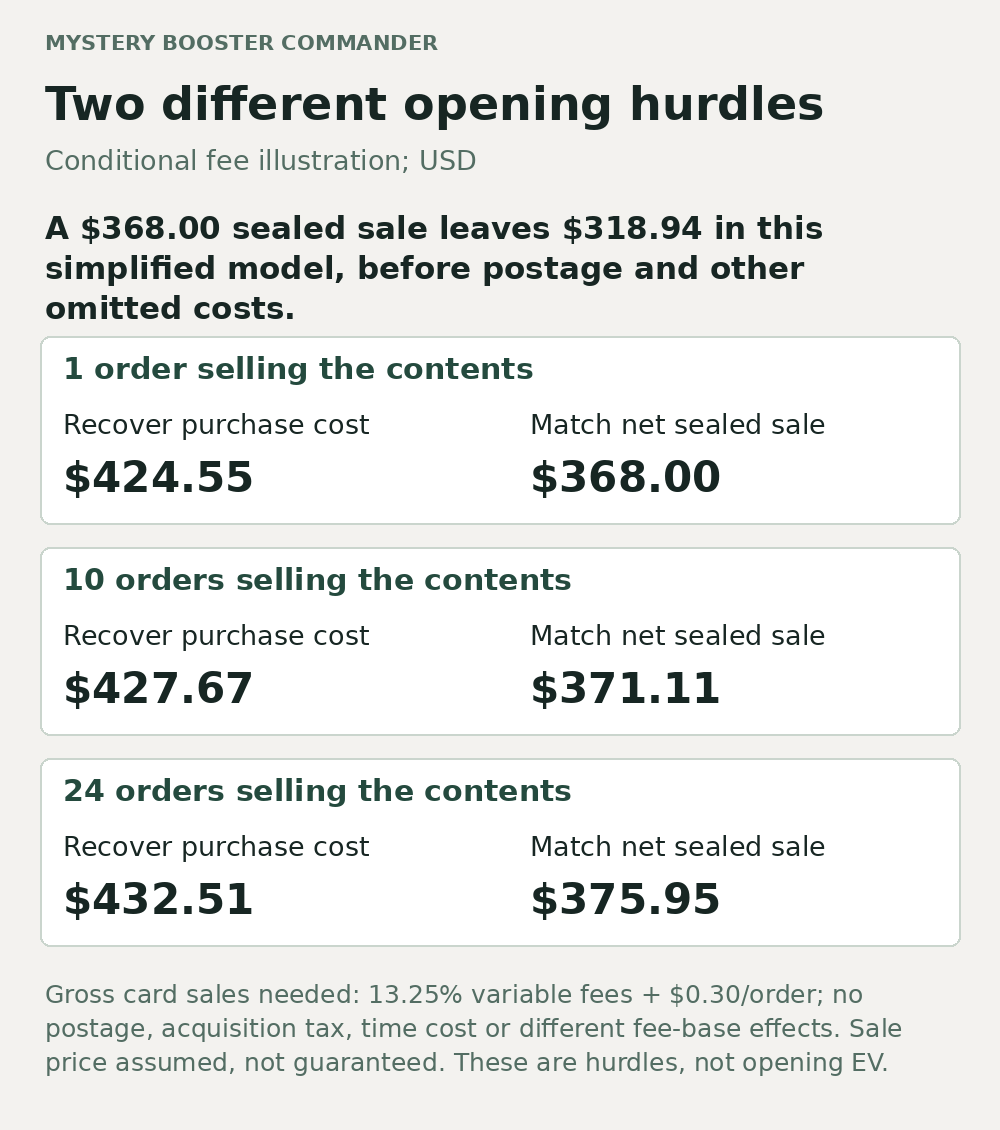
In this simplified fee model, a US$368.00 sealed sale leaves US$318.94 before postage and other omitted costs. For 24 orders selling the contents, gross card sales must reach US$432.51 to recover the purchase cost, or US$375.95 to match that modeled net sealed sale. The model uses 13.25% variable fees and US$0.30 per order; it is not opening expected value.
In the simplified 24-order illustration, recovering a US$368.00 purchase cost requires about US$432.51 in gross card sales. Matching the modeled net sealed-sale alternative requires about US$375.95. Both calculations omit outbound postage, acquisition tax and other costs, and both assume the stated sale prices can actually be achieved.
The gap is useful, but it does not tell us what an average box contains. These are hurdles. A proper opening expected-value calculation would need a supported distribution of individual cards, their realizable selling prices and the costs of turning them into cash.
A chase-card list cannot do that job
A product can contain expensive possibilities while most openings depend on less dramatic cards. To evaluate opening financially, the frequency of each relevant outcome matters alongside its price.
The official MBC breakdown publishes treatment-category rates. Those do not, by themselves, establish the individual-card frequencies needed to calculate a complete numerical opening value. Assuming every card in a category is equally common would add an unsupported input.
Prices also need the correct printing and condition. A rare foil's quotation cannot value an ordinary copy. A market indicator cannot guarantee that a buyer will pay the same amount for your copy when you list it.
TCGplayer's Market Price explanation says its indicator draws on recent sales. That makes it useful context. It does not turn every price-guide entry into cash available to you immediately.
The right conclusion is to keep the numerical opening-profit claim unproven. Neither a spectacular pull video nor a discouraging opening supplies a distribution of outcomes. A buyer can still make an informed decision about the experience without pretending that missing calculation has been solved.
Opening creates a collection of selling decisions
A sealed box can be one sale. An opened box may become many: different cards, different prices, different buyers and different shipping requirements. Some cards may be worth keeping, some worth listing and others not worth selling individually.
That fragmentation is why fixed order fees and postage belong in the comparison. The illustrative 24 orders are a scenario, not a prediction of how many sales your box will produce. The actual number depends on your inventory, buyers and selling method.
Time matters too. Pricing cards, describing condition, packing orders and handling problems are work. A seller with an established operation may absorb that work more efficiently than a player selling a handful of cards after one draft.
For cards you intend to keep, use their value to you rather than treating them simultaneously as cash proceeds. Counting a card as sold in the recovery calculation while also keeping it for your deck spends the same benefit twice.
The same rule applies to bundle extras. If you bought Festival in a Box, separate the booster box from the extra products. Use actual or conservatively estimated net proceeds when allocating recovered cash, and be clear about any extras you retain.
Keeping it sealed preserves options, not a guaranteed return
An intact product can appeal to future drafters and sealed collectors in ways that loose cards do not. Keeping the box sealed preserves the choice to sell that product or open it later. Opening removes the sealed option.
That flexibility has a cost. Money remains tied up, the box needs suitable storage and its condition matters. A buyer may eventually want proof of condition, appropriate shipping and confidence in the transaction. Selling later can involve the same fees and market frictions as selling now.
Future supply and demand are uncertain. Wizards advertises MBC at future Magic events, so the first online sale should not be treated as the entire distribution story. At the same time, planned availability does not specify a new print wave or tell us what prices will do.
Additional versions of desirable cards can also affect demand for opening the product without recreating the exact sealed box. Collectors and players may respond differently. “Keep it sealed” is therefore a strategy with assumptions to examine, not an automatic interest payment.
When opening makes sense
Opening can be a good use of the product when you want the draft experience and can comfortably pay for it. A planned game with friends gives the box a purpose beyond liquidating its contents afterward.
For someone who owns the box, the relevant entertainment cost is what they forgo by using it, adjusted for cards they genuinely value afterward. A low historical purchase price does not make today's opportunity cost disappear. It can still leave the owner happy to choose the experience.
For someone who mainly wants a particular commander or treatment, compare buying that card directly with purchasing random packs. Specific singles and a box of possibilities solve different problems. The uncertainty may be part of the fun, but it should be part of the budget too.
Opening is harder to justify on a purely financial basis when the case rests on a few expensive potential hits, ignores selling costs or assumes current price indicators will all be realized. The available data here does not establish that edge.
Choose the reason before breaking the seal
If the goal is a draft, judge the box as an experience and decide what you are willing to spend on it. If the goal is a few cards, price the singles. If the goal is releasing cash, compare a realistic net sealed sale with the work and uncertainty of selling the contents.
If the goal is future appreciation, write down what would have to stay true: sustained interest, attractive entry cost, manageable future supply and selling costs that leave enough of the gain. Be equally clear about what would change your mind.
The seal preserves a decision you can make later. Break it when you want what is inside enough to give up that option—not merely because the best possible pull would make an excellent photograph.