Stephen Miller’s promotion could make aggressive enforcement easier to organise and increase the pressure on safeguards that let people challenge it. The consequences could reach detained families, workers and customers far beyond a White House staffing dispute.
Trump’s November 6 announcement names Miller White House chief of staff, replacing Susie Wiles. The change takes effect Monday, November 9, according to Roll Call’s appointment reporting. Miller was already deputy chief of staff overseeing domestic policy. This is an expansion of an established power centre, rather than the arrival of an outsider.
The danger is a more effective operation for pursuing policies that impose serious costs on people who have little control over the decisions. Detention, access to courts and disruption at workplaces are concrete places to examine that possibility. A title change alone cannot tell us how far any of it will go.
Miller can shape the agenda; agencies wield the legal powers
A chief of staff manages the president’s operation and access to him. Reuters describes the job’s gatekeeping and staff-management influence. That gives the appointment importance beyond another forceful voice on television.
Consider the ordinary decisions surrounding an aggressive proposal. Who gets a meeting? Which objections reach the president? Does an agency receive time to examine a problem, or pressure to produce a result? Those choices can shape policy before the public sees an order.
The legal signatures still matter. Federal law governing White House staff provides for employees to perform duties the president prescribes. Separately, 6 U.S.C. 112 places the Department of Homeland Security under its secretary’s direction, authority and control. Miller’s promotion does not erase that allocation.
That distinction creates an accountability trail. When White House pressure produces an agency decision, the relevant questions include who authorised it, which law they relied on and what the agency actually did. An adviser’s influence can be substantial while responsibility also rests with the officials who approve and implement the policy.
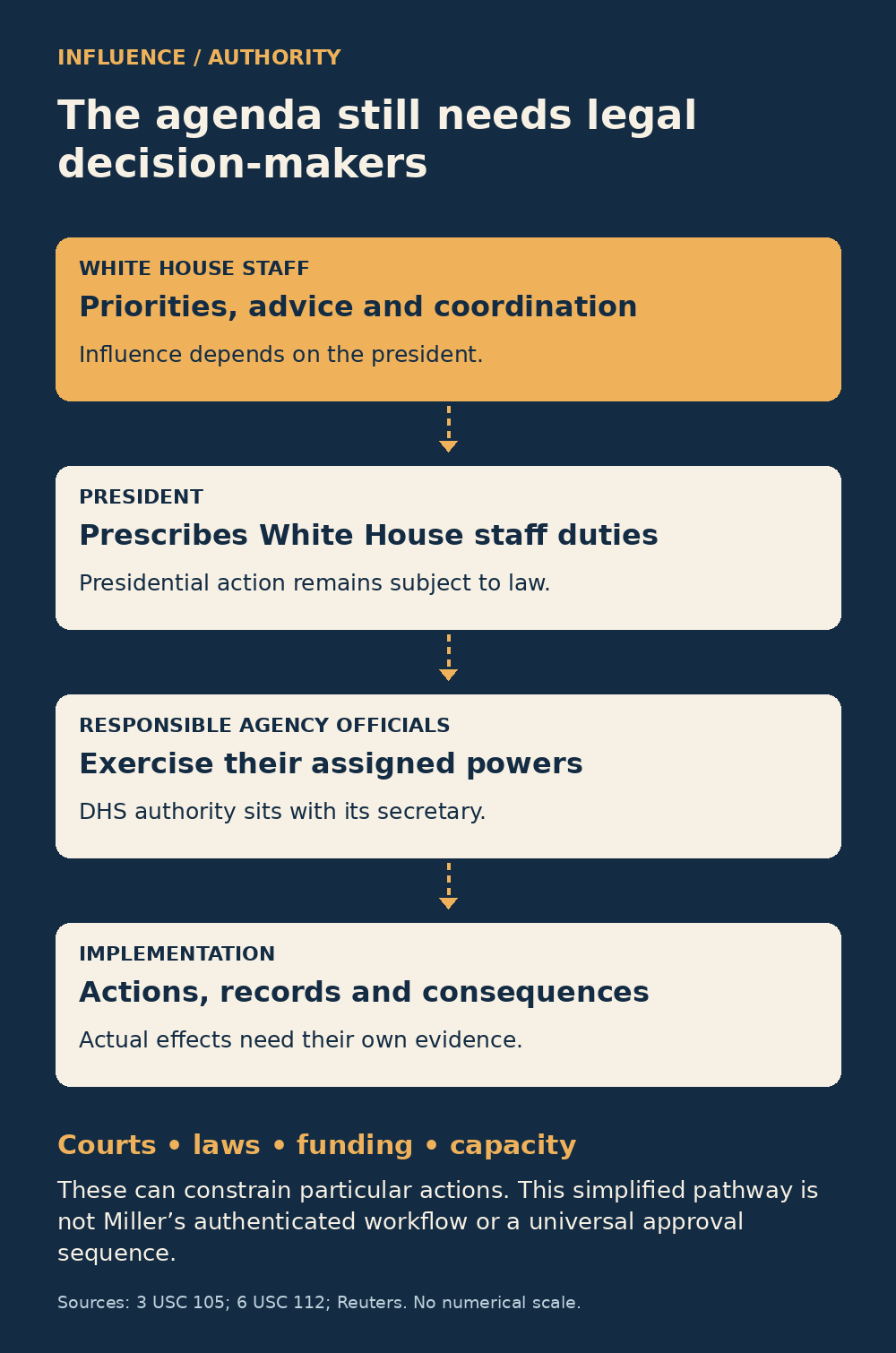
The diagram traces a simplified path from White House priorities to presidential decisions and legally responsible agency officials. Courts, legislation, appropriations and operational capacity can constrain particular actions. It is an explanatory model, not an authenticated account of Miller’s private workflow or a universal approval sequence.
Court access is where the rhetoric becomes personal
Miller has supplied a specific reason to scrutinise how he views restraints on detention. On May 9, 2025, he told reporters that suspending habeas corpus was an option the administration was “actively looking at.” The recorded transcript also links the discussion to whether courts do what he considers right.
Habeas corpus gives a detained person a way to challenge the legality of confinement. Weakening access to that challenge can make a government error much harder to correct while the person remains in custody. The consequences are measured in a person’s freedom and ability to contest what officials say about them.
Miller’s statement was a historical public position. It did not itself suspend anything. The Constitution’s Suspension Clause specifies rebellion or invasion and a public-safety condition. Declaring a policy urgent does not answer the constitutional questions about an attempted suspension.
There is also a documented example of why the corrective machinery matters. In its April 10, 2025 order in Noem v. Abrego Garcia, the Supreme Court recorded the government’s acknowledgement that sending Kilmar Abrego Garcia to El Salvador violated an order forbidding his removal there. The government described the removal as an administrative error.
The Court preserved a requirement to facilitate his release while directing clarification of other relief, with attention to executive authority in foreign affairs. That historical order illustrates both the necessity of judicial intervention and the complications of repairing an unlawful action after it has happened. It does not establish that Miller personally ordered the removal or describe the case’s current status.
The question his promotion raises is whether the White House will make lawful review easier to respect—or treat it as an obstacle to overcome.
The economic damage can reach people outside the enforcement target
The workplace consequences deserve attention even from readers who assume immigration enforcement cannot affect their own lives.
In September, the National Association of Home Builders reported that enforcement fears were keeping some legally authorised workers off construction sites. Its members described delays and cost pressure. These are accounts from an interested industry association, rather than a national causal estimate.
They nevertheless identify a plausible spillover: the person deterred from work need not be the person an operation intends to arrest. A disrupted project can affect coworkers, contractors and customers as well. That is a reason to examine actual staffing and delivery problems, rather than count arrests as though they captured every consequence of a policy.
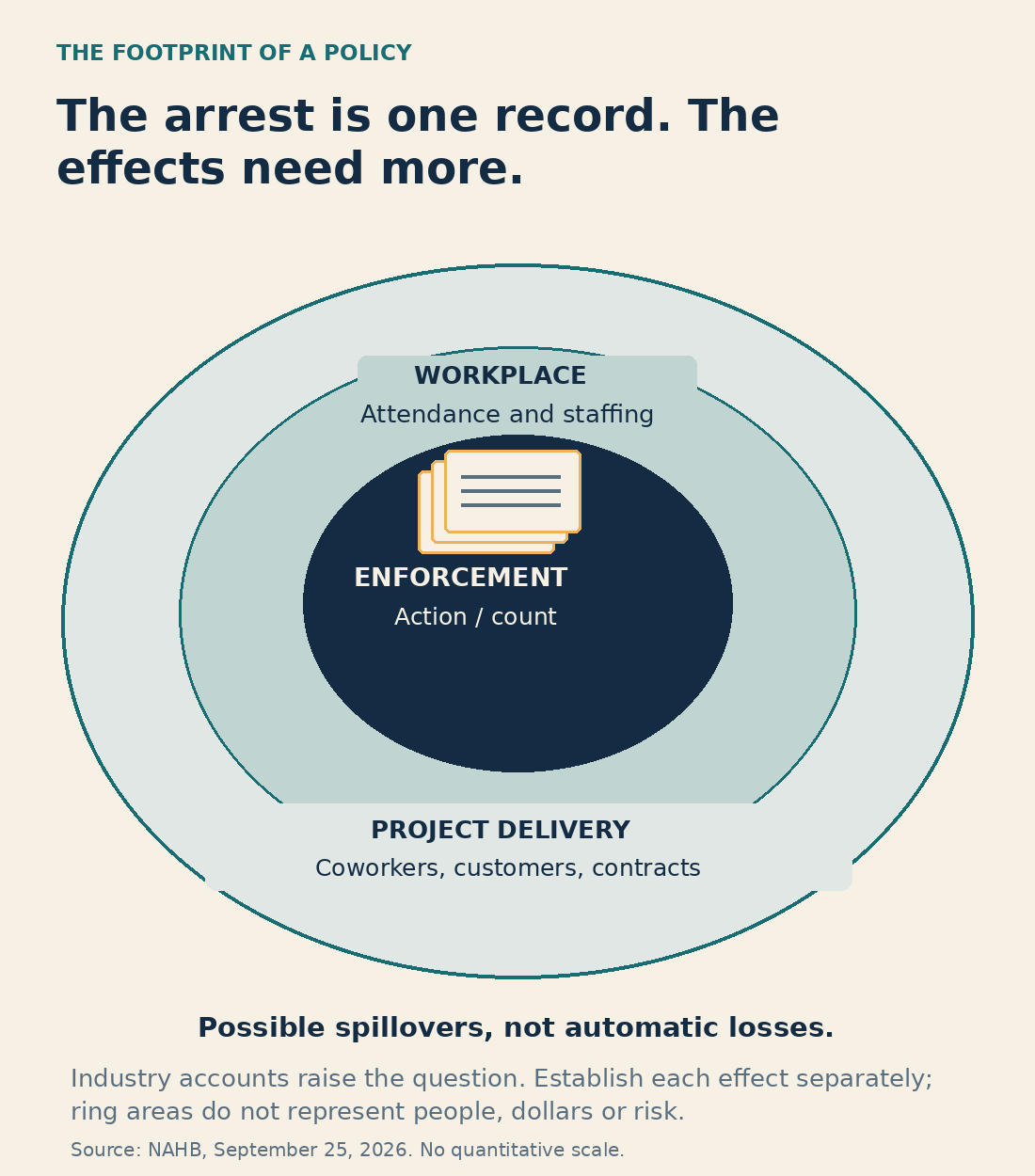
The graphic distinguishes the action being recorded from possible effects on attendance, project delivery and other people. Those effects require separate evidence. The relationships are conditional; the diagram assigns no loss estimate and does not attribute every labour shortage to enforcement.
There is an important economic countercase. In its February 2026 outlook, the Congressional Budget Office explains that reduced immigration affects both production capacity and consumer demand. Fewer workers can constrain supply; fewer consumers can also reduce demand. In its broader demographic projections, which also include fertility and ageing, CBO describes weaker demand and lower potential output as roughly offsetting for long-run overall inflation.
That older outlook cannot measure the effect of this appointment. It also prevents an easy but misleading leap from disruptive enforcement to a claim that every American’s prices must rise by some invented amount. Specific industries, places and time periods need their own evidence.
His foreign-policy views deserve scrutiny without inventing a command role
Reuters reports that Miller has backed strikes on suspected drug boats and praised U.S. and Israeli strikes in Iran. It also says his post-election Iran position was unclear. That record makes his access to presidential decision-making relevant to foreign policy as well as immigration.
The statutory combatant chain of command ordinarily runs from the president through the defence secretary to the combatant commander, unless the president otherwise directs. A chief-of-staff appointment does not, by itself, install Miller in that chain.
His promotion warrants attention to the advice reaching Trump and the decisions that follow. Evidence of a particular military action would have to come from that decision process; the appointment does not establish one.
A more confrontational White House still faces constraints
The strongest caution against overstating the promotion is that Miller already had major influence. The incremental effect of his new title remains unknown. Wiles’s departure does not prove that every previous policy had faced an effective internal brake.
Nor do election results immediately change every institution. As GripRoom’s explanation of Trump’s two lame-duck clocks sets out, the congressional term changes on January 3, 2027; the scheduled presidential term continues until January 20, 2029. The Twentieth Amendment keeps those boundaries distinct.
Congressional scrutiny, legislation and funding restrictions can matter, but their effect depends on the instrument, the votes and the existing legal and funding position. Courts and responsible agency officials remain relevant too. None of those constraints should be assumed to work automatically or dismissed as meaningless before examining the particular decision.
The most useful warning signs will be observable: directives that broaden enforcement, attempts to restrict court access, implementation records that reveal harm, and responses when courts or legislators demand a correction. Evidence that policies are narrowed, errors repaired or operational objections respected would count in the other direction.
Miller could make Trump’s remaining presidency more dangerous by helping turn aggressive preferences into sustained government action. The scale of the harm will depend on which policies advance, how they are carried out and whether the people with authority insist on their limits. For someone wrongly confined, the most consequential test is immediate: whether they can challenge the error, and whether officials correct it.