
he Iran weather reports circulating on November 6 describe a concrete civilian concern: heavy rain, flooding and hazards around rivers and mountain roads. They do not, by themselves, reveal an attack order. The important details are the places, valid periods and hazards named in each account.
That is more specific than “red alert over Iran.” The reports cover different areas, and some refer to northern parts of a province rather than northern Iran as a whole. Compressing them into one national label can change the story before any military interpretation is added.
The original signed meteorological bulletins were not available for direct verification in this review. The accounts below therefore retain their publishers and attributions. They establish what the inspected reports say, rather than an independently authenticated nationwide warning map.
One report concerns parts of Khuzestan
In a November 5 report, local news agency Eizna attributed a red-level rain warning to Khuzestan’s meteorological director. The account described a system expected from late Friday into Sunday, with specific northern, northeastern and eastern areas of the province identified.
The hazards it listed included heavy showers, thunder, hail in susceptible areas and strong winds. Its recommendations included avoiding riverbanks and seasonal watercourses, as well as unnecessary travel.
Those details explain the riverbed advice in this part of the story. It is consistent with the flood hazard described in the report. It is not evidence, on its own, that authorities are clearing a military corridor or disguising a war evacuation.
The geographic wording deserves care. “Northern Khuzestan” identifies a part of a named province. Removing the province’s name and retaining only “northern” produces a different geographic claim.
Tehran and Alborz appear in a separate account
Nournews’s November 5 report described heavy rain and flood concerns in Tehran and Alborz, with an expected peak late Saturday into early Sunday. It also referred to mountain-road hazards, including snow at higher elevations and risks around river margins.
This is another reported footprint and timetable. It should not silently inherit every detail of the Khuzestan account, nor should the two headlines be treated as proof that all intervening territory is under identical conditions.
Forecasts also describe expected hazards. A prediction of severe rainfall is not a measurement showing that the predicted rain has fallen everywhere named in a headline. Any later account of actual flooding would require observations with their own dates and locations.
The Iraqi outlook has its own geography
On November 6, 964media reported an Iraqi meteorological outlook for rain and thunderstorms across central and northern areas. Its account separated Friday, Saturday and subsequent days rather than describing one unchanging regional condition.
That separation matters when a short post combines “Iraq and Iran” into a single operational backdrop. A forecast for part of one country cannot establish the conditions at every point across the other. Even when neighbouring areas share a weather system, the actual observation and forecast fields still need to be checked.
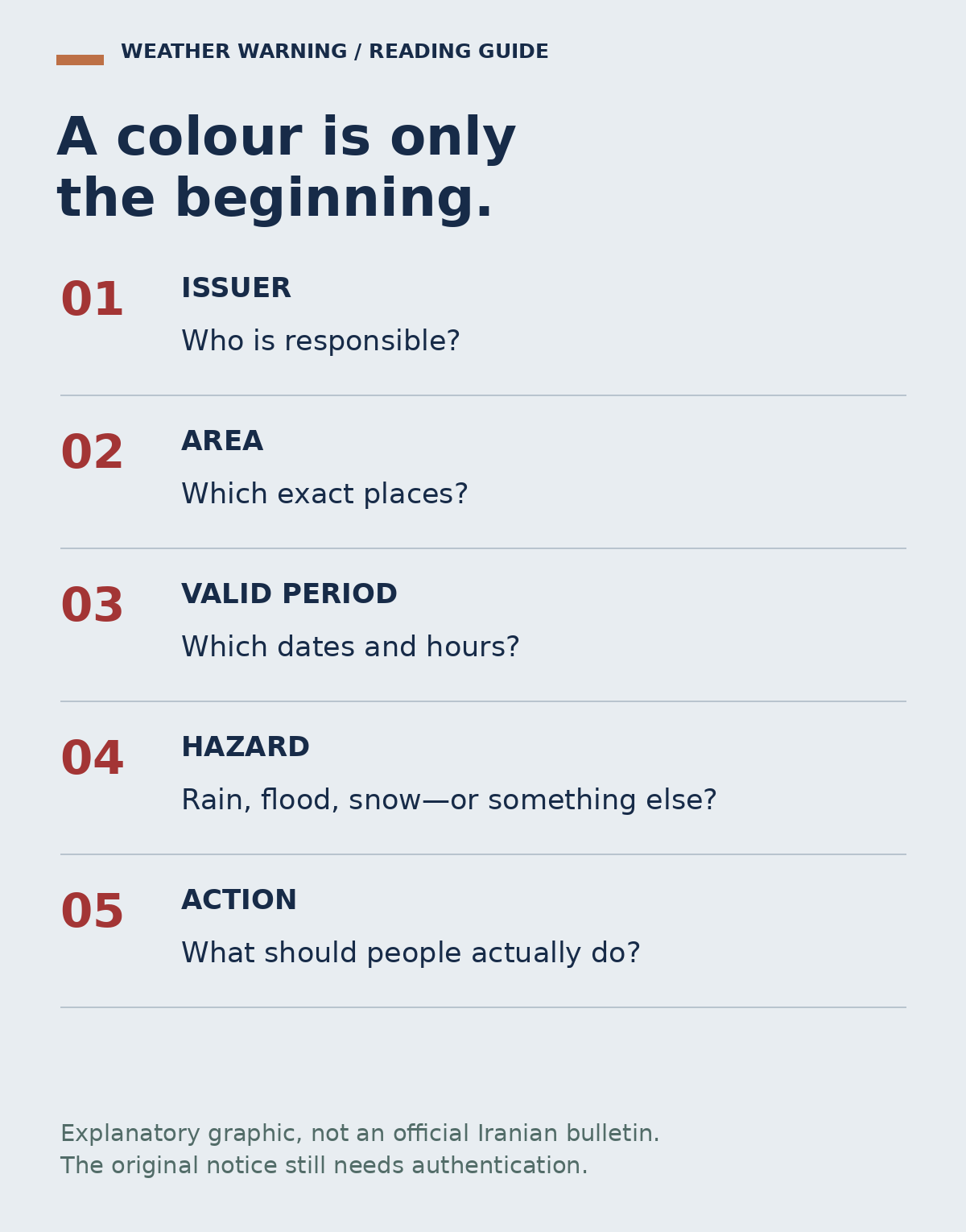
This explanatory graphic is not an official bulletin. It identifies the information needed to interpret an alert: issuing authority, affected area, valid period, named hazard and recommended action. A colour label alone cannot supply those details.
A warning is a document, not just a colour
The World Meteorological Organization’s Common Alerting Protocol guidance stresses consistent dissemination and authoritative warning sources for designated areas. That is a useful principle for readers, although it does not establish that a particular Iranian notice used that protocol.
The practical questions are ordinary but powerful. Who issued the warning? Which area does it cover? When does it apply? What hazard does it name, and what action does it ask people to take?
If a repost leaves those fields out, it has removed information needed to understand the alert. A subsequent claim that the missing information must conceal a military meaning does not restore it.
Weather can matter to military activity. But a civilian flood warning answers a different question from whether a government has authorised a strike. Reading the first as proof of the second requires evidence beyond their appearance in the same news cycle.
For now, the inspected local accounts provide a specific explanation for advice to avoid rivers and hazardous roads. The next useful evidence would be the original, current bulletins and observations showing what happened. Until then, the publishers, dates and local boundaries should stay attached to every retelling.