November 9, 2026 is a real new-moon date. It is also Monday, after the November 7–8 weekend. Those are the firm calendar facts behind a new strand of Iran strike speculation. They do not establish that President Donald Trump has selected that date for an attack.
The distinction matters because the moon supplies something the military story lacks: a precisely calculable event. Put the two together in one headline and the certainty of the astronomy can make the political timetable feel equally settled.
Public reporting on November 6 links the new moon to discussions about renewed military action. The useful question is how far that reporting goes—and where its evidence stops.
Where the November 9 connection comes from
An inspected Times of Israel liveblog entry attributes the account to senior officials speaking to Fox News. It reports a Thursday national-security meeting and the officials’ explanation that reduced moonlight around the new moon would provide preferred conditions for operations.
The attribution is important. This is reporting about officials’ account of deliberations and conditions, rather than an independently authenticated operational instruction. Direct access to the originating Fox liveblog was restricted during this review; the accessible account identifies where its information came from.
Repetitions by other outlets should not be counted as new witnesses merely because the wording or headline differs. If they point to the same Fox report, they belong to the same reporting chain.
That chain deserves attention. It still leaves separate questions about whether an operation has been authorised, what kind of action is contemplated and whether a reported plan remains current.
The astronomy checks out
The US Naval Observatory’s 2026 phase table places the new moon on November 9. The event falls on that Monday in Tehran as well. It is not a special phase that begins only over the Middle East.
The Observatory’s explanation of lunar phases distinguishes an instantaneous primary phase from the gradually changing illuminated fraction of the moon. For practical purposes, the phase event occurs at the same time regardless of the observer’s location.
The calendar date is therefore easy to verify. Describing the relevant night, the moon’s position in a particular sky and the conditions on the ground involves additional information. The word “new” does not make the sky switch from bright to dark at midnight on one chosen date.
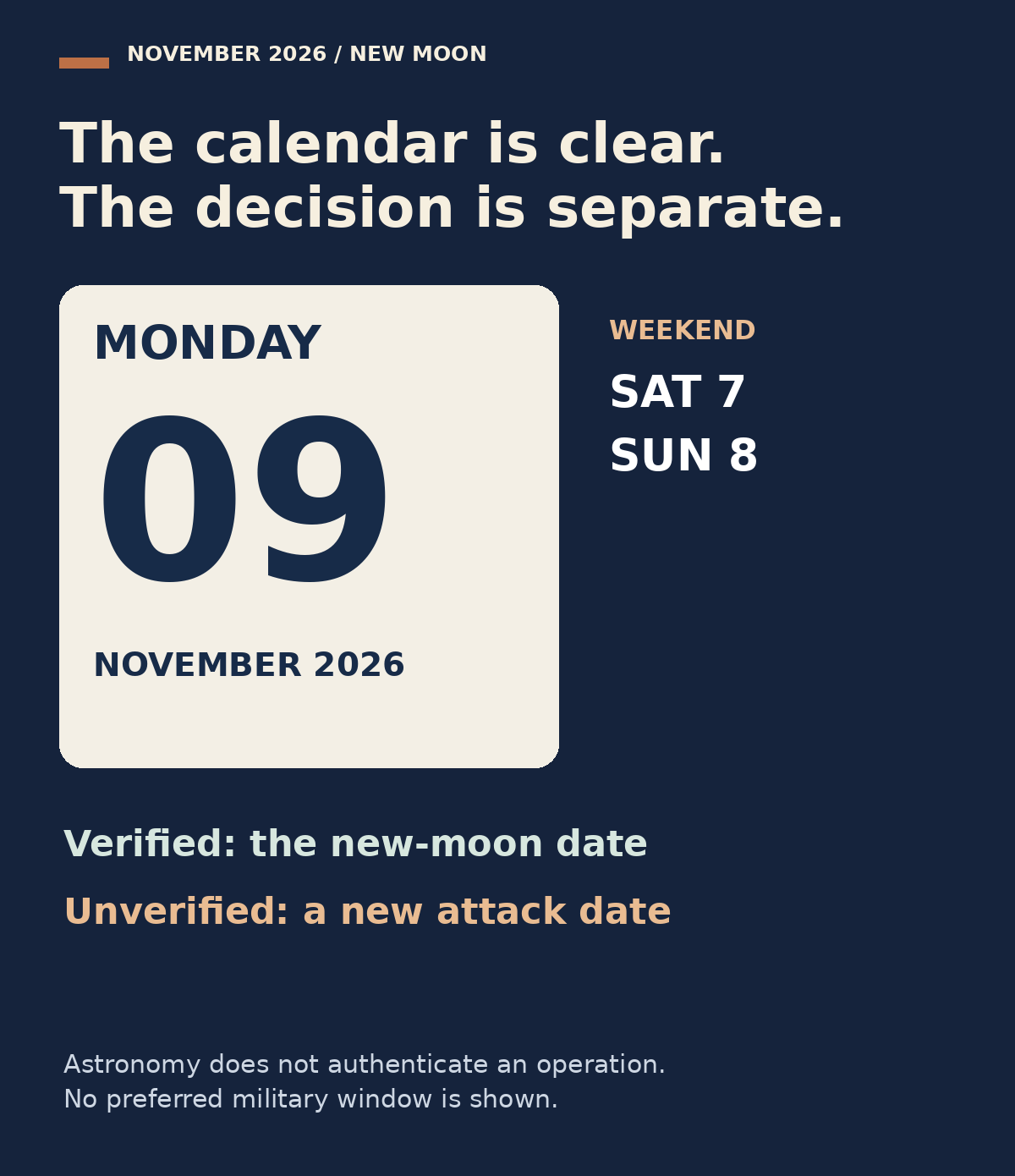
November 7–8 is the weekend; November 9 is Monday. The graphic does not identify a preferred attack period or suggest that an operation requires a particular lunar phase. It separates the verified date from the unverified decision.
A new moon does not describe the whole sky
NASA explains the new-moon geometry in straightforward terms: the side facing Earth is dark, while the sunlit side faces away. Around this phase the moon is in the same part of the sky as the sun. The phase describes the relationship between the sun, moon and Earth.
It does not describe every condition at every place. A phase table contains no local cloud forecast, rainfall observation or visibility measurement. Those require their own dated records and geographic scope. A regional weather headline cannot silently supply all of them.
That does not make the officials’ reported explanation meaningless. It means a general statement about conditions should retain its attribution and scale. It is a large step from “officials discussed this factor” to “the calendar reveals the order.”
This article is not assessing a particular mission’s requirements. Public astronomy cannot establish the equipment, objectives, alternatives or decisions involved in an undisclosed operation.
The decision is a different category of evidence
A meeting can establish that an issue was discussed. A publicly described preparation can show that an option is being maintained. Neither is interchangeable with an instruction to execute a particular operation at a particular time.
The reverse inference is weak, too. The absence of a public order cannot prove that no private decision exists. It tells us about the limits of the record available to readers. It should not become reassurance that an attack is impossible.
The correct distinction is between an observation and the conclusion being drawn from it. The moon’s phase is observable and calculable. The claim about preferred conditions is attributable reporting. A confirmed decision would need evidence addressing that decision directly.
This is why several genuine details do not automatically make a countdown. They may be relevant to the same confrontation while answering different questions about it.
Diplomacy belongs beside the military reporting
On November 5, Reuters reported that a senior Iranian official said a nuclear proposal had been sent through Qatar. The account described conditions and continued mediation, rather than a completed agreement.
That is a countercase to a one-directional reading of the news. Talks do not guarantee restraint, and their existence cannot establish that military options have been abandoned. But treating them automatically as a distraction would require evidence of its own.
Readers should keep each record in its proper category: a dated proposal, an attributed meeting account, a calculation of the moon’s phase and any later evidence of an actual decision. The first three cannot be collapsed into the fourth.
November 9 may remain a date to which reporting refers. What would materially change the story is more direct, current evidence about the decision—not another website displaying the same lunar calendar.