Reports that Iran is distributing iodine tablets near nuclear facilities deserve attention. They also leave three details unresolved: which facilities are covered, when the latest deliveries began, and whether the programme has changed from earlier wartime preparations. Those answers would tell us far more than the word “iodine” on its own.
The distinction is consequential. A precaution can reflect a serious concern without identifying the weapon an opponent has selected or revealing whether an attack order exists. And a tablet-distribution boundary cannot double as a map of where a hypothetical radioactive release would stop.
The public reporting available on November 6, 2026 supports a narrower, useful story: an attributed account of preparedness, a documented earlier distribution programme, and a medicine with a very specific protective role.
First, follow the claim back to its source
The current account originates with The Times’s reporting about Pickaxe Mountain. The full original article was not accessible for this review. An accessible Israel Hayom reproduction attributes an acknowledgement of distribution to an unnamed medical official quoted by the newspaper. The reproduced wording refers to attempts to supply communities near nuclear facilities during previous wars.
That wording matters. It describes a practice with a history, rather than establishing the launch date of a wholly new national operation. It also leaves the individual facilities and the latest delivery dates unspecified in the material we could inspect.
Several websites repeating that account do not provide several independent confirmations. A new headline can lead back to the same interview. The attribution should travel with the claim, especially when an unnamed official’s account is being read as evidence of a private military decision in another country.
Question one: which facilities are covered?
“Nuclear facility” is a broad description. A power reactor, an enrichment plant and a complex whose contents are uncertain do not automatically present the same hazards. Naming the site is therefore essential to understanding what a precaution might be intended to address.
The reported two-to-three-kilometre distribution radius does not answer that question. Without a facility list, it cannot establish that every sensitive installation is covered or that a particular underground complex is the reason for the deliveries.
It also cannot establish a maximum exposure distance. Distribution describes where an administrative or medical programme is being implemented. A physical exposure assessment would need evidence about a release and its circumstances. Those are different records.
Question two: when did the latest deliveries begin?
There is a clear historical complication. On April 7, Iran International reported that Bushehr authorities had distributed iodine tablets, citing the state-run Young Journalists Club and a local health official. The account said the programme began before the June 2025 war and initially prioritised areas around the nuclear power plant before expanding across the city.
That is a dated report about an earlier local programme. It does not authenticate the latest deliveries, explain every other site or prove that nothing has changed. It does show why the publication date of a November story cannot simply be treated as the first day Iran considered this precaution.
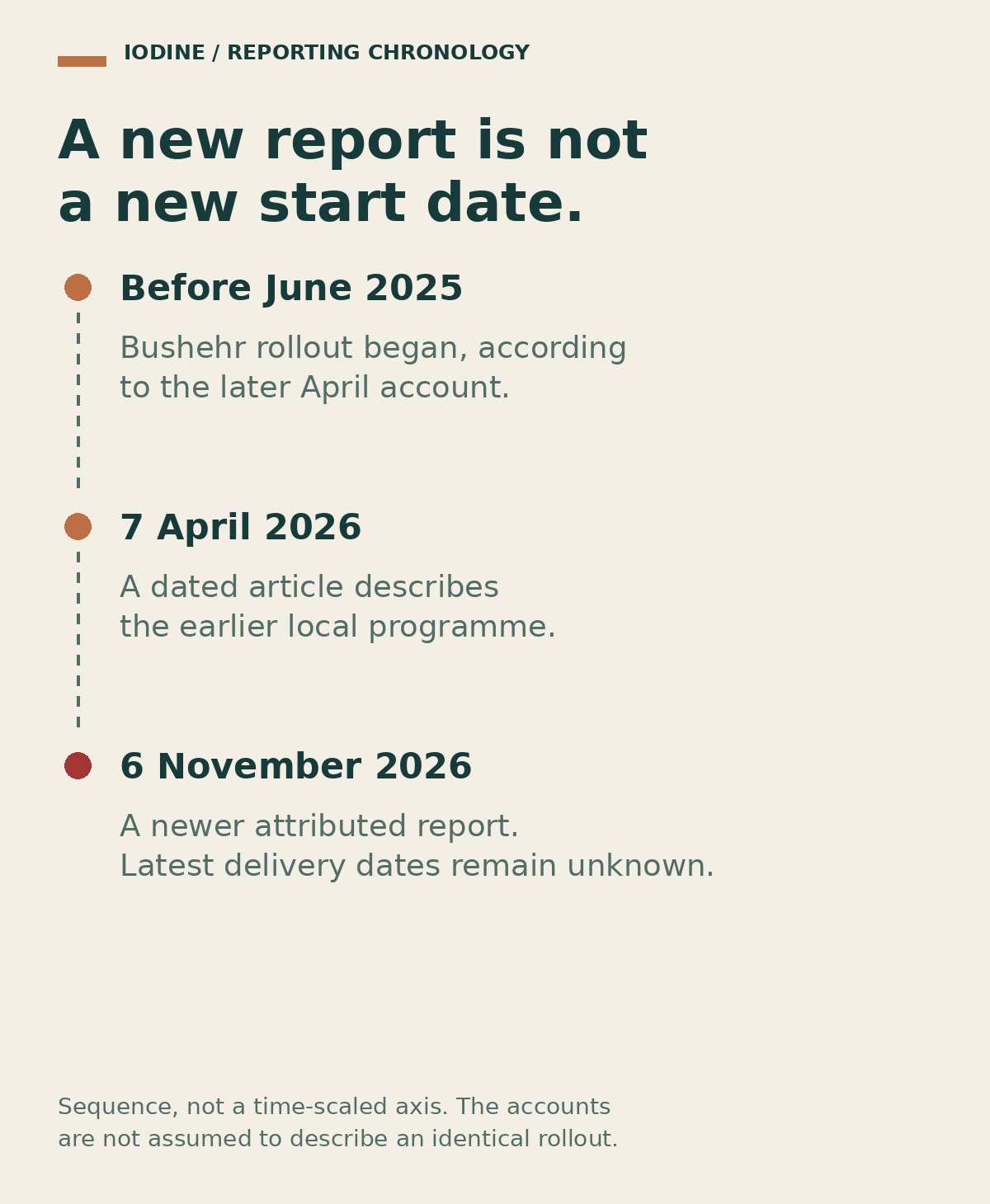
The April account places the Bushehr programme before the June 2025 war. The November claim concerns a newer report whose latest delivery dates and facility list remain unverified here. The timeline does not assume the accounts describe an identical rollout.
Question three: what changed from past practice?
The most revealing evidence would be a documented change: newly covered communities, additional stocks, different instructions or a new official assessment. Each would need its own source and date.
Continuing an existing programme and urgently expanding one can look similar in a photograph of tablets. A stock delivery, a reminder about availability and an instruction to take the medicine are also separate actions. Their significance depends on what actually happened.
The historical programme is therefore a baseline to investigate. It is neither a reason to dismiss the new account nor proof that the current preparations are unprecedented. Without a comparison, “more alarming than before” remains an interpretation rather than an established finding.
What the tablets can actually do
The World Health Organization explains potassium iodide as a way to reduce the thyroid gland’s uptake of radioactive iodine when used under the appropriate conditions. Its protection is specific to that gland and that substance. It does not protect against external radiation or the other radioactive materials that may be present in an emergency.
That narrow mechanism is important to the political interpretation. Distributing tablets does not identify a nuclear weapon as the expected cause of danger. Radioactive-iodine protection is also part of planning for certain nuclear-facility emergencies.
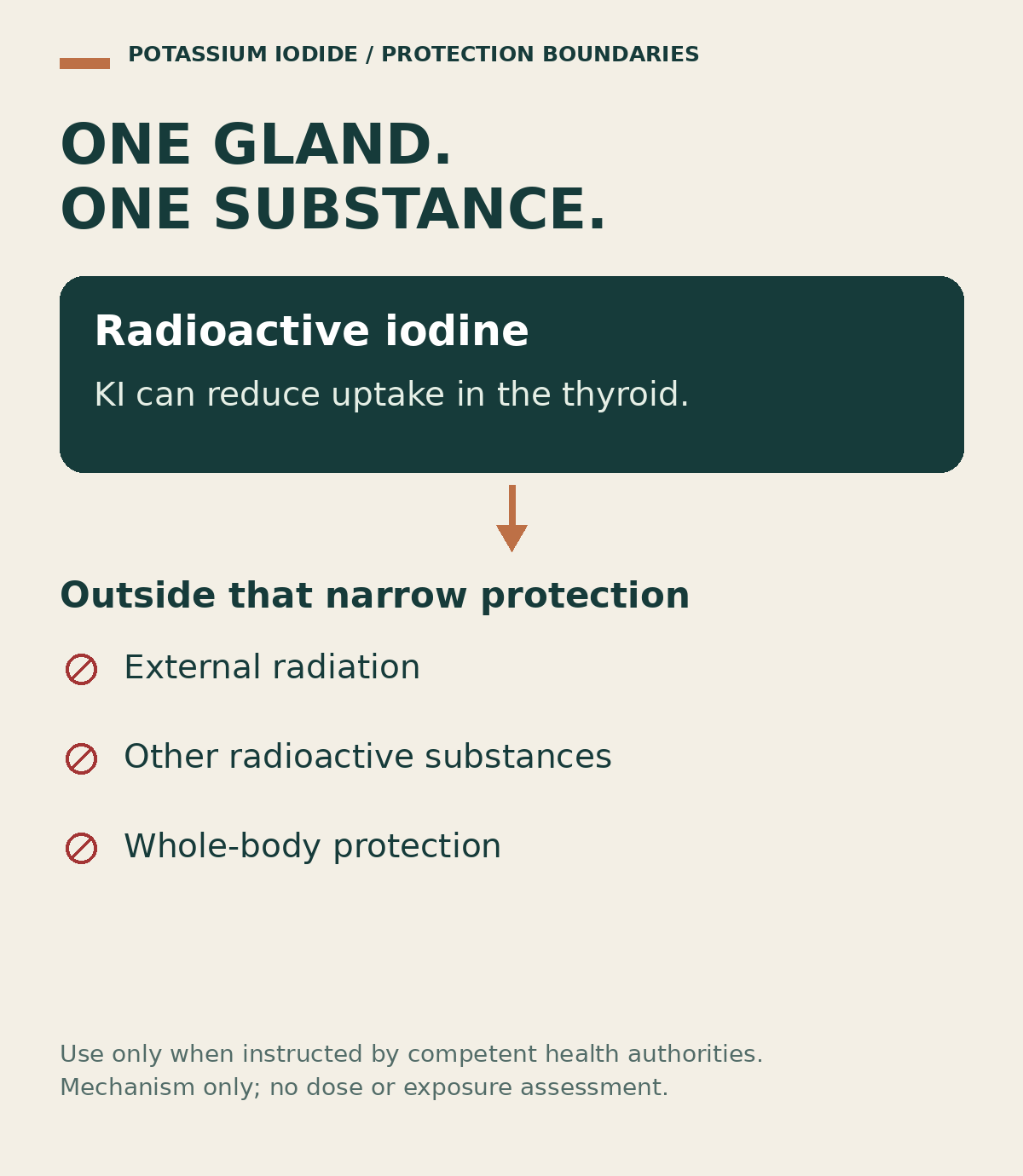
The diagram separates thyroid protection against internal radioactive iodine from external radiation and other radioactive substances. It is a mechanism explanation, not a dosing guide, an exposure assessment or a recommendation to take tablets.
The CDC’s radiation-emergency guidance also warns against treating potassium iodide as general protection from nuclear-bomb fallout. Leaving shelter to find it can expose someone to additional danger. Public-health instructions, rather than a viral geopolitical interpretation, determine when its use is appropriate.
The evidence worth looking for next
The useful next development would be an attributable facility list, dated local distribution records, or instructions showing a change from the earlier programme. Those would improve our understanding of the precaution. An authenticated military decision would answer a different question.
The latest iodine account is a reason to investigate preparedness seriously. Its missing details should remain visible, rather than being replaced by a confident story about what someone in Washington must have decided. A medicine can tell us something about the hazard a programme is designed to address. It cannot, by itself, tell us what happens next.