
he election can be over while the government it rejected is still making decisions.
That is the awkward starting point after the 2026 midterms. Democrats have won control of both chambers, according to AP’s election reporting, although individual races remain uncalled. The incoming majority does not immediately inherit the outgoing majority’s votes. Donald Trump does not hand over the presidency in January, either.
There are two clocks worth watching. The outgoing Congress reaches its term boundary on January 3, 2027. Trump’s presidential term is scheduled to end on January 20, 2029, subject to the constitutional provisions for an earlier departure.
Calling everything “the lame duck” makes those very different windows sound like one short interval. One lasts roughly two months. The other stretches through the next two years of executive decisions, negotiations and fights over what Congress can actually stop.

The first clock belongs to the Congress that voters just replaced
The Twentieth Amendment sets the congressional term change at noon on January 3. That means the current Congress can continue conducting business after Election Day. The people who won seats in November generally have to wait for the new term; the regular-term incumbents they defeated generally keep their seats until that boundary, unless they leave earlier.
This interval matters because an outgoing majority can still pass legislation, subject to the usual requirements, and the Senate can still act on nominations. Election-night television graphics describe who won the next Congress. They do not replace the membership of the current one.
For Trump, that creates a remaining window to work with the present Republican majority. Whether it produces much depends on actual votes, floor time, priorities and attendance. The existence of a window is not evidence of a secret agreement to use it.
It also explains a common source of confusion in the news. A defeated senator may be preparing to leave Washington while retaining the authority to approve an appointment. A future committee chair may be promising investigations while still lacking that chair’s current institutional authority. Both things can be true at once.
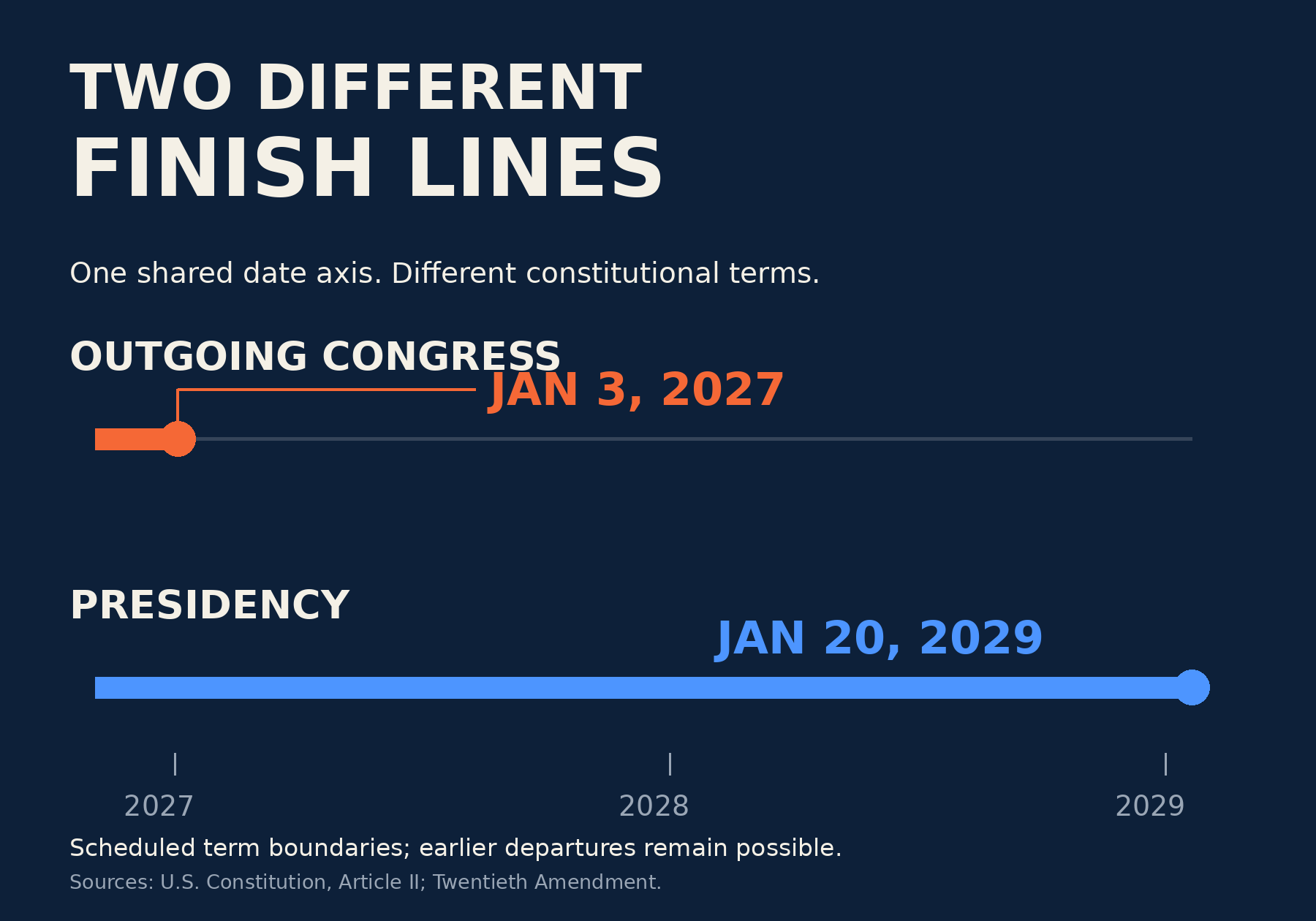
The outgoing congressional term reaches its boundary on January 3, 2027. The presidential term is scheduled to end on January 20, 2029. Those are separate constitutional endpoints; neither line predicts which policies will succeed.
The second clock belongs to a presidency that keeps operating
“Lame duck” is a political description, not an amendment that switches presidential powers off.
Trump was already a twice-elected president before this election. The Twenty-Second Amendment’s limit on being elected president did not suddenly appear because Republicans lost congressional races. The midterms changed his political position and the composition of the Congress he will face. They did not create a shortened presidential term.
That distinction matters whenever a headline moves too quickly from a damaged mandate to an incapacitated office. A president can have less influence over legislators while retaining powers that do not require a fresh congressional vote every time they are used.
The presidency continues directing the executive branch within the law. Constitutional powers such as pardons for federal offenses, subject to the impeachment exception, also do not disappear because the opposition wins seats. Other actions depend on authority Congress has already granted through particular statutes. Each route has its own boundaries.
The useful question is therefore specific: which power, under which law, with which limits? “He lost the midterms” is an important political fact. It is not, on its own, a legal answer to any of those questions.
Democrats gain gates, levers and opportunities to say no
Incoming control of Congress can make the second half of a presidency much harder. But the effect depends on the decision being made.
Consider appointments. The Senate’s advice-and-consent role gives senators a direct part in approving covered nominees. A president can announce a preferred candidate; he cannot simply turn an announcement into the Senate’s consent. The change in Senate control can therefore alter the path for future judges and officials without changing the president’s constitutional job description.
Legislation is different again. Bills normally have to clear both chambers and reach the president. Trump retains the veto. Overriding it requires the constitutionally specified two-thirds support in each chamber, rather than merely winning enough seats to control the agenda. The House’s explanation of presentment lays out the choices once an enrolled measure reaches the president.
Funding offers another set of levers, because the Constitution assigns Congress a central role in appropriations. But “Congress has the power of the purse” does not mean an incoming majority has already enacted a spending restriction. The text, the votes, the existing funding and the president’s response still matter.
For a reader trying to understand Washington, those distinctions are more informative than a general declaration that Trump is either powerless or unconstrained. Ask whether the action needs new legislation, Senate consent, existing statutory authority or money that has already been appropriated. The answer identifies the relevant gate.
Courts keep a separate clock of their own
Some of the strongest limits on executive action have little to do with which party has just won an election.
The Supreme Court’s February 2026 decision in Learning Resources v. Trump held that the International Emergency Economic Powers Act did not authorize the president to impose tariffs. That was a ruling about statutory authority. It did not wait for the midterms to impose a boundary.
The example cuts in both directions. A president cannot create unlimited authority by calling a policy urgent. Equally, the rejection of one legal route does not establish that every different statute conferring trade powers has vanished.
That is why an executive order deserves more scrutiny than its announcement ceremony. Its practical reach depends on the authority supporting it, the action it directs, the litigation it faces and whether it is actually implemented. Dramatic wording and legal effect are separate things.

A cornered president still has choices
The more provocative interpretation of a lame-duck presidency is that political defeat makes confrontation attractive. It is a possibility to investigate, not a psychological fact that can be read from the election result.
The Council on Foreign Relations’ post-election analysis discusses Congress’s ability to obstruct parts of a president’s agenda while also recognizing the executive’s substantial foreign-policy role. That institutional imbalance is real. It does not tell us which choice Trump will make in a particular dispute.
A president facing a hostile Congress can seek deals, rely on existing authorities, test legal boundaries or accept that some proposals will not pass. More than one approach can appear in the same presidency. The evidence for an escalation has to come from a concrete action, directive or decision, rather than from the word “cornered.”
The same care applies to Iran. The election result does not automatically end military activity. GripRoom’s explanation of Congress’s Iran war-powers options examines the separate questions of authorization, funding and measures that can survive the legislative process.
The first post-election clock is short, and the decisions made within it can matter well beyond January. The second is longer, with a presidency that keeps acting and a new Congress that will have different tools to resist it. Watch the powers, the documents and the votes attached to each clock. The label alone tells you very little about what happens next.