An attack on a nuclear-related facility can create serious civilian dangers without the attacker using a nuclear weapon. But the phrase “nuclear site” does not tell us enough to describe those dangers. A reactor, an enrichment facility and an underground complex with uncertain contents require different consequence assessments.
That is the crucial distinction behind the latest concern about Iran, iodine tablets and Pickaxe Mountain. The name of the weapon is one question. What material is present, what condition it is in and what happens to it are others. A dramatic photograph of a mountain cannot answer all of them.
The historical record offers useful comparisons. It does not provide a live inventory of every Iranian facility or a ready-made map of the consequences of another strike.
Start with the material, not the label
“Nuclear” can describe several stages of an industrial and scientific process. Material prepared for enrichment is different from material that has been used in an operating reactor. Equipment manufacturing, research and storage introduce further distinctions. Even two buildings on one large site may not present identical hazards.
The International Atomic Energy Agency’s June 2025 assessments demonstrate why the distinction matters. The agency separated concerns about reactors from the local effects reported at damaged fuel-cycle facilities. It did not describe every nuclear-related installation as one interchangeable source of danger.
For a reader trying to understand a worst case, that changes the first question. Before asking how far contamination might travel, establish what could actually be released. An impressive-looking radius cannot compensate for an unknown starting inventory.
Enrichment sites can present chemical hazards
Following the June 2025 attacks, IAEA Director General Rafael Grossi described contamination within Natanz. His account identified both radiological and chemical concerns, including uranium compounds, while distinguishing conditions inside the facility from off-site measurements.
That chemical dimension can disappear when the public discussion centres entirely on radiation. A substance can be dangerous because of its chemical toxicity as well as its radioactivity. The route of exposure matters, too: material inside a damaged building is a different situation from a verified release affecting a wider population.
The historical assessment should be read with its date attached. A report of unchanged off-site radiation in June 2025 does not certify conditions at the same site in November 2026. Equally, a dangerous local contaminant should not automatically become a claim that an entire region has been exposed.
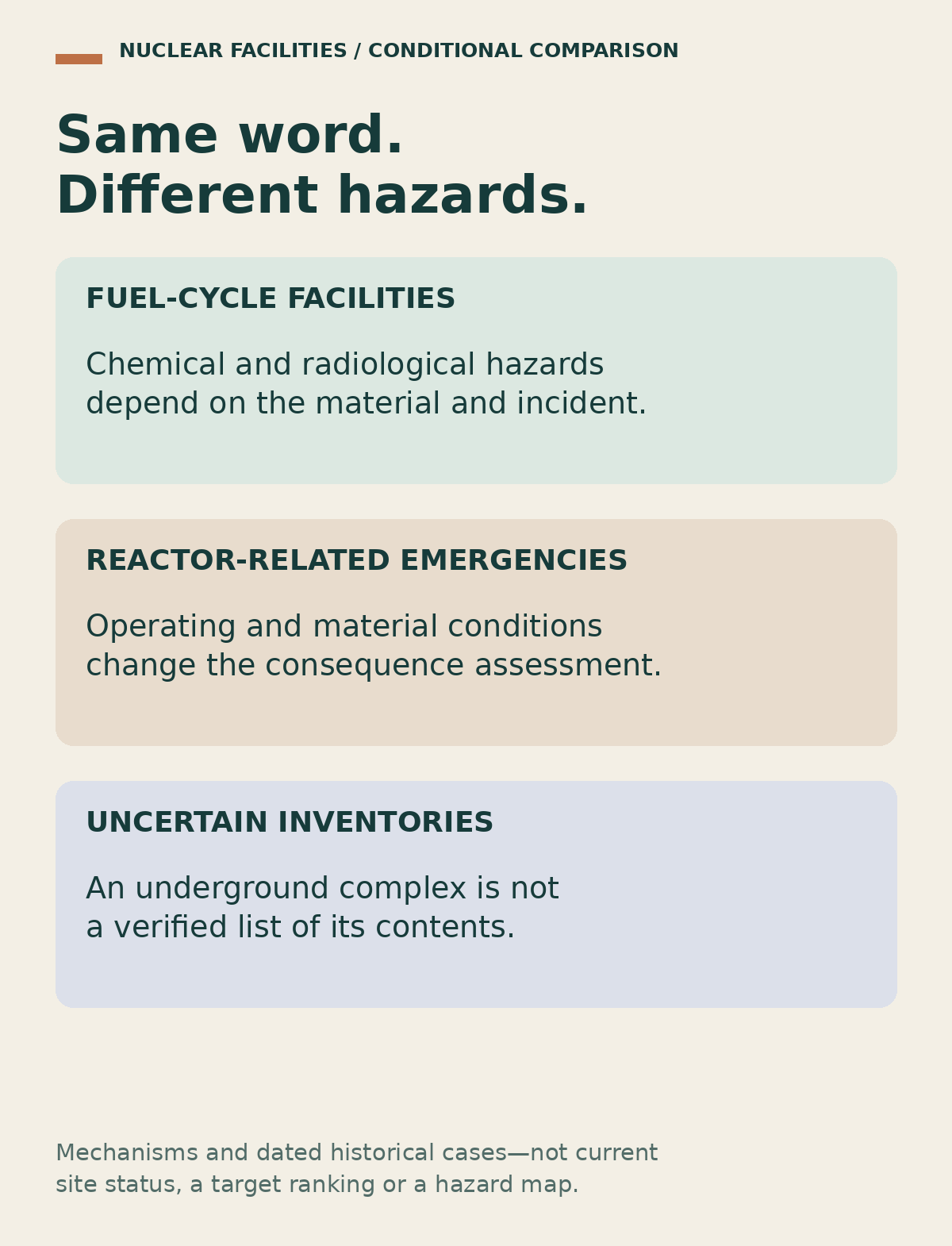
Fuel-cycle facilities can involve chemical and radiological hazards. Reactor-related assessments depend on operating and material conditions. An uncertain underground inventory remains uncertain. The comparison describes mechanisms, not present site conditions or a ranking of targets.
Reactors belong in a different consequence assessment
In his June 20, 2025 Security Council briefing, Grossi warned that a serious incident involving Bushehr could have consequences beyond the plant and potentially beyond Iran. He also discussed concerns about the Tehran research reactor. Those were conditional assessments grounded in the facilities and their material at that time.
The distinction is not simply that a reactor has a more alarming name. Reactor-related emergencies can involve different radioactive inventories and safety requirements from enrichment or equipment-manufacturing facilities. Current operating condition, material present and the nature of any damage would all need to be established before describing a specific new scenario.
Supporting services matter as well. Darya Dolzikova’s RUSI research explains that military activity can threaten nuclear safety through disruption around a facility, rather than only through a direct hit on a reactor. That is a reason to assess dependencies carefully, not to assume a particular chain of failure has occurred.
For civilians, the difference can change the relevant warning, protective action and monitoring requirement. A generic image of a radiation symbol communicates concern. It cannot supply the missing assessment.
Pickaxe Mountain has an additional uncertainty
Underground facilities create a particularly difficult public-information problem. Exterior construction can be visible while the current inventory inside remains uncertain.
CSIS’s September 9, 2026 imagery analysis examined construction activity at Pickaxe Mountain. It explicitly said its assessment could neither substantiate nor refute a reported intelligence claim about centrifuges being moved there. Observable work and a verified inventory are different findings.
That does not make the site unimportant. It means a consequence analysis should keep its assumptions exposed. A scenario involving equipment alone is not identical to one involving a substantial quantity of material. Neither scenario becomes a confirmed description of the interior merely because the building is hard to inspect.
The existing Pickaxe Mountain nuclear-strike discussion concerns a related but separate issue: what public claims establish about weapon choice and decision-making. The public-health consequences still require their own evidence.
A release is not the same thing as an exposure
A sound consequence assessment follows a series of conditions. Material has to be present. An incident has to release some of it. Its movement and persistence affect where it goes. People then need an exposure pathway that makes the health assessment relevant.
Each step introduces information the broadest headlines often omit. The amount released cannot be read from the total amount believed to be somewhere on a site. A wind forecast cannot identify a plume that has not been observed or modelled with a defensible release scenario. A distribution boundary for protective medicine is not a measured edge of contamination.
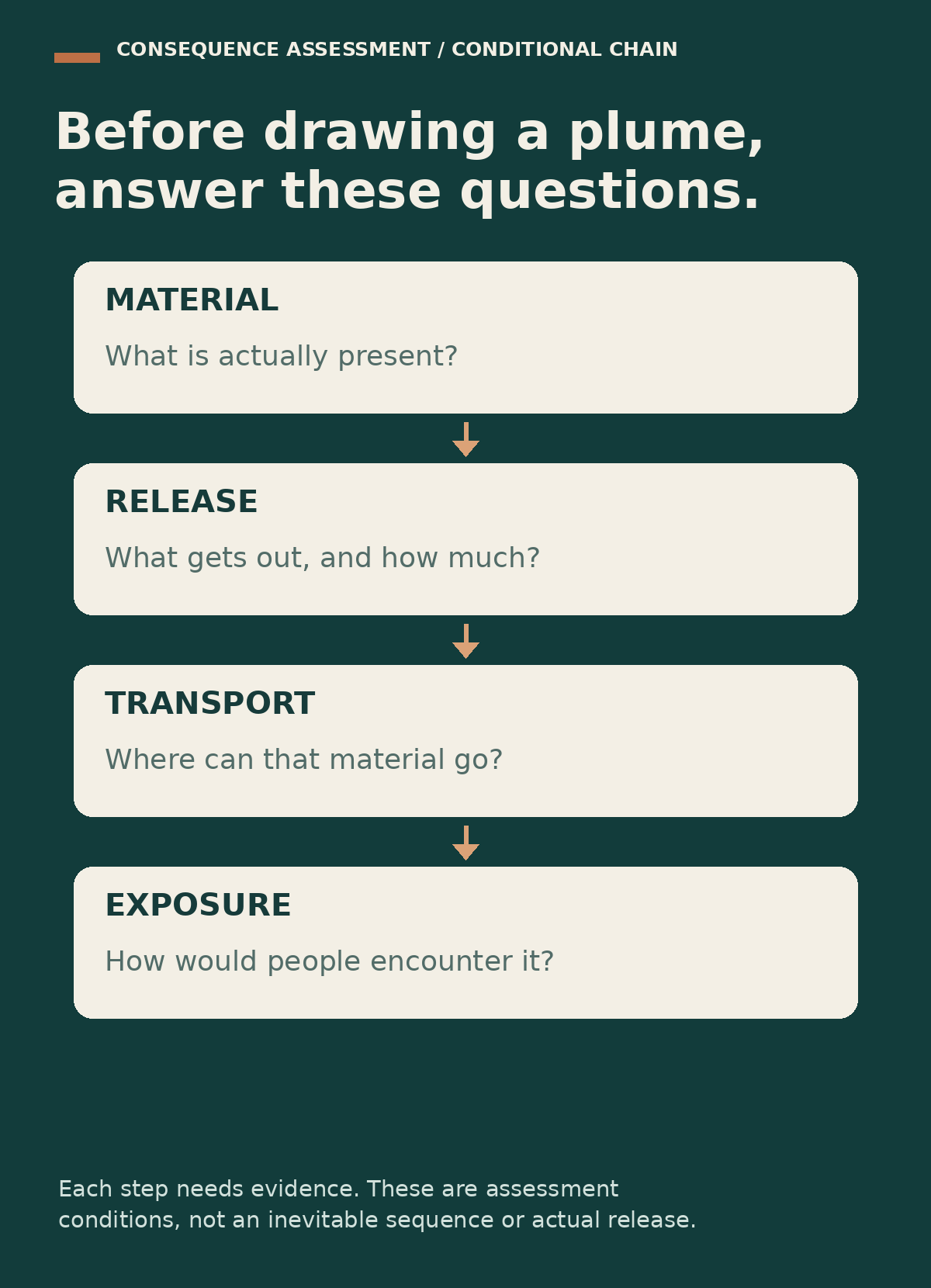
The chain shows assessment questions, not an inevitable sequence. Material inventory, the fraction released, environmental transport and exposure pathways must be specified before a site-specific consequence can be estimated. No current release or plume is depicted.
RUSI’s analysis also stresses the unpredictability of contaminant dispersion and the potential for effects to reach third countries. That supports taking wider consequences seriously. It does not justify drawing an actual fallout corridor from a general regional weather report.
Iodine cannot settle the scenario
Reports of iodine tablets can make several very different possibilities appear to merge: a reactor emergency, damage to another nuclear-related facility and the use of a nuclear weapon. They should remain separate.
The WHO’s explanation of potassium iodide limits its protective role to the thyroid’s uptake of radioactive iodine. It does not protect the whole body from all radiation or address every chemical hazard. A medicine prepared for one exposure concern cannot identify every component of the event authorities are considering.
The useful worst-case question is therefore specific: what facility, what material, what damage and what route to civilian exposure? The answer can still be grave. It will be more informative—and more honest—than treating every nuclear-site strike as the same disaster.