Pickaxe Mountain has become the meeting point of two very different threats: another attack on Iran’s nuclear-related infrastructure, and the use of a nuclear weapon to carry it out. The first has been discussed publicly by President Donald Trump. The second is the subject of alarming claims and anonymously sourced reporting.
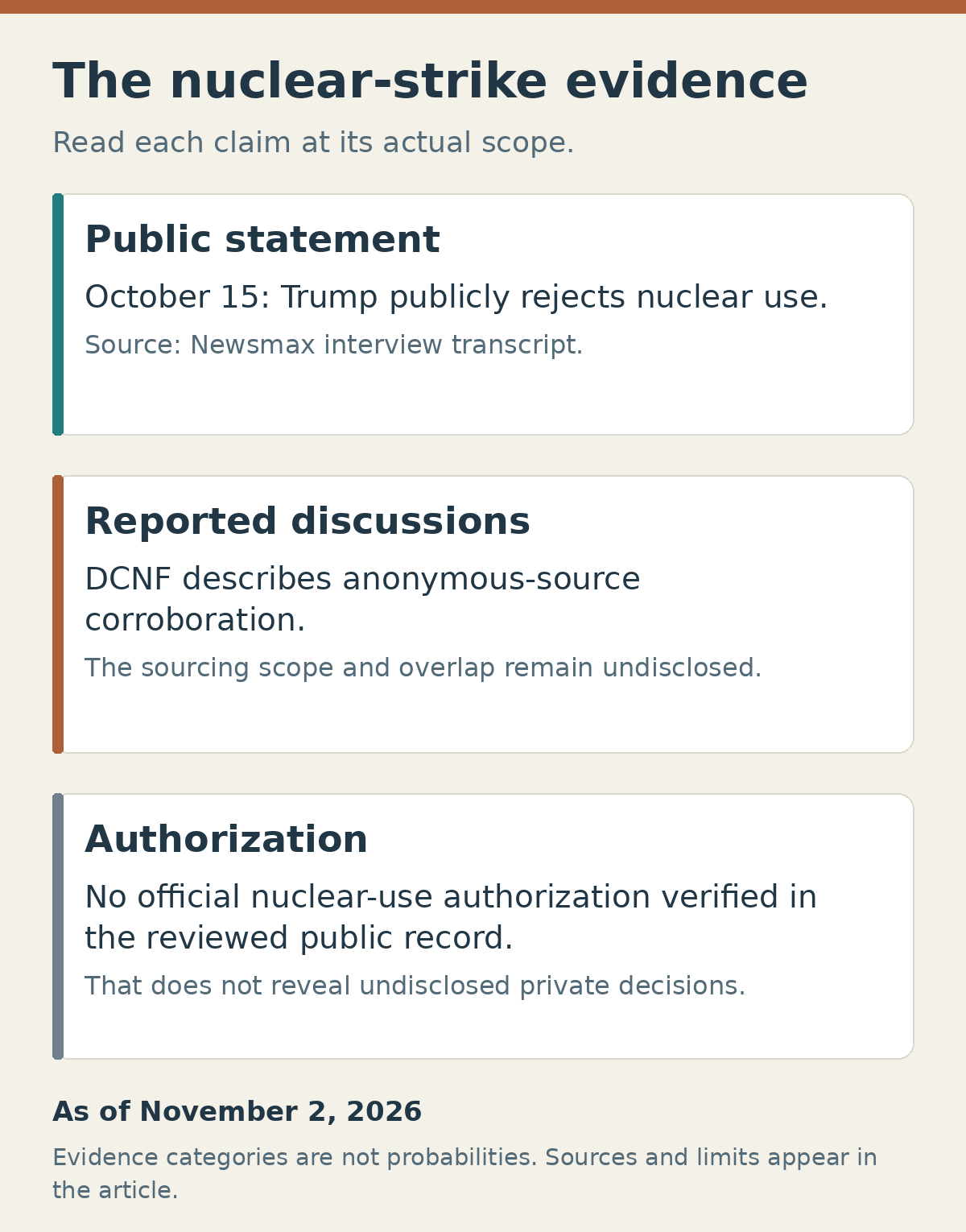
As of November 2, those reports warrant attention. They do not establish a confirmed nuclear-use authorization. Trump has publicly rejected using nuclear weapons against Iran, while reporting about possible discussions inside his administration leaves questions about what has been considered, by whom and with what seriousness.
That distinction matters because a difficult underground target can make an escalation story sound mechanically inevitable. A mountain is hard to destroy, conventional weapons have limits, therefore a nuclear attack must be next. Each step in that argument needs evidence. The political decision cannot be read straight from the rock.
The reporting stops short of a nuclear order
Tucker Carlson’s latest warning named Pickaxe Mountain and alleged that Israeli pressure could bring Trump close to a nuclear decision. Reporting on the post also described a purported November 7 decision timetable. That is Carlson’s claimed timetable, rather than an announced government deadline.
The story also has an earlier reporting history. In August, the Daily Caller News Foundation said it had confirmed that an anonymous senior U.S. official supplied Carlson with information about nuclear discussions at the Pentagon. A November 2 DCNF article carried by BizPac Review asserted additional corroboration of the central allegation.
Those accounts belong in an assessment of the risk. Their limits belong there too. Readers cannot inspect the underlying briefings, determine exactly what was corroborated or establish whether the confidential sources overlap. Discussion of a contingency, advocacy for an option and a presidential authorization are different events.
Trump’s clearest public statement points in another direction. In his October 15 Newsmax interview, he said: “I wouldn’t use nuclear. We don’t have to.” Reuters reported the interview the following day.
A public rejection is meaningful counterevidence. It is also a statement made on a particular date, rather than a permanent guarantee about every subsequent private conversation. The public record contains both the denial and the reports of discussions.
The mountain is difficult to see inside
Pickaxe Mountain is an underground complex near Natanz. The Institute for Science and International Security’s July assessment described continuing construction and uncertainty about when the facility could become operational. A September CSIS imagery study identified increased activity while leaving important questions about the interior unanswered.
Those assessments have dates. They should not be promoted into a complete inventory of what is happening inside the mountain in November. Satellite images can reveal construction and movement without establishing the purpose of every room or the contents of every vehicle.
The more recent official record is also unsettled. In his October 27 Security Council briefing, IAEA Director General Rafael Grossi described continuing problems with access and verification of Iranian nuclear material. Iran’s representative defended the peaceful character of the country’s program.
An inability to verify material is a serious proliferation concern. It is different from a verified observation that enrichment has resumed at this particular site. Treating uncertainty as proof would exaggerate the evidence; treating it as reassurance would make the opposite mistake.
The distinction also affects the proposed purpose of an attack. Damaging a facility, accounting for nuclear material and preventing a future weapons program are related objectives. They are not interchangeable measures of success.
MOAB, MOP and nuclear weapons are different categories
The names of large bombs add another layer of confusion. The U.S. Air Force handbook distinguishes the GBU-43/B Massive Ordnance Air Blast, or MOAB, from the GBU-57 Massive Ordnance Penetrator, or MOP. Both are conventional weapons. The latter has a different role involving hardened underground facilities.
A nuclear weapon introduces a separate source of destructive energy and radiological consequences. Calling a conventional weapon enormous, or using a dramatic nickname, does not move it into that category.
Nor does a public comparison between a mountain’s estimated depth and a weapon’s claimed performance settle the entire military problem. Public information about the facility is incomplete. Assertions of guaranteed destruction or complete invulnerability go beyond what these sources can demonstrate.
Specialists interviewed by DCNF have discussed substantial limits on destroying the complex and constraints on nuclear use. Their assessments help explain why the issue is difficult. They do not establish that a nuclear attack has become the unavoidable next step.
First use was already part of America’s nuclear ambiguity
Carlson’s warning also alleged that U.S. nuclear doctrine had quietly changed since February. A claim that specific requires more than the observation that first use is possible.
The public 2022 Nuclear Posture Review already rejected categorical No First Use and Sole Purpose policies. It described an extreme-circumstances standard for considering nuclear employment in defense of vital interests.
That historical policy does not prove that every instruction has remained unchanged. It does show why the mere existence of a first-use option cannot authenticate a newly alleged policy revision. The questions are what changed, when it changed and what reliable record establishes the change.
The same discipline applies to official ambiguity. An October White House comment to VOA kept military options open while declining to discuss sensitive plans. That broad formulation did not identify a nuclear-weapon authorization.
Presidential authority does not remove legal duties
The institutional question is more uncomfortable than the idea of an automatic safeguard. The Congressional Research Service’s explanation of nuclear-use authority describes the president’s authority to authorize U.S. nuclear weapons, while also discussing the requirement that military orders be lawful.
It would be misleading to promise that Congress or a military adviser necessarily has a simple veto over a presidential decision. It would be equally misleading to suggest that presidential authority makes any order lawful.
Military necessity, distinction and proportionality remain relevant. So do the actual objective and foreseeable consequences. A nuclear decision would have to be assessed against those duties, using facts that the public does not yet possess.
For the broader political framework, GripRoom’s guide to Congress and renewed Iran strikes addresses the separate questions of authority, funding and oversight.
Pressure for a decisive finish can keep options alive
There is a supported political context for the escalation concern. CNN’s October reporting described administration discussions about a definitive end to the conflict, including its public presentation, while officials questioned how further strikes would produce a lasting result.
Our reading is that this helps explain the appeal of a dramatic military option. An unresolved objective can keep pressure on advisers to offer another way forward. But pressure for a result does not identify the weapon chosen to pursue it. The distinction is especially consequential when moving from a conventional attack to nuclear use.
The alternative paths also matter. More negotiations, continued pressure, a conventional operation and a nuclear decision would carry different costs and require different evidence to establish that they had been selected. An assessment that treats only the most alarming branch as available would overstate what the reporting shows.
That is why neither reassurance from a dated denial nor alarm from an anonymous account can settle the entire question. The risk assessment turns on the evolving decision, not simply on whether officials have discussed a frightening option.
Fallout is a hazard, not a ready-made map
The humanitarian stakes are not speculative in the sense of being imaginary. Nuclear weapons create radiological dangers that conventional explosive weapons do not reproduce in the same way. The ICRC describes immediate and lasting consequences, including radiation harm and the risk of escalation.
Specific projections still require specific evidence. The National Academies’ study of nuclear earth-penetrator effects explains how consequences depend on the event and environmental conditions. Its general findings are not a calculation for Pickaxe Mountain.
Claims that a particular population across the Gulf would lose safe water need a defensible chain from the hypothetical event to contamination, exposure and water-system effects. A large regional population figure alone cannot supply that chain.
The same applies to predictions of inevitable world war. Breaking the nuclear non-use norm could create profound dangers and change other governments’ calculations. It does not make every subsequent decision automatic. Serious concern is compatible with refusing an unsupported claim of certainty.
The decision is larger than the bunker
The strongest reason to take the nuclear scenario seriously is that its consequences extend far beyond whether one facility can be damaged. The strongest reason to resist an imminent-strike narrative is that the publicly available evidence leaves the decisive authorization unestablished.
A threat, a confidential discussion and an executable order can all be consequential. Reporting should identify which one it has established rather than letting the gravity of the subject blur the boundaries.
The next revealing development would be an attributable account of an actual decision, a documented policy change or new verification findings. Another photograph of the mountain would answer much less.
Grossi’s briefing places verification at the center of a durable solution. That is the problem left after the most dramatic hypothetical explosion: somebody still has to establish what nuclear material exists, where it is and what constraints can be verified. The size of a blast cannot provide an inspection report.
Sources