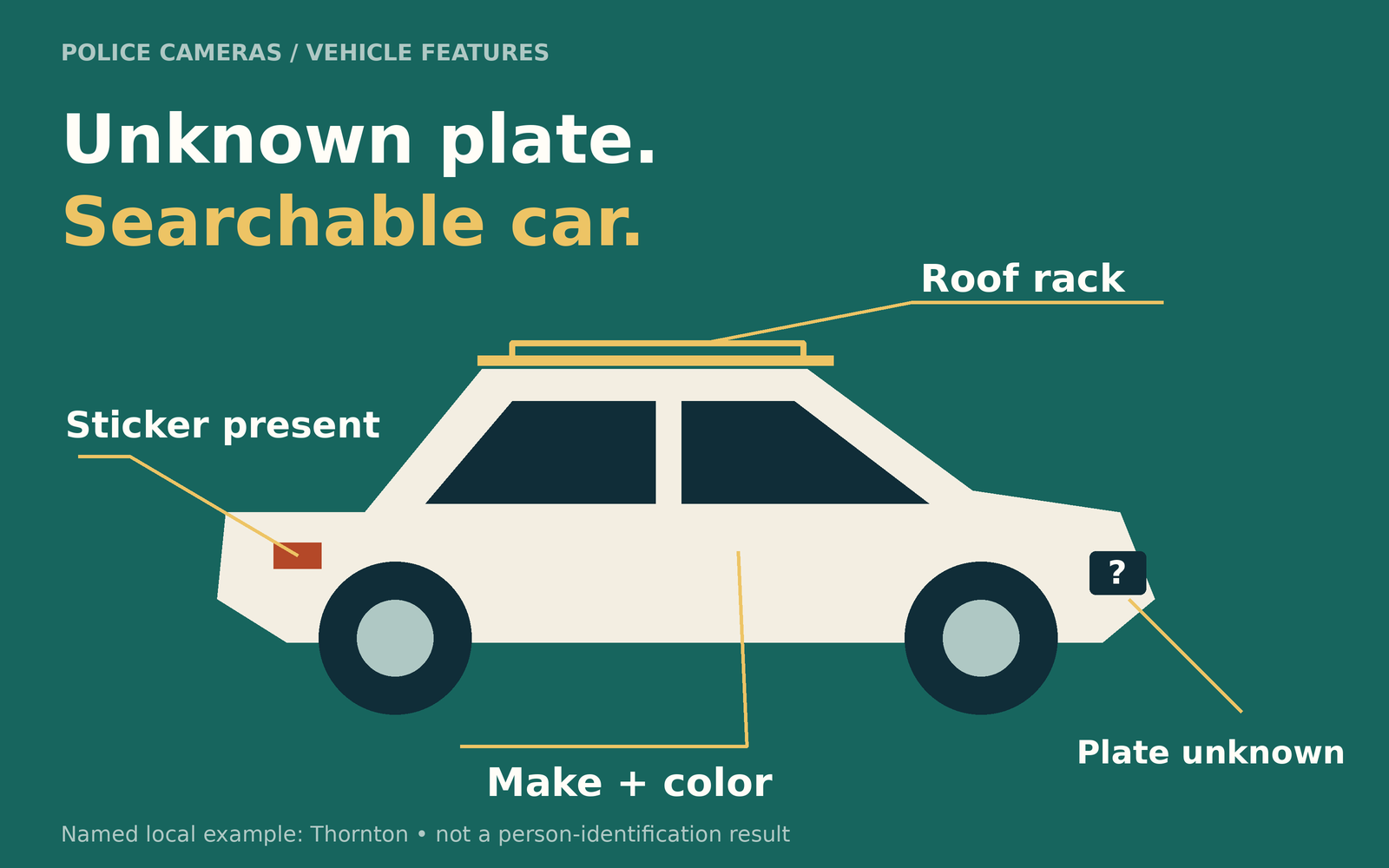
A witness remembers a dark vehicle and a roof rack. The plate is a blur. That can still be enough to begin a database search, because some police camera systems index more than the characters on the plate.
Officers can filter stored vehicle images by visible characteristics, then examine the resulting candidates. The important distinction is between finding a possible vehicle and identifying the person responsible for an incident. A search result does the first job; it cannot finish the second on its own.
Thornton, Colorado, provides the documented example throughout this article.
That changes what the phrase “license plate reader” conveys. It sounds like a machine that reads a registration number. The searchable record can contain a much richer description of a passing vehicle.
A description becomes a filter
Consider a hypothetical report of a vehicle leaving an incident. The witness supplies a broad appearance and a time and place, but no complete plate. An investigator can use the available descriptors to look for candidate images rather than immediately search for a known registration.
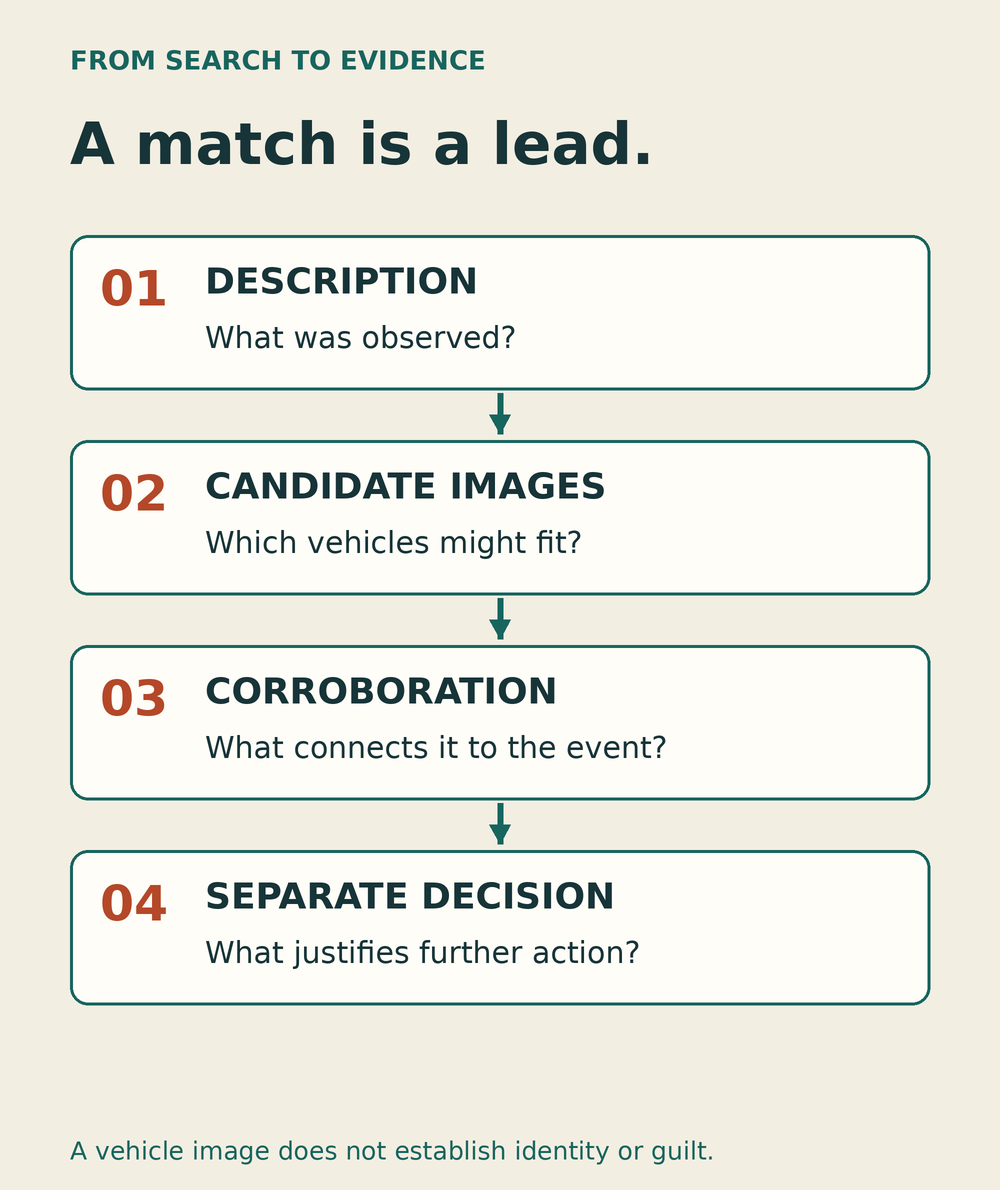
That is a different operation from asking a camera to recognize a person. It starts with vehicle observations. If the search returns plausible images, the investigator still needs to establish whether any one of those vehicles has a relevant connection to the incident.
Each extra descriptor can be useful, but it can also be mistaken. A rack that looked obvious to a witness may be hard to distinguish in an image. A remembered color may not be reliable. These are reasons to treat the result as a lead and preserve the path by which the investigator reached it.
There are two separate questions to ask about any impressive demonstration: what did the search include, and what evidence subsequently connected the candidate to the event? A persuasive answer to the first question does not substitute for the second.
A bumper sticker is not necessarily a searchable slogan
Thornton's FAQ allows searches for sticker presence, not sticker wording.
The distinction can disappear in a social-media retelling. “Searches cars with stickers” becomes “searches what drivers believe,” with the crucial technical step quietly supplied by the storyteller.
It is reasonable to ask how vehicle features expand surveillance. It is also necessary to identify which feature is actually searchable. Otherwise the discussion starts assessing a capability that the cited document does not support.
Finding the car still does not establish the driver
A vehicle image can place a vehicle at a camera location at a recorded time. It does not automatically establish who occupied it, why it was there or whether an occupant committed an offense.
The same separation applies to an automated alert. A match is a reason to verify information. The implications of taking action are a further question, governed by the circumstances and the applicable rules.
Thornton's written Policy 423, revised April 1, 2025, provides one dated example of those rules. It restricts use to legitimate law-enforcement business, requires training and says officers should, when practicable, verify an ALPR response through the Colorado Bureau of Investigation before enforcement based solely on an alert. The department's transparency page links its policy portal.
That policy snapshot is not a nationwide warrant rule. Its conditional verification language is also not a claim that every possible use requires the same step. The current portal did not provide a readable replacement during the follow-up check, so the older document should be understood as a dated record rather than a certified statement of every current requirement.
Two different meanings of 30 days
Small administrative details can change the meaning of a privacy claim.
The department's public FAQ describes automatic deletion after 30 days, with an exception for material retained as evidence in an ongoing investigation. The inspected 2025 policy has a different 30-day provision: a maximum interval between transferring ALPR data stored in department vehicles to the department server. It discusses server retention separately.
The first is a description of deletion. The second is a transfer interval. Treating the two as interchangeable would misread the documents. Their differing scope deserves clarification rather than an unsupported accusation that a retention promise has been broken.
More generally, asking “how long is the data kept?” works better when followed by “which data, in which system, under which exception?” A short headline retention period cannot describe every possible evidentiary record.
An audit promise is another thing to verify
Thornton describes weekly reviews and monthly record links. Automated flags cover Thornton searches; staff separately review outside agencies' use. Flags are not findings, and those process descriptions do not establish compliance.
These are statements about the department's process. They do not independently demonstrate that every search was proper. This article makes no finding from the contents of the linked audit PDFs, which were not available for a reproducible independent inspection.
For residents, the more revealing oversight questions concern actual access, search justifications, outside-agency use, investigation of unusual queries and exceptions to deletion. A policy can specify those safeguards; records and review are needed to assess how they operate.
The missing plate, then, does not necessarily stop the search. What should stop is the assumption that the resulting image has already answered every question about the people connected to that car.