A lunch can offer excellent protein value and still cost more than you planned to spend. That is the small trap inside a very tidy number: grams of protein per dollar tells you how efficiently an order buys protein, while the bill tells you whether you can buy that order today.
To compare complete orders, keep the actual cost, total protein and calories together, then apply your spending ceiling. Among the meals you can afford, compare grams of protein per dollar. The highest ratio is an answer to that particular question, rather than a search of every restaurant menu or a recommendation for your personal diet.
Compare the orders you can actually buy
Start with a receipt or current local menu and the matching nutrition information. Write down the country, exact product and portion, nutrition source and date checked. One sandwich, one stated serving or one specified package gives you something you can compare; an unlabelled “chicken” does not.
Use one currency throughout. Multiply each portion’s price, protein and calories by the quantity you will buy, then add the items together. Add tax, fees or tip that is not already included in the prices. A sauce or drink with nutrients belongs in the food totals; a delivery charge belongs only in the bill.
For each complete order, divide its total protein grams by its complete cost. Then check whether the bill fits your budget. You can do this on paper or with an ordinary calculator. The fictional examples below show the arithmetic; they are not prices or nutrition figures for the food pictured above or for a named restaurant.
A better ratio can require a bigger purchase
Imagine two complete orders in the same currency. Order A costs $12, contains 60 grams of protein and has 700 calories. Order B costs $8, contains 32 grams of protein and has 500 calories. These are hypothetical numbers, chosen to make the distinction visible.
For A, divide 60 by 12: 5 grams of protein per dollar. For B, divide 32 by 8: 4 grams per dollar. A has the higher ratio, more total protein and more calories. With a $10 spending ceiling, however, only B fits. Keep that $12 bill beside the ratio so the attractive number does not conceal the purchase required.
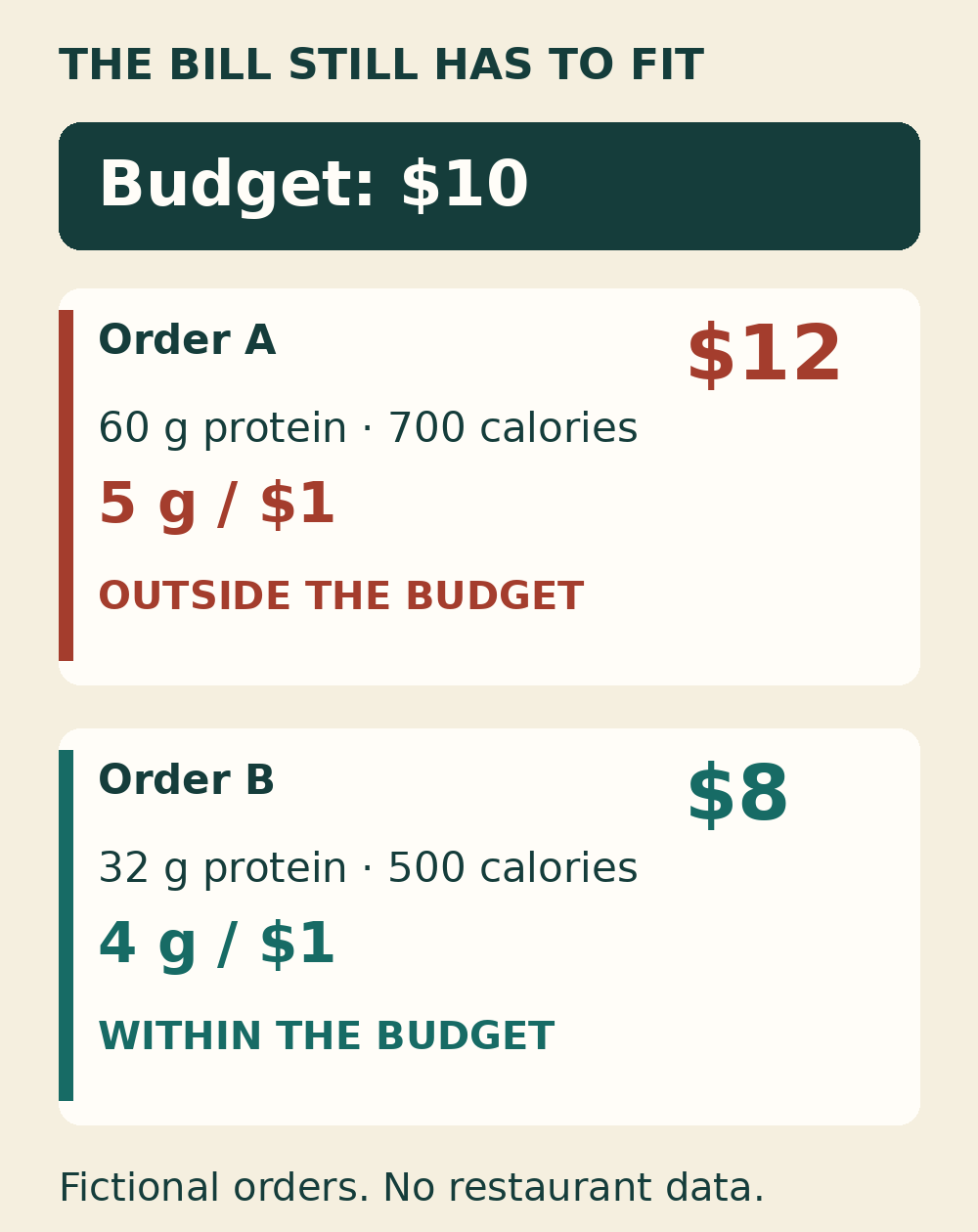
The hypothetical $12 order supplies 5 grams of protein per dollar; the $8 order supplies 4. Under a $10 budget, the higher-ratio order is unaffordable. Their calorie totals are 700 and 500 respectively; neither example is a dietary recommendation.
This is also why “cost per 25 grams of protein” needs a little care. It is a normalized comparison, not necessarily something on a menu. For these examples, the calculated cost per 25 grams is $5 for A and $6.25 for B. You still have to purchase their actual portions. The restaurant is unlikely to accept a request for exactly $5 worth of an indivisible sandwich.
Build the whole order before dividing
For each food row, multiply the quantity by its price, protein and calories. Add those amounts across the order. Add cost-only charges to the price total, then divide the order’s protein grams by its complete cost.
For example, two fictional $3.25 items containing 20 grams of protein and 300 calories each would total $6.50, 40 grams and 600 calories. Adding a $0.50 charge makes the bill $7. Protein per dollar becomes 40 divided by 7, or about 5.71. The charge changes the denominator; it does not create another serving of food.
The FDA’s label-reading guide explains that nutrient and calorie amounts relate to the stated serving. Eating two servings means accounting for two servings. The label’s serving size is also not an individualized recommendation of how much you should eat.
Keep that distinction intact when a nutrition page describes several pieces as one serving. If your source gives the total for a six-piece portion, count that portion once. Multiplying those figures by six would count six such portions. The arithmetic can be flawless while the portion entered is wrong.
Local price and matching nutrition belong together
Use the price you can actually obtain through the ordering channel you intend to use. A pickup price, delivery-platform listing and final delivered bill answer different questions. Keep tax and charges consistent between the alternatives; do not add them twice when a listed price already includes them.
Match the nutrition country and exact product, too. A familiar chain name does not establish that its recipes, sizes or customization rules are identical across countries. Chick-fil-A’s own nutrition page, for example, warns of variation in standard formulations, locations and customizations. Keep the source with your notes, and check that each figure belongs to the product and portion you actually intend to buy.
Our A&W Canada versus McDonald’s protein-per-dollar comparison shows how much these definitions matter in a specific local sample. Its dated prices should not become permanent national defaults. Use your current menu or receipt for today’s comparison instead.
Read a close result with proportionate confidence
Two orders can tie. When they do, keep both in the comparison rather than manufacturing a winner. A tiny ratio difference can also disappear when local prices change or when rounded nutrition figures conceal a small underlying difference. More decimal places do not make the original figures more precise.
A zero-dollar order has no ordinary finite grams-per-dollar ratio. Compare the actual offer and its conditions separately. Zero protein gives a ratio of zero when the price is positive; a normalized cost per 25 grams cannot be calculated from an order containing none. These cases should stay understandable, rather than producing an impressive-looking infinity.
Finally, the highest ratio is one possible objective. It is different from the most total protein, the lowest ticket price, fewer calories, preferred ingredients or overall nutritional suitability. Keep the totals visible, choose the objective you actually care about and compare the orders you would genuinely be willing to eat. A bargain that solves the wrong lunch problem is an unusually well-documented distraction.
Sources
FDA: understanding serving size and nutrition labels