
A blender can change more than an almond's texture. Breaking its structure into smooth butter can make more of the energy already inside it available to the body, even when no sugar, oil or other ingredient is added.
That is the intriguing result of a small controlled feeding study comparing different almond forms. For the same weight, whole roasted almonds delivered less measured usable energy than roasted almond butter. The explanation lies partly in the microscopic packaging around the fat. An ingredient list tells you what a food contains; it cannot fully describe how easily digestion can reach it.
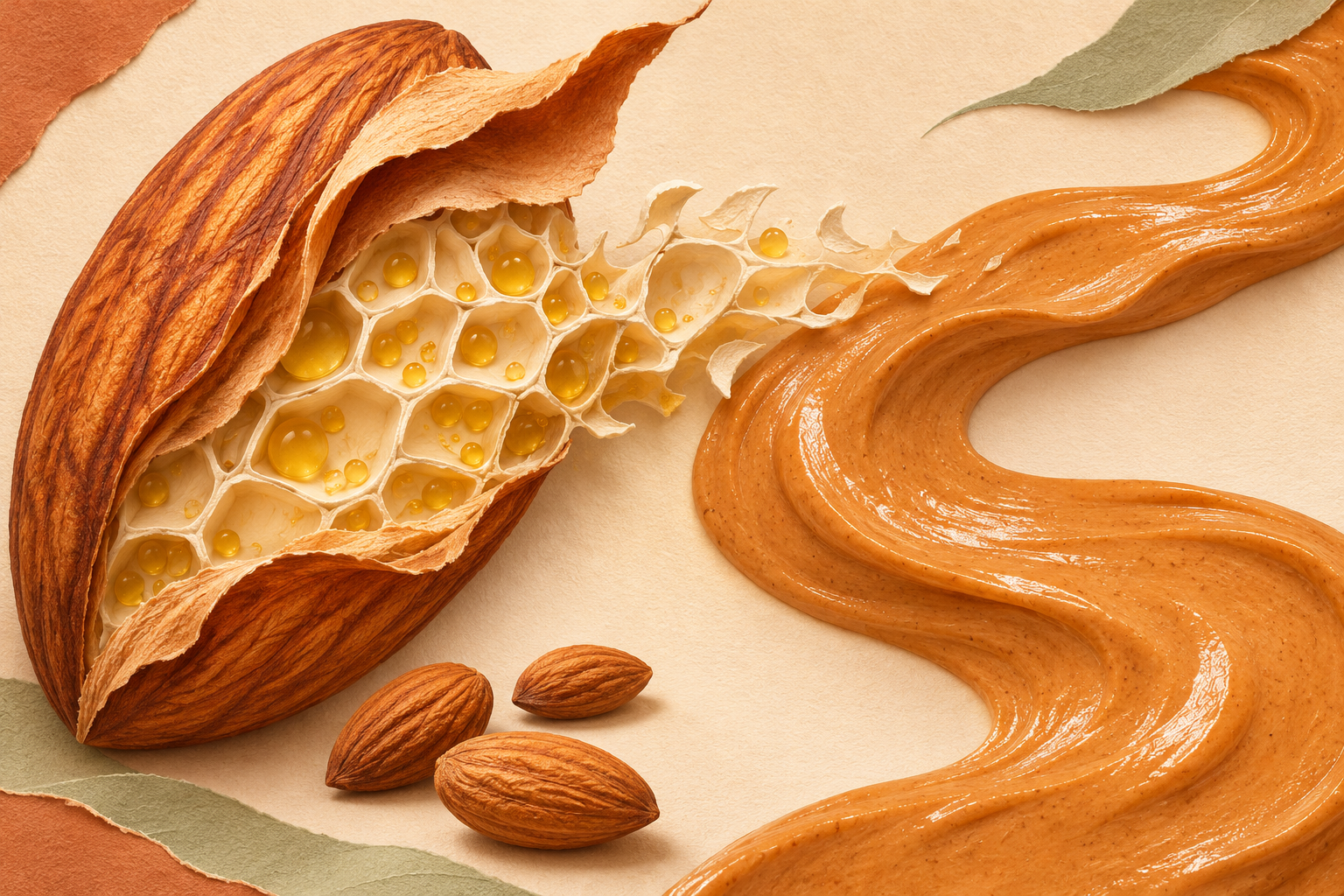
The comparison that makes the difference clear
In the 2016 trial by Sarah Gebauer and colleagues, 18 adults ate controlled diets during a randomized crossover experiment. Each participant went through five conditions: no almonds, whole natural almonds, whole dry-roasted almonds, chopped dry-roasted almonds and smooth roasted almond butter. The almond conditions supplied 42 grams a day.
All the almonds came from the same lot. The butter was made without additives. Those details matter because they remove two obvious explanations for a difference: different starting ingredients and something extra stirred into the jar.
The researchers calculated metabolizable energy, meaning dietary energy available after accounting for energy lost in feces and urine. They collected those outputs during controlled feeding periods rather than treating a nutrition-label calculation as the measured result.
That design asks a narrow question: when the food's form changes, how much energy remains available after those losses? It does not directly measure fat gain. The crossover design also means the same people tried the different conditions, rather than comparing almond eaters with an unrelated group of butter eaters. That makes the comparison more informative, while leaving the small number of participants as a real limit.
Whole roasted almonds averaged 4.86 kilocalories per gram, compared with 6.53 for roasted almond butter. A kilocalorie is the unit usually called a calorie in food discussions. Scaled to equal 28-gram portions, those means become about 136 and 183 calories, respectively. These are study-derived averages, not promises about what any particular person will absorb.
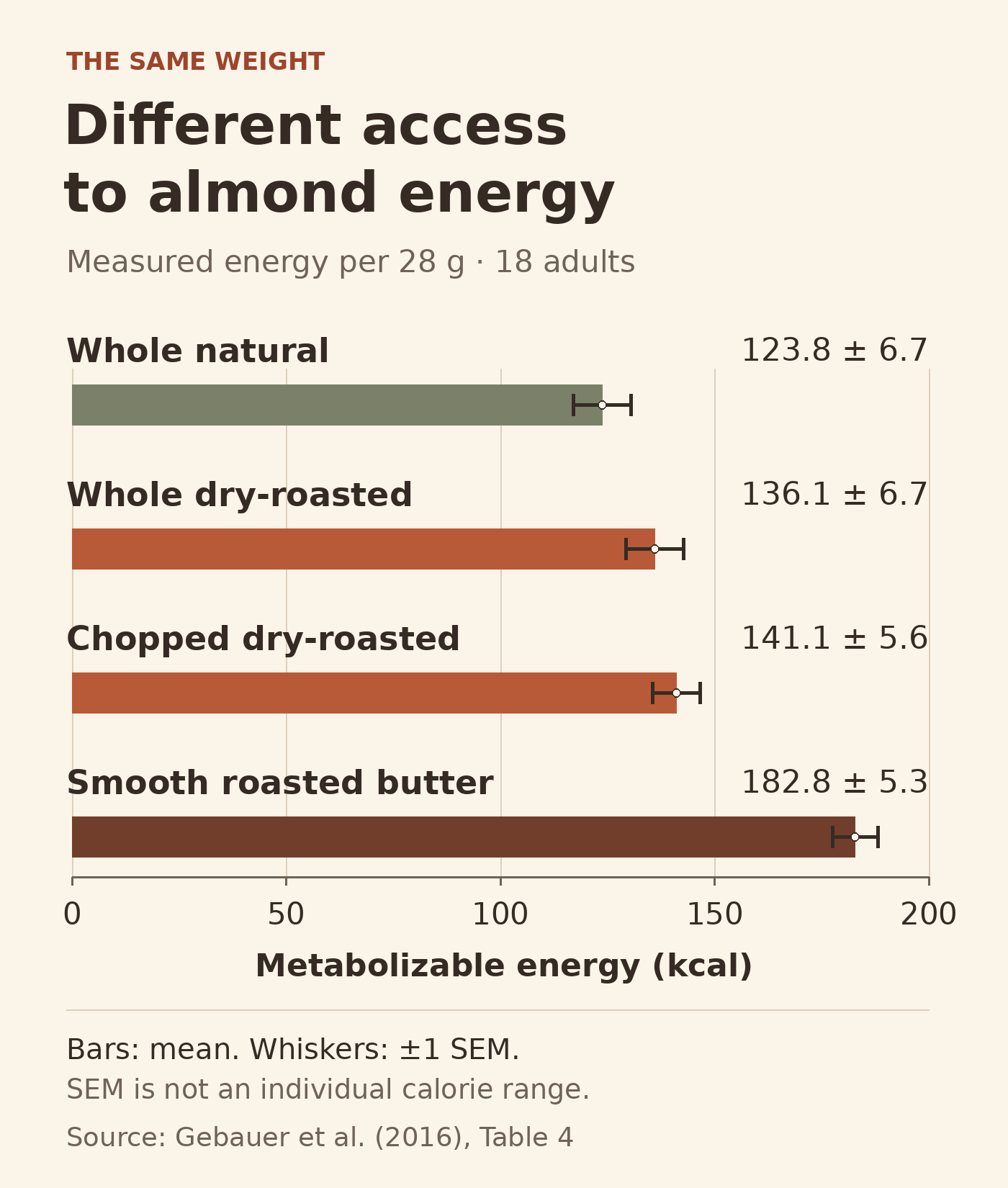
Equal-weight comparison calculated from Gebauer et al. (2016), Table 4. Bars show group means; whiskers show ±1 standard error of the mean (SEM). The study fed 42 grams daily; 28 grams is a comparison amount.
For 28 grams, the calculated means and SEMs are 123.8 ± 6.7 calories for natural whole almonds, 136.1 ± 6.7 for roasted whole, 141.1 ± 5.6 for roasted chopped and 182.8 ± 5.3 for roasted butter. SEM describes uncertainty around a group mean, not the spread of individual results. Whole roasted and chopped roasted almonds did not differ significantly, so their small numerical gap should not become a chopping rule.
An almond comes with its own packaging
An almond is a collection of plant cells, with much of its fat held inside cell walls. Digestion must reach that fat before it can make use of it.
Chewing breaks an almond into particles, but a particle can still contain many intact cells. Breaking the nut into visible pieces does not necessarily open every microscopic compartment inside those pieces. Think of breaking a building into blocks while leaving some of the rooms closed.
Research on almond cell walls has found lipid, or fat, retained within intact cells, including in material recovered after digestion. Those observations support the physical-barrier explanation. Some energy can remain out of reach rather than becoming fully available simply because the food has entered the digestive tract.
Grinding almonds into smooth butter disrupts that structure much more extensively. It exposes more of the existing fat to digestion. No new energy needs to appear for the body to gain access to more of what was there.
Roasting also changes almond structure. That is why roasted whole almonds versus roasted butter is the cleaner comparison for discussing grinding. Comparing natural whole almonds with roasted butter changes both roasting and physical form. It produces a larger numerical contrast, but a less tidy explanation.
Nor does every product described as “ground” behave like butter. A 2023 study of whole and ground almonds found only a modest difference in predicted fat accessibility after chewing. That experiment used a modeled early-digestion endpoint, not a full measurement of metabolizable energy. Flour, chopped nuts and smooth butter are different preparations, and their results cannot be swapped around.
What this means for calorie numbers
Calorie labels are estimates of usable energy, not simply readings of how much heat a food releases when burned. The traditional Atwater approach applies energy factors to nutrients. It offers a practical way to calculate food energy, but a food's physical structure can complicate the result.
In the 2016 experiment, measured energy for the whole-almond forms was lower than the Atwater predictions. Almond butter's measured energy did not differ significantly from those predictions. That supports a specific lesson about the tested foods; it does not establish that every retail almond label is wrong.
The distinction also helps explain conflicting percentages in stories about almonds. An earlier USDA whole-almond study reported that conventional estimates overestimated measured energy by about 32 percent. That is not the same as saying measured energy was 32 percent below the estimate.
If an estimate is 132 and the measured amount is 100, the estimate is 32 percent higher than the measurement. The measurement is about 24 percent lower than the estimate. The denominator changes with the question.
Whole almonds versus butter is a separate comparison again. Using the 2016 roasted-form means, 4.86 is about 26 percent below 6.53. That percentage describes this study's group averages. It is not a discount to subtract from every handful of almonds you eat.
A useful finding, with a small-study boundary
The direct butter comparison involved just 18 adults, one almond lot and particular preparations over short feeding periods. Food intake was controlled and adjusted to maintain weight. It was not a long-term test of whether people lose weight by replacing almond butter with whole almonds.
The study was supported by the USDA Agricultural Research Service and the Almond Board of California, which also supplied the almonds. The authors declared no conflicts of interest. Industry funding does not erase the measurements, but it belongs in the picture, alongside the sample size and the need for broader testing. The earlier whole-almond trial came from the same research group, so it should not be counted as an independent replication of the butter comparison.
In everyday eating, portion size and what a food replaces also matter. A spoonful of butter and a handful of nuts are not automatically equal weights. Brands may have different ingredients. More available energy is not, by itself, proof that a food is unhealthy.
There is no reason here to chew less thoroughly. Eat normally and safely rather than trying to preserve intact cells. Almond allergy still matters, and whole nuts and thick spoonfuls of nut butter can pose choking risks for young children.
The useful surprise is that nutrition has a physical dimension. Two foods can begin with the same almonds and still give digestion different access to their contents. The cell walls are part of the story, even though they never get their own line on the ingredient list.