Gabagool, Guilt, and Baked Ziti: What The Sopranos Gets Right About Food, Family, and Control
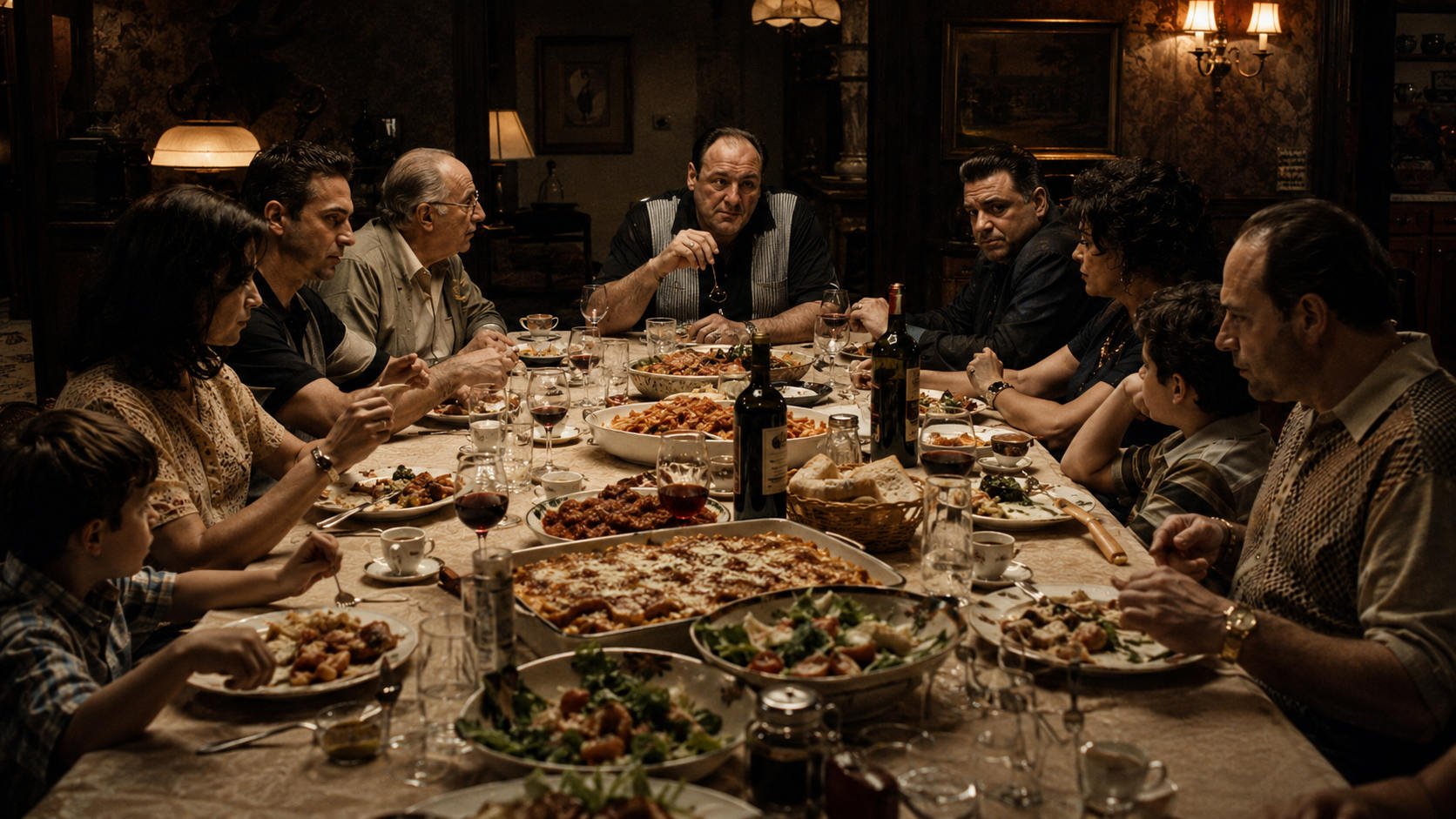
A plate of baked ziti on The Sopranos is never just baked ziti. It is affection, obligation, seduction, resentment, Catholic guilt, social currency, and enough ricotta to clog both an artery and a marriage.
That is the genius of the show’s food. It looks comforting because it is pasta, meat, pastries, red sauce, cold cuts, wine, and Sunday dinner. Lovely. Cozy. Grandma-adjacent. Then the show reminds you that the same table where people pass bread is also where they lie, threaten, judge, manipulate, perform loyalty, and quietly decide who still belongs. Very family-friendly, assuming your family communicates mainly through veal and emotional extortion.
The Sopranos understands something most food television and half the internet refuse to admit: family meals are not automatically healing. Sometimes the family table is a therapy session with worse lighting and better sausage. Sometimes feeding someone is love. Sometimes it is control wearing an apron.
Food Is the Show’s Real Second Language
On paper, The Sopranos is about Tony Soprano, a New Jersey mob boss dealing with anxiety, family strain, criminal power, and therapy. Max describes the series as being about a mob boss whose professional and private pressures land him in treatment, while The New Yorker summarized the pilot as Tony managing his “waste-management” cover, his crime family, panic attacks, Carmela, A.J., Meadow, Uncle Junior, and his nightmare mother, Livia. So, you know, a normal suburban dad show, except the dad is a criminal rhino in a bowling shirt.
But food is the code that makes the whole world legible. The cold cuts in the fridge, the barbecue, Vesuvio, Satriale’s Pork Store, the pastries, the Sunday spreads — they are not garnish. They are how the show says family, status, gender, appetite, inheritance, and threat without forcing someone to deliver a graduate seminar over manicotti.
La Cucina Italiana notes that meat is everywhere in the Sopranos diet, from prosciutto and “gabagool” to steaks and sausages grilled from Satriale’s, one of Tony’s legitimate business fronts and a frequent hangout. The New Yorker also singled out Tony’s interests in “vinegar peppers” and gabagool among the show’s comic catalogue of New Jersey commerce and appetite. This is a world where deli meat has more narrative responsibility than some prestige-TV side characters.
The Family Meal Is Supposed to Connect People. Naturally, These People Use It as a Weapon.
Family meals are powerful because they are never just about food. TIME’s reporting on family meals describes shared eating as a way people slow down, connect, talk, and create stability through ritual. A 2024 research paper on family meal technologies puts it even more bluntly: meals are a “central and messy” part of family life involving coordination, care, tension, and complicated dynamics.
That is basically The Sopranos with Parmesan.
The show gets the “messy” part right. The Soprano dinner table is not a soft-focus commercial where everyone learns gratitude over salad. It is where A.J. sulks, Meadow moralizes, Carmela manages, Tony explodes, relatives perform tradition, and everyone pretends the family is normal because there is food on the table. Food becomes camouflage. If there is a pot of sauce, perhaps nobody has to say, “Dad is a murderer and Mom is spiritually laundering the money through baked pasta.”
The brilliance is that the meal really does hold the family together. It just also traps them there. The table is glue, yes. But glue is also how you catch pests.
Carmela’s Cooking Is Love, Labor, and Leverage
Carmela Soprano’s food is one of the show’s sharpest tools. She cooks because she loves, because she is expected to, because it gives her power in a house where money comes from violence, and because domestic competence is one of the few socially approved weapons available to her. Congratulations, patriarchy, you turned baked ziti into a hostage negotiator.
The official HBO shop page for The Sopranos Family Cookbook leans into this perfectly, presenting Carmela’s baked ziti and her instinct to send over pastina and ricotta as “healing food.” The cookbook copy frames the food of the show as a family table full of recipes, memories, and character voices, which is adorable until you remember half these people should not legally be near knives.
Carmela’s famous food dynamic with Father Phil is the cleanest example of food as desire and control. Food Network’s roundup of iconic Sopranos food moments traces that relationship from Father Phil’s craving for Carmela’s baked ziti to Carmela later dumping pasta after seeing him enjoy Rosalie’s lasagna. That is not just a funny food scene. That is Carmela realizing her cooking, her attention, her little sacred domestic offering, was not unique. The priest was not in love with her soul. He was making the rounds like a holy raccoon near parish leftovers.
Carmela throwing out the pasta is not waste. It is a breakup scene. With penne. Which is somehow more honest than most HBO sex scenes.
Tony Eats Like a Man Trying to Own the Room
Tony’s appetite is one of his main forms of domination. He enters kitchens, opens refrigerators, grabs cold cuts, eats off other people’s plates, demands meals, chews while threatening people, and uses restaurants as territory. He does not simply consume food. He consumes space.
That is why the food around Tony is so often funny and gross at the same time. A sandwich in his hand becomes a prop of power. A fork becomes a gavel. A plate of pasta becomes a little red-sauce throne. He eats like the world is owed to him, which is exactly the problem, because the world around him has been organized to keep feeding that belief.
But The Sopranos is too smart to make appetite equal strength. Tony’s body betrays him. In the pilot, as The New Yorker recalls, Tony collapses after grilling sausages, and that collapse leads him into therapy. So the barbecue, that suburban ritual of manly control — meat, flame, backyard kingdom, someone’s dad acting like a pork chop requires military command — becomes the site of his panic. The grill does not obey. The body does not obey. The boss goes down next to the sausages. Beautiful. Humiliating. Correct.
This is what the show gets right: appetite can look like power while actually revealing need. Tony can control men, money, and fear. He cannot control his hunger, his rage, his mother wound, or the fact that his family dinner always has an undertone of doom wearing a napkin.
Satriale’s Is a Butcher Shop, a Clubhouse, and a Threat With Tile Floors
Satriale’s Pork Store is one of the show’s great food locations because it compresses everything into one place: meat, money, friendship, murder, business, gossip, and sandwiches. It is a “legitimate” front, naturally, because nothing says legitimate like a pork store full of men who treat conversation as foreplay for violence.
Satriale’s works because food retail gives criminal power a neighborly costume. A butcher shop is wholesome. It suggests tradition, craft, family, sausage. Then The Sopranos puts Tony’s crew inside it and reminds you that meat can be lunch or metaphor. Sometimes both. Sorry, prosciutto, you had one job.
The guys eat together constantly because eating together confirms membership. It is not enough to work together. You sit together. You break bread. You talk business with your mouth full. The sandwich becomes a loyalty badge, which is stupid and also how male institutions have functioned forever, just usually with worse bread.
Vesuvio Shows That Hospitality Can Become Extortion With Wine Service
Artie Bucco’s restaurant, Vesuvio, is another perfect Sopranos food machine. Restaurants are supposed to represent welcome, taste, generosity, community. In Tony’s orbit, they become staging grounds for obligation, favors, debt, humiliation, protection, and the constant question of who is using whom.
The HBO cookbook copy calls Nuovo Vesuvio the “family” restaurant redefined and positions Artie as the chef-host of the Sopranos food universe. That phrasing is funny because Artie’s restaurant is family-adjacent in the worst possible way: close enough to the mob to benefit from Tony’s presence, close enough to be endangered by it, never quite free of the gravitational pull of men who think “friendship” means “let me ruin your life but comp the meal.”
Food Network’s “Blackout” entry captures this tension beautifully: during the Season 1 finale, Tony, Carmela, the kids, and members of the crew end up at Nuovo Vesuvio during a storm, and Artie feeds them despite his history with Tony and the destruction of the first Vesuvio. Hospitality wins, but not cleanly. It is kindness with resentment simmering underneath, like a sauce that knows too much.
Artie is a chef. Tony is a mob boss. Both feed people. Only one of them pretends less.
Food Is How Women Get Power in a World Designed to Ignore Them
The show’s men use food as appetite, territory, status, and entitlement. The women use food as care, judgment, seduction, social currency, and moral accounting. That does not mean the women are “better.” It means the show understands gendered labor with the subtlety of a meat slicer.
Carmela cooks, hosts, sends food, and manages the domestic rituals that make Tony’s life look legitimate. Rosalie, Janice, Karen, and the other women are tied to casseroles, dinners, widowhood meals, church-adjacent food, and the social choreography of who brings what where. The men may run the “family,” but the women maintain the actual family theater, which is much harder because it involves fewer guns and more emotional cleanup.
This is where The Sopranos cuts deeper than a mob show needs to. Feeding people gives women power, but it also traps them inside service. Carmela’s food is praised, desired, and consumed, but the labor behind it is treated as natural. Of course there is dinner. Of course there is ziti. Of course there are leftovers. Of course the house runs. Of course everyone eats.
The show gets that “of course” is where resentment goes to ferment.
Livia Turns Food Into Refusal
Livia Soprano is what happens when maternal care curdles and gets a speaking role. If Carmela’s food often says, “I care, and you owe me,” Livia’s food dynamic says, “I refuse care, reject care, poison care, and somehow still make you responsible for my suffering.” A real ray of sunshine, if sunshine were damp and accused you of abandonment.
The New Yorker’s early review called Livia “mean, selfish, and manipulative,” and that is the polite version. Livia’s power is not abundance. It is withholding. She makes need itself a weapon. She turns every gesture toward her into evidence of someone else’s failure. Offer food, help, housing, care — she will twist it into an insult, because why enjoy soup when you can emotionally waterboard your son with it?
That is part of the show’s genius: food is not always warmth. Sometimes the absence of food, the rejection of food, or the refusal to be comforted is the control move. Livia does not need to cook a feast. She can starve the room of tenderness and still leave everyone full of guilt.
The Final Scene Makes the Diner Into a Trap
Of course The Sopranos ends in a restaurant. Where else could it end? A church would be too obvious. A therapy office would be too neat. A strip club would be too Tony. The diner is perfect because it is American, ordinary, family-friendly, and completely terrifying once the show has trained you to distrust every doorway.
The series finale places Tony, Carmela, and A.J. at Holsten’s Diner waiting for Meadow, while suspicious figures move through the room before the cut to black. People notes that the family is gathered for dinner when the screen abruptly cuts out, leaving viewers to debate Tony’s fate for years. That is the whole show in one booth: family meal, onion rings, jukebox, paranoia, possible death. Bon appétit, America.
The final meal matters because it strips the food down. It is not a huge Sunday spread. It is not Carmela’s ziti. It is not Vesuvio’s Italian comfort. It is diner food — democratic, casual, exposed. The family is together, but the togetherness does not protect them. Food cannot save Tony. The table cannot save him. Family cannot save him. The onion rings are innocent bystanders.
What The Sopranos Gets Right About Real Family Food
The show’s food feels true because real family food is also contradictory. It can be love and pressure. Care and control. Tradition and obligation. Comfort and performance. A family meal can be a safe place, a battlefield, or both before dessert.
TIME’s reporting emphasizes that the important part of family meals is not culinary perfection but shared time, connection, and ritual. The research on family meals also stresses the hidden labor, coordination, and emotional complexity involved in feeding families. The Sopranos simply adds murder, goomahs, panic attacks, Catholic guilt, and cured pork, because HBO was not making a pamphlet for pediatricians.
The useful lesson is not “eat like the Sopranos.” Please do not. This diet has the nutritional profile of a funeral home buffet run by a butcher. The lesson is to notice what food is doing in a family. Who cooks? Who gets served? Who gets praised? Who gets criticized? Who eats first? Who cleans up? Who uses food to apologize without apologizing? Who withholds it? Who expects it? Who treats the table like a throne?
Those questions reveal more than any recipe.
The Sauce Was Never Just Sauce
The Sopranos gets food, family, and control right because it refuses to make food simple. The baked ziti is never just baked ziti. The gabagool is never just gabagool. The restaurant is never just a restaurant. The Sunday dinner is never just a meal. Every plate carries power.
Food is how Carmela cares and bargains. It is how Tony dominates and soothes himself. It is how the crew performs loyalty. It is how Artie tries to maintain dignity while feeding predators. It is how Livia withholds love without lifting a finger. It is how the family pretends to be whole while everyone at the table knows something is rotten under the Parmesan.
That is why the food scenes still stick. Not because the pasta looks good, though it absolutely does, the smug little carb opera. They stick because the show understands that food is one of the oldest ways families lie to themselves.
Sit down. Eat. Smile. Pass the bread.
Don’t mention the bodies.