Why The Simpsons Made Duff Beer and Donuts Feel Like Cultural Symbols
The Simpsons did not invent beer. It did not invent donuts. Humanity was already perfectly capable of turning yeast, sugar, fried dough, and poor impulse control into a lifestyle long before Homer Simpson waddled into the national bloodstream like a yellow bowling ball with a mortgage.
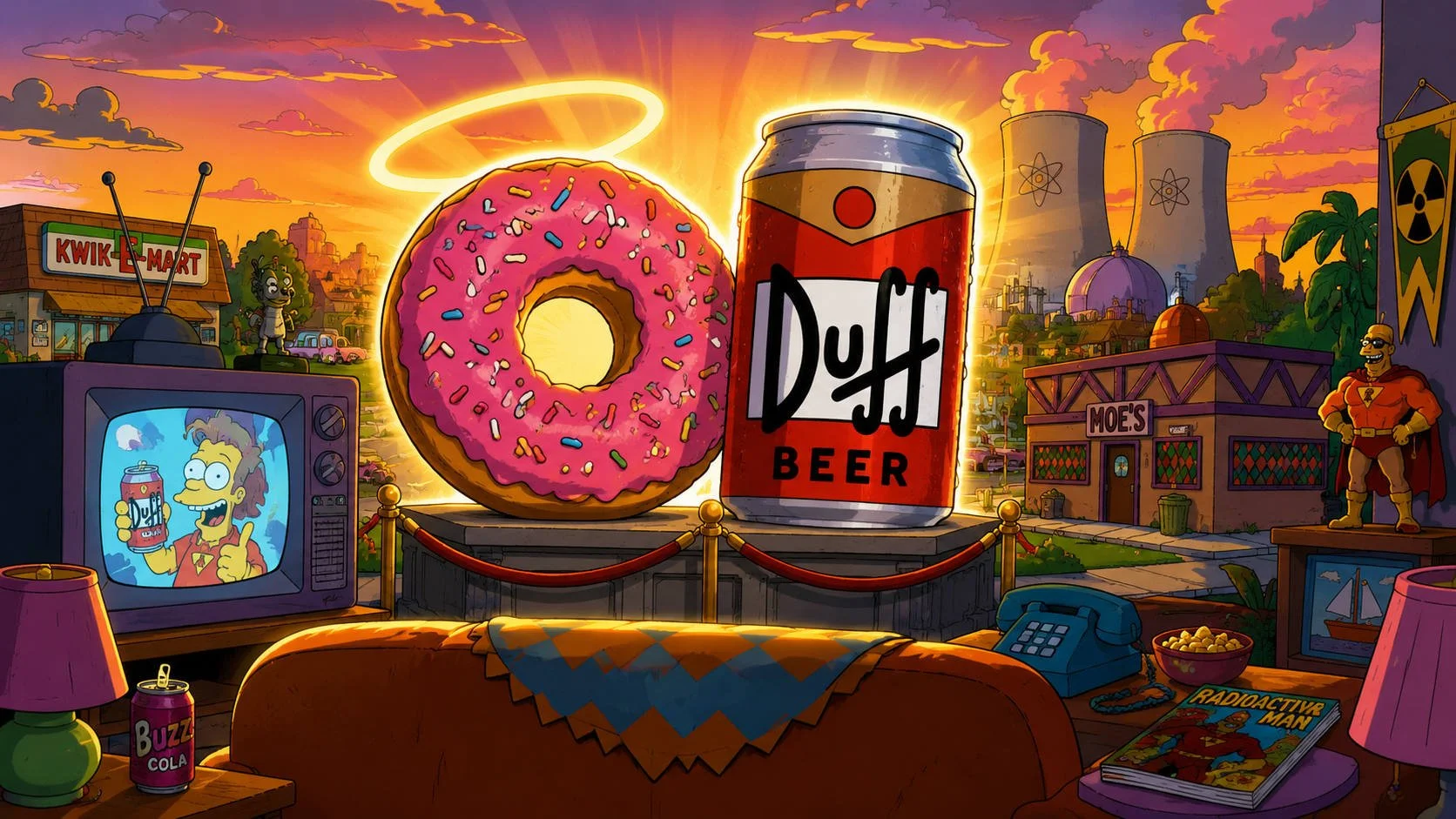
But The Simpsons did something much more dangerous. It took Duff Beer and pink frosted donuts—two ordinary items from the strip-mall altar of American consumption—and turned them into cultural symbols. Not just props. Not just jokes. Symbols. Visual shorthand. Snack hieroglyphics. The kind of objects you can slap on a T-shirt and every mildly conscious person understands the assignment.
Duff Beer means Homer. Donuts mean Homer. Homer means appetite, laziness, pleasure, failure, comfort, working-class exhaustion, dad-brain, and the eternal human desire to solve problems by sitting down with something unhealthy and calling it a personality.
That is not branding. That is cultural possession.
The Simpsons Had the Reach to Make Dumb Objects Immortal
The first reason Duff Beer and donuts became cultural symbols is painfully simple: The Simpsons was everywhere for a very long time. You do not become a symbol by showing up twice and hoping the internet builds you a shrine out of reaction GIFs. You become a symbol by appearing again and again and again until the audience’s brain gives up and files you under “permanent furniture.”
The Simpsons debuted as a half-hour show in 1989 and became the longest-running animated TV show, sitcom, and scripted prime-time television series in U.S. history. Britannica also calls it an iconic cultural touchstone for generations of viewers, which is academic language for “this cartoon has been living in the walls of pop culture like a raccoon with syndication money.”
That kind of repetition matters. If Homer had loved craft kombucha and artisanal figs for three episodes on a forgotten cable cartoon called Dadzone, nobody would care. But Homer loved beer and donuts on one of the most influential TV shows ever made. The objects got baptized in airtime.
And airtime, as every advertiser knows and every normal person fears, is how nonsense becomes memory.
Homer Simpson Turned Beer and Donuts Into Character X-Rays
Duff Beer and donuts work because they are not random. They reveal Homer instantly.
Homer is not merely “a guy who eats donuts.” He is a man whose entire emotional operating system seems to be powered by frosting, beer foam, and the belief that tomorrow’s problems are for Future Homer, a man he openly despises. Britannica describes Homer as a nuclear plant operator and a devotee of beer, doughnuts, and bacon, while noting that the Simpson family embodies consumption, envy, laziness, opportunity, stubbornness, and redemption—basically the American character report card, but with more yelling at clouds.
That is why the objects stick. Duff Beer and donuts are not decorative. They are Homer’s biography in snack form.
A donut says: I want comfort immediately, preferably circular.
A Duff says: I have completed my responsibilities to the absolute minimum legal standard and now wish to dissolve into a couch.
Together, they form the sacred Homer triangle: job, couch, snack. It is not admirable. It is familiar. Which is worse.
Duff Beer Is Fake Branding So Good It Became Real Branding
Duff Beer is one of the most successful fake brands in television because it looks like it has always existed. It feels less invented than discovered, like the writers found it behind a bowling alley under a pile of damp promotional koozies.
The name itself is stupidly perfect. Short. Blunt. Heavy. “Duff” sounds like a beer that would sponsor a demolition derby and then deny responsibility when the blimp catches fire. According to Time, longtime Simpsons writer and former showrunner Mike Reiss said producer Jay Kogen came up with the name “Duff” for Homer’s favorite beer, rejecting the later myth that it was named after Guns N’ Roses bassist Duff McKagan.
That origin story matters because Duff was not designed as a sleek fantasy product. It was designed as a joke about mass-market beer branding. Duff is every beer ad that ever shouted masculinity at a confused man holding a cooler. It is every corporate lager that pretends opening a can will transform your life into a beach volleyball commercial where everyone has abs and nobody has child support.
The brilliance is that Duff became what it mocked. It started as satire and became merchandise. Which is either genius or capitalism eating its own tail with a souvenir cup.
Duff Beer Made Consumer Satire Look Effortless
Duff Beer is not just Homer’s drink. It is Springfield’s beer-industrial complex. It has ads. Mascots. Variants. Corporate nonsense. Promotional events. A brand universe. The show made Duff feel real by giving it the full vocabulary of real-world consumer garbage.
That is how fictional brands become believable. They need clutter. They need slogans, mascots, side products, shady corporate decisions, and the vague implication that some executive in a windowless room signed off on this disaster.
A 2024 academic article on Duff Beer and reverse product placement argues that fictional Duff gained visibility and narrative relevance inside The Simpsons, becoming a central part of the show’s universe and creating cultural and emotional associations with viewers. Translation: the fake beer did not just sit in Homer’s hand. It became part of the story machinery. It became emotional furniture.
And because The Simpsons is satire, Duff Beer could mock beer marketing while also benefiting from the exact same mechanics. The show made fun of brand loyalty, then created brand loyalty for a brand that did not exist. A perfect little capitalism pretzel. Very elegant. Very cursed.
The Simpsons Donut Is Visual Branding for People With Eyes
Duff Beer is verbal and conceptual. The donut is visual warfare.
The Simpsons donut—pink frosting, rainbow sprinkles, cartoon simplicity—is so recognizable it barely needs Homer. It is not just a donut. It is the donut. A round pink emergency siren for appetite. A sugar life raft. A halo for people who gave up spiritually but still believe in dessert.
Its power is design. The pink frosting pops against the show’s yellow characters. The sprinkles make it childish and ridiculous. The shape is instantly readable from across a room, across a screen, or across the burned-out wasteland of a Monday morning.
There are many donuts in the world. Glazed donuts. Jelly donuts. Maple bars. Fancy donuts with bacon on them, because apparently brunch needed a midlife crisis. But the Simpsons donut is the one that became symbolic because it looks like an icon before you even think about it.
Universal’s own Springfield food guide describes Lard Lad Donuts as selling “The Big Pink,” a giant donut with frosting and rainbow sprinkles, explicitly connecting it to the pink glazed donut Homer is always eating. That is the whole thing right there: a cartoon snack became a theme-park pilgrimage object. People now line up to buy a massive real-world version of a fake-world donut associated with a fictional man who should not be anyone’s wellness model.
Civilization is doing great.
Lard Lad Made the Donut Feel Like a Civic Monument
The donut became bigger than Homer because Springfield itself worships junk food. The show did not merely show Homer eating donuts. It built a world where donuts had institutions.
Lard Lad Donuts is not just a shop. It is a shrine with a giant mascot holding a giant donut like some hideous suburban Statue of Liberty. Instead of “Give me your tired, your poor,” it says, “Give me your cops, your dads, your children with access to frosting.”
That world-building matters. Cultural symbols need settings. The donut feels important because Springfield treats it as part of daily life. Police eat them. Workers eat them. Homer lusts after them. The show repeats the image until the donut stops being food and becomes a mood.
A regular donut is breakfast. A Simpsons donut is resignation with sprinkles.
Repetition Turned Duff and Donuts Into Ritual Objects
The real magic is repetition. Homer does not love Duff once. He does not eat one donut as a quirky character note, then move on to salads and personal growth. Thank God. Nobody wants a season arc where Homer discovers chia pudding and mindfulness.
Instead, the show returns to these objects constantly. Duff at Moe’s. Donuts at work. Donuts in fantasies. Duff in ads. Duff in cans. Duff in jokes. Donuts in Homer’s hands. Donuts in his dreams. Donuts as temptation, reward, escape, comfort, and evidence that the human animal is only about three bad decisions away from licking frosting off its own shirt.
Repetition makes objects symbolic because audiences begin to anticipate them. A Duff can appears and you know what emotional weather system is arriving. A donut appears and your brain immediately plays the Homer file. It is Pavlov, but instead of a bell, it is a cartoon dad drooling at fried dough.
The Simpsons Made Everyday Consumption Feel Mythic
This is what The Simpsons did better than almost any sitcom: it turned ordinary American nonsense into mythology.
Springfield is not realistic. It is too elastic, too absurd, too packed with idiots who somehow remain employed. But it feels emotionally accurate. The nuclear plant, the bar, the school, the Kwik-E-Mart, the living room couch—these are not just locations. They are tiny stages for American habits.
That is where Duff Beer and donuts thrive. They are low-status pleasures. Cheap pleasures. Worker pleasures. Dad pleasures. “I survived the day” pleasures. The show understood that most people are not navigating life through grand dramatic gestures. They are getting through it with snacks, beverages, grudges, and maybe one chair they sit in too much.
The Encyclopedia of Television notes that The Simpsons helped define the satirical edge of prime-time television in the early 1990s and was hugely important in establishing Fox as a legitimate broadcast network. That satirical edge is why the food symbols worked. The show was not simply saying, “Beer and donuts are funny.” It was saying, “Look at this entire society of consumption gremlins, and please notice you are one of them.”
Rude. Accurate. Deeply unnecessary. Very funny.
Moe’s Tavern Made Duff Beer Emotional, Not Just Alcoholic
Duff Beer works partly because it lives in Moe’s Tavern, one of the saddest recurring rooms in television. Moe’s is not glamorous. It is not a cool bar. It is a fluorescent cave where lonely men go to be lightly insulted by a bartender who looks like he was assembled from old shoe leather and tax resentment.
That sadness gives Duff weight. It is not just party beer. It is after-work beer. Failure beer. Friendship beer. Avoid-your-family-for-one-more-hour beer. It turns the can into a symbol of escape.
And because Homer is both ridiculous and weirdly sympathetic, Duff becomes more than a joke about drinking. It becomes part of his routine. His weakness. His reward. His social life. His tiny rebellion against adulthood, which is otherwise just bills wearing different hats.
Universal’s Springfield guide now lets visitors drink Duff at Moe’s Tavern and the Duff Brewery Beer Garden, which is a surreal achievement for a fictional beer invented to mock mass-market beer branding. Somewhere, satire is lying on the floor, exhausted but technically profitable.
Real-World Duff Proved the Symbol Had Escaped the Cartoon
A fictional product becoming real is always a little embarrassing for everyone involved. It is like watching a joke put on a blazer and ask for shelf space.
But Duff Beer did exactly that. Time reported in 2015 that 21st Century Fox planned to roll out a real-life version of Duff Beer in Chile, partly because unauthorized versions had spread and Fox wanted more control over the brand.
That is the symbol crossing the border from fiction into commerce. Duff became so culturally recognizable that bootleggers wanted it, fans wanted it, theme parks sold it, and the rights holder eventually had to treat it like a real brand instead of a cartoon gag.
This is the absurd triumph of The Simpsons: it mocked commercial culture so effectively that commercial culture stood up, saluted, and said, “Great, can we monetize that?”
The 7-Eleven Kwik-E-Mart Promotion Turned Simpsons Food Into Retail Reality
The 2007 Simpsons Movie promotion with 7-Eleven is one of the best examples of The Simpsons food universe escaping containment.
ABC News reported that 7-Eleven transformed 12 stores into Kwik-E-Marts for the movie promotion, selling real versions of fictional products like KrustyO’s cereal, Buzz Cola, pink doughnuts, and Squishees. Duff Beer did not make it to shelves, because apparently even promotional chaos has a lawyer with a clipboard.
The numbers are deranged in the best possible way. ABC reported that customer counts and sales roughly doubled at the transformed stores, more than 880,400 pink “Sprinklicious” doughnuts sold nationally in three weeks, and more than 3.4 million units of Simpsons merchandise were sold during the promotion.
That is not nostalgia. That is a feeding event.
People did not just recognize the symbols. They wanted to touch them, buy them, eat them, and briefly live inside the cartoon. That is how you know a prop has become culture: when the audience drives across state lines for a donut associated with a fictional slob.
Why Duff Beer and Donuts Beat “Better” Symbols
The funny thing is that The Simpsons has more intellectually respectable symbols available. The nuclear plant could represent corporate greed. Lisa’s saxophone could represent idealism. Bart’s skateboard could represent rebellion. Mr. Burns could represent capitalism as a skeleton in a suit.
But Duff and donuts are stronger because they are simpler.
No one has to decode them. No one needs a graduate seminar called “Frosted Semiotics and the Postmodern Working-Class Patriarch.” God spare us. You see Duff and donuts, and you instantly understand Homer’s universe: appetite, comfort, repetition, stupidity, joy, and collapse.
The symbols are democratic. Everyone understands wanting something bad for them. Everyone understands small pleasures. Everyone understands the moment when life has become annoying enough that a donut starts looking like a spiritual advisor.
That is why they work. They are not aspirational. They are anti-aspirational. They do not say, “Be your best self.” They say, “Your best self left early. Have a beer.”
The Simpsons Made Gluttony Lovable Without Making It Noble
A weaker show would have turned Homer’s love of Duff and donuts into either moral panic or empty celebration. The Simpsons does neither. It mocks him constantly. It shows the consequences. It makes his appetites embarrassing, funny, pathetic, and human.
That balance is crucial. Homer is not cool because he drinks Duff and eats donuts. He is funny because he is completely enslaved by them while pretending he is in control. This is different from modern “relatable” branding, where every company tries to sound like your depressed roommate on Twitter.
The show gives us permission to laugh at appetite without pretending appetite is wisdom. Homer’s cravings are dumb. They are also understandable. That tension makes the symbols durable.
A donut is not just delicious. It is weakness in a cute outfit.
Duff is not just beer. It is avoidance with carbonation.
What Brands and Writers Can Learn From Duff Beer and Simpsons Donuts
Here is the useful part, because apparently even sarcasm has to pay rent.
First, symbols need repetition. You cannot make one joke once and expect it to become culture. Duff and donuts became iconic because the show kept using them until they became part of Homer’s visual DNA.
Second, symbols need emotional clarity. Duff means escape and routine. Donuts mean comfort and temptation. If your fictional product means “synergistic lifestyle activation,” please throw it into the sea.
Third, design matters. A red beer can with a bold name and a giant pink donut with sprinkles are easy to remember. If your symbol requires six explanatory paragraphs and a brand mood board, congratulations, you have invented homework.
Fourth, make the object part of the world. Duff had ads, mascots, bars, breweries, and fake corporate life. The donut had Lard Lad, work scenes, police jokes, fantasies, and rituals. A symbol gets stronger when the world around it treats it as normal.
Fifth, satire can create affection. The Simpsons mocked beer and donuts, but it did not drain them of pleasure. It understood the stupidity and the charm. That is why people still want the donut. Not because it is healthy. Because it is emotionally accurate garbage. Beautiful garbage. Garbage with frosting.
Final Verdict: Duff Beer and Donuts Became Cultural Symbols Because The Simpsons Understood Us Too Well
Duff Beer and donuts became cultural symbols because The Simpsons made them more than props. It attached them to Homer’s personality, repeated them for decades, built institutions around them, made them visually unforgettable, and used them to satirize consumer culture without being a joyless lecture from a man wearing linen.
They are symbols of appetite. Comfort. Routine. Working-class exhaustion. Corporate branding. American excess. The tiny treats people use to survive lives they did not fully read the terms and conditions for.
Duff Beer is fake beer that became real enough to sell.
The pink donut is a cartoon snack that became a theme-park object, a merchandise icon, and a shorthand for Homer Simpson’s entire tragic snack-based theology.
Together, they prove that The Simpsons did not merely parody culture. It manufactured culture while making fun of the factory.
Which is annoying. And brilliant. And exactly the kind of thing that would happen in a country where a fictional beer and a giant pink donut can become more recognizable than most elected officials.
D’oh, indeed.