
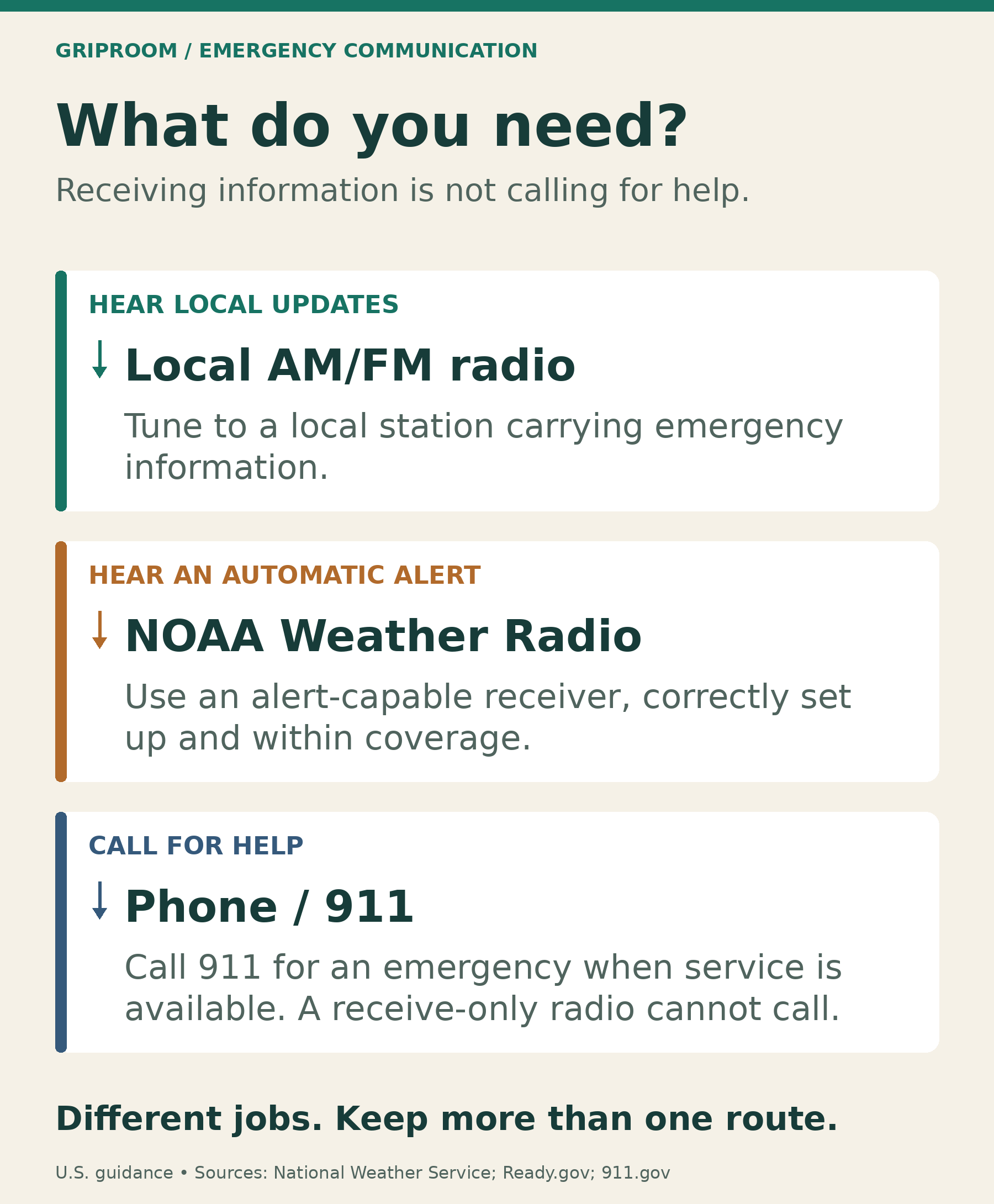
An emergency kit includes a radio because a fully charged phone can lose its connection. If your local station is still transmitting, a battery-powered radio can pick up its broadcast without cell service, home internet, or a working outlet. And in the U.S., a properly set up NOAA Weather Radio with a tone alarm can wake you for certain warnings. Those are two different jobs: AM/FM tells you what’s happening after you tune in. A weather-alert radio can tell you when to pay attention. Neither replaces a phone for calling 911 or checking on family. That’s why FEMA’s emergency kit checklist calls for both a radio and a way to keep a phone charged.
What radio did, and didn’t do, in two real outages
Hurricane Helene: The stream and the broadcast came back at different times
At 9 a.m. on September 30, 2024, three days after Helene brought flooding to western North Carolina, the Federal Communications Commission counted 235 of 348 reported cell sites out of service in Buncombe County, home to Asheville. The report listed 125 sites out because of power and 104 because of problems with the links connecting the sites to the wider network. You didn’t need a tower to fall over to lose service. And the figure describes sites in one county at one point in time, not the percentage of residents whose phones stopped working. Coverage can overlap, and service can vary by location and carrier.
In the aftermath, Blue Ridge Public Radio documented residents listening on a hand-crank radio. North Carolina’s Department of Public Safety listed stations for post-storm updates, including Asheville’s 570 AM and 99.9 FM. If your town has shut off the water or opened a supply site, it matters whether there’s a station still on the air that actually covers your town. A clear signal from a station in another market may tell you less than a scratchy signal from the one carrying your county’s briefing.
Helene also makes the best argument against counting on radio alone. On September 27, BPR’s own service log noted a power outage affecting all its broadcast channels. At 5:06 p.m., the station reported that its internet livestream was back but some over-the-air distribution was still affected. At 7 p.m., it announced it was signing off to conserve generator power. At 7:37 p.m., it reported that power was restored and broadcasts were resuming. The FCC’s September 30 report also listed two North Carolina AM stations and two FM stations out of service.
Spain’s blackout: Most people surveyed listened to the radio, but many didn’t tune in right away
During the April 28, 2025 Iberian blackout, RTVE reported that an 83-year-old woman near Valencia heard on her battery radio that hospitals were running on backup generators. Spain’s government attributed telecom interruptions mainly to loss of power at antennas.
Radio Nacional de España presenters described working on diesel backup, without internet in the studio. They told listeners that children could stay safely at school until parents picked them up and relayed information about getting stranded train passengers out. The station could broadcast without an internet connection at the listener’s end. Gathering the news was harder: the studio relied in part on reporters who could still find a phone signal or Wi-Fi.
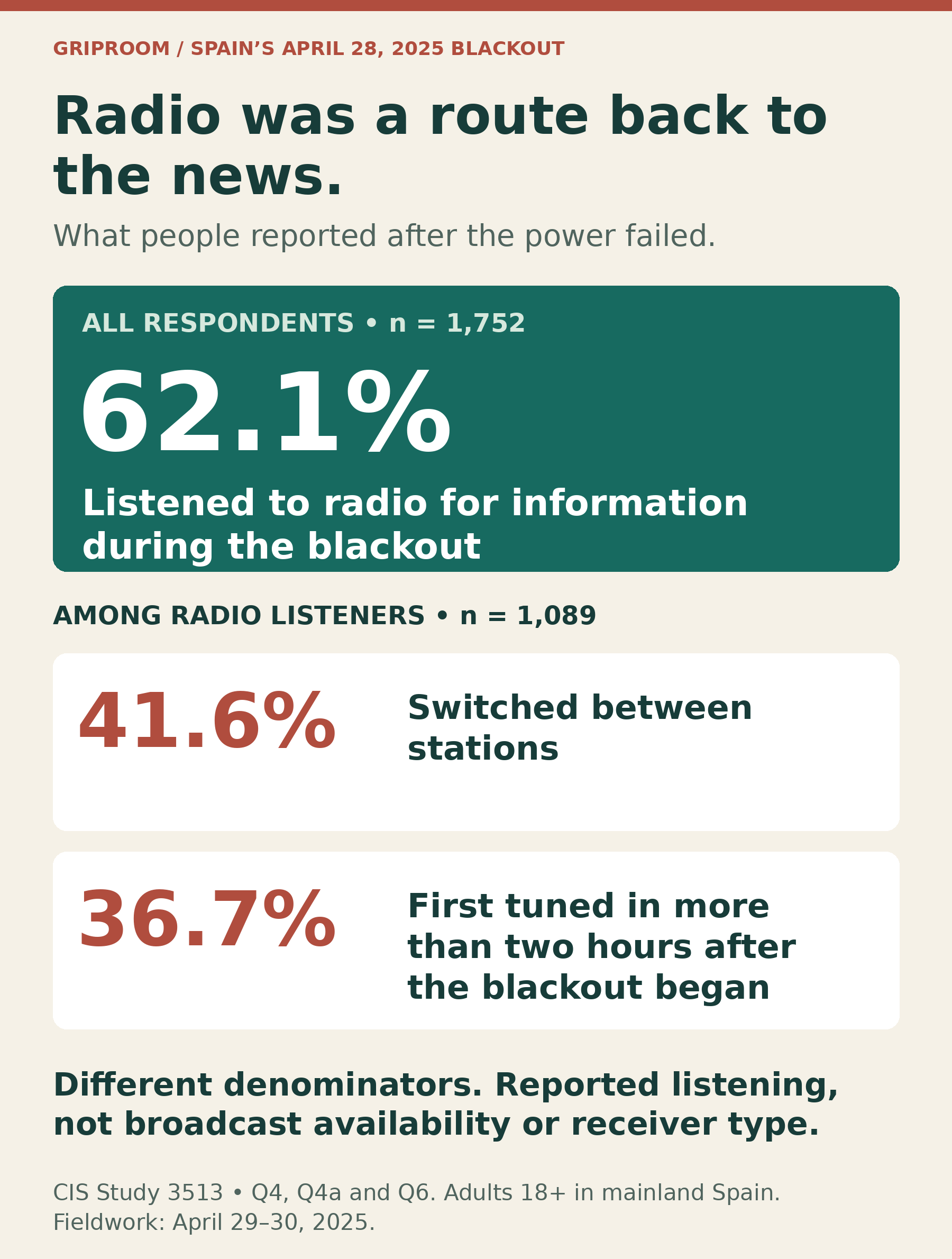
In a survey of 1,752 mainland Spanish adults, conducted April 29–30, 62.1% reported listening to radio for information during the blackout. Among the 1,089 who said they listened, 41.6% switched stations, and 36.7% said more than two hours passed before they first tuned in. These were post-outage telephone interviews, not measurements of transmitter uptime or of how many people used a battery set. The answers don’t tell us why people switched or waited. They do show why the radio is worth knowing how to find and tune before you need news.
There’s another reason to check those saved frequencies now and then. The same Spanish broadcaster shut down its medium-wave AM service in December 2025, while its FM service continued. A station that helped during the last blackout may still be broadcasting, just not where you remember finding it.
A blackout, a bad data connection, and no cell signal aren’t the same problem
If just your home loses power, use your phone. Your Wi-Fi may disappear when your router loses power, but mobile data and calls may still work. An already-charged power bank solves a real problem here. You don’t have to put the phone away because the lights went out.
If apps won’t load, don’t assume your phone has lost every way of reaching you. U.S. Wireless Emergency Alerts, or WEAs, are sent to compatible phones using participating wireless networks. They don’t require a weather app, an account, or a working mobile data session. They use a different delivery method from an app notification, and a small emergency alert coming through doesn’t mean a website will load. If the phone can’t get a usable signal from a network carrying the alert, though, there’s no ordinary terrestrial WEA delivery path to that handset. FEMA’s explainer and the FCC’s WEA technical description explain the difference. If someone next to you gets an alert that you didn’t, see why two phones may receive different tornado warnings.
If there’s no usable cell service, check a broadcast. A regular battery-powered receiver doesn’t log in, request an audio stream, or ask a tower to connect it. The station sends the same signal whether one household or a thousand households are listening. It does still need a working transmitter and a signal strong enough to reach your room. A station can also be on the air without having any useful local news. The FCC’s description of the Emergency Alert System shows that stations can get messages via broadcast relays or online delivery. You don’t need internet at your end, but that doesn’t mean the whole chain behind what you hear is internet-free.
Your situation can change during the same outage. A phone might get enough service to send a text while loading a map is still frustrating. A local station might be off the air in the morning and back in the afternoon. North Carolina’s emergency guidance suggests trying texts for routine check-ins when calls aren’t going through. That’s a fallback when some service is available, not a way to send messages through a complete outage.
AM/FM and NOAA Weather Radio aren’t the same thing
AM/FM: Find out what’s happening locally
When you need to know what’s closed, where officials are sending people, or when they’ll hold the next briefing, tune to a local AM or FM station that carries news from your area. A regular receiver can also play formal Emergency Alert System messages if the station airs them while you’re listening. That doesn’t turn a switched-off radio into an alarm. And a presenter reporting which roads are open is doing something different from relaying a formal alert. Both are useful. The FCC describes how the Emergency Alert System reaches stations and their audiences.
Save two local frequencies with different programming or transmitters if you can. During Helene, several stations carried one live broadcast together, according to the company that aired it. That can extend the reach of useful reporting, but two numbers on the dial don’t necessarily give you two newsrooms or two different sources of information.
NOAA Weather Radio: Get certain warnings without listening all day
In the U.S., NOAA Weather Radio All Hazards carries National Weather Service forecasts, watches, warnings, and some non-weather emergency information. It uses seven frequencies from 162.400 to 162.550 MHz, outside the range of an ordinary AM/FM broadcast receiver. Look for a weather-band receiver if you want to hear it. Look for tone alert and a standby mode if you need the radio to interrupt the silence.
A “WB” label tells you to check whether the radio receives the weather band. It does not prove the radio will sound an alarm overnight. A button marked “SOS” on a receiver is not proof it can contact anyone, either. Check what each button and mode does in the manual.
Some alert receivers support Specific Area Message Encoding, or SAME. This lets the radio use a location code, usually for a county or an equivalent area, to filter which alerts it sounds for. You need both the right code and a transmitter that serves it. Adding an adjacent county code won’t make the radio hear a transmitter that’s out of range. And not every forecast, advisory, watch, or warning triggers the alarm. The NWS’s coverage lookup helps you find a transmitter and code; its SAME setup and testing guide explains how to check that the alarm works.
Receiving a warning is only part of the job. A 2026 Texas legislative report found that the 1:14 a.m. flash flood warning on July 4, 2025 went out through Wireless Emergency Alerts, the Emergency Alert System, and NOAA Weather Radio. Multiple people at Camp Mystic received the warning, but the committees found there was no protocol to act on it. The report identifies phone recipients; it does not establish who heard a weather radio. It shows something different: adding a receiver can help get a message into the building, but it won’t decide who wakes the others or where to go. Make that part of your plan before the alarm sounds.
A Canadian reader should not assume these U.S. instructions carry over. Environment and Climate Change Canada says its Weatheradio and Hello Weather services are no longer in service. That is separate from Canada’s Alert Ready system, which delivers public alerts through broadcasters and compatible wireless devices. A regular AM/FM radio still has a job in Canada; a NOAA label on the box is not evidence of local weather-band coverage.
Doesn’t satellite SOS make the radio obsolete?
It solves a different problem. If you’re hurt or stranded, a supported phone with satellite SOS may help you contact emergency services even when you can’t get cellular or Wi-Fi service. Apple and Google both document clear-sky requirements and offer practice demos on supported phones. Check your exact model and region. Walls, terrain, or tree cover can complicate the connection, and it is not a reason to leave safe shelter during severe weather just to get routine updates.
Satellite SOS isn’t the same thing as being able to hear a local news broadcast or receive every local evacuation notice. T-Mobile, for example, documents Wireless Emergency Alerts over its satellite service for compatible setups. That’s a separate feature from a phone’s built-in Emergency SOS, and obstructions such as buildings or terrain can still interfere. Check which features your phone and service actually support.
The reverse matters too: a normal emergency broadcast radio cannot call 911, send your location, or tell anyone you’re safe. It’s a receiver, not a walkie-talkie. In an immediate emergency, try calling 911; do not wait for a radio update. If the call connects, give your location directly, especially if calling on a phone without an active plan. The National 911 Program explains what dispatchers need and the limitations of phones without active service.
Three radios, three different things the manuals say
The feature list on the front of the box doesn’t tell you which jobs the device can do at the same time. These are examples from manufacturer documentation, not product picks or hands-on tests.
A basic battery radio: Sony’s ICF-P27 specifications list AM, FM, and two AA batteries. If a radio like this can pick up local news from inside your home, you already have a way to listen without a phone. It doesn’t receive the NOAA weather band or wake you for a NOAA alert.
A crank radio with an alert mode: Midland’s ER310 manual says the radio can monitor alerts with regular listening switched off if WX Alert is enabled, but it can’t receive alerts while charging another device through its USB output. That is a real tradeoff: you can have a charged radio in the right room and still lose its warning function by putting it into phone-charging mode. Keep a separate power bank for the phone rather than assuming every USB port is a backup for both devices.
A desktop weather-alert receiver: Midland’s WR120DSP manual shows AC power, three AA backup batteries, and SAME setup. In Display mode the warning is silent. The printed manual explains that moving the physical ON/OFF switch to OFF disables alerts. The built-in alarm test checks the sound, not whether a real broadcast can reach the radio. That last check comes from a local station test.
If you want local news, start with a radio you already own. If you want a second way to wake up for warnings in the U.S., look for battery-backed alert standby and choose the alert mode you can actually notice. A crank is a way to put energy into a battery. It tells you nothing about those alert settings.
Test your setup before you put it away
There’s also a cheaper test if you think your phone already receives FM. Some models really do have an over-the-air tuner. Motorola’s instructions for certain phones specify wired headphones as the antenna, even when sound comes through the speaker. A live radio app that streams over the internet doesn’t count. Check your exact model and try receiving a live station with Wi-Fi and mobile data switched off. Turn connectivity back on afterward. Real FM is useful if it works, but it still shares your phone’s battery and isn’t the same as NOAA weather-alert standby.
Before you put the kit away:
Write down two local news frequencies. Check your county or city emergency-management page for preferred stations. Hear both from inside, not just in the driveway, and write the frequencies on a card in the kit.
Check where you’ll actually use the radio. Try your usual listening spot and the room where you might shelter. If there’s static, try moving or reorienting the receiver while it’s safe. A station list tells you what to try; it can’t tell you how your building affects reception. For NOAA signals, check posted transmitter outages and look for an alternate that covers you if reception is poor.
Test the alarm separately from the speaker. For a NOAA alert receiver, find the local NWS office’s weekly test schedule and check the radio’s expected test behavior in its manual. Some models can show the test silently on the display. Confirm reception on backup power by unplugging an AC-powered receiver with fresh backup batteries installed, and check that alert mode remains enabled. If a sound alone won’t reliably wake or reach someone in your household, NWS describes receivers with visual alerts or outputs for strobes and bed shakers.
Tell someone else where everything is. Keep spare batteries or the correct charging cable with the receiver. Write down the station presets, a household contact, and a meeting place. On your phone, keep emergency alerts enabled and learn how to use any supported satellite SOS demo. Never call 911 just to test it.
What to write on the card: Local station 1 and frequency; local station 2 and frequency; NOAA channel and county code if you use them; the date you last checked the backup power and alert mode; and your household contact and meeting place. Leave the card next to the radio instead of saving it only on your phone.
The larger preparedness guidance governments give households covers several kinds of disruption. For communications, the useful rule is simple: keep the phone for reaching people, the local radio for listening, and a tested alert channel for getting your attention when you aren’t listening. Finding those channels now is more useful than opening a sealed emergency kit in the dark and trying every number on the dial.


