On July 1, 2026, Sweden began requiring covered grocery stores and pharmacies to accept cash at staffed checkouts. On the same day, it expanded a system that lets customers at participating stores pay by card when communications go down. Why protect both? Because you can have money in the bank and still be unable to buy dinner.
Central banks are recommending a small cash reserve so people can buy essentials during a payment outage. The amounts come from local spending estimates. The advice dates back years in some countries, and the European Central Bank did not set the widely reported €70–€100 target for all households.
Did the ECB really tell everyone to keep €70–€100 at home?
In September 2025, The Local attributed that range to the ECB. But the ECB Economic Bulletin article it linked to describes advice from national authorities, including in the Netherlands, Austria and Finland. The authors make a broader case for keeping cash usable in emergencies. They do not prescribe one amount for the euro area.
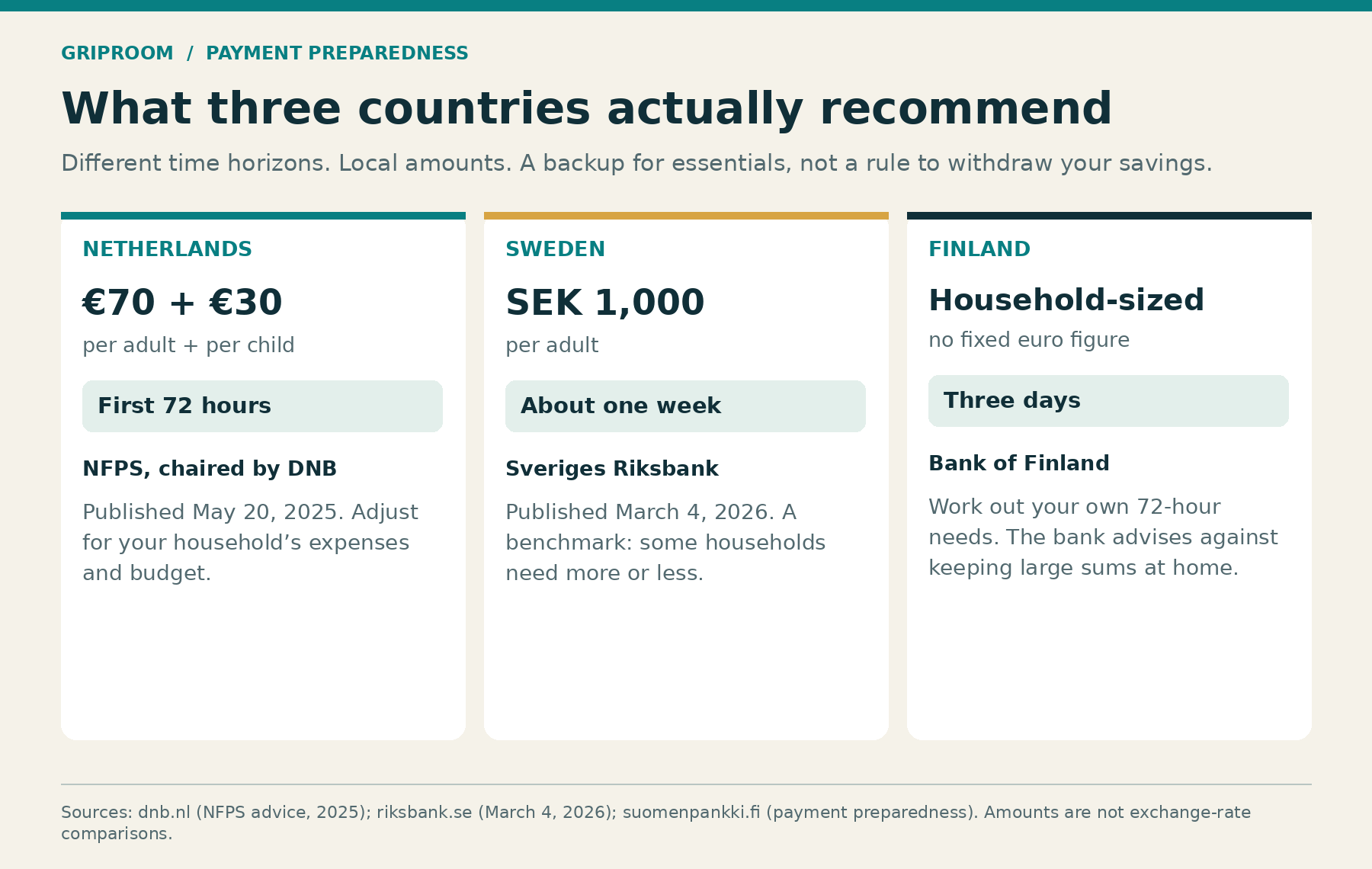
Read the original guidance and the difference becomes obvious. The Dutch figure is €70 per adult and €30 per child for 72 hours. Austria suggests up to €100 per household member. Finland gives no fixed euro amount and asks households to price three days of essentials. A family of two adults and two children following the Dutch formula would set aside €200 total, not €70–€100 for each of the four.
A similar mix-up can happen with Spain. A Banco de España staff article urges readers to have some cash on hand, but the €70–€100 range appears in its discussion of recommendations elsewhere. The post also says the author's views do not necessarily represent the Bank of Spain or the Eurosystem. It is good evidence of what happened during the blackout. It is not the announcement of a Spanish cash target.
The European Commission’s Preparedness Union Strategy is a fourth document people can confuse with the others. Its 72-hour goal is about households being able to get by at the start of a crisis. It is not a uniform cash recommendation. If a headline gives a number, ask who issued it, whether it applies per adult or per household member, and what the money is supposed to cover.
Some advice is old. Some of the changes are real.
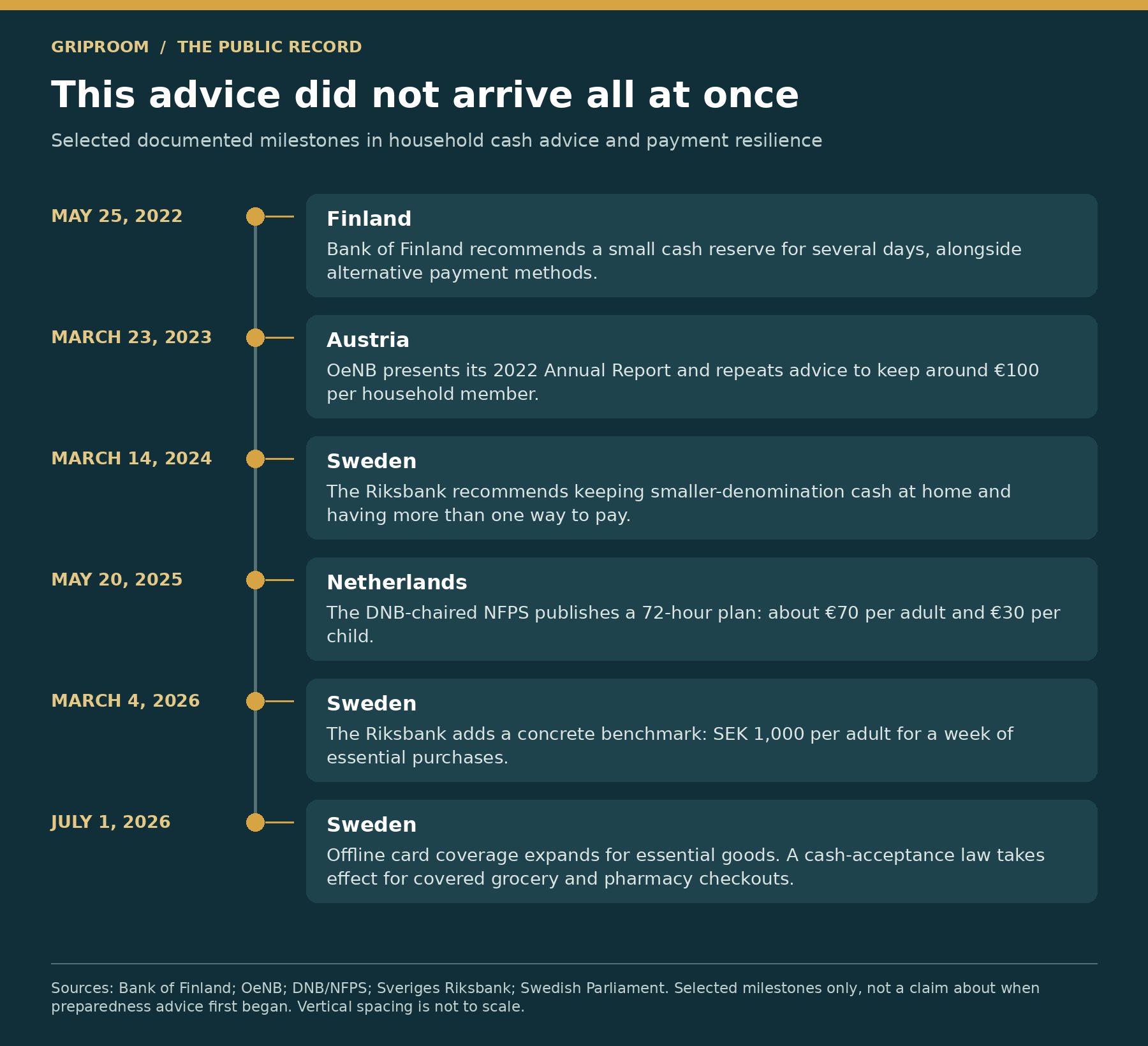
The public records show three distinct developments: longstanding advice to have more than one way to pay, newer efforts to turn that advice into a number, and changes to the rules and systems that make the backup usable. Putting them on the same timeline makes it harder to mistake them for one coordinated new alert.
In May 2022, the Bank of Finland was already advising households to keep enough cash for several days and to consider having payment options at more than one bank. It explained the problem as dependence on a single provider. Finland’s current payment emergency kit says to plan for 72 hours without card payments and cautions against keeping large sums at home. Bank of Finland’s 2022 release
In February 2023, Austria’s central bank launched a campaign recommending around €100 per family member, in small denominations. Its current guidance compares the amount to roughly two weekly grocery shops. That is a way to size the reserve, not a prediction that the power will be out for two weeks. Austrian National Bank’s 2023 campaign
Sweden’s central bank was advising people to have smaller-denomination cash by March 2024. It set its SEK 1,000 per adult one-week benchmark in March 2026 and noted that less could still help. The report starts from estimates of food costs. The recommendation became more specific; the underlying advice was already there. Sweden’s 2024 advice and the 2026 calculation
Sweden changed what happens on both sides of the checkout
Sweden’s new rule is a checkout rule, not a withdrawal rule. From July 1, 2026, grocery stores and pharmacies with staffed checkouts must accept cash, within specified limits. The obligation covers payments of up to one-tenth of the statutory price base amount, or SEK 5,920 in 2026, and no more than 25 coins. There are exceptions for safety, costs that would prevent the outlet remaining open, and acceptable reasons for declining an individual transaction. It is not a universal command that every Swedish business accept every cash purchase. Enacted Swedish law, SFS 2026:769 and Statistics Sweden’s 2026 base amount
This addresses the obvious weakness in household advice: money in your wallet is not much of a backup if the place selling dinner will not take it. Cash preparedness requires a usable route from the household to the seller, not just banknotes somewhere in the economy.
Sweden also expanded offline card payments from July 1, 2026 under an agreement involving the Riksbank and market participants. The arrangement is designed to support essential purchases, including food, medicine and fuel, during communications disruptions lasting up to seven days. It covers most Visa and Mastercard cards issued to adults by participating issuers. Fuel coverage is for staffed stations, and a physical card and PIN are required. Riksbank’s July 1 announcement and offline-payment guidance
The point is not to choose cash instead of cards. Sweden is trying to make both more useful when normal connections fail. An offline card transaction can be stored and transmitted later; that does not make the shop immune to a power outage, nor eliminate the conditions attached to a particular card or terminal. “Offline” is a description of the payment connection, not a promise that the whole store can operate without electricity.
The law is only part of the work. Under separate reforms announced alongside it, banks must also provide places for consumers to deposit cash to a satisfactory extent across the country, and businesses need access to services for managing change and depositing takings. A shop cannot keep breaking twenties if it has no reliable way to get smaller notes. These arrangements matter even in weeks when nobody calls cash an emergency backup. Swedish Parliament’s summary
Why the amounts differ from country to country
The Dutch recommendation arrived on May 20, 2025: approximately €70 per adult and €30 per child for a three-day disruption. It came from the National Forum on the Payment System, which brings together DNB, banks, retailers, consumer organizations and public authorities. DNB chairs the forum; the advice was a joint preparedness effort rather than a lone institution telling depositors to flee. Dutch announcement
The same announcement says the forum began exploring precautionary measures in November 2024, prompted by geopolitical tensions and cyber threats. The Iberian blackout of April 2025 gave the public a visible example of the problem, but the Dutch effort was already underway.
The amounts were based on calculations by the Dutch household-budget institute Nibud for minimum expenses such as food, water, medicine and transportation. They were not an estimate of how much wealth people should move out of their accounts. The advice allows households to adjust for their own needs and budgets and to build the reserve gradually, using a mix of notes and coins.
Denmark’s central bank, by contrast, cited the 2025 Nets payment disruption and the Iberian blackout when it issued its October 2025 update. Its current FAQ recommends DKK 250 per household member, generally enough for at least three days of essentials. The benchmark starts with about 70 kroner a day in food spending, times three, plus a cushion. The initial English release said per adult; the FAQ and June 2026 release say per household member. Use the current wording if you are comparing amounts.
Denmark also helps explain why a card backup in one country doesn't tell you what will work in another. The Danish Payments Council’s report describes an arrangement that can work with eligible Danish-issued cards in mobile wallets as well as physical cards at covered shops. Sweden’s expanded arrangement requires the physical card. The labels sound identical until you are at the checkout with a phone but no wallet. Coverage, the way you identify yourself and the type of store can matter more than the headline duration.
The numbers are only comparable if you also compare what they buy. Sweden’s figure covers about a week, the Dutch figure about three days. Norway gives no set amount and tells people to factor in what they already have. Converting a Swedish figure to U.S. dollars will not tell an American household how much it costs to buy food or get home in its own town. Norges Bank’s practical guide
In Spain, the blackout made it harder to get cash too
At 12:33 p.m. Central European Summer Time on April 28, 2025, continental Spain and Portugal lost power. A small part of southwestern France experienced brief disruption, but the rest of Europe’s power system avoided a significant disturbance. This geographic distinction matters: a serious regional failure can strand millions of customers without becoming a continent-wide collapse. ENTSO-E’s investigation
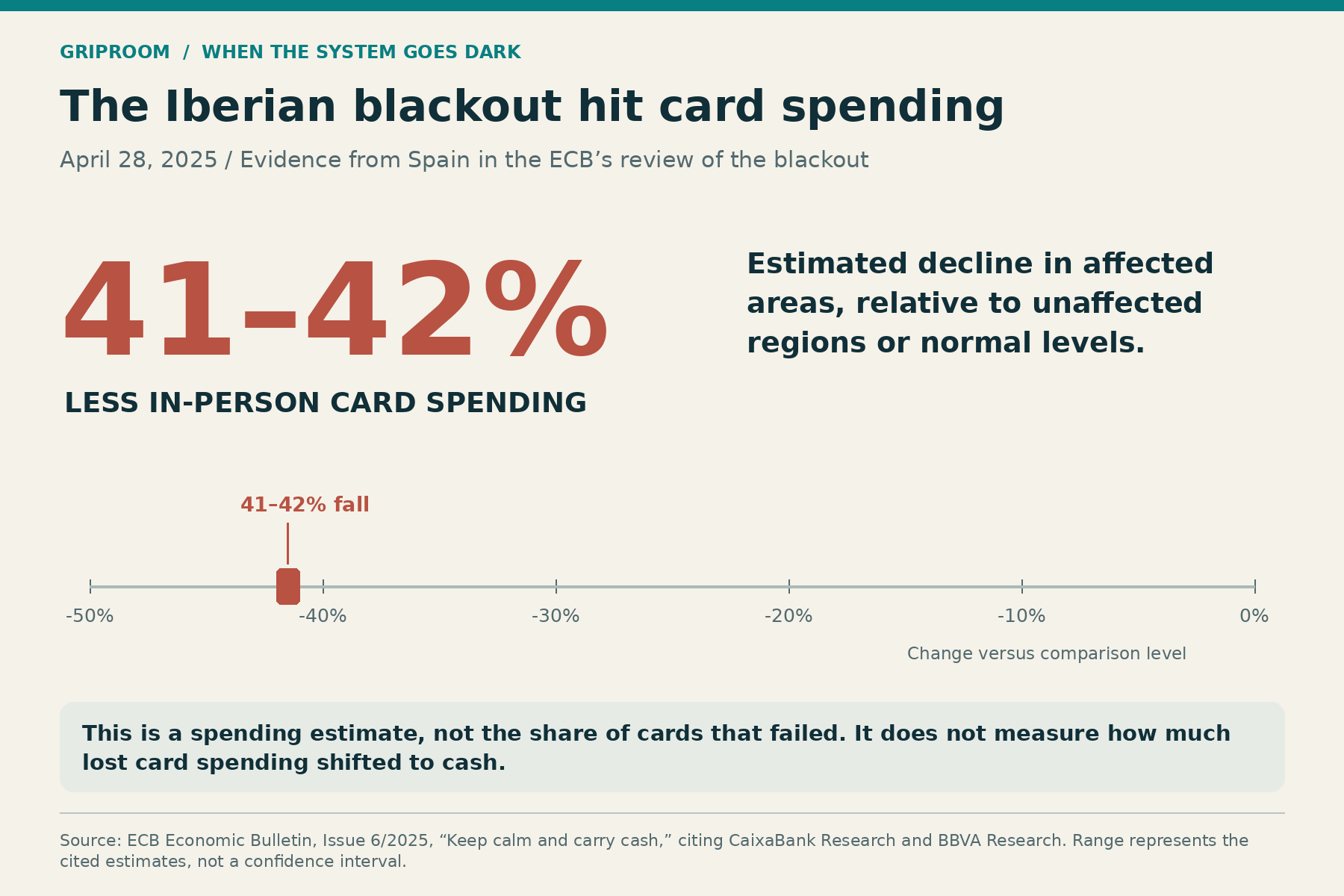
The payments damage was measurable. An ECB analysis reported that in-person card spending in affected areas fell an estimated 41–42% against comparison areas or normal activity. National e-commerce spending fell about 54%. These are changes in spending, not the percentage of cards that malfunctioned. They capture interrupted shopping as well as payment failures, so they cannot tell us exactly how many purchases cash rescued. ECB Economic Bulletin
Cash withdrawals also fell sharply in affected areas, then rebounded after services returned. The ECB examined data from approximately 4,500 Spanish ATMs, comparing activity with an expected baseline that accounted for ordinary weekday and pre-holiday patterns. That is more informative than an isolated photograph of an ATM queue, although withdrawal data still cannot measure every cash transaction people completed. The important practical distinction is between banknotes already in a wallet and money someone hopes to withdraw after the electricity fails. ECB’s methods and findings
Banco de España’s subsequent account describes two different ATM problems: some functioning machines ran out of notes, while others still contained cash but lacked the power or connection to dispense it. Cash in the system was not necessarily cash within reach. On April 29 and 30, banks and cash-transport companies replenished machines, prioritizing important locations. Their collections from the central bank were 15% higher than on the same dates a year earlier. Banco de España’s account
This is why the advice is to have some cash before a disruption. A bank balance and a full ATM can be on opposite sides of a failed communications link. Cash pulled out beforehand can still settle a purchase if the shop is open and processing sales. It does not guarantee the shop stays open.
The blackout also has a documented cause. The ENTSO-E panel’s March 2026 final report traced a cascade involving interacting electrical-system factors, including voltage control and generator disconnections. The payments data show what can happen when electricity fails; they do not establish a hostile cyber operation.
No blackout was needed for a similar checkout problem in Canada. The July 2022 Rogers outage began with a configuration error during a network upgrade; the CRTC’s independent assessment describes how wireless and wired services shared a core network. Interac says its Debit and e-Transfer services were unavailable during the outage and that it subsequently added a secondary network carrier and other backups. Two payment options can look independent to shoppers and still rely on the same infrastructure.
Cash also has a supply chain
Sweden has an unusually clear view of the problem because people there rarely pay in cash. In the Riksbank's 2026 Payments Report, 5% of respondents said they used cash for their most recent purchase in a physical store in 2025, down from 10% in 2023. That doesn't mean only 5% of Swedes ever use cash. It tells you how rarely the system is being exercised in an ordinary shopping trip.
Sweden got a reminder of that in 2025. According to the Riksbank’s review of cash access, a shift in who handled cash transport for Swedish ATM operator Bankomat left some counties with only one or a few working ATMs at times, even though the country still met its national withdrawal-distance target. A good national average can conceal a bad week in a particular place.
The two ends of a transaction have different problems. If a cash machine is out of service, people who have notes at home can still pay. If the pharmacy cannot fill prescriptions or the gas station cannot run its pumps, it doesn't matter how many ways a customer can pay. And if a grocery store has a working register but no connection to authorize a card purchase, a properly supported offline card may be exactly the right backup.
Spain showed how some of those problems can pile up at once. Sweden’s reforms show that the people who keep the backup usable include retailers, banks and card networks, not just the household putting money in an envelope.
Does this mean officials expect a war or a bank run?
The war language is real. Sweden's March 2026 announcement puts temporary payment disruptions, crises and, in the worst case, war in the same planning frame. It would be misleading to strip those concerns out of the story. They explain some of the institutional urgency, particularly when an outage could affect several services at once.
But the documents don't identify an imminent event or say when a disruption will begin. The record also contains evidence against the idea that all the guidance came from one undisclosed development: several recommendations predate the Iberian blackout; Denmark describes actual incidents that prompted updates; and the numbers are tied to local costs. The case for a specific hidden warning would need evidence specific to that warning, not simply similar advice reappearing in several countries.
There is also a difference between a surge in demand for banknotes and a government telling people to keep them for groceries. The same ECB bulletin that covered Spain examined the rise in net banknote issuance in five countries near Ukraine after Russia’s full-scale invasion in 2022. That was a change in how much currency went into circulation during a crisis. It is a different measure from either the amount a household needs to buy three days of essentials or the amount people actually spent in a blackout. Treating all three as evidence for the same prediction throws away what makes them useful. ECB’s analysis of banknote issuance
A bank run is a different claim. The household amounts are small and sized around purchases, not deposits. Norges Bank's guide draws that distinction in its instructions to the public: its purpose is to let people pay for essentials when part of the system is unavailable, not to protect them from a loss of bank deposits. Norges Bank gives no fixed cash figure and tells households to account for supplies they already have. A checkout that can't reach your bank is a problem with access at that moment. It tells you nothing by itself about the balance sheet of the bank.
Digital payments themselves are not the problem. They allow many more kinds of purchases and are convenient every day. The problem is losing an independent way to pay as more purchases pass through the same connections. Sweden’s decision to expand offline cards at the same time that it protected cash at certain checkouts is the clearest example. A policy set up for several kinds of disruption tells you which failures officials want the system to withstand, not which one they think will happen next.
What does the advice mean outside Europe?
In the United States, the comparable advice comes from FEMA. In 2018 FEMA advised keeping some small notes at home because ATMs and cards might not work during a disaster. Its 2023 guidance distinguishes a small amount of cash from emergency savings. Neither source sets a dollar total. These are disaster-preparedness recommendations, not Federal Reserve instructions to withdraw deposits. Canada’s federal emergency checklist includes small bills and coins without setting a standard amount either.
Use those examples for their logic, not as prices to copy. Start with essentials you might still need in the first few days, such as a grocery top-up or transport. Deduct what you already have. If you can comfortably put anything aside, smaller notes are usually more flexible than a single large one. Keep them somewhere secure that the people who need them can access. A modest reserve for a checkout outage serves a different purpose from savings for rent or a lost paycheck.
If the outage is happening now, the question changes: Which nearby shop is open, and what can it take? GripRoom’s grocery payment outage guide covers what to try at the register. The bigger point from the central-bank records is that no way of paying works under every condition. Sweden is taking that seriously enough to change both the law and the card system, not just ask people to find an envelope.
How we checked the claims
We compared original releases and current household guidance with enacted legislation and post-outage reports. We distinguished a new benchmark from an older recommendation, and a law from an agreement between payment providers. The amounts above are selected national examples, not a comprehensive list. The blackout spending data measure changes in transactions, not how many purchases cash rescued.