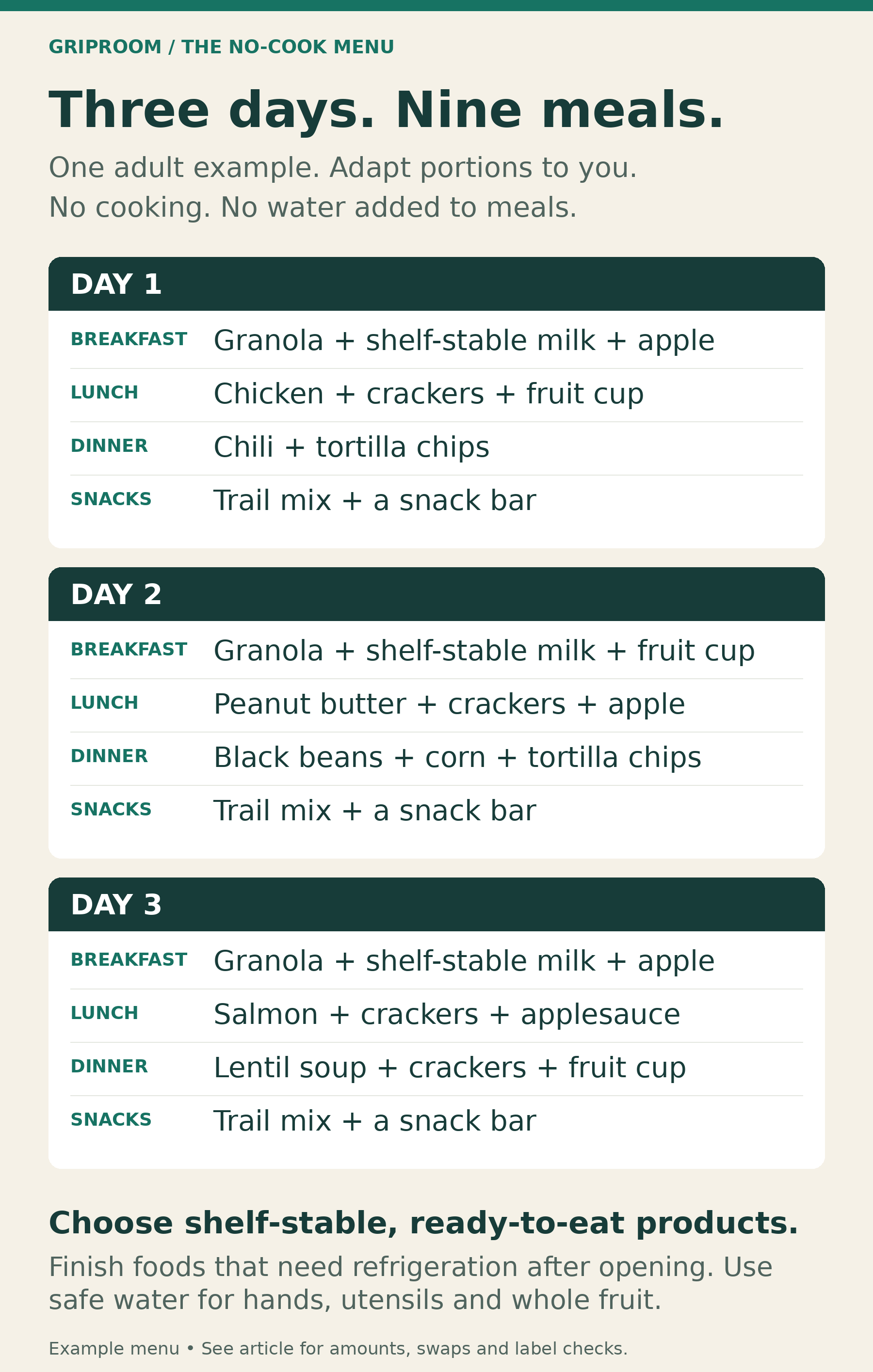
For three days without power, you can eat granola with shelf-stable milk, peanut butter or chicken on crackers, and ready-to-eat canned chili, beans or lentil soup. Add whole fruit, trail mix and snack bars. None of the meals below needs a stove or a fridge. You don’t have to boil or rehydrate anything.
Build the plan around nine meals, not nine cans. A small carton of milk works for one breakfast; opening a big carton on day one won’t give you milk for days two and three. Buy perishable-after-opening foods in portions you’ll finish at one sitting. If the power just went out, keep the fridge door shut and start with the pantry.
A three-day no-cook menu for one adult
Each day has three meals and two snacks. This is a starting point for an adult, not a prescribed diet or a promise that these portions will suit everyone. The dry-food weights are amounts to pack out of larger bags; the perishable-after-opening items should be sized to the meal. Use clean hands and utensils. Wash whole fruit under safe running water before eating it; if you’re short on safe water, swap the apples for sealed fruit cups. Three days is a planning window, not an estimate of when power will come back.
Day 1: Chicken and crackers, then chili and chips
Breakfast: 2 ounces of granola, one 8-fluid-ounce carton of shelf-stable milk or soy milk, and an apple. Open the carton when you eat.
Lunch: One 2½- to 3-ounce pouch of ready-to-eat chicken, 2 ounces of crackers and one fruit cup. Spoon the chicken straight onto crackers. If you want mustard, use a packet.
Dinner: One meal-sized can of fully cooked, ready-to-eat chili and 2 ounces of tortilla chips. Hormel’s product FAQ is an example of an explicit ready-to-eat confirmation. Eat the chili cold from a bowl if you have one; the chips give it some crunch. If the can is too big, buy a smaller one and add another dry side.
Snacks: 2 ounces of trail mix and one snack bar, whenever you want them.
Day 2: Peanut butter crackers and a black bean bowl
Breakfast: 2 ounces of granola, one small shelf-stable milk carton and one fruit cup.
Lunch: 2 ounces of crackers with two 1-ounce peanut butter packets and an apple. Or use a shelf-stable jar and a clean, dry utensil; you don't need packets for a spread whose label allows room-temperature storage after opening.
Dinner: One small pouch of ready-to-eat black beans (roughly 8 to 10 ounces), one small can of fully cooked corn (8 to 9 ounces) and 2 ounces of tortilla chips. Drain the corn into a cup or sink if you like; you don’t need to rinse it for this meal. If the only corn comes in a large can you won’t finish, leave it out and add a sealed fruit cup, or split the can at dinner with someone else.
Snacks: 2 ounces of trail mix and one snack bar.
Day 3: Salmon crackers and lentil soup
Breakfast: 2 ounces of granola, the last small milk carton and an apple.
Lunch: One 2½- to 3-ounce pouch of ready-to-eat salmon, 2 ounces of crackers and one applesauce cup.
Dinner: One meal-sized can of ready-to-eat lentil soup, 2 ounces of crackers and one fruit cup. Buy a soup that needs no added water and is safe to eat without further cooking.
Snacks: 2 ounces of trail mix and one snack bar.
The shopping list, counted out for all nine meals
The amounts below cover three days for one adult. Double the list for two adults. You can share a larger container if you’ll finish it at the same meal. For example, two 8-fluid-ounce milk cartons can become one 16-fluid-ounce shelf-stable carton if you eat breakfast together. If you’re on different schedules, stick with the small cartons.
Breakfast and snacks
6 oz granola
3 shelf-stable milk or soy milk cartons (8 fl oz each)
3 whole apples, 3 fruit cups, and 1 applesauce cup
2 peanut butter packets (1 oz each)
6 oz trail mix and 3 snack bars
Lunches and dinners
1 ready-to-eat chicken pouch and 1 ready-to-eat salmon pouch (2½–3 oz each)
8 oz crackers and 4 oz tortilla chips
1 meal-sized can of ready-to-eat chili
1 ready-to-eat black bean pouch (about 8–10 oz)
1 small can of fully cooked corn (8–9 oz)
1 meal-sized can of ready-to-eat lentil soup
Water and supplies
Store at least 3 U.S. gallons of safe water for one adult, or 6 gallons for two, based on the CDC’s three-day minimum.
Add a manual can opener, utensils, and a clean bowl or disposable plates. Keep them with a flashlight so you can find them in the dark. Try opening a pouch and draining a can before you need to. If pull tabs or tight lids are hard for you, test those too. USDA’s emergency pantry guidance also recommends a manual opener and smaller cans to avoid leftovers.
Test the cart: Do you have enough food, in usable packages?
Look at what you’ll actually eat, not what the front of the package suggests. A can of Campbell’s Protein Mediterranean Lentil Soup has 280 calories, 20 grams of protein and 1,120 mg of sodium on the manufacturer’s label. The one-cup column says 150 calories and 590 mg of sodium. The whole-can column is the useful one if the plan is to finish it. On its own, that can may be a light dinner. The crackers and fruit in the day-three menu do real work. That particular lentil soup also contains chicken broth, something the name doesn’t tell you.
Check the package size after choosing the food. Del Monte’s whole-kernel corn comes in an 8.75-ounce can the company labels as one serving and a larger can it labels as 3½ servings. The small one works for the solo bean bowl. The large one makes more sense if you know who will eat the rest at that sitting. For beans, some manufacturers explicitly say their fully cooked beans can be eaten straight from the pouch. These are examples of what to look for, not brands the plan requires.
What Day 1 adds up to with real labels
We checked one version of Day 1 using U.S. manufacturer labels and USDA apple data. At the portions listed, it came to about 2,100 calories, 80 grams of protein and 3,300 mg of sodium, before optional condiments. That is one set of products, not a target or an estimate for Days 2 and 3.
Breakfast, about 435 calories: 2 oz Quaker Simply Granola, one Organic Valley shelf-stable 1% carton and one medium apple.
Lunch, about 385: One StarKist 2.6 oz chicken pouch, 2 oz Triscuit Original and one Dole peach cup.
Dinner, about 845: One full can of Campbell’s ready-to-eat Cajun Style Chili and 2 oz Tostitos Original Restaurant Style chips.
Snacks, about 405: One 2 oz Planters trail mix package and one individual Nature Valley Oats ’n Honey bar. That wrapper contains two bars; this example counts just one.
The chili alone supplies about half the sodium in this example. If you’re comparing cans, look at sodium for the portion you’ll actually eat, then check the salted sides. Unsalted nuts can replace a salty trail mix without requiring another can, more prep or any fridge space.
Before storing the food, make the smallest dinner you picked, using just the gear you’ve set aside. If you were still hungry afterward, add a bigger side, extra trail mix or another sealed entrée now. If the serving was too large to finish, use a smaller wet package and make up the difference with dry foods you can reseal. When a household member has a sodium limit or another dietary requirement, check the whole meal, including crackers, sauces and snack bars. Keep their usual foods and dietary plan in mind. FDA guide to the Nutrition Facts label
Three label checks that keep the menu usable
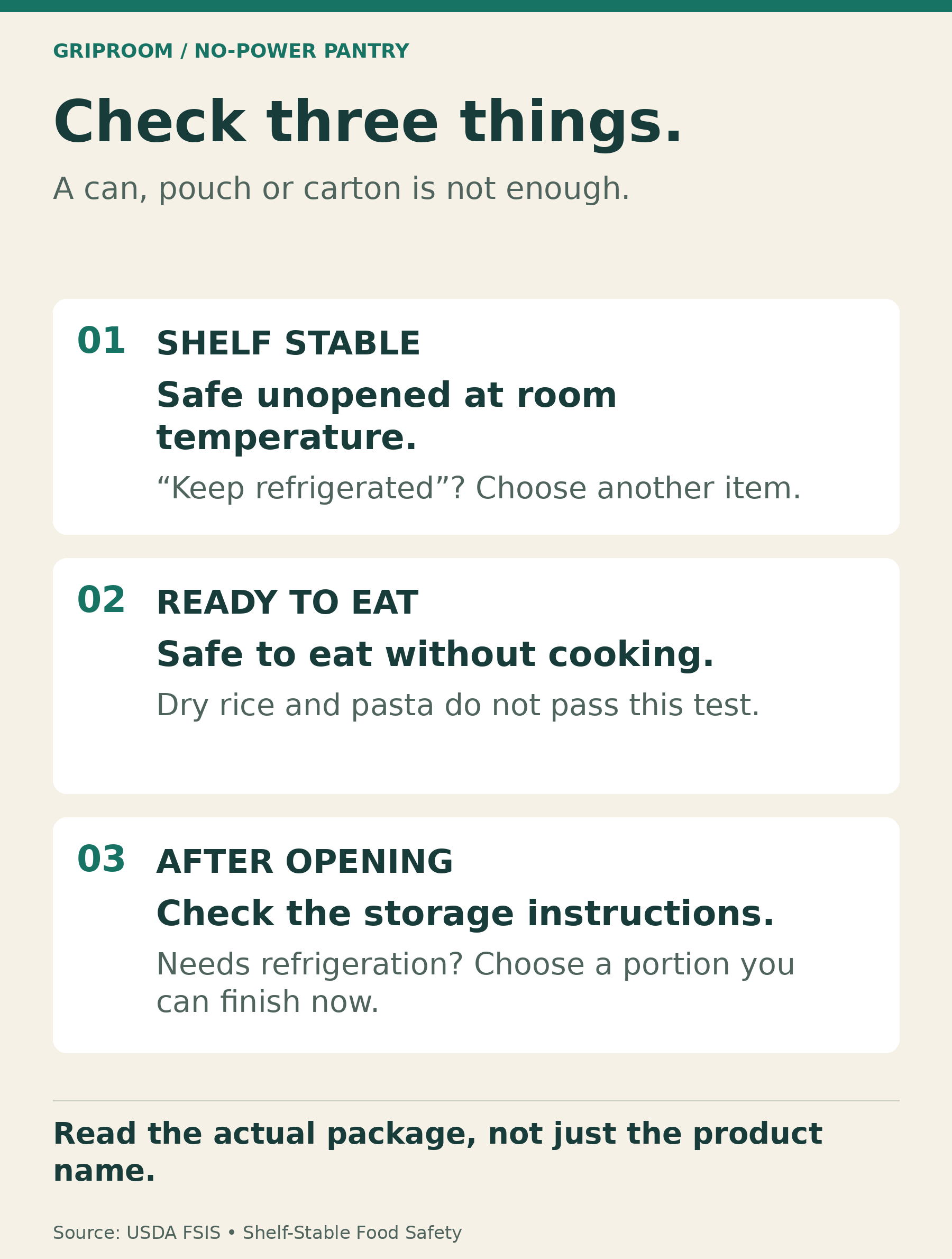
Can this sit unopened in the pantry? Look for room-temperature storage. A bottle or pouch sold from a refrigerator may still need continuous refrigeration, and even some canned meats and seafood must be kept cold. Shelf-stable milk comes in a package made for pantry storage; “ultra-pasteurized” on a refrigerated carton is not a substitute for reading the storage directions. USDA on shelf-stable foods
Can I eat it without cooking or adding water? Look for a fully cooked, ready-to-eat product. Don’t assume that every microwave pouch, condensed soup or instant meal is ready to eat as packed. A serving suggestion to heat a fully cooked product is different from a requirement to cook it. If you can’t establish that a product is ready to eat, choose another. Dry rice, dry beans and regular pasta are pantry staples, but don't count them toward these nine meals.
What happens when I open it? Follow the package's instructions. If it says to refrigerate after opening, choose a portion you can finish and don’t save leftovers without reliable cold storage. Individual milk cartons, pouches and fruit cups are convenient. Larger bags of crackers, granola and trail mix are different: keep them sealed and dry between meals as the package directs.
If you're shopping from scratch, skip leaking, bulging or deeply dented cans and damaged pouches. If a package spurts unexpectedly when opened, don't sample it. When food may have touched floodwater, it's a different situation from a simple power cut. Follow the FDA's flood guidance; do not assume that a screw-top jar or a milk carton is waterproof. USDA on damaged cans
What to do with the fridge when the power goes out
Keep the doors shut. A closed refrigerator normally keeps food cold for about four hours after power goes out. After four hours without power or another cold source, discard refrigerated perishables like milk, eggs, meat, leftovers and cut fruit. If you have ice and a cooler, keep the food at 40°F (4°C) or colder and verify it with a thermometer. For individual foods, use the FoodSafety.gov keep-or-discard chart. Whole uncut fruit and ordinary bread aren't in the same category as cut fruit, deli meat or a leftover bowl of rice. CDC outage guidance
The room-temperature rule is separate. Perishable food that is out of cold storage should not sit out for two hours or more, or one hour if the air is above 90°F (about 32°C). That applies to opened milk, chicken or salmon from the menu as well as perishables pulled from the fridge. The four-hour closed-fridge estimate and the two-hour room-temperature limit don't add together. And getting power back does not reset the clock. Don't taste food to test it or trust a normal smell. FDA safe food storage guidance
If you need to decide what to do with thawed groceries or food of uncertain temperature, use GripRoom’s fridge and freezer safety guide. For tonight, you don’t have to rescue dinner from the freezer. Never use a camp stove or charcoal grill indoors. CDC on carbon monoxide
Water is part of the food plan
The CDC recommends storing at least one U.S. gallon of water per person per day for three days. That's a household emergency water baseline, not an instruction to drink an entire gallon. It also covers uses such as food prep and brushing teeth. Add more for hot conditions, illness, pregnancy or pets as needed. If local officials say tap water is unsafe, follow their notice and use an approved safe source. CDC emergency water guide
Swap the packages, not the jobs they do
Vegetarian or vegan: Replace the chicken and salmon with ready-to-eat chickpeas, beans or a lentil dish. Check the broth in the soup and the ingredients in the chili. For a vegan plan, choose shelf-stable plant milk and check your granola, bars and crackers too. Keep enough of the replacement to make a meal, rather than matching an ounce count.
Nut allergy or gluten restriction: Pick a safe seed butter or a different ready-to-eat protein if suitable for your household. Check trail mix and bars too; for gluten, swap in clearly labeled gluten-free crackers, chips and granola. Keep allergy-safe foods separate if needed.
Infant formula, prescribed diets or feeding needs: Don't use the sample adult menu as a substitute. For babies already fed formula, CDC recommends single-use ready-to-feed infant formula as the safest emergency option because it doesn't need to be mixed with water. Shelf-stable cow's milk or plant milk from this menu is not infant formula. Plan for safe feeding supplies as well. CDC infant-feeding emergency guidance
If the power is already out, build tonight’s meal first
Check the pantry before trying to shop or opening the fridge. Pair something filling, like crackers or wraps, with a protein you can open now, like a fish pouch or nut butter. Add fruit or a snack you have on hand. No opener? Start with pouches, fruit cups and packets you can open safely by hand. No safe tap water? Choose sealed drinks and fruit cups rather than dry meals that need water or fruit that needs washing. Missing one ingredient? Repeat a meal you can make. Variety is useful when buying ahead; there’s no reason to improvise with an unsafe leftover just to make dinner different.
When the power is back, replace what you used with food you’d eat normally. Put the opener and flashlight back together, and write the next three days’ meals on a note next to the food. The point is to be able to answer “what’s for dinner?” before you need to ask whether the store is open. For the reasoning behind three days, see GripRoom’s stockpiling explainer.