A store may round your final cash total to the nearest nickel when it can’t make penny change. Take a $10.53 purchase. At a Florida store using the state’s rounding method, you’d owe $10.55 in cash or $10.53 by card. A $10.51 cash total can go the other way, to $10.50. Which rules apply depends on where you shop and how the store handles cash. Start by looking for a rounding adjustment after the tax line. Florida Department of Revenue
Why a $10.53 purchase can cost $10.55 in cash
Florida’s tax department uses a $9.84 item with a combined 7% state and local sales tax. The tax comes to $0.69, so the total is $10.53. If the store rounds the cash sale, the amount collected becomes $10.55. The item price remains $9.84 and the sales tax stays $0.69. The extra two cents come from settling the final bill with the coins available. Florida’s June 2026 cash rounding bulletin
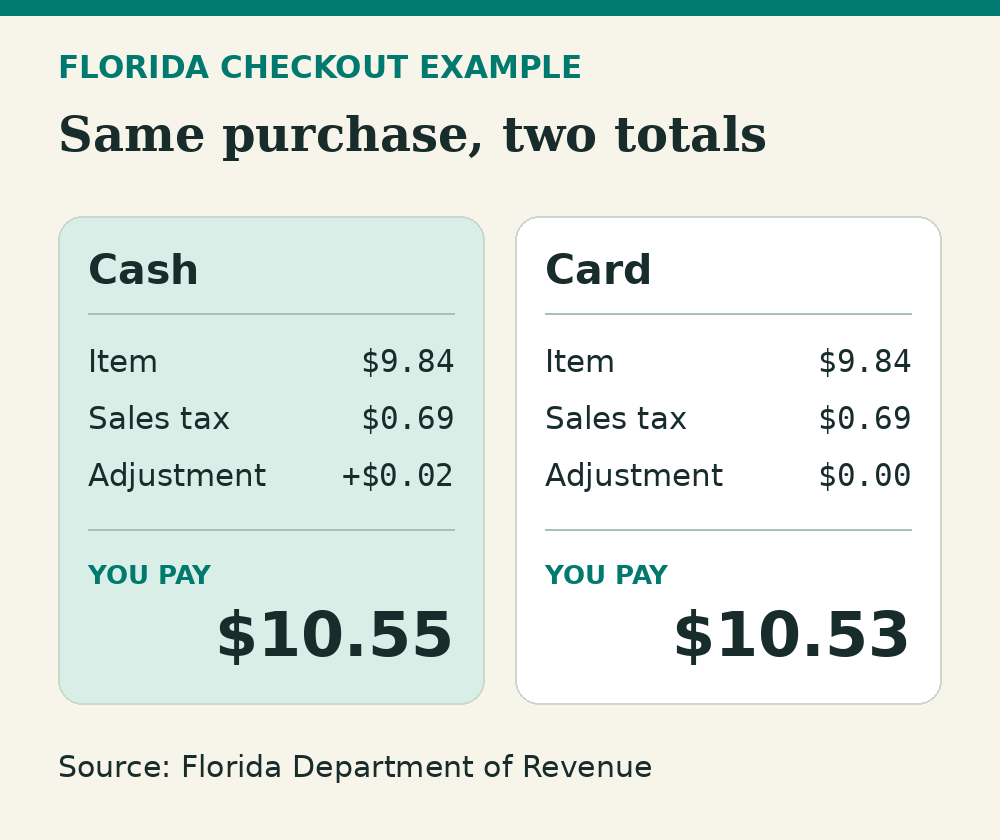
The same Florida basket costs $10.55 when rounded in cash and $10.53 by card. Both start with a $9.84 item and $0.69 in tax.
The final digit tells you which way nearest-nickel rounding goes. If the total ends in 1, 2, 6 or 7 cents, it rounds down. If it ends in 3, 4, 8 or 9 cents, it rounds up. A total ending in 0 or 5 cents is already payable in nickels, so it stays the same. You may see the adjustment described from the other side of the transaction. If you hand over $11 for a $10.53 order, exact change would be 47 cents. Giving you 45 cents in change has the same effect as rounding the amount you paid up to $10.55. Florida Department of Revenue · Florida law
A store applying the method to each item would come up with a different bill. Two items priced at $2.03, for example, add up to $4.06 before tax. At a 7% sales tax rate, the order totals $4.34 and the cash total rounds to $4.35. The price tags still say $2.03 each. If you want to check the receipt, start with the whole purchase and its tax.
Why one store might handle your change differently
The U.S. Mint struck new pennies for circulation for the last time on November 12, 2025. The pennies already out there still have value and remain legal tender. Some cash drawers still have plenty. Another store might be short enough that customers start seeing rounded totals on receipts. The Treasury encourages people to spend the pennies they already have at businesses that accept them. U.S. Mint · U.S. Treasury penny FAQ
Florida is a good example of why the date on an answer matters. Its first tax bulletin allowed dealers a choice of rounding direction under certain conditions. A May 2026 law addressed cash rounding, and the tax department replaced its bulletin on June 10. The updated guidance describes the nearest-nickel method for eligible cash purchases. A screenshot of the old policy can still look official long after the state has replaced it. Earlier Florida bulletin · Current Florida bulletin
New Jersey’s tax agency also describes rounding as optional and calls for it to be applied after taxes and fees. Its guidance tells businesses to disclose their policy clearly before the customer incurs a charge. The exact place you look for that disclosure could be the counter, a checkout sign or the store’s posted policy. If you hand over the exact amount, ask how that store handles it. A nickel adjustment on a previous trip may have reflected how much change was in the drawer that day. New Jersey Division of Taxation
What happens if you pay by card or split the bill?
In the Florida example, electronic and other noncash payments remain exact. If you put $5 on a card and hand over the rest in cash, Florida’s rounding rule generally excludes that split payment too. There is an exception to the extent cash is paid out to the customer. Keep the split-payment example tied to Florida, since the details are where a quick internet answer turns into bad checkout advice. Florida law
North Carolina’s retail law shows why the state matters. It lets eligible sellers apply rounding to the cash portion of a split payment. So if you’re looking at an adjustment after paying partly in cash, the Florida example may be the wrong one to use. Check the rule where the purchase happened, then look for the amount the register assigned to each payment method. North Carolina Session Law 2026-31, Part XIV
If your credit-card receipt shows a higher amount than the subtotal you remember, check taxes and any separate fee first. Compare the final total with the amount charged. For a cash purchase, compare the same total with what you handed over minus the change you received. Either calculation lets you ask a precise question at the counter, down to the two cents.
Is there a nationwide cash-rounding rule coming?
Congress passed the Common Cents Act, H.R. 10167, and sent it to the president on November 12, 2026. As of November 18, the latest recorded action showed the bill had been presented to the president. The text passed by Congress would allow rounding to the nearest nickel when exact change is unavailable. It separately allows rounding in the customer’s favor and excludes specified noncash methods such as credit cards and electronic transfers. Section 3 also says the ordinary rounding options it describes are voluntary. Enrolled Common Cents Act · November 12 congressional actions
For now, the most reliable way to make sense of a few missing cents is to check the date on your state’s guidance and the math on your receipt. A bill total ending in three cents and a cash payment ending in five can fit together perfectly. If the numbers still don’t line up, save the receipt and ask the store to show which line changed. It’s a lot easier to sort out while you can still see the sign at the register.