What Domino’s Delivery Teaches About Food Logistics Jobs
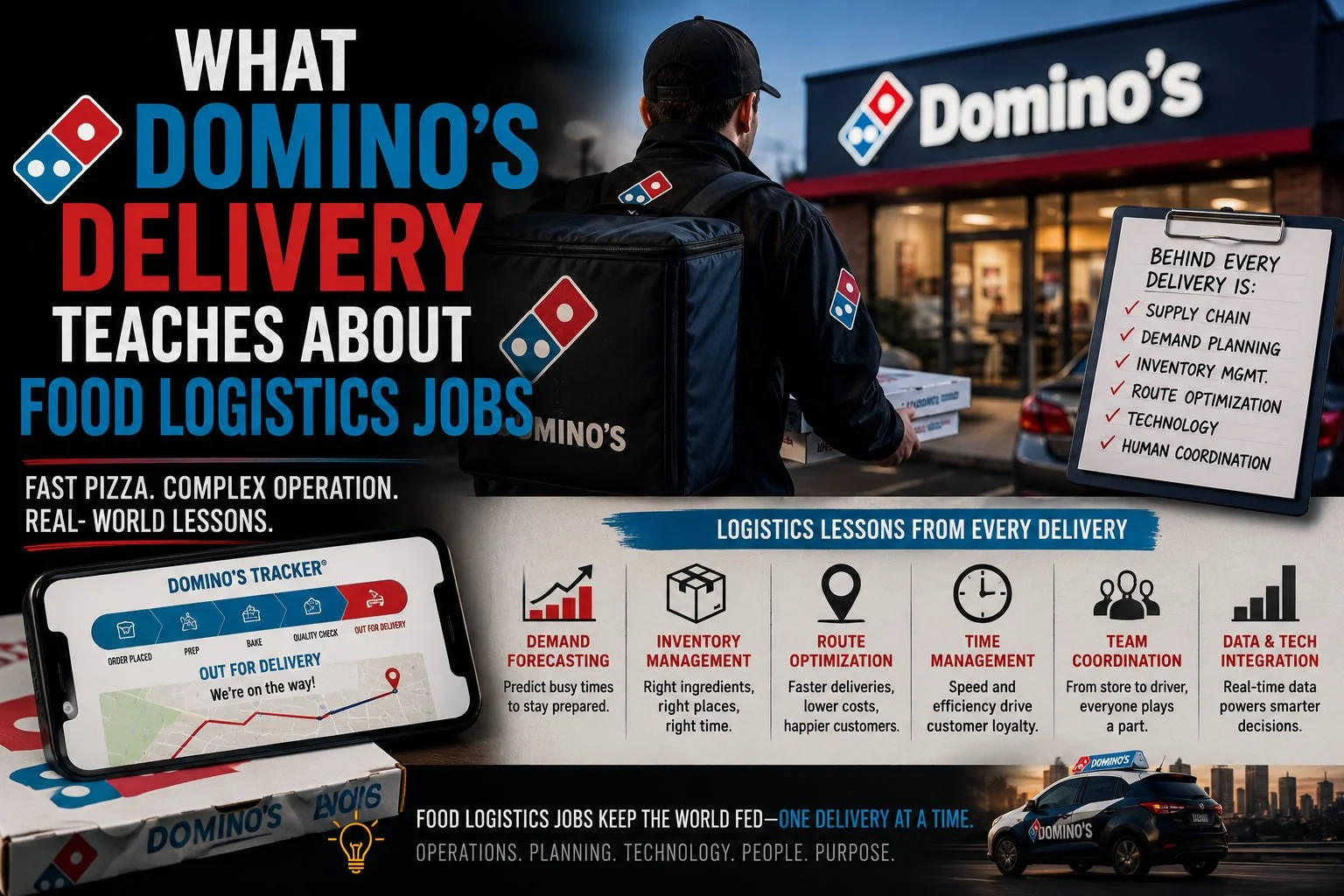
Domino’s delivery looks simple if your brain has been softened by pizza commercials: a cheerful driver appears at your door, hands you a hot box, accepts a tip, and vanishes into the night like a mozzarella-based woodland spirit.
Adorable.
In reality, Domino’s delivery is a tiny logistics miracle performed thousands of times a day by people juggling ovens, phones, addresses, traffic, stairs, weather, customer moods, GPS nonsense, franchise policies, tips, vehicle costs, and the sacred duty of keeping cheese from fusing itself to cardboard like a dairy-based welding project.
Domino’s is not just a pizza company. It is a logistics company wearing pepperoni camouflage. As of December 28, 2025, Domino’s reported more than 22,100 stores in over 90 markets, with significant business in both delivery and carryout. It also said roughly 99% of global stores were owned and operated by independent franchisees, which means the shiny brand is one thing, and the actual employment reality can vary store by store like a nationwide pizza-themed weather system.
That is what makes Domino’s such a useful case study. It teaches the truth about food logistics jobs: the work is not “driving around with snacks.” It is retail, transportation, customer service, route planning, food handling, timing, cash handling, conflict management, and low-grade urban obstacle-course survival, all stuffed into one shift and handed a hat.
Domino’s Delivery Is Last-Mile Logistics With Extra Cheese
The phrase “last-mile logistics” sounds like something a consulting firm invented to bill $400,000 for explaining that things must arrive places. But in food delivery, the last mile is where the whole operation either succeeds or collapses into a sweaty little opera.
A Domino’s delivery driver is the final human link in a chain that starts long before the customer taps “order.” Dough is manufactured and distributed. Ingredients are supplied. A digital order hits the store. The makeline has to assemble it. The oven has to cook it. Someone has to box it. Someone has to route it. Someone has to drive it. Someone has to find the address, the apartment, the lobby, the customer who wrote “call when outside” and then apparently threw their phone into a lake.
Domino’s own delivery-driver career page says drivers split time between the road, customer interaction, and working with the store team to ensure orders are accurate. It also says the role depends on responsibility, safe driving, and order accuracy, because apparently customers are upset when the chicken wings they paid for vanish into the void like a poultry ghost.
That is the first lesson: food logistics jobs are not just movement jobs. They are handoff jobs. The driver inherits everyone else’s timing, accuracy, and mistakes, then becomes the face of the entire brand at the door. If the pizza is late, cold, wrong, upside down, missing sauce, or spiritually disappointing, the customer is not going to yell at “the supply chain.” They are going to look at the person holding the heat bag.
Very glamorous. Like being a diplomat, except the treaty is garlic crust.
The Store Is a Mini Warehouse, Kitchen, Dispatch Center, and Panic Room
A Domino’s store is not just a kitchen. It is a tiny fulfillment node. There are inventory systems, prep routines, order screens, make times, oven flows, delivery dispatch, customer pickup, phones, coupons, cleaning tasks, and a crowd of people trying not to collide with each other while carrying hot metal and emotional exhaustion.
One Domino’s fleet-driver posting describes the job as “timely, safe, and customer-focused delivery,” but adds that while not on runs, the driver assists with store operations including order preparation, inventory management, customer service, phones, carryout orders, dishes, cleaning, and helping on the makeline. Translation: you are not a mysterious road warrior. You are also washing things. Welcome to logistics, hero.
Another franchise delivery-driver posting lists duties like stocking ingredients, preparing product, processing phone orders, taking inventory, cleaning equipment, and working around hot ovens, sharp edges, walk-in coolers, cornmeal dust, and tight workspaces. It also mentions lifting cases up to 50 pounds. So yes, the job is technically “delivery,” but the store will absolutely find ways to make your spine participate.
This is what food logistics jobs teach immediately: the job title is often a lie wearing a uniform. “Delivery driver” may include food prep, cleaning, stocking, customer service, cash handling, and whatever else the dinner rush punches into existence.
Domino’s Proves Food Logistics Is Built on Standardization
Pizza delivery only works at scale because the system is boring in exactly the right places.
The dough has to be consistent. The boxes have to fit. The oven time has to be predictable. The store layout has to support speed. The menu has to be complex enough to sell, but not so complex that every Friday night becomes a hostage crisis involving Alfredo sauce.
Domino’s 2025 annual report says its supply chain segment accounted for $2.99 billion, or 60.5% of consolidated revenues, and that in the U.S. it operated 22 regional dough manufacturing and supply chain centers, two thin-crust manufacturing facilities, and one vegetable processing center, plus five regional dough and supply chain centers in Canada. The company also said its supply chain leases a fleet of more than 1,100 tractors and trailers and regularly supplies more than 7,800 stores.
That means the delivery driver is the last little visible fingertip of an enormous system. Customers see the person at the door and think, “My pizza arrived.” They do not think, “A vertically integrated dough and distribution machine has successfully completed its final ritual.”
But that is what happened. The driver is not separate from the supply chain. The driver is where the supply chain grows legs, gets yelled at by a doorbell camera, and hopes the apartment building elevator is not broken.
Digital Ordering Turned Pizza Into a Data Pipeline
Domino’s did not become a delivery monster by waiting for people to call and describe toppings through a landline while someone named Brad screamed “what size?” over oven noise.
It became a logistics machine by digitizing the order flow.
Domino’s reported that more than 85% of U.S. retail sales in 2025 came through digital channels, and it described its Domino’s Operating System, or DOM OS, as a set of tools, processes, and technologies designed to optimize store operations and order flow. Its PULSE point-of-sale system is meant to drive efficiencies and help franchisees manage operations.
That matters because modern food logistics jobs are increasingly app-mediated, screen-driven, and timer-haunted. The driver is not just taking a pizza from Store A to Human B. The driver is moving inside a system that predicts, tracks, timestamps, routes, updates, and judges.
The Domino’s Tracker is the customer-facing mascot of that system. In 2026, Domino’s announced updates to its Tracker, saying the technology had tracked more than 2.5 billion orders since 2008 and now uses AI-supported timing, real-time inputs, and machine learning models to provide more precise order-ready estimates.
In plain English: the customer can stare at the app and become impatient with greater accuracy. Beautiful innovation. Humanity really did build machine learning so someone could know precisely when to start complaining about breadsticks.
Tracking Makes Customers Feel Powerful and Workers Feel Watched
Pizza Tracker culture teaches one of the nastiest truths about logistics jobs: visibility is not neutral.
Customers love tracking because it reduces uncertainty. Fair enough. Nobody likes wondering whether dinner is arriving or whether the store accidentally launched it into a retention pond.
But for workers, tracking turns the job into performance surveillance theater. Every stage becomes visible. Order placed. Make. Bake. Quality check. Out for delivery. Driver location. ETA. The customer is not merely waiting; the customer is watching. Like a tiny hungry air-traffic controller in sweatpants.
Domino’s Pinpoint Delivery pushes this even further. The service lets customers receive delivery at nontraditional locations by dropping a pin, then track the driver’s GPS location and receive ETA updates. Customers must provide a personal description so the driver can identify them, and once the driver arrives, the customer has four minutes to meet the driver and retrieve the order.
This is brilliant and insane. Domino’s looked at address-based delivery, a system already full of cursed apartment numbering and “use side door” riddles, and said, “What if the destination was just a person standing somewhere near a park?”
The lesson for food logistics workers: technology may make ordering easier, but it often makes the physical job weirder. Apps can drop pins. Humans still have to locate the customer in the rain while holding hot food and pretending civilization is functioning.
Domino’s Delivery Shows the Difference Between Gig Work and Store-Based Delivery
Domino’s sits in an interesting place between old-school delivery and app-platform delivery. It has its own delivery infrastructure, its own stores, its own uniforms, and its own internal systems. But it also now participates in third-party marketplace ecosystems.
Domino’s 2025 annual report says the company has multinational agreements with Uber Technologies and DoorDash that allow customers to order Domino’s products through their marketplaces, and the company also noted that competition has increased from aggregators and other food-delivery services, not just for customers but also for hourly employees and drivers.
Reuters reported in 2025 that Domino’s DoorDash partnership would involve uniformed Domino’s drivers delivering pizzas ordered through DoorDash, with the rollout going nationwide in the U.S. and expanding to Canada later.
That means Domino’s is teaching the future of food logistics: the boundaries are getting messy. A customer may order through DoorDash, but a Domino’s employee may deliver it. The consumer sees “platform convenience.” The worker sees one more channel feeding demand into the store.
This is not the pure gig model where an independent contractor accepts random orders from many restaurants. It is not the old model where every order comes directly through the store. It is a hybrid beast. A platform octopus wearing a franchise hat.
The Pay Lesson: Tips, Mileage, and “Flexible” Math
Food delivery jobs often sell flexibility. Flexibility is real. It is also one of those words employers love because it sounds like freedom and sometimes means “we need you at dinner rush, weekends, rainstorms, and whenever the phone screams.”
A Domino’s franchise posting in Texas listed $9 hourly pay and said drivers could average over $20 per hour with mileage and tips. The same posting required applicants to be at least 18, have a valid driver’s license, a safe driving record, and access to an insured vehicle.
Another Domino’s fleet-driver posting in Virginia offered $12.80 per hour plus tips and advertised “No Car / No Insurance Needed,” meaning some stores use company vehicles while others require drivers to provide their own insured vehicle.
That variability is the job lesson hiding under the cheese: delivery pay is not one number. It is hourly wage plus tips plus mileage or reimbursement, minus gas, vehicle wear, insurance complexity, bad shifts, slow nights, stiffed tips, and the emotional cost of delivering to someone who writes “contactless” but then appears at the door breathing directly into your destiny.
Anyone considering a food logistics job should ask boring questions before accepting. Boring questions are where the money lives.
Whose vehicle am I using? What mileage reimbursement applies? What insurance do I need? How are tips handled? How much cash do drivers carry? What is the delivery radius? What happens after an accident? Are there company cars? Are bad-weather deliveries optional? How often are drivers expected to work inside the store? Is the quoted hourly average based on actual recent payroll or recruiter confetti?
A paycheck should not require divination.
Delivery Jobs Are Growing Because Everyone Wants Everything Brought to Them
Domino’s is part of a much larger labor shift: local delivery work is growing because modern consumers have become accustomed to pushing buttons and summoning objects like lazy suburban wizards.
The U.S. Bureau of Labor Statistics says delivery truck drivers and driver/sales workers pick up, transport, and drop off packages and small shipments in local or urban areas. It reported 1.53 million jobs in 2024, 2024 median pay of $42,770 per year, and projected 8% employment growth from 2024 to 2034, much faster than the average for all occupations.
BLS also notes that growth in e-commerce, mobile ordering apps for groceries and takeout, and consumer demand for faster and more convenient delivery services should increase demand for these workers.
So yes, food delivery jobs are not going away. If anything, society is becoming more delivery-shaped. We are building an economy where more people sit still and more workers move around them, like a feudal system with insulated bags.
Delivery Work Is Physically and Mentally Rougher Than Customers Think
Customers see a delivery fee and assume the hard part is over. No. The hard part is often just changing outfits.
BLS says delivery drivers do physically demanding work involving lifting, carrying, walking, driving in congested traffic, and adhering to strict delivery timelines. It also says light truck drivers have one of the highest rates of injuries and illnesses of all occupations, with injuries resulting from lifting heavy objects and automobile accidents.
The Canadian Centre for Occupational Health and Safety lists delivery-person hazards including overexertion, working alone, vehicle or bicycle incidents, slips and falls, stress, shift work, late hours, workplace violence, extreme weather, dog bites, and fatigue. Finally, a job description that sounds like a cursed scavenger hunt designed by an insurance adjuster.
This is why the “easy side gig” framing is misleading. Delivery work can be accessible, flexible, and useful. It can also be risky, exhausting, and wildly dependent on location, employer, vehicle, weather, time of day, and customer behavior.
Food logistics workers are not just delivering food. They are absorbing friction from the built environment: bad roads, bad lighting, locked buildings, missing numbers, snow, rain, dogs, stairs, drunk customers, cash orders, and people who think “leave at door” means “psychically determine which door in this 300-unit complex is mine.”
Safety Is Not a Footnote. It Is the Job.
The safety side of delivery work does not get enough attention because customers prefer the fantasy where dinner arrives through vibes.
OSHA says workplace violence includes threats, harassment, intimidation, physical violence, and homicide, and identifies risk factors such as exchanging money with the public, working alone or in isolated areas, working late at night, and working in high-crime areas. OSHA specifically lists delivery and taxi/rideshare drivers among workers at higher risk.
Research on New York City app-based food delivery workers published in the Journal of Urban Health found that among 1,650 respondents, 21.9% reported injury and 20.8% reported assault while working; the study also found higher prevalence among two-wheeled drivers and among workers fully dependent on delivery gig work.
Domino’s drivers are not identical to NYC gig couriers, and a car-based pizza delivery job in Boise is not the same as e-bike delivery in Manhattan. But the broader lesson is impossible to dodge: last-mile food logistics puts workers into unpredictable public spaces, often alone, often at night, often under time pressure, often carrying food, money, phones, and the customer’s expectations like a backpack full of bees.
Good delivery systems do not just optimize speed. They protect people. Wild idea. Somebody alert the app designers.
Domino’s Teaches That Food Logistics Is Hospitality Under a Timer
The delivery driver is doing logistics, but the customer experiences it as hospitality.
That is deeply unfair and completely true.
If a package is late, people get annoyed. If dinner is late, people become theologians of grievance. Hunger adds drama. A pizza delivery driver is not simply bringing cargo; they are arriving at the emotional moment when a family, dorm room, office, party, or exhausted parent has decided dinner should happen now.
BLS lists customer-service skills, patience, math skills, hand-eye coordination, and safe driving as important qualities for delivery drivers. Domino’s job postings similarly mention customer service, communication, money handling, navigation, problem solving, and the ability to work under stress.
That is the secret: the food logistics worker is also a customer-service worker who happens to use a vehicle. They are the person who must remain polite after the store got slammed, the address was wrong, the customer did not answer, and the GPS decided the destination was in a retention pond.
The job requires emotional suspension: carry the stress, hide the stress, hand over the pizza, say something pleasant, leave. Repeat until closing.
Franchise Labor Makes the Same Brand Feel Like Different Jobs
A major lesson from Domino’s is that a national brand does not mean a uniform workplace.
Domino’s says approximately 99% of global stores are independently owned by franchisees, and its own career postings repeatedly warn that many store jobs are with independent franchisees, not Domino’s corporate. Those franchisees are responsible for employment matters including hiring, firing, discipline, supervision, compensation, benefits, staffing, and scheduling.
That means two Domino’s delivery jobs can be wildly different. One store may have company cars. Another may require your own vehicle. One may have strong training and safety policies. Another may run like a pizza bunker after a raccoon coup. One manager may be excellent. Another may treat labor law like optional seasoning.
For workers, the lesson is blunt: do not apply to a logo. Apply to a store. Interview the workplace back. Ask about pay, staffing, safety, reimbursement, scheduling, closing duties, cash policies, and turnover.
A brand can buy national ads. It cannot magically make every franchise manager competent. If it could, the human species would have solved management by now instead of inventing the phrase “we’re like a family here,” history’s most reliable workplace smoke alarm.
Domino’s Also Shows the Career-Ladder Pitch
To be fair, Domino’s is not only a cautionary tale wrapped in parmesan dust. It does have a real internal-growth story.
Domino’s 2025 annual report says substantially all U.S. franchisees started as delivery drivers or in other in-store positions, and that experienced store managers and operators can apply for Franchise Management School to train for store ownership.
That is meaningful. A food logistics job can be an entry point into operations, management, franchising, dispatch, supply chain, fleet work, training, inventory, and business ownership. The person delivering pizza tonight may understand the business better than someone in a corporate office who has never tried to find Building C in an apartment complex designed by a drunk maze enthusiast.
But the career ladder is not automatic. “Some people became franchisees” is not the same as “this $9 hourly job is secretly a golden escalator.” Opportunity exists, but so does turnover, burnout, vehicle cost, schedule strain, and the everyday dignity erosion of being yelled at because ranch was forgotten.
Both things can be true. Annoying, I know.
What Domino’s Delivery Teaches Future Food Logistics Workers
Domino’s delivery teaches that food logistics jobs reward speed, reliability, patience, and route intelligence, but punish naivety.
It teaches that customer service does not end at the counter. It follows the driver into parking lots, apartment halls, office lobbies, campus dorms, parks, bad weather, and doorbell-camera courtrooms.
It teaches that technology helps, but technology also watches, pressures, and occasionally dumps weird tasks onto humans. A map can point to a pin; a driver still has to figure out which hoodie-wearing person in the dark is the customer and whether the parking situation was designed by demons.
It teaches that food delivery is an operations job. The best workers are not just fast. They are accurate, safe, calm, organized, and good at deciding what problem matters first.
It teaches that tips are income but not a business model anyone should have to pray over. It teaches that vehicle costs are real. It teaches that weather is not ambience. It teaches that “flexible schedule” can mean freedom or chaos, depending on who writes the schedule.
It teaches that the last mile is where all corporate promises become one human being holding a bag.
Useful Questions Before Taking a Domino’s Delivery Job
Before accepting a Domino’s delivery job, ask direct questions. Not “what’s the vibe?” The vibe will not pay for brake pads.
Ask whether you use your own car or a company vehicle. Ask what the hourly wage is before tips. Ask how mileage reimbursement works. Ask whether delivery fees go to drivers or the store. Ask how cash orders are handled. Ask whether the store delivers to high-risk areas after dark. Ask what happens in snow, ice, flooding, or extreme heat. Ask how many drivers are usually scheduled for rush. Ask what in-store work is expected between deliveries. Ask how tips are tracked. Ask about accident reporting, insurance requirements, and whether your personal auto policy covers delivery work.
If the manager acts annoyed by normal questions, that is not a red flag. That is a red billboard with fireworks and a tiny man screaming “run.”
Domino’s Delivery Is the Whole Food Economy in a Car
Domino’s delivery teaches that food logistics jobs are not simple, cute, or magically frictionless. They are the messy human edge of a system that combines supply chain, digital ordering, franchise labor, route timing, customer service, food safety, vehicle risk, and the public’s completely deranged belief that hot dinner should materialize exactly when desired.
The driver is not “just delivering pizza.” The driver is completing the final step of a chain involving dough centers, trucks, store labor, POS systems, app orders, oven timing, digital tracking, franchise policies, traffic conditions, customer behavior, and enough small mistakes waiting to happen that the whole thing should come with a helmet.
Domino’s has spent decades making delivery feel easy to the customer. That is the trick. Good logistics always looks effortless from the couch. The couch is where logistics goes to be misunderstood.
Behind every hot box at the door is a worker navigating a physical world that apps keep pretending is neat.
And that is the lesson: food delivery is not convenience. It is labor disguised as convenience.
The pizza may be round, but the job is a jagged little triangle of speed, safety, and service, held together by drivers who somehow keep showing up while the rest of us sit at home watching a tracker and acting like melted cheese is a constitutional right.