
A six-month energy shock could squeeze paychecks, threaten jobs and leave businesses caught between rising costs and retreating customers.
The damage could arrive before a recession gets a name: a shorter shift, a hiring freeze, another purchase abandoned because the money has gone into the fuel tank. A prolonged Middle East energy shock would reach American households through the bills they cannot easily avoid—and the paychecks they need to cover them.
We estimate a 40% chance that a new U.S. recession begins between November 2026 and the end of 2027, conditional on a severe Middle East supply shock: Brent's monthly spot price averages above $200 in every month from January through June 2027, with official energy assessments identifying persistent conflict-related supply constraints as a material contributor.
This is a stress test, based on information available October 26. It is not a forecast that oil will reach those levels, or a 40% estimate of recession under ordinary conditions. It asks what happens to the American economy if that unusually damaging energy scenario comes to pass.
The danger extends beyond the official verdict. An economy can keep growing while particular households lose purchasing power and particular businesses cut jobs. Avoiding a national recession would offer little comfort to a worker whose hours disappear.
Six expensive months would change the problem
A brief price surge allows buyers to hope for a quick reversal. Six consecutive expensive months would turn an emergency into a recurring expense. Trips could be canceled, purchases postponed and business plans shelved. Costs that looked bearable for a week could become much harder to absorb across half a year.
The EIA's monthly Brent spot series recorded a September average of $114.16 a barrel. Our hypothetical threshold is more than 75% above that level. Every January–June monthly average would have to exceed $200; one dramatic trading day would not satisfy the condition.
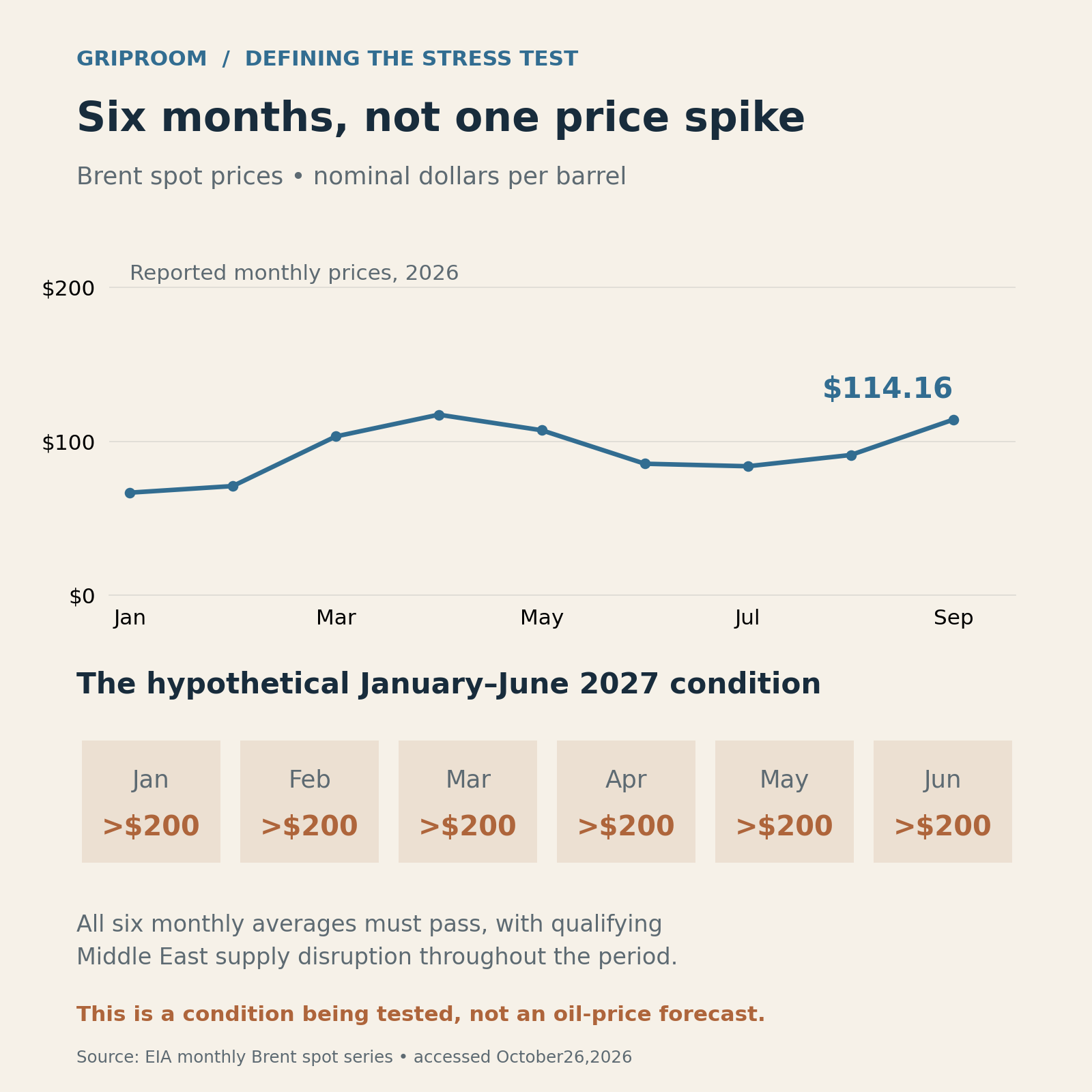
The six $200 tests define the hypothetical scenario; they are not predicted prices. The full condition also requires qualifying Middle East supply disruption. Source: EIA monthly Europe Brent spot series.
There is a credible route to further disruption. Reuters reported renewed attacks on Saudi pipeline pumping stations as diplomatic efforts continued. The important escalation would be repeated damage to production, export routes and replacement routes, extending shortages despite repairs and adaptation.
But the region has also demonstrated an ability to keep oil moving. The IEA's October report describes recovering Gulf crude exports alongside persistent shortages of refined products. Bypasses and ship-to-ship transfers have helped restore flows. Those workarounds are part of the countercase, even when they are costly or vulnerable.
Repeated damage to production and replacement routes is one plausible way to sustain the scenario. Strong demand could contribute alongside the disruption; the condition does not stipulate an exact quantity of lost supply. We have not assigned a probability to the entire condition occurring.
The damage reaches beyond the gasoline pump
For households, the immediate pressure is purchasing power. Driving to work and heating a home are harder to abandon than a restaurant meal or a weekend away. If essential energy costs take more of the budget, discretionary businesses can lose customers even while those customers remain employed.
For an employer, the pressure can arrive from both directions. Fuel, materials and deliveries become more expensive just as customers start looking for savings. Raising prices protects margins only if buyers can afford to pay them. Absorbing the increase leaves less money inside the business. Either route could end in fewer hours, delayed investment or reduced hiring. A household's attempt to protect its budget can become another household's lost income.
The starting labor market supplies little room for complacency. September payrolls increased by just 29,000, following an average monthly gain of 45,000 over the preceding year. Unemployment remained at 4.2%. That is slow hiring, rather than an established nationwide contraction. But a job market adding few positions offers less reassurance to someone who needs a replacement paycheck. An energy squeeze would arrive with hiring already subdued.
Spending was stronger: real consumer spending increased 0.6% in August, while real disposable income was unchanged. Consumers were still buying more after inflation. A sustained additional squeeze would test how long that strength could continue.
The shock could also reach U.S. businesses through weaker overseas demand and disruptions to industrial inputs. Those channels matter because the economic consequences of damaged shipping routes can extend beyond the crude oil being transported.
The human toll would depend on how far the squeeze spreads. A household losing hours could face harder choices about rent, debt payments and essentials; a business losing customers could struggle to keep its staff. We have not estimated how many Americans would face those outcomes. The recession probability does not supply a separate forecast of unemployment, home losses or falling stock prices.
America has a cushion that the 1970s did not
The strongest reason to resist a near-certain recession forecast is that the United States now produces much more energy and uses less oil for each dollar of economic output.
The EIA's October petroleum outlook puts U.S. liquid-fuel consumption at 20.7 million barrels a day in 2025, while combined crude and petroleum-product net exports were about 2.8 million barrels a day. Those totals cover different components of the energy system; domestic production does not make every region or fuel market self-sufficient.
The national totals can also conceal local shortages. The same EIA report put East Coast distillate inventories 32% below their seasonal five-year average in September. Heating fuel and diesel must reach the places that need them, in the right form and at the right time. An exporting country can therefore contain households facing sharply higher bills and businesses struggling with particular fuels. National income gains and an individual family's ability to pay are separate questions.
Some of the extra money paid for oil can become American income. That supports producers, investment and spending in energy-producing areas, partially offsetting losses elsewhere. The offset matters to national output. It does not automatically put money back into the budget of a commuter facing higher costs or restore a shift cut at a struggling restaurant.
A Dallas Federal Reserve working paper makes this countercase unusually concrete. Its model finds an initial reduction of roughly 0.3 percentage point in annualized U.S. growth after a major global oil-supply disruption under modern economic conditions. Crucially, it also examines longer disruptions. The model's U.S. effects remain comparatively small even when the supply loss lasts two or three quarters.
These are reductions relative to the model's baseline, not predictions that GDP itself falls. They cannot be converted directly into recession odds. Its oil benchmark, price path and supply assumptions also differ from our six-month Brent condition.
The paper leaves out several relevant shipping, industrial-input and LNG disruptions, and does not incorporate country-specific monetary policy rules and nominal rigidities. Those omissions leave room for a worse outcome. They do not prove that the missing effects would be large enough to overwhelm the cushion.
The dangerous second round is financial
An oil shock becomes more threatening when inflation pressure and financing conditions reinforce the damage to spending.
September consumer inflation was 3.7% over the previous year, with gasoline responsible for more than half that month's overall price increase. The Federal Reserve had already raised its policy-rate target to 3.75–4% in September.
Another sustained supply shock could complicate efforts to bring inflation down. Further tightening, or borrowing costs that stay high despite weakening demand, could leave households and businesses squeezed by both energy and finance. Borrowing to bridge a temporary shortfall becomes harder when credit is costly or lenders pull back. A business facing weaker sales could then have fewer ways to keep paying staff while it waits for demand to recover.
Those are possible responses, not facts built into our scenario. The latest Chicago Fed financial-conditions index was still below zero, indicating conditions looser than average. Recent tightening did not establish that a financial crisis was already underway.
The worst paths would involve these pressures feeding each other: expensive essentials weaken spending, weaker sales threaten jobs, and lost income makes the original bills harder to pay. A major credit crisis is not assumed in our scenario. Whether financial pressure intensifies is one of the reasons the outcome remains uncertain.
How the 40% judgment is built
We give half the weight to paths where producer income, adaptation and resilient demand absorb much of the additional damage. Within that group, we assign a 20% chance of a qualifying recession, including other sources of economic weakness.
We give 30% weight to a broader, persistent squeeze on households and businesses, with recession and continued expansion roughly balanced. The remaining 20% weight goes to paths with material additional financial or policy pressure; there, we assign a 75% recession chance.
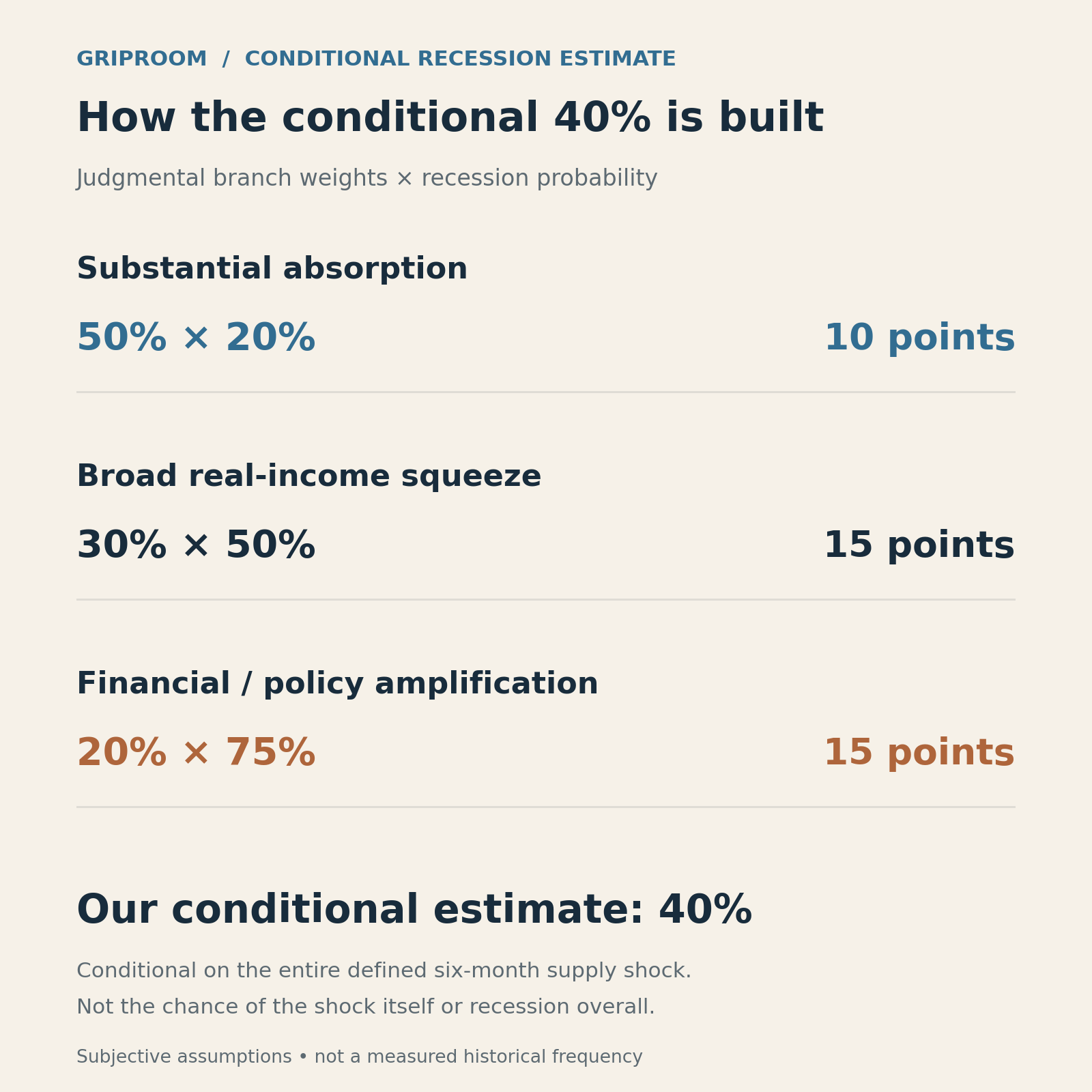
GripRoom's subjective branch weights and within-branch probabilities produce 40%. These are judgments about the defined conditional event, not observed failure rates or the probability of the energy shock itself.
The weighted calculation produces 40%. Reasonable changes to those assumptions move the result to roughly 25–60%. That sensitivity range is not a statistical confidence interval, and the point estimate should not suggest the economy's response is known precisely.
There is also a complication in the condition itself. A recession can reduce oil demand and prices. If even one qualifying month averages $200 or lower, this particular scenario no longer passes—even though recession may still occur. Conversely, deeper supply losses could keep oil expensive during a downturn. Prices alone cannot identify which path the world takes.
We use a new recession as dated retrospectively by the National Bureau of Economic Research. Its monthly assessment considers activity across the economy; two negative GDP quarters are not the official definition. The recession must begin within our window, although its formal identification can come later.
The decisive question is whether the energy squeeze spreads into employment, real incomes, lending and demand widely enough to overwhelm America's offsets. Six months above $200 would test much more than the fuel budget. It could test whether businesses can keep their workers, whether paychecks stretch to essentials and whether families have room for another setback. Even a national economy that avoids recession could leave many of them worse off.