
An election complaint is easy to broadcast. A crowd has to leave the house.

Editorial illustration: a signal is easier to send than a crowd is to mobilize.
Donald Trump does not need a mob to turn an election into a fight. Sometimes, a court filing will do.
On October 22, the Justice Department asked a federal court to intervene in Alaska’s Senate election, seeking to block certification under specified conditions while alleged voter confusion was investigated. That was a request, not a ruling. But it offered a concrete glimpse of how a contested result could become a battle over whether the winner gets recognized.
The harder question is whether that fight spills into a violent crowd attack.
As of October 25, we estimate about a 3% chance that Trump rejects an adverse congressional result and a documented Trump-linked crowd violently disrupts an official election process between November 3 and January 31, 2027—if Republicans win 190 or fewer House seats.
That condition means a loss of at least 30 seats from the party’s opening strength after the 2024 election. Losing the Senate is not an extra requirement.
The path to that 3% runs through a distinction that election coverage can blur: an accusation is easy to broadcast. A crowd has to leave the house.
An angry president still has a presidency
We put the chance of a narrower kind of rejection at 80% in that same blowout scenario. Here, rejection means Trump calls at least one adverse House or Senate result illegitimate and demands that it be reversed, rerun or not recognized. Mere grumbling does not count.
He could accept a Democratic House while insisting that one congressional race was stolen. That is a very different outcome from refusing to accept the national result, let alone trying to overturn it by force.
There is precedent for that split. After the 2018 midterms, Trump recognized Nancy Pelosi’s path to becoming speaker. Two days later, he alleged corruption in Arizona’s vote and raised the prospect of a new election. Those statements are evidence of how acceptance of a chamber loss can coexist with attacks on individual contests; they are not proof that every complaint meets our rejection test.
The less obvious difference from 2020 is the job at stake. A midterm defeat can cost Trump allies, legislative control and protection from hostile oversight. It does not, by itself, take away the presidency.
There is also no presidential Electoral College count for Congress to conduct after these elections. Under the Constitution, elections involve state processes, while each chamber judges its members’ elections and qualifications. Outgoing congressional terms end in January; an outgoing majority’s refusal to acknowledge defeat does not make those terms permanent.
That removes a ready-made national rally point. It does not remove the stakes or the many local places where trouble could occur.

A protest post is not a bus ticket
January 6 established that a public summons can help bring people into a violent confrontation with an official process. The House committee’s final report documents Trump’s invitation, the response of participants and the attack that interrupted Congress.
It remains a serious precedent. It is also one episode, not a reliable frequency table for every later grievance.
ACLED’s study of extremist mobilization found a much thinner street response around later legal troubles. It recorded roughly three dozen pro-Trump demonstrations in the month after his March 2023 protest call, fewer than five after his August arrest, and roughly a dozen after his May 2024 conviction.
Those were different disputes, under different conditions. Still, they challenge the idea that Trump can post a grievance and reliably order up the crowds of 2020. Outrage has an excellent distribution network. Attendance is harder.
At his April 2023 Manhattan arraignment, ABC’s reporters described a mixed crowd of supporters and opponents, verbal skirmishes and proceedings that went ahead. The scene was contentious. It did not become another Capitol attack.
Nor did releasing January 6 defendants instantly rebuild the old national networks. Trump’s January 2025 clemency action changed the legal position of those defendants. Its effect on future deterrence and organizing is harder to measure.
ACLED’s January 2026 assessment described no massive resurgence in extremist public activity after clemency. Groups had lost organizers and weakened. Some also had less reason to mobilize while a friendly administration pursued policies they supported.
That last point cuts both ways. A large Democratic gain could give them a fresh grievance.
The local exception
The strongest case against our low estimate is not necessarily a vast march on Washington. It is a smaller confrontation somewhere else.
Our event requires a gathering of at least 100 people overall, not 100 attackers. It requires physical force, assault or property destruction to enter or seize access to a government site handling a count, certification or congressional seating. The official process must be interrupted for at least one consecutive hour, or responsible officials must be evacuated.
Trump must also publicly call for attendance or support for that identified gathering or an organizing effort aimed at blocking the specific process. Evidence must connect the actual gathering to that call. Shared slogans and a generic fraud post are not enough.
This is a measurable link between a call and a crowd, not a finding that Trump ordered violence or committed criminal incitement. And it is not a prediction of destruction on January 6’s scale.
Those rules leave a real local risk. A small violent faction could force an evacuation while most of a larger gathering stayed peaceful. Only one incident needs to meet the test.
Reduced public activity is not the same as vanished capacity. Princeton’s Bridging Divides Initiative describes groups that remained able to react to flashpoints while shifting toward online threats and harassment. ACLED’s July overview likewise found localized reactivation, even as overall activity remained well below earlier levels. These accounts partly share data; they are not separate votes for the same conclusion.
Protection is uneven, too. A survey of local election officials, conducted early this year, found both plans to coordinate with other agencies and concerns about resources. Later, officials told Nextgov that renewed federal offers arrived too late for some preparations, while others still intended to accept help.
Much of that evidence concerns cyber support and coordination. It cannot tell us how every local office would handle a hostile crowd. Neither an announced security plan nor an earlier budget cut settles that question.
Why we land at 3%
Our estimate puts three judgments together. First, the 80% chance of the defined result rejection. Then a 25% chance, given that rejection and the House blowout, of a specific process-blocking call with an actual linked gathering. Finally, a 15% chance that the remaining crowd-size, violent-access and disruption requirements are met somewhere in the episode.
That gives 80% × 25% × 15% = 3%. These are our reasoned judgments, not rates measured in a laboratory. The second step does not quietly assume that the crowd is already large or dangerous. A small, peaceful gathering can pass that step and fail the last one.
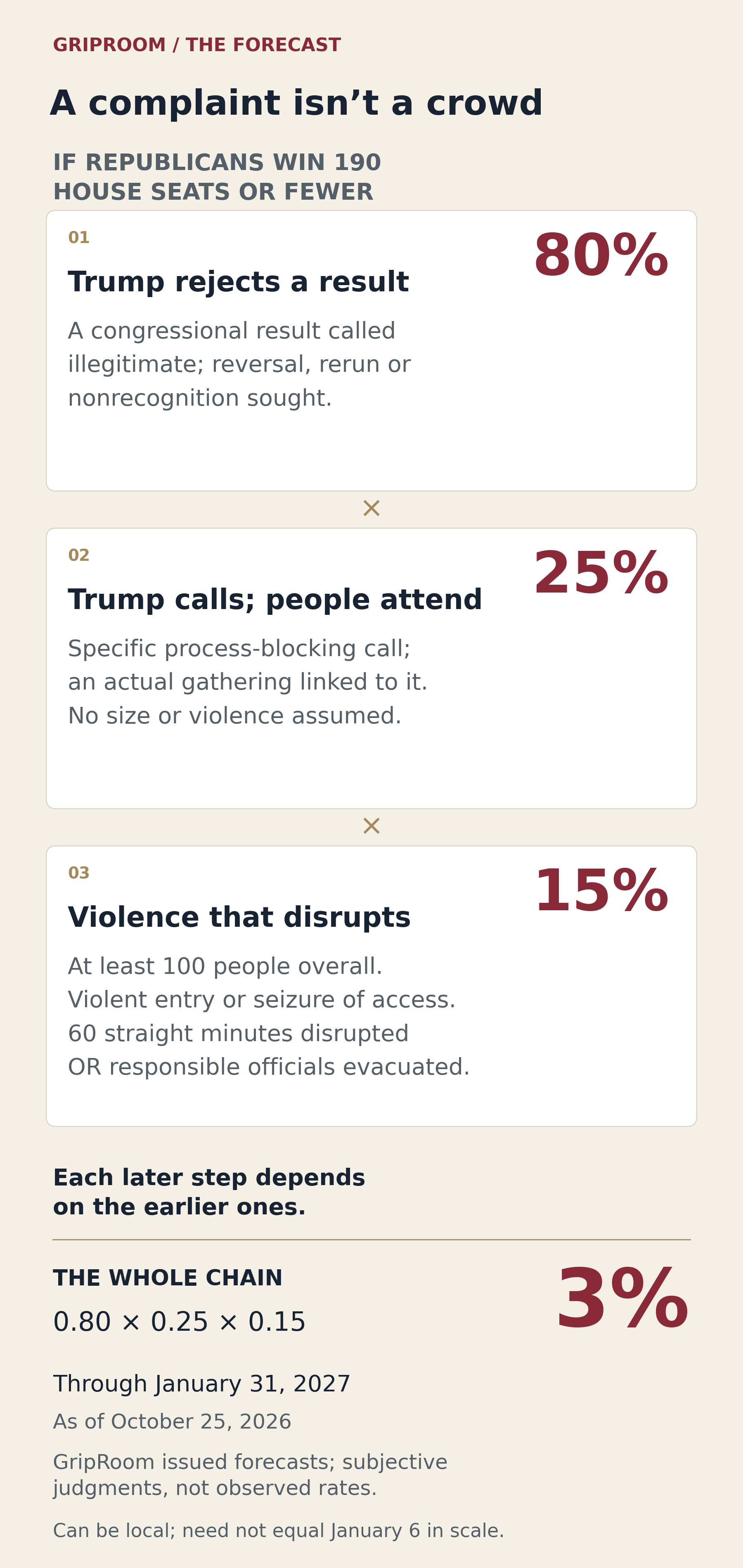
Reasonable changes matter. Holding the other judgments fixed, a 10% final-step estimate produces a 2% overall chance; 25% produces 5%. Combining our wider low and high assumptions gives a stress range of 0.3%–11.4%. That is not a confidence interval. Our point estimate remains 3%.
This is lower than our initial 8% because the earlier reasoning did not sufficiently separate modest organizing from an already dangerous mobilization. The current estimate counts every remaining hurdle. The older number is not the number to use for this forecast today.
The ordinary alternative is a bruising aftermath dominated by lawyers, officials, public accusations and political pressure, with any crowds too small, peaceful, disconnected from Trump or insufficiently disruptive to meet this test. That would not mean intimidation or other violence had disappeared.
We would raise the estimate after a verified process-specific summons with real uptake, sustained organizer coordination or credible failures of protection. Clear acceptance, effective discouragement of obstruction and peacefully completed processes would push it down.
The forecast runs through January 31. Official returns and controlling court decisions establish the seat condition; authenticated statements and official incident records, backed by reliable reporting, establish the rest. If Republicans win 191 House seats or more, this particular conditional forecast does not apply. Unclear crowd size or linkage stays unclear, rather than being forced into a verdict.
The decisive signal is therefore more specific than another furious post. Watch for a place, a process and a call that people actually answer. The distance between a complaint and a crowd is where much of the risk lives.