

In November 2022, CIA director Bill Burns spent four hours in Turkey warning his Russian counterpart about nuclear use. Ukraine had won back territory. Washington was worried about where further Russian losses might lead.
Burns’s account of that meeting offers a useful way to think about the danger today. A nuclear crisis can be serious enough to demand urgent action while remaining an unlikely outcome.
We put the chance of Russia intentionally detonating a nuclear weapon between October 25 and April 25, 2027 at 3%. That includes an attack, retaliation or a deliberate explosion intended to frighten an adversary. It also includes deliberate unauthorized use by a Russian military unit. Genuine weapons tests and accidents are excluded.
Three percent is a low probability of an event with enormous consequences. It warrants attention without treating nuclear use as a coin toss.
The Financial Times reported on October 24 that Tucker Carlson put the chance of Putin using a nuclear weapon within six months at 50%, citing his Russian contacts. The profile places those remarks before a visit described as six weeks before the midterms. His exact starting date and definition remain unclear.
That matters. Our window starts on October 25. A fair assessment must keep the clocks and the outcomes straight.
The missing step between a crisis and a launch
Burns described a particular concern in 2022: further Ukrainian advances might threaten Crimea and create pressure for Russian nuclear use. He also described limits on Ukraine’s ability to reach that point, Russian moves to more defensible positions, US warnings and Chinese objections.
The lesson is that two questions sit inside the frightening headline. How likely is the crisis that might prompt nuclear use? And how likely is a detonation if that crisis arrives?
Someone can believe the second risk is substantial while giving the overall event a much lower chance. The crisis itself still has to happen. Once it does, the decision can still go several ways.
This is the core of our lower estimate. Russia has means to threaten, strike with conventional weapons, change its military position or seek an agreement. Leaders can choose those options even after a serious setback. Each carries its own costs, but detonating a nuclear weapon adds a new and deeply uncertain set of consequences.
A warning can also influence an opponent without being carried out. That gives Moscow a reason to keep making threats. It does not tell us that every warning is empty, or that the next one will be.
China adds a potential political cost. Its April statement to the Nuclear Non-Proliferation Treaty review process opposes nuclear use. Beijing’s position cannot bind Moscow, and we should not assume it would stop a decision Russian leaders viewed as vital. It does give them another reason to consider the diplomatic consequences. Restraint comes from several pressures working together; none is a safety lock.

The rulebook leaves a choice
Russia’s November 2024 nuclear doctrine widened the circumstances in which Moscow says nuclear use could be considered. It includes conventional attacks creating a critical threat to Russian or Belarusian sovereignty or territorial integrity, along with threats to Russia’s ability to respond with nuclear weapons.
Those are troubling provisions. The language gives Moscow room to decide what counts as a critical threat. It also allows Russian leaders to warn that a conflict involving a non-nuclear country could implicate the nuclear power supporting it.
The decision still rests with the president. The decree does not make a specified battlefield loss an automatic launch order.
That discretion cuts both ways. It allows restraint when a declared threshold appears to have been crossed. It also leaves room for dangerous judgments about threats that outsiders may assess very differently.
The public battlefield picture matters here. October reporting describes continued fighting alongside tentative diplomacy. The October 24 campaign assessment includes damage to Crimea’s energy supply and localized Russian advances. It does not establish an imminent loss of Russian control over Crimea.
Damage, defeat and a perceived threat to the state are different developments. Collapsing them into one category makes the forecast less useful.
The strongest reason our estimate could be too low
The most serious counterargument starts with a conventional conflict that gets out of control.
Danish military intelligence warned in September that Russia could conduct limited attacks while its war in Ukraine continues. Its separate timelines for building the ability to wage larger wars depend on conditions, including an end or freeze in Ukraine and Russia’s perception of US support for Europe.
The distinction matters because a limited attack could create a crisis well before a larger invasion becomes feasible. A leader might expect a small operation to stay small. The other side might respond more forcefully than expected.
In an October 25 interview, nuclear-policy scholar Spenser Warren describes a related danger: weaker perceived US commitments could encourage Russian aggression, followed by nuclear pressure if conventional fighting turns against Moscow. That is a credible sequence worth taking seriously.
There is another route. RUSI’s study of Russian nuclear doctrine examines fears that an opponent’s conventional forces could threaten Russia’s nuclear response. If leaders believe their ability to retaliate is in danger, waiting can begin to look risky to them.
This is why a low estimate cannot rest on the comforting idea that everyone understands the costs. Leaders can misunderstand the situation, misjudge the response or believe that their remaining choices are even worse.
A demonstration would still count
The event we are forecasting is broader than a nuclear attack on a city. A deliberate explosion used to coerce an adversary would count even if it killed nobody.
That possibility weakens one familiar reassurance: Moscow could wish to avoid a general nuclear exchange while still considering a limited demonstration. An attempt to frighten the other side could itself cause a much larger crisis.
A genuine weapons test is a different event. The line depends on purpose and context, not simply on what a government calls the explosion. A disputed case would require evidence before we counted it either way.
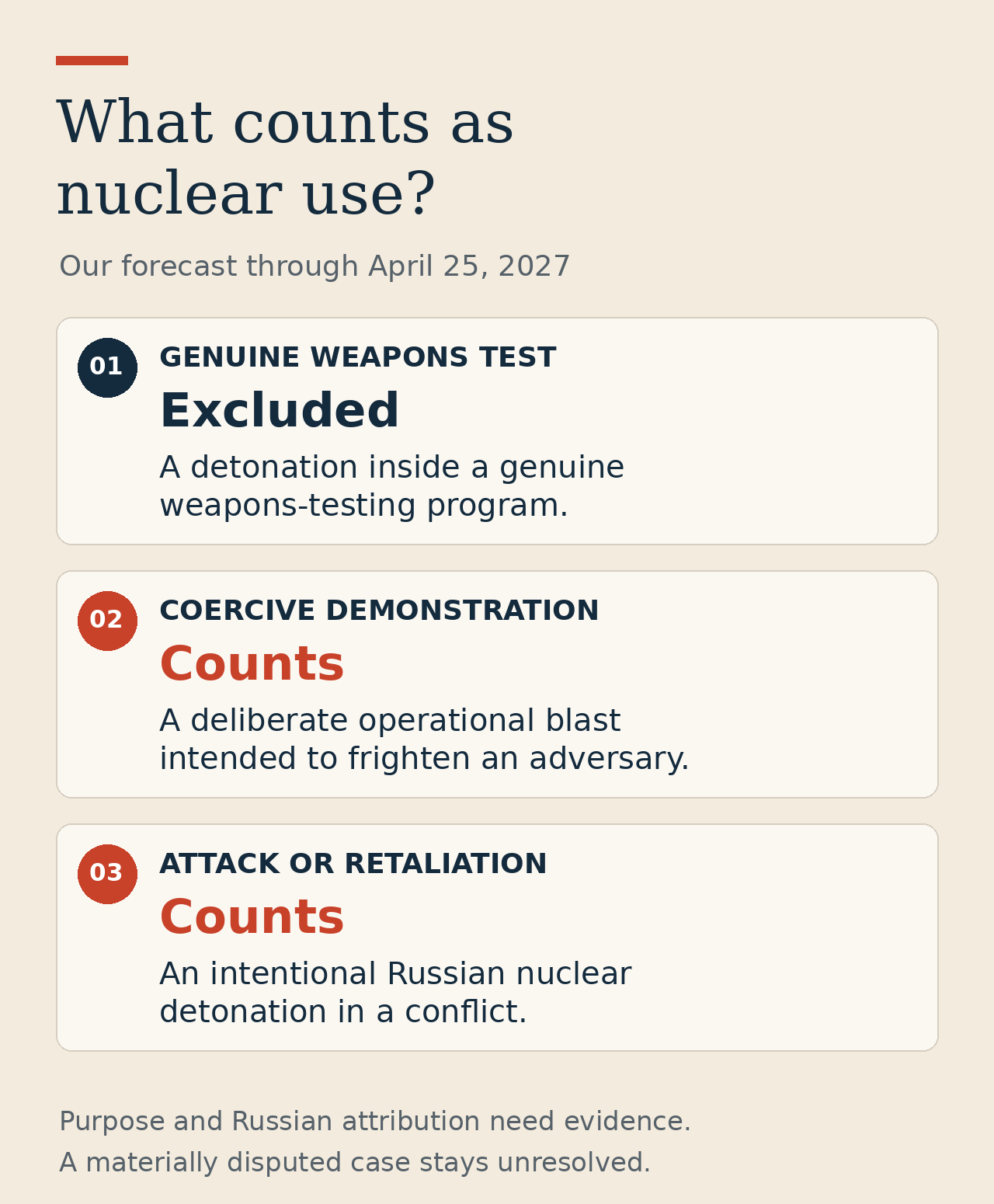
Our forecast excludes genuine tests. It includes intentional operational demonstrations, attacks and retaliation, wherever they occur.
Russia’s arsenal and its exercises establish capability. They do not supply a calendar for use. May reporting on a Russian exercise described military footage claiming to show warhead handling and movement. The footage’s payloads and locations were not independently verified. It cannot establish October release readiness.
The opposite inference would be unsafe too. A lack of public proof of preparations cannot guarantee a long warning period. Some decisions and movements may remain hidden.
Why we land at 3%
Our central judgment is that a severe crisis remains a minority path over this six-month window. Even within one, conventional alternatives, fear of retaliation and political costs give Russian leaders strong reasons to stop short of detonation.
The evidence supports those restraints. It also supports dangerous exceptions: direct fighting with NATO, a rapid reversal threatening vital territory, or fears about the survival of Russia’s nuclear forces. We allow for use outside those specific crisis paths as well.
A simple calculation helps expose the assumptions. Our central case gives a severe crisis roughly a one-in-ten chance, and nuclear use within it about a one-in-five chance. A smaller allowance for other routes brings the combined estimate to roughly 3%.
Those inputs are judgments. Multiplying them does not turn them into measured facts. The public evidence cannot tell us that 3% is precisely right while 2% or 5% is wrong.
Changing the assumptions meaningfully changes the answer. Stronger restraint produces a scenario near 0.5%. A more crisis-prone environment, weaker restraint and greater demonstration risk can push it toward 20%. That range describes alternative assessments; it is not a statistical confidence interval or a firm ceiling.
The absence of wartime nuclear use since 1945 is important context. It is not a pile of identical six-month experiments from which we can read off today’s odds.
What would raise our estimate is evidence of a changing situation: corroborated operational preparations, sustained lethal NATO–Russia fighting, a rapid territorial reversal or a perceived threat to nuclear command. A broad ceasefire and durable de-escalation would pull in the other direction.
The next nuclear warning will deserve scrutiny. The harder task will be finding out what has changed behind it: the battlefield, the available choices, or the decisions being made.