
Creditor advisers raise the pressure. The decisive question is whether JetBlue retains access to enough cash to cross the year-end deadline
An airline can have planes in the sky, customers buying tickets and a frightening conversation taking place among the people who lent it money.
JetBlue has reached that uncomfortable stage. A group of senior creditors has hired restructuring advisers, according to Wall Street Journal reporting. That is a serious warning. It also leaves the most important question unanswered: how quickly could financial pressure become a formal bankruptcy decision?
We put the chance that JetBlue officially announces intended or completed bankruptcy before the end of 2026 at 14%, based on information available October 26. An announcement that the company intends to enter bankruptcy would count, even if the filing follows later. Hiring advisers or negotiating a debt exchange would not.
That puts the outcome well below even odds. It still represents a substantial risk for people whose savings, jobs or business relationships depend on the airline. The short deadline makes this a question about access to money and the speed of negotiations, rather than simply whether JetBlue has too much debt.
The calendar offers some protection
The bond-market signal is ugly. The Journal reported that JetBlue's $2 billion notes due in 2031 fell from about 80 cents on the dollar early in October to 42 cents on October 22, then recovered into the mid-40s the following day.
The maturity date matters. Those bonds do not come due this Christmas. Their price reflects a much longer stretch of uncertainty, including what investors might recover if a restructuring occurs. Reading a discounted bond as the probability of bankruptcy over the next two months would answer the wrong question.
JetBlue's June financial filing reported about $2.2 billion in unrestricted cash and investments, plus a separate undrawn $600 million credit line. Scheduled principal and finance-lease maturities for the rest of 2026 totaled $236 million.
That comparison supplies the strongest reason to resist an imminent-bankruptcy narrative. The reported resources were much larger than the remaining scheduled principal bill. JetBlue had also completed a $500 million aircraft-backed financing by June.
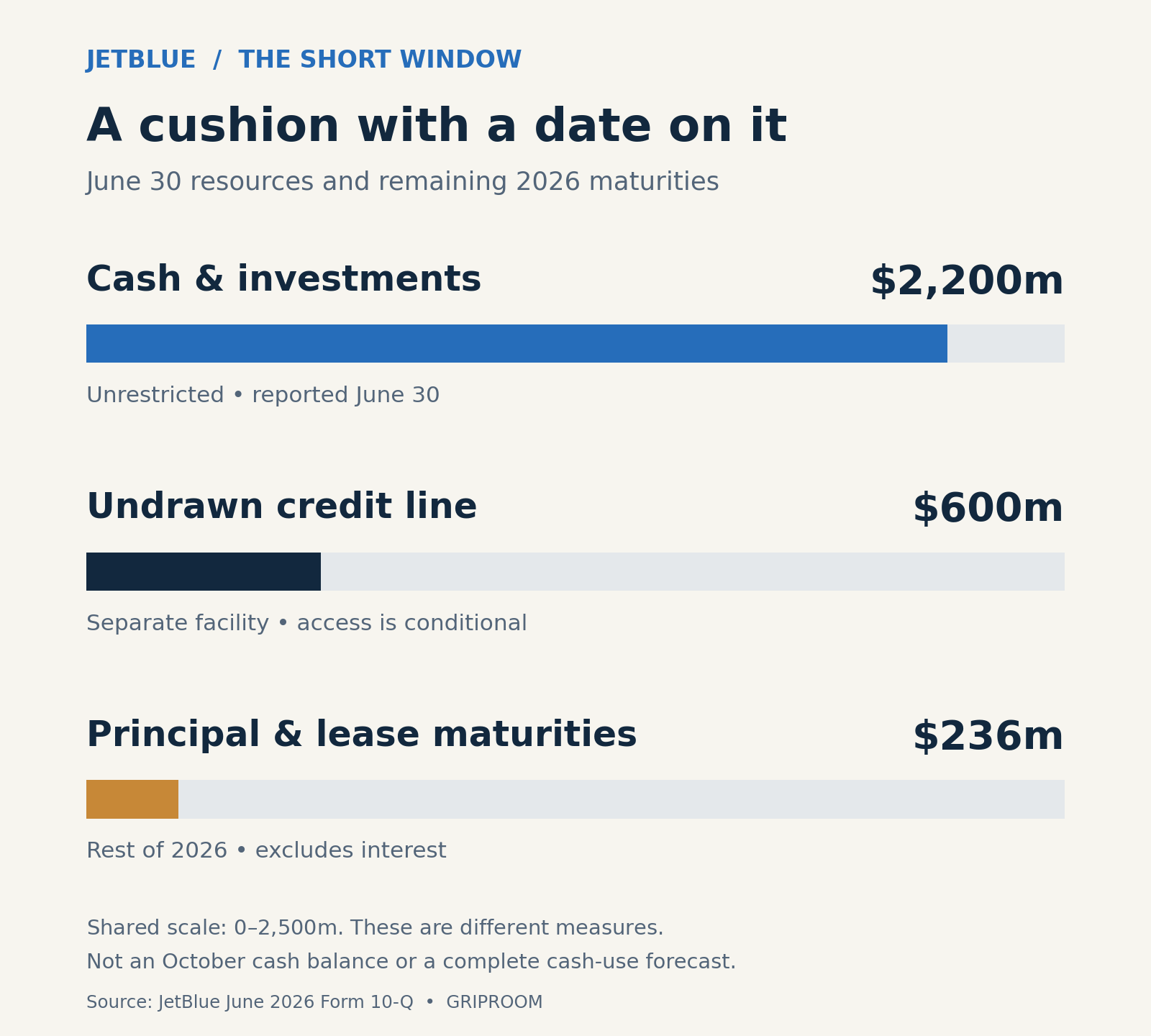
June resources provide context, not an October cash balance. The credit line is conditional; the maturity bar excludes interest, operating costs and other commitments. Source: JetBlue's June 2026 Form 10-Q.
There is no useful countdown clock obtained by dividing those resources by that bill. An airline also pays for fuel, people, aircraft and the daily work of keeping its network running. Borrowing can provide breathing room while making the next financing harder to arrange.
More important, June is four months behind the question we are trying to answer. We could not verify an October cash balance. The latest known cushion supports a lower estimate, but it cannot certify how much money is available today.
The money can become harder to reach
A bankruptcy timetable can accelerate when cash stops being freely available, even without a giant bond maturity approaching.
Start with tickets. Customers often pay before they fly. JetBlue's filing describes card processors' rights to require reserves or withhold funds in certain circumstances. No processor collateral requirement existed at the end of June; that dated disclosure does not establish the current position.
The business logic is straightforward. A processor exposed to refunds has a reason to protect itself. Money retained for that protection is money the airline cannot use elsewhere. The same ticket sale can create revenue for the carrier and a potential liability for the intermediary handling the payment.
That creates a possible feedback loop. Financial concern prompts tighter cash protection; tighter cash protection puts more pressure on the airline. The mechanism deserves attention precisely because it can work faster than a distant debt maturity. We have not established that such a loop is operating at JetBlue now.
The loyalty program supplies another constraint. JetBlue's TrueBlue financing agreement specifies a $750 million quarter-end minimum for its defined measure of liquidity. Qualifying available revolving credit can count toward that measure. A separate debt-service coverage test steps up to 1.75 times after June 2026.
These provisions can affect where money goes. Under specified circumstances, loyalty cash can be directed toward accelerated debt repayment, leaving less available to support the airline. The agreement also contains cure and waiver mechanisms. A test failure, cash diversion and bankruptcy are distinct developments.
This is why the next useful disclosure is more detailed than a reassuring cash total. How much is unrestricted? How much credit is actually available? Are financing tests being met? Has a lender or processor imposed a new condition?
A large balance and unrestricted access to that balance are different advantages. For this forecast, the second may prove decisive.
Demand helps, but costs still get a vote
JetBlue's September operating update complicates the bleak version of the story. The airline described strong bookings into September and raised its expected third-quarter growth in revenue per available seat mile to 17–20%, from 12.5–16.5%.
That is an encouraging demand and pricing signal. It is guidance, however, rather than a completed quarter's financial result.
The same update raised expected growth in unit costs excluding fuel to 6–8%, from 2.5–4.5%. Its fuel-price assumption increased to $3.96 a gallon from $3.49. Northeast weather and air-traffic-control disruption also affected operations.
Those figures can coexist. Selling seats at better prices does not guarantee that the money left after expenses is improving enough. The relevant question is how much cash the operation produces or consumes, and whether financing remains available while management tries to improve it.
A creditor can therefore believe the airline has valuable customers and assets while also wanting professional advice about repayment. Hiring advisers reveals concern and preparation. It does not reveal which solution the parties will choose, or whether they will choose it before New Year's Day.
What the 14% estimate assumes
Our estimate gives the greatest weight to JetBlue finding enough room to cross the deadline without a qualifying announcement.
We assign a 65% weight to a state in which resources and financing options remain sufficient to bridge the window. Even there, we allow a 3% chance of an announcement: a company could choose to reorganize before exhausting its money, or an unexpected development could change the decision.
A second state, weighted at 27%, involves material deterioration with a bridge, waiver or negotiated solution still possible. We put the announcement chance within that state at 20%.
The final 8% weight goes to an acute funding or creditor shock that makes a timely bridge difficult. In that state, we assign an 80% chance of the qualifying announcement before the deadline. Rescue financing and decisions slipping into January remain possible.
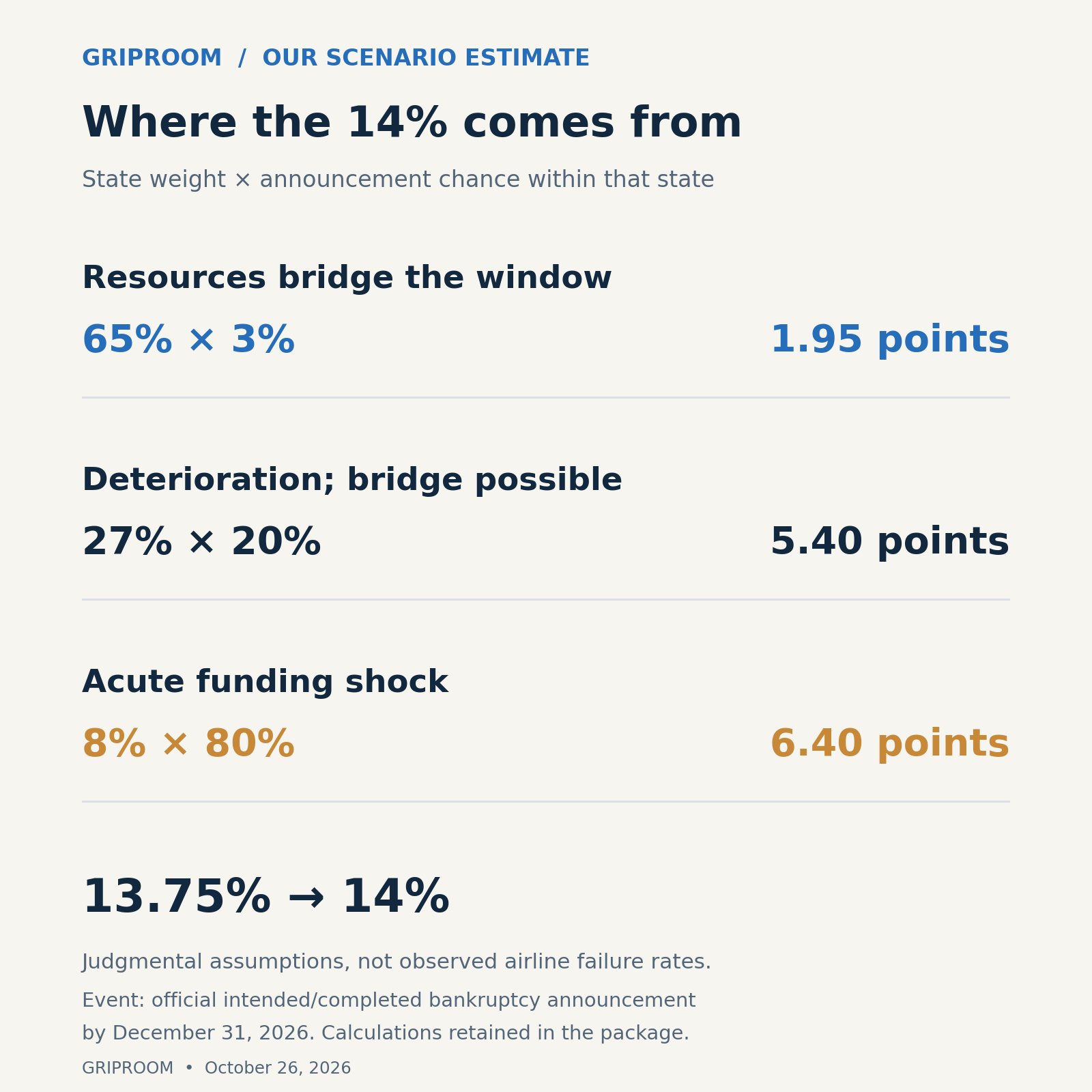
Scenario weights and conditional probabilities are GripRoom judgments. Their weighted contributions total 13.75%, rounded to 14%; they are not observed airline failure rates.
Multiplying each state's weight by its announcement probability produces 13.75%, rounded to 14%. The arithmetic is reproducible; the assumptions remain judgments. We do not have a representative historical sample that converts these conditions into a measured failure rate.
Changing the funding mix and the speed of decisions moves the estimate to roughly 5–27% in our sensitivity exercise. That is a way to show dependence on assumptions, rather than a statistical confidence interval. Verified current liquidity or a new restriction on cash would matter far more than another alarming headline repeating the same adviser report.
A bankruptcy announcement has different stakes for different people
For shareholders, preserving the airline does not necessarily preserve their investment. The SEC explains that companies can continue operating through Chapter 11, while existing common shareholders are frequently replaced through the reorganization plan.
Employees would face uncertainty about what a restructuring demands. Creditors would face negotiations over repayment and control. Customers would reasonably want to know whether their trips and loyalty benefits are affected. Those are substantial concerns, but this estimate does not assign a probability to any particular job loss, flight cancellation or change to points.
The distinction matters because a bankruptcy headline can make several different futures sound identical. An announcement of intended restructuring can qualify for our forecast while leaving the operational outcome undecided. A shutdown would be a separate, more specific event.
JetBlue's next scheduled financial checkpoint is its October 27 earnings call. The most revealing news will concern usable liquidity, financing conditions and cash generation. Strong evidence of access to funds would reinforce the case for crossing the year-end deadline. A verified cash restriction or an imminent, unwaived demand would challenge it.
For now, 14% captures a real risk with a limited window. JetBlue does not have to solve every long-term problem before December ends. It has to retain enough money, flexibility and creditor cooperation to keep those problems from forcing a bankruptcy announcement first.