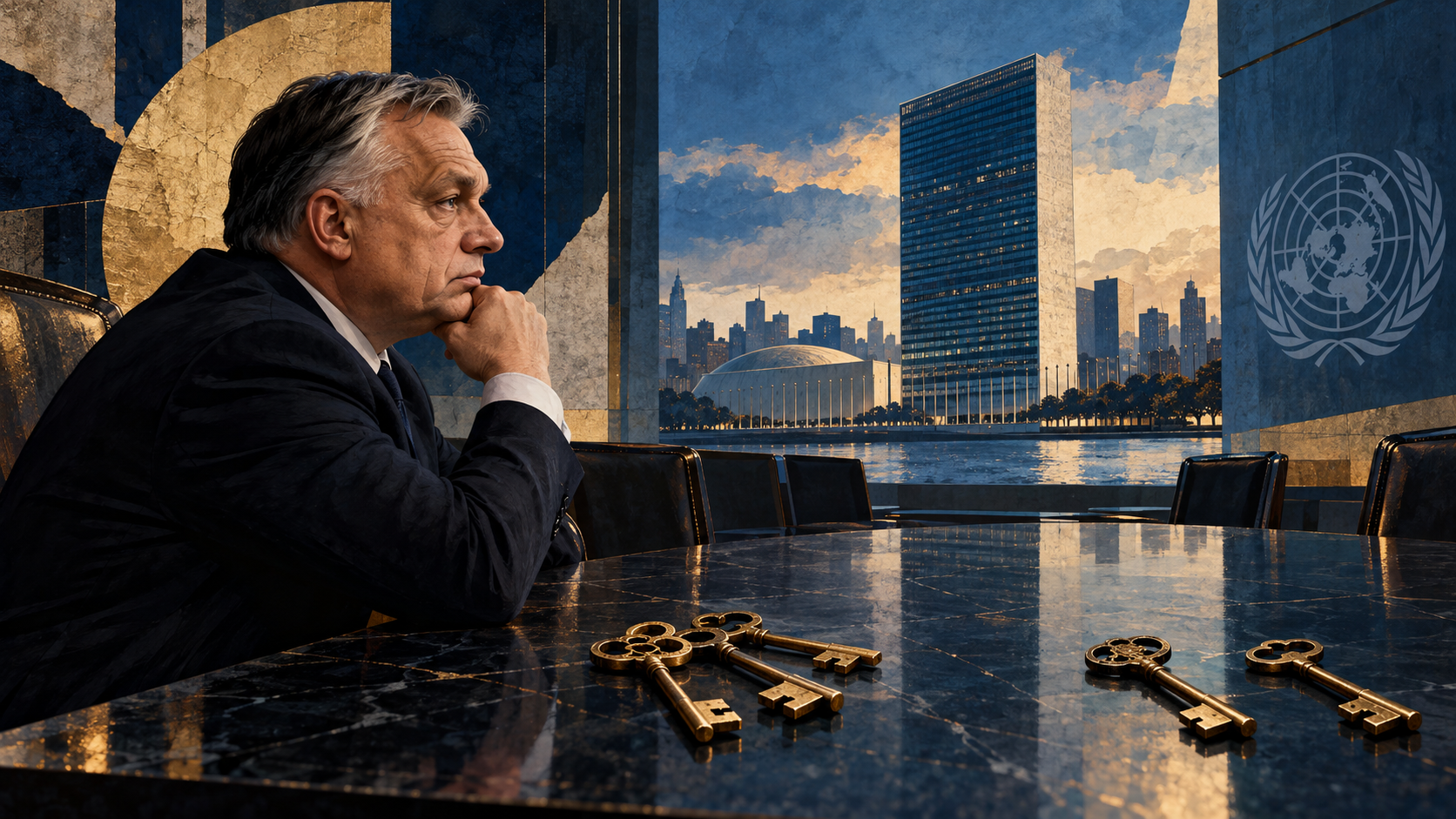
Trump’s reported plan could reopen the race. Britain and France still hold the keys.
In 1996, Boutros Boutros-Ghali won fourteen of the fifteen votes on the United Nations Security Council. He still lost his bid for a second term as secretary-general. The lone opponent held a veto.
That is the detail to keep in mind as Viktor Orbán’s name enters the conversation about the UN’s next leader. A coalition can look enormous on television and still be one government short of a job offer.
The Wall Street Journal’s editorial board reports that Trump administration officials have encouraged Hungary’s former prime minister to run, with possible Russian and Chinese backing. No final decision has been announced.
We put the chance of the UN General Assembly appointing Orbán as António Guterres’s successor by December 31, 2026, at approximately 10%, as of October 26. The appointment could be made this year for a term beginning in 2027.
Ten percent leaves room for a startling comeback. It also means we think this proposal is much more likely to end somewhere short of an appointment.
Three powerful friends do not make five
The UN does not choose its leader through a worldwide popularity contest. Nor can the American president simply send someone over with a new business card.
The appointment rules require a Security Council recommendation followed by a General Assembly appointment. The Council has fifteen members. A candidate needs at least nine votes and must avoid a veto from any of its five permanent members: the United States, China, Russia, Britain and France.
That makes the reported Washington–Moscow–Beijing alignment important. If it becomes real, Orbán would have three exceptionally powerful sponsors.
But those countries cannot outvote a British or French veto. Nine votes with a veto are insufficient. Fourteen votes with a veto are insufficient. The 1996 result is recorded in the UN’s own account of that selection.
The rule cuts the other way too. Orbán would not need London and Paris to become fans. Under the Council’s voting practice, a permanent member can abstain without blocking a decision.
That is his narrow opening: persuade both governments that allowing him through costs less than holding out.
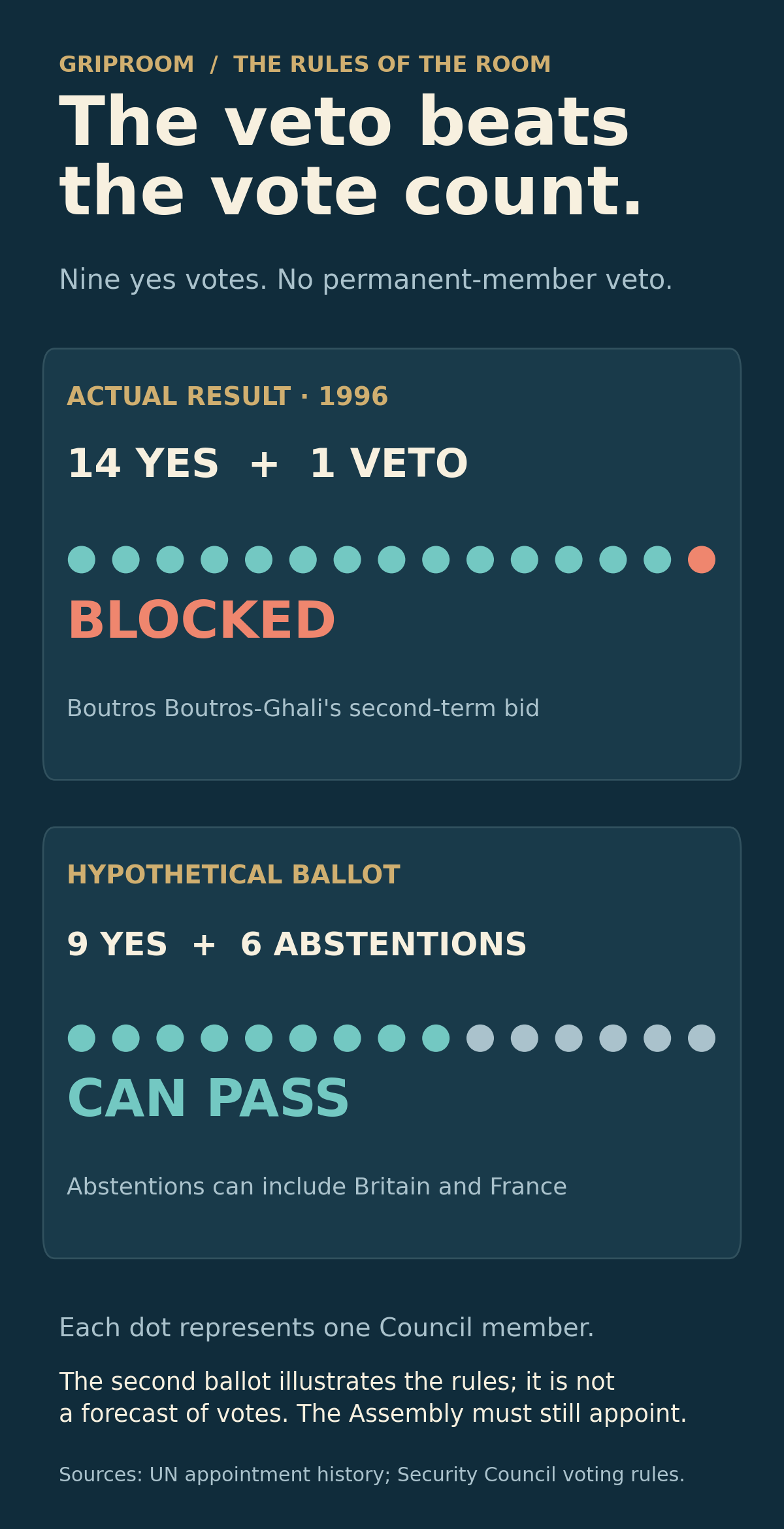
The first ballot reflects the 1996 attempt to reappoint Boutros Boutros-Ghali. The second is hypothetical, showing how abstentions can permit a recommendation. Neither is a reported vote on Orbán.
The leak has arrived before the candidate
There is a large difference between being discussed, becoming a candidate and collecting an appointment.
The reported plan has not crossed those gaps. Euronews reports that Orbán’s interest comes with reservations and that the White House and Beijing have not confirmed the proposal. A senior US official separately told the Daily Beast that Washington has “no position” on the appointment.
Those accounts can coexist. Officials can explore an idea while their government declines to adopt it publicly.
Russia’s response also needs careful reading. Deputy Foreign Minister Aleksandr Alimov said another candidate could still enter, according to Hungarian reporting of his remarks. An open door is not an endorsement.
For now, the evidence supports taking the initiative seriously. It does not support treating three governments as a signed voting pact.
A proposal leaked into public view can also test resistance or strengthen a negotiating position. That is an alternative explanation, not proof of what the officials intend.
Britain and France have something to protect
The most tempting shortcut is to declare that London and Paris would never accept Orbán. We would not go that far. We have not verified a public, Orbán-specific veto pledge from either government.
But resistance would have a clear basis.
Orbán’s record would arrive with him. In 2022, the European Parliament formally condemned democratic deterioration in Hungary, citing concerns about judicial independence, corruption, expression and minority rights. That is an institutional assessment of his period in power, not a prediction of how France would vote.
It nevertheless helps explain why his appointment could carry a substantial political cost for a European government.
France has also described what it wants from the selection. In an October interview published by its foreign ministry, spokesperson Pascal Confavreux stressed multilateralism, consensus-building and the ability to move issues forward.
Our inference is that presenting Orbán as the choice of three powers would not, by itself, answer those concerns. It could sharpen them.
Still, opposition and a final veto are different things. A government can dislike a candidate, bargain hard and eventually abstain. Our estimate leaves a meaningful opening for that outcome.
The deadlock is real—and Orbán is not its only beneficiary
The strongest argument for a surprise is the weakness of the existing finish line.
AP reported that the October 16 straw poll left the leading candidates with opposing votes from permanent members. Rebeca Grynspan had nine encouraging votes, but encouragement is not the same as a veto-free recommendation.
A stalled field gives a late entrant a reason to try.
It does not give Orbán exclusive rights to the opening. The UAE’s Lana Nusseibeh announced her candidacy on October 21. She brings more than a decade of experience as her country’s UN ambassador.
A compromise candidate could offer the powerful states some of what they want while provoking fewer objections elsewhere. That possibility keeps the contest from becoming a simple choice between Orbán and endless paralysis.
There is also pressure for the UN to choose its first female leader. The UN notes that gender is not a formal selection criterion. Preferences shape bargaining; they do not replace it.
The same applies to regional expectations. France’s spokesperson explicitly acknowledged that no fixed rule requires a woman or a Latin American candidate.
The diplomatic seating plan has traditions. It does not have assigned seats.

Why we land at 10%
Our estimate is a rounded judgment, checked against one illustrative route through the obstacles. There is no useful pile of identical Orbán candidacies to count, and this is not a complete map of every possible deal.
First, does the initiative become a viable campaign? We assign roughly a 55% chance to that working scenario: personal acceptance, formal nomination and sustained backing along the reported route. The credible report matters; the unconfirmed commitments matter too.
Second, if that campaign develops, do both Britain and France let it through? We put that joint chance around 20%. We assess them together because the two governments could coordinate. Treating their decisions as unrelated coin tosses would miss the politics.
Third, after those barriers clear, can the campaign secure the remaining support and complete the appointment this year? We put that at roughly 90%.
That last number is high because a viable campaign and nonopposition from the veto holders would already be in place. The final steps can move quickly: in 1996, the Council recommended Kofi Annan on December 13 and the Assembly appointed him on December 17. That example illustrates speed after agreement, not a historical 90% success rate. Missing votes, Assembly resistance or a late deal could still run out the clock.
Multiplying our working assumptions gives just under 10%. Routes without the full reported coalition remain possible but have less evidence behind them. The headline is our approximate judgment for the whole event, rather than a claim to have measured every route.
These steps are linked. If Orbán enters only after securing strong private assurances, that entry should change our assessment of the later hurdles too.
The result is most sensitive to British and French nonopposition. More pessimistic and optimistic assumptions give roughly 3% to 29% for the illustrated route. That is a sensitivity exercise, not a confidence interval or a limit on every possible outcome.
The essential judgment is that a serious campaign is plausible, but a bargain acceptable to both remaining veto holders is much harder.
His sponsors could block everyone else
The strongest case against our low estimate is also built into the voting rules.
Three permanent members cannot appoint Orbán on their own. But each can stop a rival. If they truly unite behind him and refuse alternatives, they could make the other governments choose between an unwelcome candidate and a prolonged standoff.
That is much more powerful than a friendly endorsement. It is a potential negotiating position with teeth.
London and Paris would then have to judge how long they were prepared to resist, whether a different compromise remained possible and what an acceptable arrangement might look like. We have no evidence of a settled bargain, so we do not assume one exists.
The same pressure could also produce someone else. An initial demand for Orbán might end with a less divisive candidate acceptable to all five powers. A hard bargaining position does not always become the final agreement.
That is why public commitment matters so much. The crucial signal would be the reported sponsors ruling out alternatives and holding together when that stance becomes costly.
The job would matter even within its limits
This is more than a contest for a grand office and a good microphone.
The secretary-general influences senior appointments, diplomatic efforts, the Secretariat’s priorities and how crises reach the world’s attention. The Council on Foreign Relations outlines responsibilities that include budget preparation, conflict mediation and oversight of peacekeeping operations.
That gives governments reasons to care deeply about the choice.
It also creates an important limit on the idea of a three-country candidate. Article 100 of the UN Charter requires the secretary-general to serve independently of outside governments. Sponsorship would not give Washington, Moscow or Beijing a lawful right to issue instructions.
The appointment would therefore raise a consequential question: could a leader promoted through that alignment win broader trust and exercise an independent role?
The next evidence to watch is concrete. A nomination would establish a candidacy. Public backing would establish commitments. British and French nonopposition would change the path.
Another approving comment from a friendly official would add much less.
For now, the proposal deserves attention because it has a plausible route to becoming serious. It remains a long shot because the governments reportedly opening the door are not the only ones holding keys.
Sources