
Editorial illustration: a higher cost of borrowing can put the same home much further out of reach.
Borrow $400,000 at 8% for 30 years, and the first monthly payment is about $2,935. Only $268 pays down the debt. The other $2,667 is interest. Property taxes, insurance and repairs still have to fit into the household budget.
We estimate a 40% chance that the average U.S. 30-year fixed mortgage rate reaches 8% during 2027, based on information available October 26. That means at least one weekly reading in Freddie Mac’s national survey. It does not mean rates average 8% for the whole year.
The danger is close enough to take seriously. Freddie Mac’s October 22 reading was 7.32%, leaving a gap of 0.68 percentage point. A brief crossing would settle this forecast; a long stay at 8% would do much more damage.
For buyers, the consequences start with a painfully ordinary calculation. On the same $400,000 loan, principal and interest would be about $2,528 a month at 6.5%, $2,748 at 7.32%, and $2,935 at 8%. The rise from today’s benchmark adds roughly $187 a month, or $2,248 a year. From 6.5%, the extra cost is about $407 a month.
The comparison with cheap pandemic-era borrowing is brutal. An equivalent new loan at 3% costs about $1,686 monthly. At 8%, it costs nearly $1,249 more—almost $15,000 a year. These are comparisons between loans of the same size and length, before taxes and insurance. An existing fixed-rate loan does not suddenly acquire that higher payment.
The damage to wealth building lasts beyond the first bill. Keep that new 8% loan for five years, without refinancing or making extra payments, and the scheduled payments total about $176,100. Only about $19,700 reduces the original debt. The rest is interest. Home-price changes would affect the owner’s equity separately; a large payment is not the same thing as a large increase in ownership.
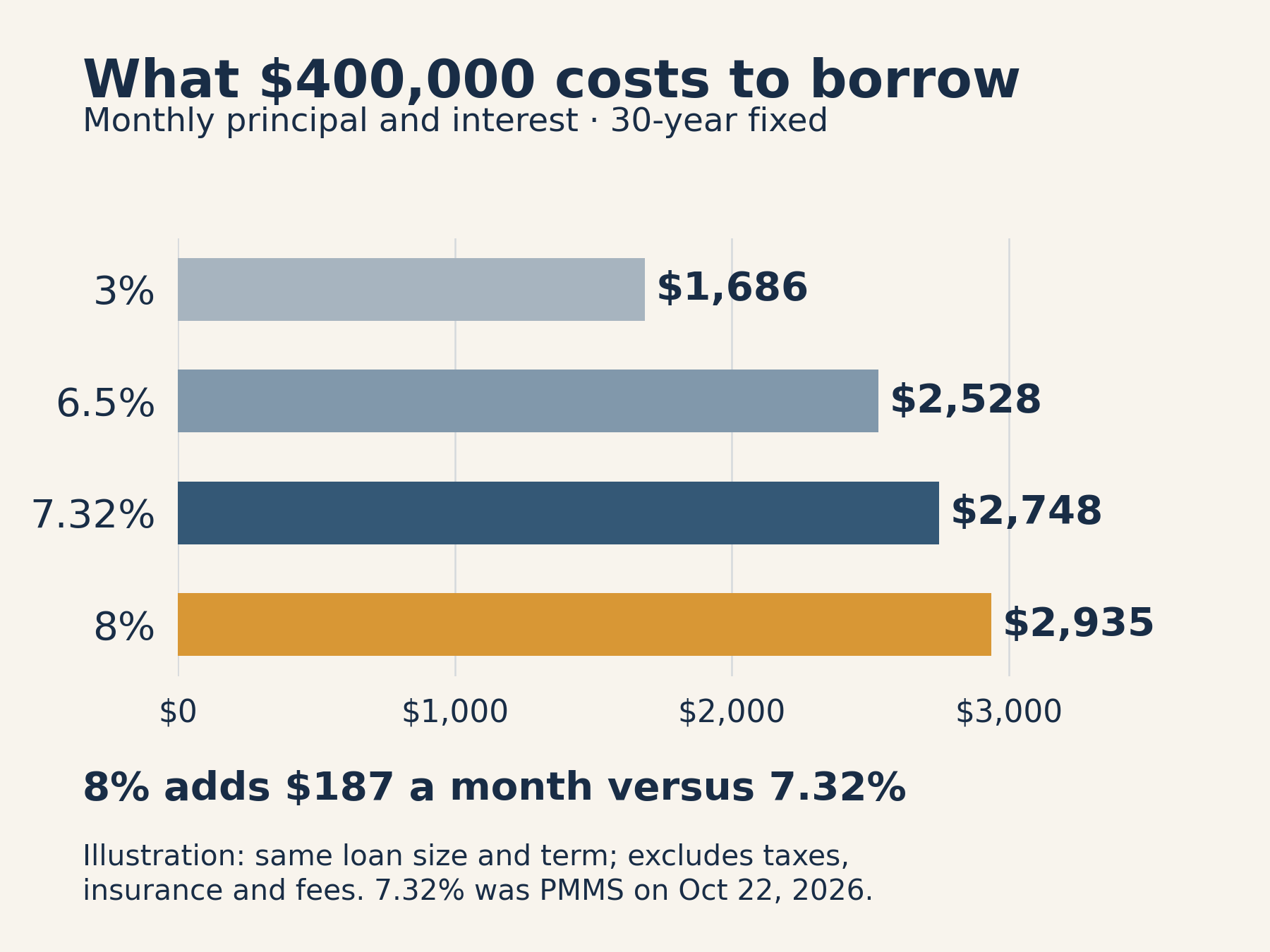
Original calculations for equal $400,000 loans over 360 months. Taxes, insurance, fees and other ownership costs are excluded. The 7.32% comparison uses Freddie Mac’s October 22, 2026 average.
Holding the payment budget fixed makes the damage clearer. A household that can devote $2,528 a month to principal and interest can borrow $400,000 at 6.5%. At 8%, that same budget supports about $344,600. More than $55,000 of borrowing power disappears, even before a lender considers the household’s other debts.
Suppose that household has a $100,000 down payment. The loan and deposit together cover a $500,000 home at 6.5%. At 8%, keeping the same principal-and-interest budget would require a price near $444,600. That is the size of the discount needed in this illustration, not a prediction that sellers will provide it. A buyer may instead have to bring more cash, choose a cheaper property, or postpone the purchase. Taxes and insurance would still need their own calculation.
The arithmetic scales to millions of households. In NAHB’s 2026 affordability table, raising the rate from 7.25% to 7.75% reduces the number of households able to qualify for its example home by about 2.1 million.
That model holds a $413,595 new-home price fixed, assumes a 10% down payment, and includes mortgage insurance and ownership costs. It counts households meeting an income test, including people who are not shopping. It is not a prediction that 2.1 million purchases disappear, or that those households lose homes they already own. It shows how a modest rate move can close the door on a large group.
The market is already showing strain. Pending home sales fell 7.3% in September, according to the National Association of Realtors. Those are signed contracts, an early measure of buying activity. A further borrowing squeeze would reach sellers and the businesses paid when a household moves.
Our 40% estimate starts with the historical distance to the threshold. We examined past mortgage-rate paths from late October through the following year, translating their changes onto today’s 7.32% starting point. In 12 of 35 annual examples since 1990, the following year contained a rise large enough to reach 8%. The other 23 did not.
That gives an anchor near one-third. Checks using other periods and blocks of weekly movements place a broadly stable-rate case in the same neighborhood. Our 40% judgment balances a further inflation-driven rise against a substantial reversal risk. It does not extend the recent upward trend indefinitely.
These examples span different economies and interest-rate cycles. They are not 35 independent rehearsals of 2027. The number is particularly vulnerable to the possibility that today’s high rate is near a cyclical peak: narrower modern comparisons starting at high rates often reverse and imply much lower odds.
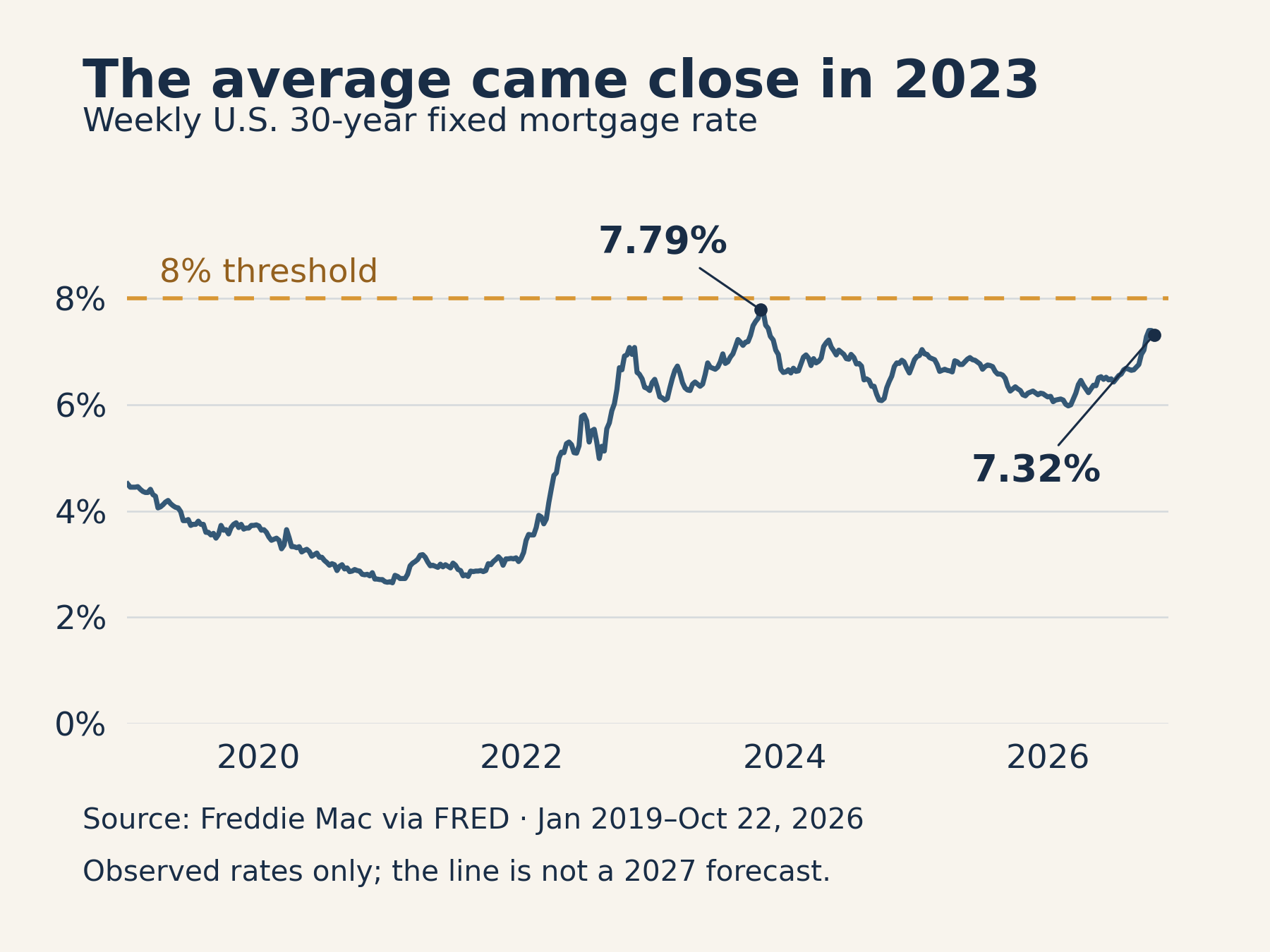
Freddie Mac data via FRED. These are observed weekly averages, not individual lender quotes or a projected 2027 path. Freddie Mac changed its collection method in November 2022.
The upward case has a clear mechanism. Mortgage rates depend heavily on longer-term bond yields and the extra return investors demand to hold mortgage debt. Dallas Fed researchers explain that interest-rate volatility and borrowers’ ability to refinance also affect that extra cost. A cut in the Federal Reserve’s short-term policy rate therefore does not guarantee an equal cut in mortgage rates.
Energy prices could keep that pressure alive. September inflation reached 3.7% over the previous year, with gasoline accounting for more than half the monthly increase. The October Beige Book described higher oil costs spreading through businesses’ fuel bills and delivery charges. Another prolonged energy shock could make investors demand more compensation for lending money over time.
The countercase is substantial. September payrolls rose by only 29,000, and earlier months were revised down. Core inflation, which excludes food and energy, was lower than headline inflation. If energy pressures ease while hiring and demand weaken, bond yields and mortgage spreads could fall. Weakness would hurt households while helping this particular forecast resolve below 8%.
Our drift and volatility checks produce a broad 10%–65% sensitivity range, with more extreme assumptions going outside it. That is not a statistical confidence interval. Forty percent is a considered estimate, not a precisely measured property of next year.
Fannie Mae’s October outlook projects a 7.5% mortgage rate in each quarter of 2027, using interest-rate inputs from September 30. A period average does not put a ceiling on individual weeks. Fannie Mae could be broadly right about the year while the weekly average briefly crosses 8%.
Washington also has reasons to intervene. The October 22 housing order targets selected insurance and refinancing costs. Those savings could matter to eligible borrowers, but they do not establish a ceiling on the national rate. Its mortgage-insurance cancellation pilot applies to loans made after the pilot begins.
The number of people forced to give up their homes cannot be inferred from the rate alone. A homeowner with a fixed 3% mortgage keeps that contractual rate. Insurance, taxes and other bills can still rise, but an 8% new-loan average does not rewrite the old mortgage.
The exposed groups include borrowers whose adjustable rates reset, people with expiring temporary payment subsidies, and owners who need to refinance or move. Their risks differ. A temporary buydown’s scheduled payment increase, for example, is not the same thing as an adjustable loan repricing.
Home loss becomes more threatening when high costs meet lost income or falling equity. New York Fed research found worsening mortgage delinquency associated with rising local unemployment and weaker home prices. Those relationships do not identify how many additional foreclosures an 8% rate would cause.
There is already real distress. ATTOM counted 40,277 properties with foreclosure filings in August, including 5,794 bank repossessions through completed foreclosures. A filing is not automatically a lost home, and those totals are not losses caused by an 8% rate. Turning them into a 2027 eviction count would invent an answer.
The human cost also extends beyond repossession. A household may abandon a purchase before signing, or give up a planned move because the replacement mortgage is too expensive. Those are different losses from a family being forced out of its current home. Counting them honestly requires knowing who needs new financing, who loses income and how long rates stay high. One weekly national reading cannot supply that information.
The more widely shared damage could be a housing market that becomes harder to enter and harder to leave. Cheap fixed mortgages protect owners’ payments while discouraging them from selling. FHFA’s historical lock-in research found that this reduced supply supported prices, counteracting the pressure from expensive borrowing.
An 8% mortgage could therefore arrive without a matching discount on the house. Buyers would face the larger bill; owners could find that moving to a smaller place no longer produces the savings they expected. A cheap mortgage offers powerful protection. In a market this strained, it can also become a reason to stay somewhere a household is ready to leave.