Changing the milk does not change every layer of a drink.
For Starbucks’ new Tiramisu Velvet lineup, the layer worth watching is the foam. The company’s U.S. holiday announcement describes the named Velvet Mascarpone topping with vanilla sweet cream and excludes it from the seasonal foams that can be made non-dairy.
If you change the milk and keep that topping, the topping remains a separate dairy component. A substitution in the cup does not automatically rewrite what sits above it.
That is the practical answer ahead of the announced November 5, 2026 launch. It is an ingredient distinction, not a complete allergy-safe ordering recommendation.
The latte and cold brew start differently
The announced Tiramisu Velvet Latte uses Signature Espresso, milk and vanilla syrup. It is available hot or iced. The Tiramisu Velvet Cold Brew starts with cold brew and vanilla syrup. Both are finished with the named foam and cocoa dusting in the inspected U.S. announcement.
That gives the lineup a shared finishing layer without making the drinks identical. The coffee format still matters to someone deciding what to order.
It also explains why “cold brew” should not be read as shorthand for an unadorned cup of coffee. This named drink is described as a composed recipe, with additions beyond its coffee base.
Choose the format you actually want, then examine the components you care about. The product name gets you to the right starting point; it cannot do the ingredient check on your behalf.
The non-dairy exception is specific
Starbucks says many of its holiday cold foams can be made non-dairy, while expressly excluding Velvet Mascarpone and Caramel Brulée. The useful detail is that named exception.
“Starbucks has non-dairy foam” is therefore too broad an answer to a question about this particular topping. A category can contain an option without every flavor in that category offering it.
The same logic applies to a milk substitution. If the base milk changes but the named topping stays, the change has a limited reach. It affects the substituted component; it does not establish a different recipe for the foam.
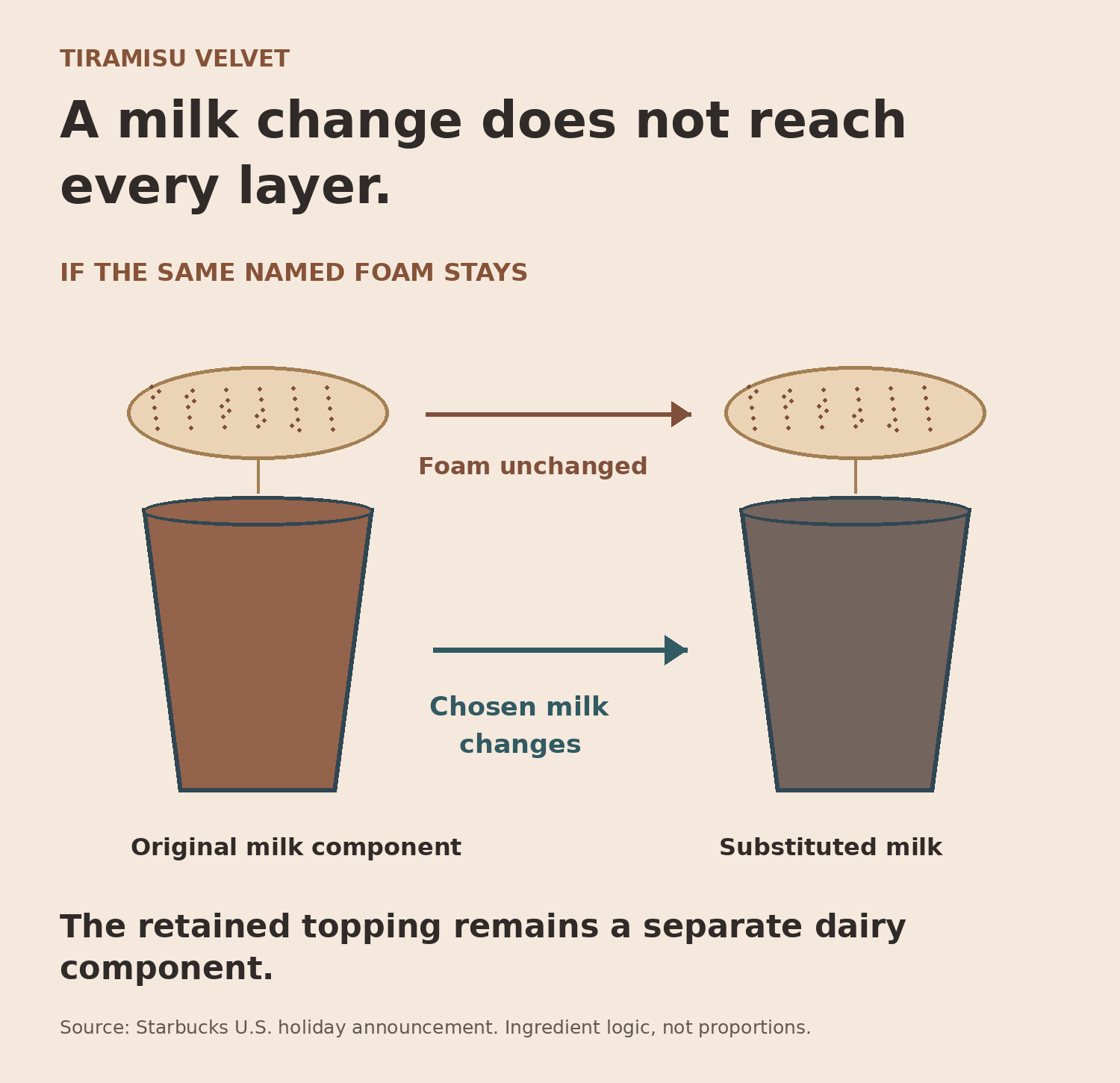
The latte and cold brew have different coffee bases but share the announced Velvet Mascarpone topping. When that same topping remains, changing the milk component does not make the whole drink non-dairy. Removing or replacing the topping changes the advertised build and does not establish allergy safety.
A different topping means a different build
There is a perfectly reasonable next question: could you order another topping, or leave this one off?
That needs a current menu check. It should not be turned into a promise that every temperature, store or ordering channel offers the same set of controls.
There is also a distinction between changing a drink and retaining the advertised version. A topping is part of the composition Starbucks is announcing. Removing it may suit an ingredient preference, but the resulting order is a modification of that build.
The useful approach is to check the components separately: coffee base, chosen milk where applicable, syrup, foam and finishing ingredients. That is more precise than trying to make the word “Tiramisu” act as a complete ingredient label.
It avoids the opposite mistake, too. A dessert-inspired name is not evidence that every ingredient in a traditional dessert appears in the drink. The actual current product information has to answer that question.
An overseas recipe cannot fill a U.S. gap
Searches can turn up Starbucks products with similar names from other countries and earlier seasons. A Norway beverage table is one example of a historical document that appears around Tiramisu searches.
It cannot establish the full recipe of the new U.S. drink. The market, period and specific formulation need to match before an ingredient list can do that job.
This is especially important when the missing information is detailed. Combining a current American product name with an older overseas sauce list creates a recipe that no single source has actually confirmed.
The U.S. announcement supports the base-versus-foam distinction. It does not supply a complete named-product allergen record or a verified table of calories, sugar and caffeine for every size and modification. Those questions require matching current information.
Check the whole order when ingredients matter
A preference to avoid a dairy component and a need for an allergy-safe order are different questions. This article establishes the former component distinction; it does not establish the latter safety claim.
Likewise, changing the milk does not provide a basis for calling the finished drink vegan, lactose-free or lower in a particular nutrient. Each claim needs its own support, including the remaining ingredients and the exact configuration.
For someone simply choosing among the new coffees, the takeaway is useful and concrete: the latte and cold brew offer different bases, while the named foam is their shared finishing feature. If you retain that foam, keep it in the ingredient decision even when you change something underneath it.