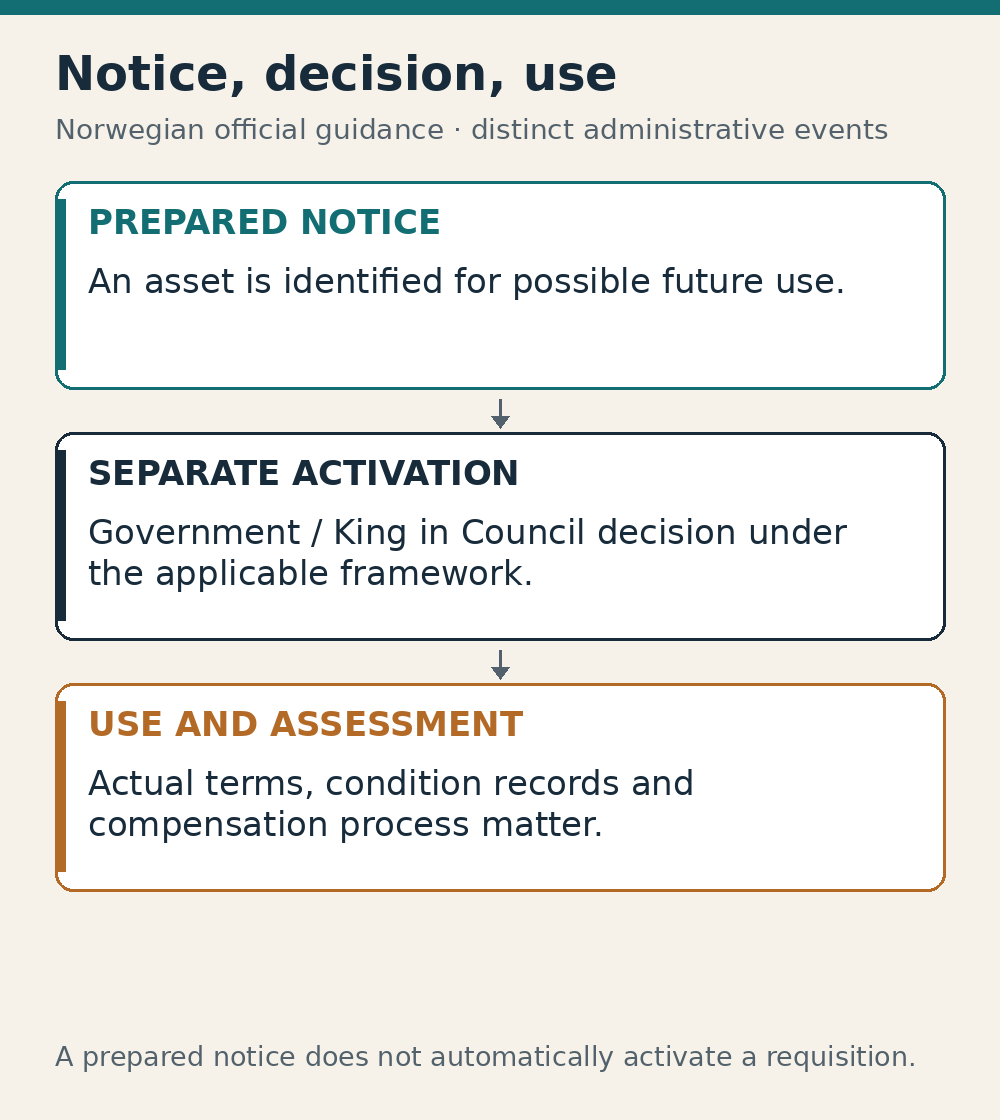
A car can remain in its owner's driveway while appearing in a military plan. That is the distinction behind Norway's prepared wartime requisition notices: selected civilian resources are identified for possible future use, while activation remains a separate step.
The Norwegian Armed Forces announced approximately 13,500 prepared requisitions for 2026. Its January 19 announcement concerned vehicles, machinery, boats and property. Roughly two-thirds were continuations from earlier years.
Those details matter as the story circulates later in the year. The record describes a January administrative round within a wider preparedness programme. It does not establish a newly announced November policy of taking people's possessions.
What a prepared requisition actually means
The military's explanation says a preparatory notice informs an owner that a resource is planned for possible military use if necessary. It says the prepared notice has no practical peacetime effect and normally applies for one year at a time, with possible renewal.
That statement concerns the notice. It should not be expanded into a promise that Norway's entire requisition framework can never have peacetime implications. The official material also discusses separate rules for military exercises and land use.
Prepared selection, a decision to activate powers and actual use of an asset are different events. Collapsing them into one makes the notices sound like evidence that vehicles are already being removed. It also hides the question that matters more for preparedness: how authorities plan to obtain resources they do not keep in everyday military service.
Why the military looks beyond what it already owns
Norway's earlier official announcement about the modernised scheme explains that military units can have needs during war or crisis that their normal resources do not cover. Advance planning helps coordinate access to civilian assets.
This makes the civilian economy part of the logistics picture. A useful vehicle, building or smaller vessel does not become less useful because a private owner normally uses it. The planning problem is how that resource could fit a broader requirement, subject to the applicable rules and circumstances.
The important distinction is between identifying potential capacity and demonstrating that it could be delivered when required. A database entry can reduce one kind of uncertainty—what might be available—while leaving practical questions about activation, availability and use.
That is why the number of notices cannot stand in for a complete measure of military readiness. It describes an administrative population, not a live stocktake of resources already under military control.
The older and newer totals do not measure the same thing
The earlier announcement, originally published in January 2024 and updated in March 2026, reports a little over 4,000 prepared vehicle requisitions in 2022 and 2023. It also says additional resource categories, including buildings and smaller vessels, entered the scheme from 2024.
The 2026 announcement covers a wider mix of resources. Comparing its 13,500 total directly with an older vehicle-only count would mix different categories. It cannot establish a like-for-like rate of growth in vehicle selections.
Renewals create another distinction. A notice continuing from an earlier year is not a newly identified asset, even though it appears in the current year's total. Without a consistent series separating categories, first selections and renewals, a dramatic growth calculation would create precision the records do not supply.
This does not make the modernisation imaginary. The official history describes a broader scheme. It changes what can reasonably be inferred from the numbers: expansion of a planning system is supported; a calculated surge in new car seizures is not.
Civilian emergency services also need resources
The same earlier release describes coordination through county governors to avoid tying up resources that would be better prioritised for emergency tasks in counties or municipalities. The 2026 release says a national resource database supports coordination among total-defence actors.
This is a more revealing part of the story than the image of a soldier arriving for someone's keys. Military need does not erase civilian need. The authorities describe a mechanism intended to reconcile them before a crisis forces choices under pressure.
The public explanations do not reveal a complete asset-level allocation list or every decision about competing priorities. They show that coordination is part of the system. Demonstrating how well it would work would require more than the announcement of a database.
For a reader assessing the signal, that boundary matters. The records explain what the authorities are trying to organise. They do not expose the detailed demands of an undisclosed operational plan.
Activation is a separate decision