

A hospital bed is a piece of furniture. A hospital bed that can receive a badly injured patient is a much larger undertaking: staff, supplies, treatment space and a working system for getting the patient there.
That distinction matters when reading the war-preparedness plans emerging from Sweden and Norway. Both countries are asking their health services to prepare for military conflict. The public records describe concrete work on capacity, transport and priorities. They do not establish that thousands of additional staffed beds are already available, or reveal a secretly known date for a war.
Norway's headline number is roughly 7,000 beds for civilian and military war casualties. Sweden's October announcements describe regional planning built around existing healthcare. As of November 3, 2026, the useful question is how each announced step changes what the health service could actually do.
Norway's 7,000 beds are a planning requirement
In its May 21 announcement, Norway instructed regional health authorities to strengthen their plans with municipalities. The requirement covers both civilians and military personnel injured in war.
The government described the bed figure as an estimate based on assumptions and existing contingency plans. Actual demand would depend on the circumstances. It had not assigned a share to each health trust.
It also made clear that these beds would not be physically in place and operational in peacetime. The task is to plan how services would reorganise and mobilise resources when needed. The figure therefore describes a capacity problem to solve, rather than a count of empty wards waiting behind locked doors.
The announcement placed that work within ordinary budget frameworks and retained normal healthcare as the peacetime priority. Those conditions make implementation worth examining. A national requirement supplies direction; it does not, by itself, show the staff and resources available at every hospital.
Norway's announcement also said war affecting the country in the near future was not considered likely at that time. That was a May assessment, not a fresh November guarantee. Planning for a severe scenario and assessing its near-term likelihood are different tasks; the public instructions should not be mistaken for an undisclosed prediction.
Sweden is planning around different regional problems
Sweden's October 14 health-agency announcement identifies northern Sweden, Gotland and the east coast as important areas for further work. The practical challenges vary.
In the north, long distances, difficult weather and challenging patient transport make cooperation among existing hospitals and care units central to the plan. Norrbotten, Västerbotten, Västernorrland and Jämtland Härjedalen are the first four regions coordinating this work.
Gotland's island geography raises a different problem: maintaining healthcare if transport to and from the mainland is restricted. The east-coast work also needs to consider receiving casualties from the Baltic states. Which regions would participate in that part remained a further planning question in the agency's announcement.
These are descriptions of healthcare dependencies. They should not be repackaged as a map of where officials know an attack will happen. A transport constraint can justify preparation without providing a timetable for the event being planned against.
A preparedness hospital does not necessarily mean a new building
The Swedish agency says the work is based on healthcare that already exists. The plan is not to build new hospitals or immediately decide which existing hospitals receive the designation. The first task is to establish how the concept would function and what resources it requires.
That makes the familiar image of a newly constructed emergency hospital a poor guide to the announcement. The organisational questions include who works where, which activities belong together, and how different facilities could cooperate. Staffing, premises, equipment and management all appear in the planning.
The distinction is useful for readers trying to assess progress. A new building is visible. A coordinated treatment system can be harder to see, even when the work is consequential. Conversely, giving a programme a name does not demonstrate that its practical arrangements have been tested.
Gotland's response shows what remained undecided
In its own October 14 statement, updated the following day, Region Gotland welcomed continued discussions. Regional leaders stressed that future assignments would need suitable resources and conditions.
The region said no decisions had yet been made about future assignments or organisation. That is a dated statement about the stage of the process, not a claim that nothing could have changed afterward.
It helps separate being identified as strategically important from receiving a settled operating role. Those are different milestones. The public record can establish that discussions are happening while leaving the eventual arrangements unresolved.
Sweden has published funding details, with limits
The Swedish pilot grant page lists 38.5 million Swedish kronor for 2026 and a November 16 application deadline. It names Norrbotten, Västerbotten and Jämtland Härjedalen as eligible recipients.
Four northern regions participating in planning and three regions eligible to claim this grant are therefore different counts. They should not be silently combined into four funded hospitals.
An allocation is also different from money already spent, equipment delivered or a service ready to receive patients. The grant information establishes an administrative and financial step. Assessing the resulting capability would require evidence about what the recipients actually put in place.
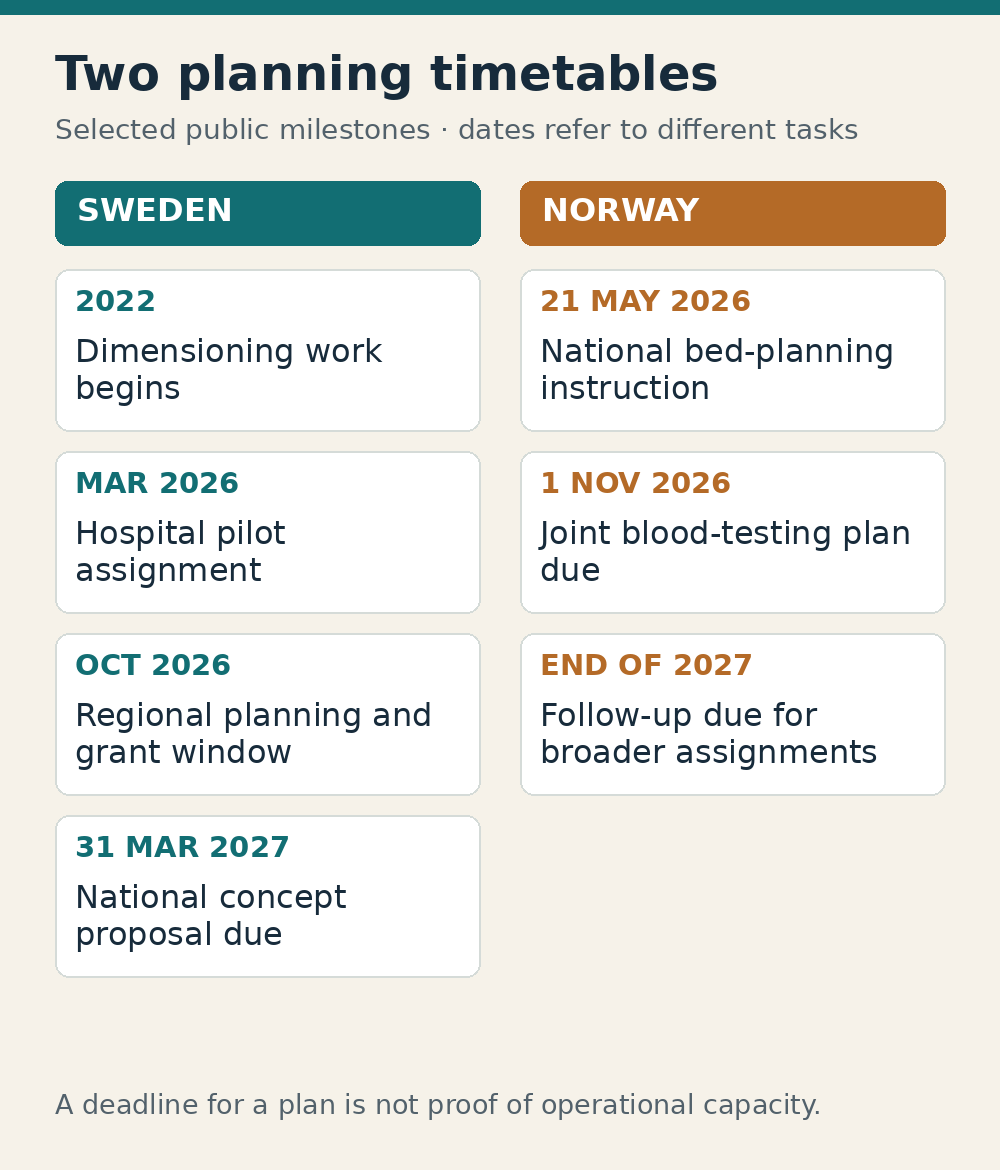
The Swedish milestones are dimensioning work beginning in 2022, a hospital pilot assignment in March 2026, regional planning and a grant window in October 2026, and a national concept proposal due March 31, 2027. Norway’s milestones are the May 21, 2026 bed-planning instruction, a joint blood-testing plan due November 1, 2026, and follow-up of broader assignments at the end of 2027. These are separate deliverables, not points on a conflict countdown or proof that capacity is operational.
Sweden's dimensioning work dates to 2022, according to its government overview. A pilot assignment followed in March 2026, and the national concept proposal is due by March 31, 2027. A visible October announcement sits within that longer programme.
Ordinary patients are part of the wartime calculation
The most consequential detail in Norway's government-posted health-trust meeting protocol concerns priorities. In a wartime scenario, services would need to treat more severely and critically injured patients. Much planned treatment and care for less serious illness would be deprioritised or postponed.
Municipal services would consequently have to manage more patients with more complicated needs. The protocol also calls for cooperation on evacuation, treatment of war injuries and maintaining prioritised hospital operations.
This is a conditional planning expectation. It does not announce the cancellation of today's appointments. It explains why increasing wartime capacity cannot be assessed solely by counting additional places: changes elsewhere in the same health service would help make that capacity possible.
The protocol sets end-2027 follow-up for the broader assignments, with a status report in the 2026 annual reporting. Its separate November 1, 2026 deadline concerns a joint plan for introducing nucleic acid testing in blood banks. A deadline for submitting a testing plan is not a deadline for completing the entire hospital-preparedness programme.
Staffing and blood supply make the plans harder to deliver
In Sykepleien's coverage, named nursing-union and health-service leaders emphasised workforce, competence, infrastructure and investment. Their comments describe the challenge of adapting the same health service that already treats the civilian population.
Those are informed concerns, but they are not a current numerical audit of readiness. They cannot tell readers exactly how many additional patients could be treated tomorrow in each region.
Blood preparation has its own timetable. An October 20 interview with the head of Norway's blood-preparedness coordination centre described earlier planning duties, uneven progress and work toward testing and better stock visibility. A publicly announced step should still be distinguished from independently demonstrated operation.
The joint testing plan due November 1 was not located in the records examined for this article. Its filing and implementation status remain unknown here. Unsuccessful retrieval is not evidence that the health authorities missed the deadline.
Four questions make a stronger test of readiness
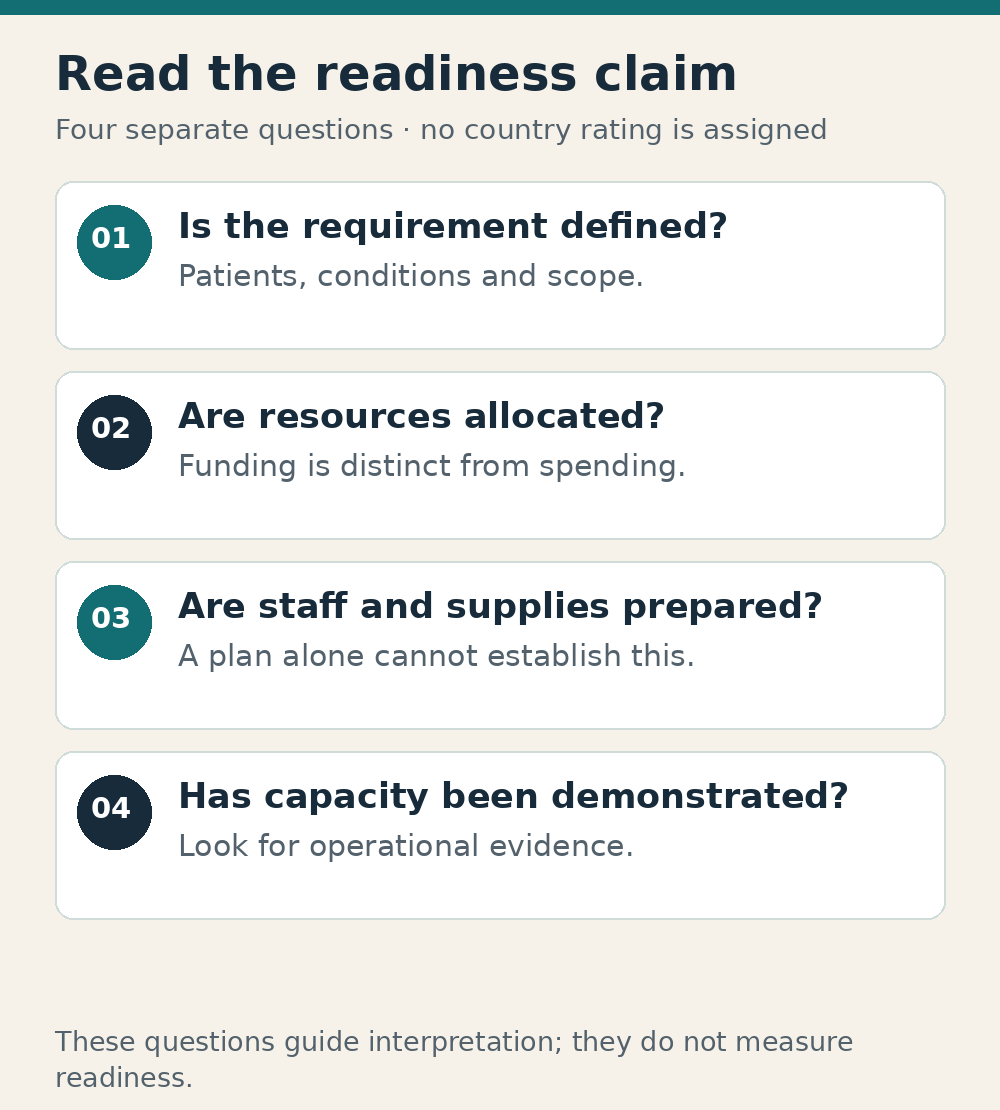
The four questions separate a defined requirement, allocated resources, prepared staff and supplies, and demonstrated capacity. Funding is distinct from spending, and a plan alone cannot establish operational readiness. The diagram assigns neither country a score.
An announcement can answer one of those questions while leaving the others open. Treating them separately avoids both dismissing serious preparations as paperwork and mistaking paperwork for a functioning service.
Sweden and Norway are making their healthcare preparations more explicit. The records show regional tasks, resource decisions and difficult choices about civilian care. They support close attention to implementation. They leave private threat assessments and much current operating capacity outside what the public documents can establish.