A promise to send troops leaves several practical questions unanswered. Which vehicles will carry them? Can the infrastructure accommodate the load? Who authorises the crossing? What keeps supplies arriving after the first convoy gets through?
Those questions are part of NATO’s reinforcement problem. They also explain why a defence discussion can turn, quite seriously, to civilian transport, administrative permissions and bridge requirements.
The obstacles are publicly acknowledged. So are attempts to fix them. The useful uncertainty is how much of the promised improvement has become demonstrated capacity—and whether a particular announcement concerns a proposed rule, an exercised movement or a result measured across the wider network.
There is ample evidence that the dependencies matter. There is much less public evidence for an exact answer to how fast an entire wartime reinforcement effort would arrive and remain supplied.
Moving a force is different from making it available
A formation’s availability and its ability to reach a destination are separate parts of a defence plan. Transport then has to work with the infrastructure and the rules along the journey.
The European Commission’s military-mobility material identifies both physical and administrative requirements. Its proposed framework addresses cross-border procedures, customs and access to transport resources, alongside the wider need for infrastructure that can serve civilian and military uses.
That makes the issue broader than a line of soldiers waiting for a stamp. Suitable transport must exist and be available. The route must be usable for the movement concerned. Administrative approval still has to match the task.
Changing a procedure can remove one source of delay without creating another flatbed wagon. An infrastructure improvement can make a route more useful without arranging every permission or supplying every unit using it. Treating either fix as the whole solution loses the practical point.
A proposed regulation is not an operating result
The Commission presented its military-mobility package in November 2025. The proposed regulation is part of the effort to make military transport easier across the European Union.
In June 2026, the Council agreed a negotiating mandate. That is an important legislative step, but it is a position for negotiations, not the final enactment of the proposed framework.
The European Parliament’s procedure record, inspected on November 3, 2026, still labels Parliament’s first-reading position as pending. The same record lists a committee report and authorisation for interinstitutional negotiations. “Pending first-reading position” therefore cannot be translated into “Parliament has done nothing” or “there is no negotiating mandate.”
Nor does the inspected record establish a final enacted regulation. The distinction matters whenever a headline announces that Europe is creating a faster way to move troops. An announced proposal, a negotiating position and an operating legal framework are different things.
Even after a rule changes, a further question remains: what difference does it make to an actual movement? A permitted procedure is not a measured transport result.
The paperwork clock is not the arrival clock
Military-mobility proposals contain different intervals for different administrative functions. A period for processing a movement request is not the time a convoy needs to load, travel, cross infrastructure and reach its destination. An emergency mechanism’s activation procedure is another clock again.
These distinctions can disappear in a compressed headline. “Permission within a specified period” becomes “troops anywhere within that period,” even though the first statement establishes nothing of the kind.
For the same reason, customs simplification does not mean every movement had previously faced an identical customs barrier at every internal border. The framework covers different procedures, movements and authorities. A useful explanation has to preserve which rule applies to which task.
The practical test is straightforward: what part of the journey does the announced measure change? If the answer is administrative authorisation, the reader still needs separate evidence about transport availability and physical passage.
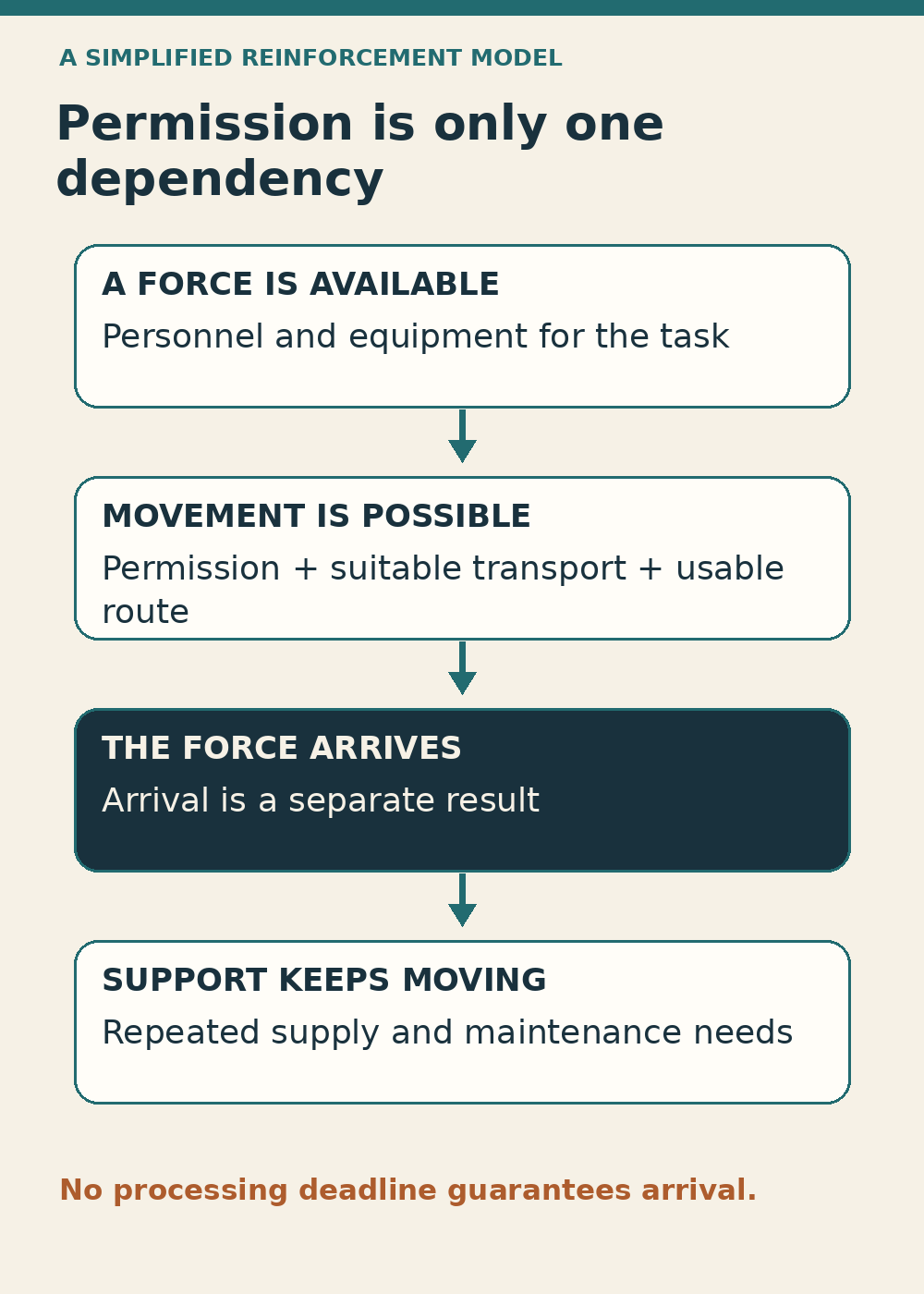
An available force still needs permission, suitable transport and a usable route to move. Arrival is a separate result, followed by continuing supply and support requirements. The simplified sequence gives no troop-arrival time or network-capacity estimate.
The audit found friction—and an urgent exception
The European Court of Auditors’ Special Report 04/2025 supplies concrete examples of why military mobility became a policy concern. Its audit covered September 2021–April 2024, examining the EU action plan, governance and associated funding work.
The auditors found variable progress and obstacles involving infrastructure, regulation and coordination. Their examples included a movement affected by a bridge’s capacity and another constrained by road-weight rules.
One example is especially easy to misuse: a member state required 45 days’ advance notification for cross-border movement permissions. The report immediately adds that the same country issued permissions within one day for urgent military-equipment movements to Ukraine.
Both parts belong in the explanation. The slower requirement demonstrates friction; the urgent exception demonstrates that the standard process did not determine every outcome. Neither is a current EU-wide average, and neither tells us the full time to destination.
The report’s historical scope also matters. It cannot serve as a measurement of the entire network’s performance in November 2026. Its examples explain the kinds of problems being addressed; they do not establish that every problem remains unchanged.
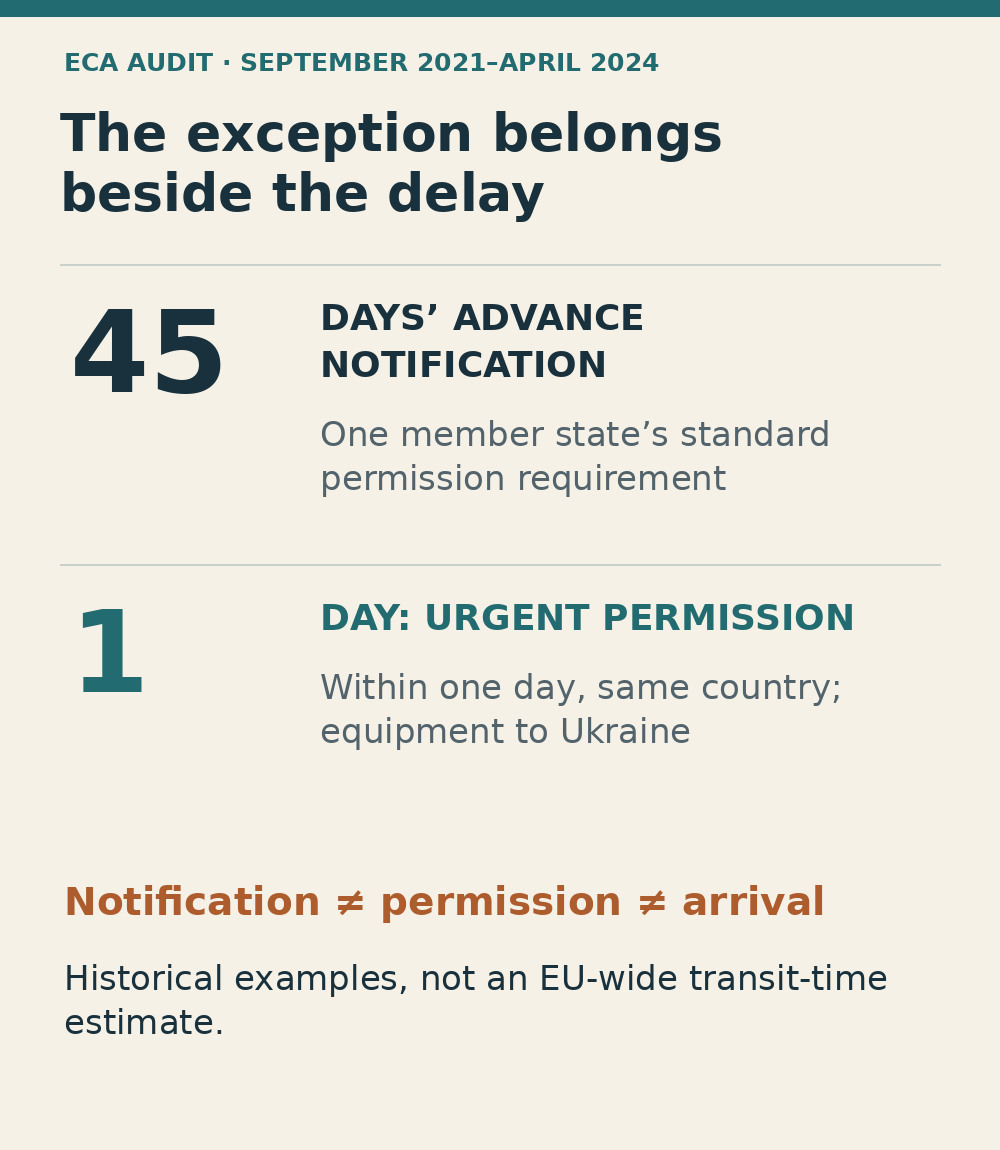
The audit describes a 45-day advance-notification requirement in one country, while that same country issued urgent permissions within one day for military equipment heading to Ukraine. Different administrative circumstances produced different outcomes; neither is an arrival-time measurement.
Exercises show alternatives, not a complete guarantee
There is public evidence that forces exercise ways around transport limitations.
In a July 27 account of a deployment exercise, Lithuania’s armed forces described road movement tested while rail, sea and air options were notionally restricted. The July 26–27 exercise involved German military equipment moving through Lithuania.
That is useful evidence of an alternative being practised. It makes an assertion of universal paralysis difficult to sustain. It also falls short of proving that every reinforcement plan would work under wartime disruption.
An exercise account tells us something about the activity undertaken under the described conditions. To turn it into a wider performance claim, we would need more information about scale, constraints, time, repetition and the standards achieved. A successful movement by a particular collection of equipment does not measure every route and transport mode that a larger operation might require.
The important idea is redundancy: having another way to perform a task can matter when a preferred option is unavailable. How much redundancy exists, and how well it works at the required scale, remains a question for evidence rather than assumption.
NATO is discussing these dependencies publicly
After an October 28 meeting between NATO Secretary General Mark Rutte and European Commissioner Andrius Kubilius, NATO’s account identified further regulatory and infrastructure work needed to improve military mobility.
That acknowledgement is a useful correction to the suggestion that transport constraints are a secret nobody will discuss. They are part of an open policy programme. What public statements do not provide is a complete account of wartime performance or a guarantee that every planned improvement has already taken effect.
Substantive analysis from the Atlantic Council also addresses the role of civilian transport and administrative barriers. The gap in understanding is therefore less about discovering that logistics exists than about keeping different kinds of progress separate.
A proposal may improve the rules. A project may improve infrastructure. An exercise may show that a particular movement can be carried out. Each adds something useful; none should quietly stand in for all the others.
The force has to keep working after it arrives
Arrival is another point at which the story can end too early.
The Commission’s mobility framework concerns equipment, goods and personnel. That wider scope matters because moving the initial force and continuing to move what it needs are related tasks. A transport plan that works once does not, by itself, answer the question of sustained supply.
This is the practical consequence of the dependency chain. Force availability, authorisation, transport and ongoing support all need attention. A shortfall in one area cannot be measured simply by counting improvements in another.
The public evidence does not establish a universal inability to reinforce Europe. It does not establish an exact, reliable arrival timetable for a full wartime effort either. The more useful question to ask of the next announcement is what it actually demonstrates: a proposed fix, an implemented change or performance under the conditions the force would need to handle.