The nickname arrives with the conclusion almost built in. A “doomsday plane” appearing on a flight tracker sounds like an emergency taking shape overhead.
The aircraft's role is serious. Its presence alone is much less specific. America's E-4B supports survivable command during national emergencies, but its documented duties also include overseas travel support for the defense secretary. Training and exercises are part of the public record too.
A sighting can establish something useful without revealing why the aircraft is flying. The key is to keep aircraft identity, observed movement, mission evidence and government intent separate. Each requires more information than the previous one.
The E-4B has an emergency role and everyday responsibilities
The official DVIDS E-4B description places the aircraft within the national military command system. It describes a survivable command, control and communications centre that can operate during a national emergency or after ground command centres have been destroyed.
The same description says E-4B operations encompass the threat spectrum and include overseas travel support for the secretary and staff, preserving command connectivity while they are abroad.
That second role helps explain why an aircraft associated with catastrophe can appear during an announced official trip. Secure communications can be a requirement of the journey itself. The platform does not have to wait for its worst-case purpose before it becomes useful.
The public mission description establishes those roles. It does not assign a mission to every aircraft seen on a map, establish who is aboard, or disclose the alert posture of a particular flight.
Training did not begin with the latest alarming screenshot
DVIDS retains an E-4B exercise example dated May 2020. An Air Force aircrew-training manual issued in April 2024 also documents an established training programme, superseding an earlier edition.
These records provide historical context for ordinary operational explanations. They do not tell us what fraction of all flights are training, travel or emergency activity.
That limitation is easy to lose when a familiar aircraft becomes newly visible to a much larger audience. A first sighting by a reader is not necessarily a first occurrence in the aircraft's operating history. Equally, an old training example cannot settle the purpose of a new flight.
Both errors begin with the same shortcut: substituting one memorable example for a complete account of what normally happens.
The E-6B is a different aircraft with different functions
The “doomsday plane” label also gets applied to the Navy's E-6B Mercury. NAVAIR describes it as a strategic communications relay and airborne command post, including the TACAMO and Looking Glass missions.
TACAMO provides communications links to strategic forces. The E-6B also has an airborne launch-control function associated with the Looking Glass mission. Those capabilities explain why the aircraft attracts attention; they do not establish that a launch decision has been made whenever it flies.
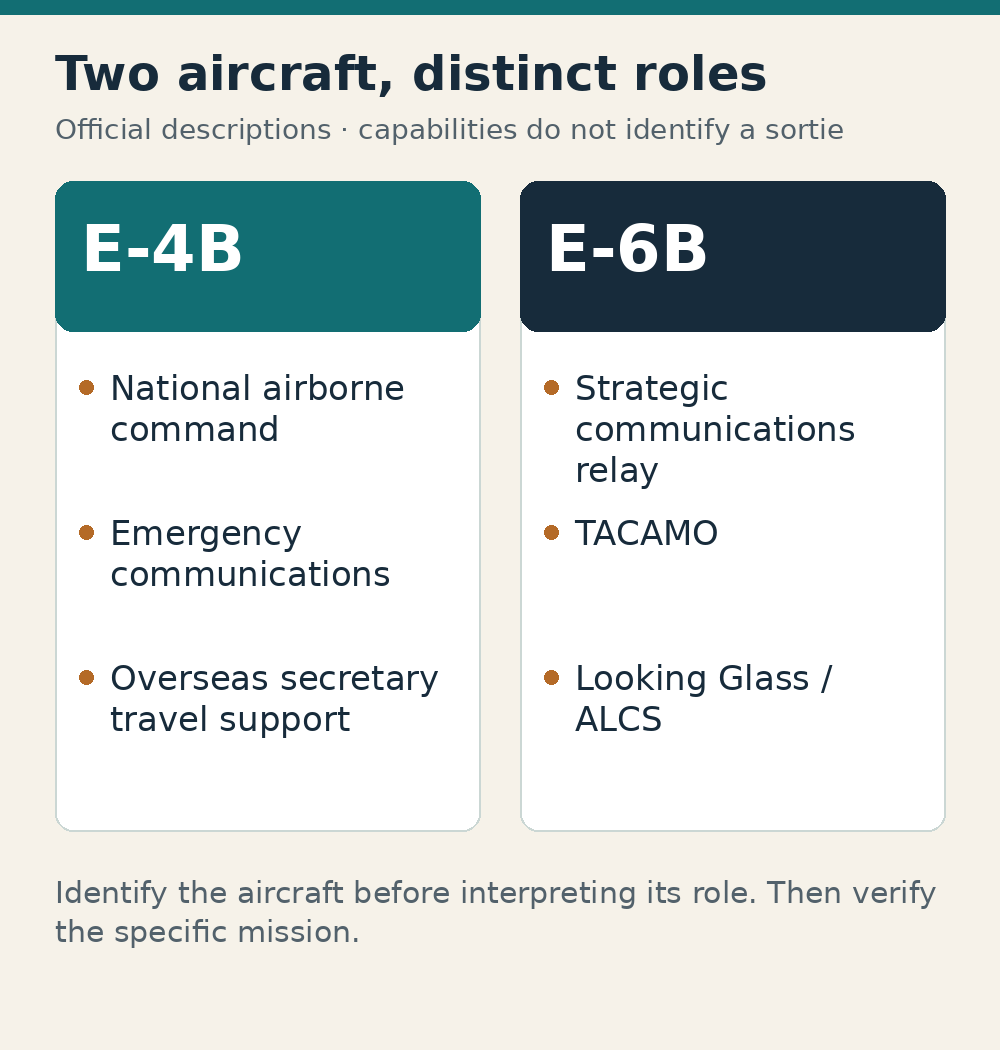
The E-4B column lists national airborne command, emergency communications and overseas defense-secretary travel support. The E-6B column lists strategic communications relay, TACAMO and Looking Glass with an airborne launch-control function. These are distinct published mission descriptions. Neither column identifies the mission or alert state of a particular flight.
An E-4B report should therefore not quietly borrow an E-6B mission description, or treat the two aircraft as interchangeable pieces of evidence. Identifying the platform correctly is an early check, not a minor technical detail to tidy up after reaching a conclusion.
The Cebu visit illustrates why attribution matters
On October 28, Philstar reported that Pete Hegseth had arrived in Cebu the previous night aboard an E-4B for meetings with regional defense officials.
Reuters separately documented his participation in the Cebu defense meetings. That supports the visit. It does not independently verify the aircraft leg described by Philstar.
Those are compatible pieces of reporting with different scopes. Keeping the distinction makes the example stronger: the public record supplies a specific official-travel context, while aircraft identification remains attributed to the outlet reporting it.
It would be an overreach to use either account as a complete description of every flight, passenger or mission connected with the trip. The useful point is narrower. The aircraft's published travel-support role has a concrete, recently reported application.
A tracker displays received information
Public tracking is valuable because it makes aircraft movements accessible. It is also dependent on the data a service receives and how the aircraft can be identified.
ADS-B Exchange explains that its system uses ADS-B and multilateration data. Its documentation describes differences in transponder information, limitations affecting what appears, and cases where identifiers can be misconfigured or invalid.
The provider's no-filtering policy is conditional on receiving the aircraft's data. That is a statement about the platform's policy and reception, not a promise of complete visibility everywhere.
A missing map position therefore does not select a single explanation. It cannot, by itself, tell a reader that an aircraft landed, stopped flying, changed missions or entered a secret operation. The gap is an observation about the public display; explaining it requires additional evidence.
The distinction between services matters as well. The FAA's description of military aircraft appearing on TIS-B concerns a cockpit traffic-information service. It should not be treated as a universal specification for commercial tracking websites.
Four evidence steps keep a sighting in proportion
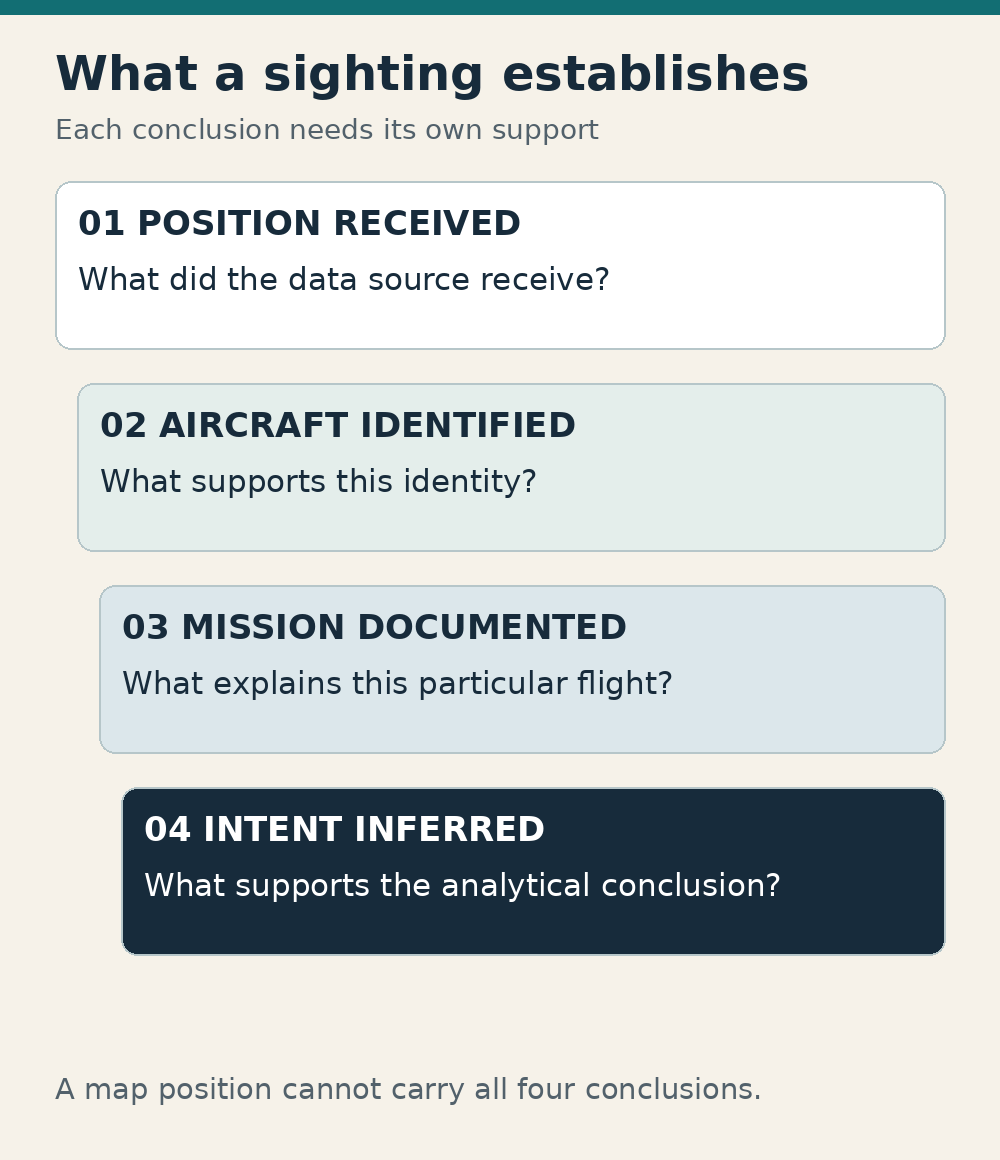
The four boxes move from a received position to aircraft identification, a documented mission and inferred government intent. Each conclusion requires its own evidence. Knowing a position does not settle identity, knowing identity does not settle the mission, and knowing a mission does not automatically reveal private strategic expectations.
Position received: A service displays data associated with an aircraft at a place and time. The source and its coverage conditions matter.
Aircraft identified: The available evidence supports which aircraft produced the observation. A familiar nickname, generic photograph or uncertain identifier is not a substitute for that check.
Mission documented: An official account, credible reporting or other suitable evidence explains the activity. Knowing the aircraft's capabilities supplies possible roles, not the answer for that particular sortie.
Intent inferred: Someone draws a conclusion about what officials expect or plan to do. This is an analytical step. It needs to account for alternative missions, missing information and the limits of the evidence already gathered.
The framework does not guarantee the right interpretation. It makes the unsupported leap easier to locate. A dramatic conclusion becomes less persuasive when its only supporting fact belongs several steps earlier in the chain.
Calling a flight unusual requires a baseline
A collection of screenshots is a record of what someone noticed. It is not automatically a representative history of the aircraft's activity.
To judge whether a pattern is exceptional, an analyst would need a suitable comparison period and an account of what the data missed. Otherwise a change in attention or reception can look like a change in military behaviour.
No complete comparable flight baseline or validated alert model was established for this article. It therefore assigns no numerical warning value to a takeoff, a disappearing position or a cluster of sightings. It also makes no blanket claim that every observed flight is routine or that a crisis cannot exist.
America's airborne command aircraft deserve serious attention because their missions are consequential. The strongest public interpretation starts with the documented role, checks the observation and keeps the missing information visible. A nickname can tell us why an aircraft is interesting. It cannot finish the intelligence assessment.