An international court can spend its days considering the gravest crimes imaginable and still need someone to process the health insurance.
That less visible side of the International Criminal Court is where the sanctions story becomes concrete. The ICC changed insurers effective October 1, a court spokesperson confirmed in Reuters reporting carried by Insurance Journal. The spokesperson described a mutual agreement, confirmed a switch to another provider and gave no reason for the change. The institutional U.S. designation followed on October 9.
The sequence matters. A change made before that designation cannot simply be presented as something the later order forced that day. It also shows why an argument about international justice can become an argument about ordinary contracts.
As of November 4, the useful answer is more specific than “the court is sanctioned.” U.S. restrictions coexist with authorizations for particular transactions. Those authorizations cover substantial everyday activity, including certain software services. What the rules permit and what a bank or supplier is willing to do are separate questions.
The designation reaches the institution’s transactions
On October 9, the United States added the ICC itself to the sanctions list. That is distinct from earlier designations of individual officials. An institution and an employee are different legal counterparties, even when the same dispute surrounds them.
The underlying Executive Order 14203 blocks covered property within the United States or in the possession or control of U.S. persons. Its prohibitions include relevant provisions of funds, goods and services, with exceptions supplied by law and licenses. The ICC-related sanctions regulations implement that framework.
This is why an invoice or a software contract can become consequential. The practical question is whether the transaction falls within a prohibition and whether a valid authorization covers it. Calling something routine does not, by itself, settle either question.
The order also provides a route for designating foreign persons determined to have given specified support. That helps explain why suppliers examine their exposure carefully. It does not establish that every foreign supplier has been designated or that every transaction everywhere faces an identical ban.
The administration’s assertions about the court’s legitimacy and jurisdiction are its stated position. They should not be quietly converted into settled findings merely because they appear in the order’s preamble.
Routine operations have a dated permission
The same day as the institutional designation, Treasury issued four general licenses. These are permissions for defined activity that would otherwise fall within the relevant prohibitions. They do not remove the ICC from the sanctions list.
General License 13 authorizes specified transactions needed for maintaining or winding down the court’s operations, contracts and agreements. Its examples include relevant state-party payments, salaries, insurance, rent, utilities and routine services. It also permits specified uses of blocked ICC accounts for the authorized transactions.
The permission has an endpoint: 12:01 a.m. Eastern Daylight Time on April 7, 2027. The precise time matters to anyone relying on the license; “sometime in April” is a poor substitute for the operative document.
Its exclusions matter, too. The license does not automatically clear transactions involving other separately blocked persons. A transaction connected to the institution can still require a closer look at the counterparties and the applicable permissions.
This produces an awkward but important distinction. A court can remain formally sanctioned while particular payments needed to keep it functioning are authorized. Neither half of that sentence cancels the other.
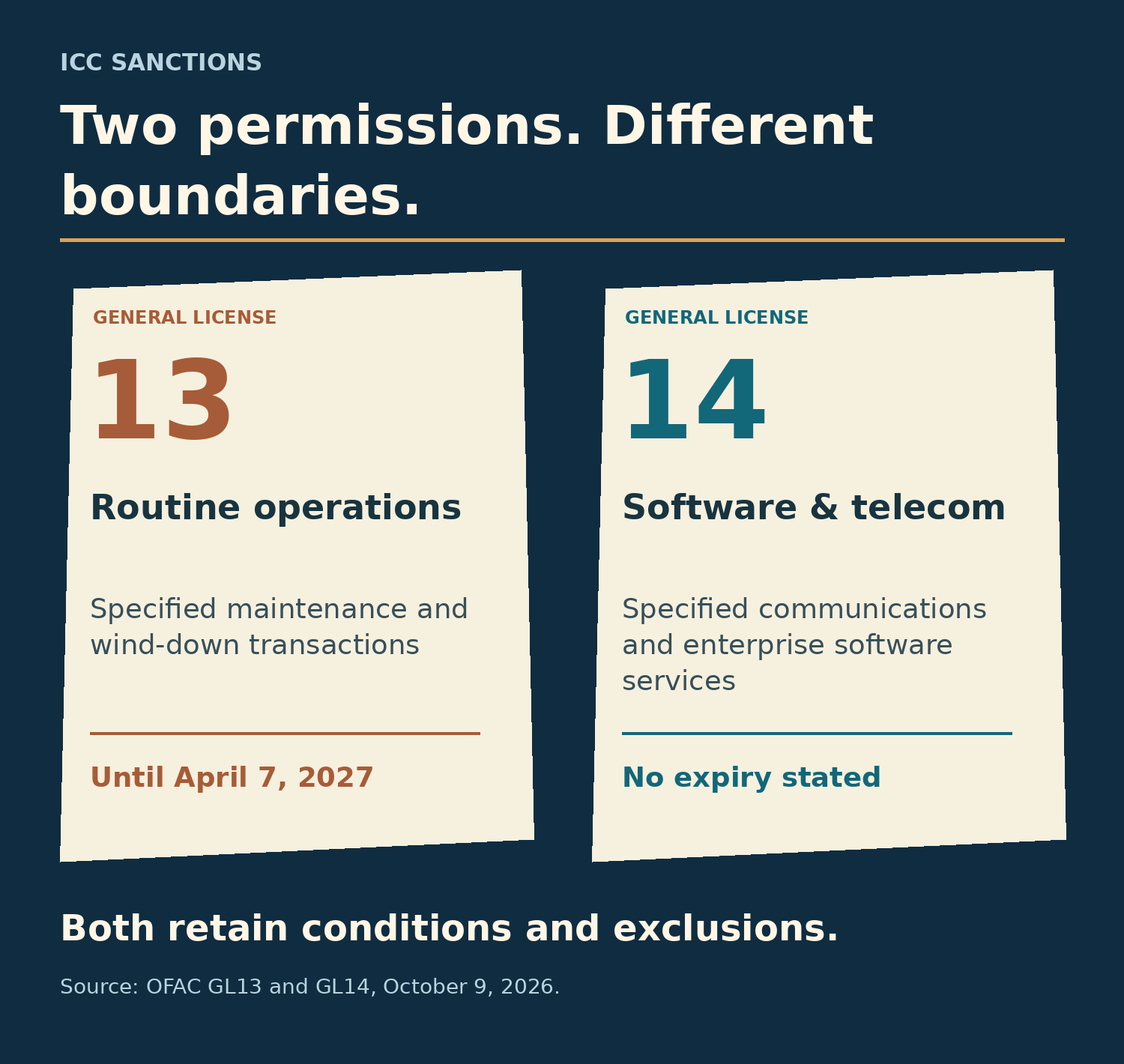
GL13 covers specified operational maintenance and wind-down transactions through its stated April 7, 2027 cutoff. GL14 separately covers specified telecommunications and enterprise software transactions and has no expiry stated in the retrieved text. Both retain conditions and exclusions.
Payroll software has a separate authorization
General License 14 covers specified telecommunications, internet communications and enterprise software activities. Its software categories include financial management, human resources and payroll, cybersecurity, data storage and related cloud services.
That is the overlooked institutional detail. A courtroom depends on systems that rarely appear in photographs of judges: authentication, records, accounts, staff administration and the software used to manage them.
The retrieved license has no stated expiration date. That is different from a promise that it can never change. Its exclusions and other applicable requirements remain part of the document.
It is also important to distinguish a payroll application from a payroll payment. Permission involving a software system should not be stretched into an assurance that every payment made through it is covered. The relevant transaction still needs its own basis.
Two further licenses address narrower functions. GL15 covers specified pension processing, with conditions for payments to blocked people. GL16 covers continued detention and welfare services for the people listed in its annex. That annex is a boundary, not decorative small print.
Europe is urging providers to keep serving the court
The strongest counterweight to a blanket-shutdown story is the European Commission’s October 23 notice.
It urges EU operators to continue providing services to the ICC, draws attention to the U.S. licenses and says necessary current or renewed activity should continue within the described permissions. It also discusses continued European diplomatic efforts to obtain a reversal of the measures.
That is substantial support for continuity. It is not a dated confirmation that a particular bank has accepted a particular payment or that every supplier has renewed a contract.
The court’s registrar, Osvaldo Zavala Giler, has pressed for stronger legal and operational certainty, according to Türkiye Today’s account of his Financial Times interview. The distinction he draws is understandable: political support and a provider’s decision about a transaction operate at different levels.
The evidence lives in the transactions
The insurer change supplies a documented operational example. The licenses supply actual permissions. Neither supports a claim that every account has closed, every computer has stopped or the whole institution has become unable to function.
A careful account therefore keeps three records separate: the legal restriction, the authorization that may apply, and the evidence of what a provider actually did. Combining them too quickly can exaggerate either the sanctions’ effects or the protection supplied by the exceptions.
The next revealing development could be a revised license, a dated supplier statement or a documented payment problem. Each would add something that a broad declaration of support or alarm cannot supply: a clearer picture of how the court’s daily work is actually being sustained.