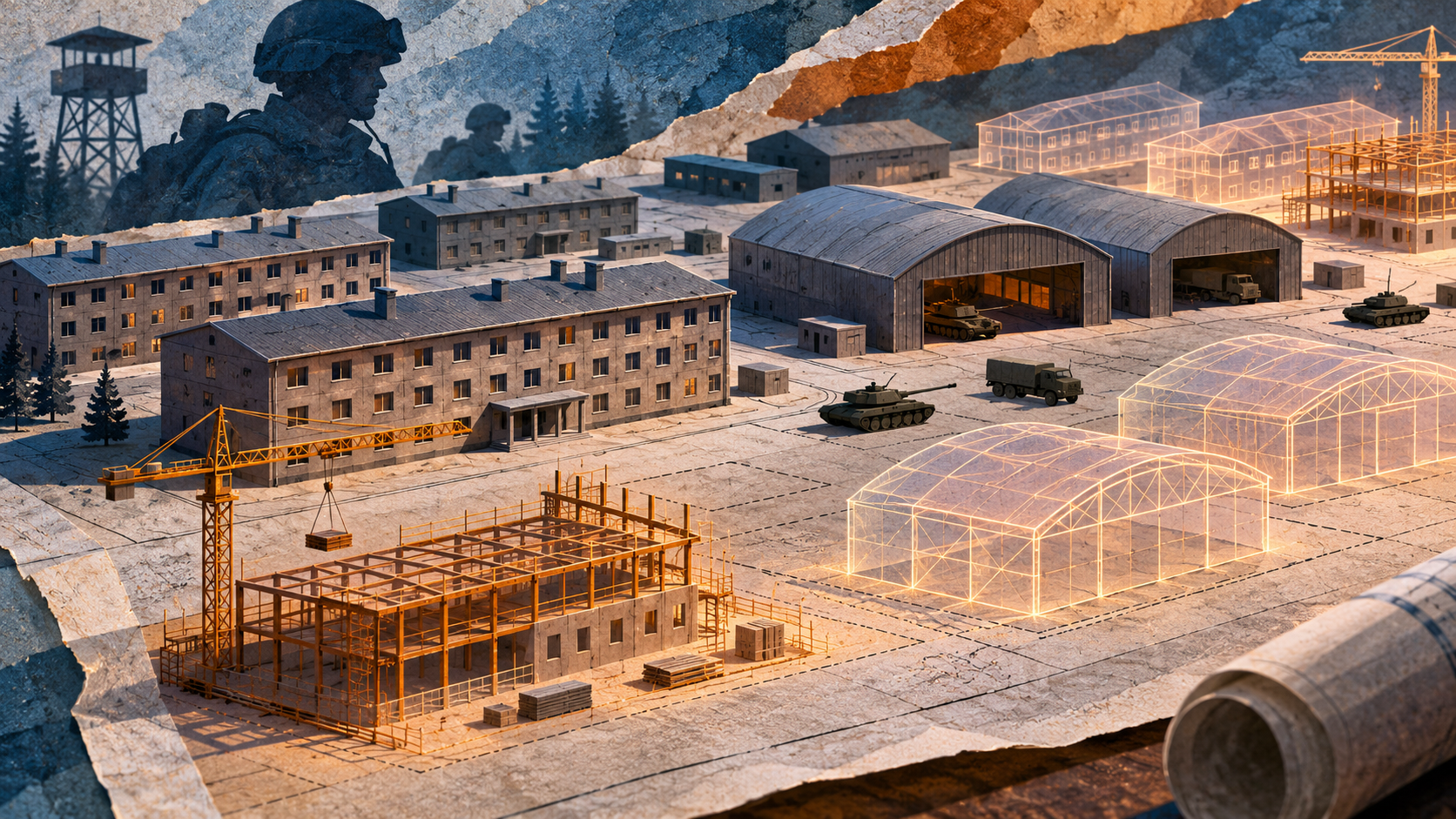
A new barracks is a meaningful military development. It is also a building.
Between a construction site and a force ready to fight lie several other questions: who is assigned there, what equipment they have, how they train together and whether those people and vehicles are actually available in that location.
Public intelligence assessments and original reporting document Russian military expansion near NATO. They also show why counting facilities or newly named units cannot establish today’s deployable combat power. The evidence supports taking the buildup seriously while resisting the convenient fiction that every formation exists at full strength the moment it appears on paper.
For readers trying to understand the warnings, the most useful distinctions are often hidden in plain sight: an image’s date, an intelligence report’s cutoff, the geography of a quoted troop figure and the conditions attached to a rebuilding scenario.
Russia is building capacity. The question is what kind.
Lithuania’s 2026 threat assessment describes new formations and infrastructure near NATO’s eastern borders despite Russia’s losses in Ukraine. It distinguishes organisational expansion from the staffing and equipment needed to fill those formations. At the assessment’s information cutoff, many new units were incomplete, while elements associated with the expansion were being used in Ukraine.
That is not a contradiction. A government can create a formation, prepare its intended home base and send personnel elsewhere. The unit’s designation and the location of its future infrastructure do not, by themselves, tell us where its available fighting strength is today.
There is an essential date attached to the Lithuanian material: the information collection cutoff was February 6, 2026. Its descriptions cannot quietly become a verified November 3 inventory.
The report remains useful for understanding the process of expansion. It is less useful as a source for the exact present disposition of a particular unit. A reader should not have to discover that difference after absorbing a headline about troops at the border.
The 80,000 figure belongs to a future expectation opposite Finland
In June, SVT and its Nordic and Baltic reporting partners published an investigation into Russian facilities opposite Finland. The reporting described new accommodation, vehicles and storage infrastructure. Finland’s army chief discussed an expected future force of 80,000, compared with the earlier force posture.
That is a statement about what Finland expects to face. It is not a count of 80,000 Russian troops already assembled along Latvia’s and Estonia’s borders.
The geographical distinction matters even before assessing whether the expectation will be realised. “Near NATO” covers different borders and military areas. A number concerning Finland cannot be moved to the Baltic states simply because both appear on the alliance’s eastern side.
The SVT page was published June 10 and updated October 23. The later update does not automatically make every image or observation an October observation. It tells us when the page changed, not when every underlying development occurred.
SVT, DR, NRK and Delfi collaborated on that investigation. Four participating news organisations are not four independent satellite confirmations of each finding. The War Zone’s subsequent coverage usefully discusses the buildup, but its use of the same investigation does not add another independent observation of those facilities.
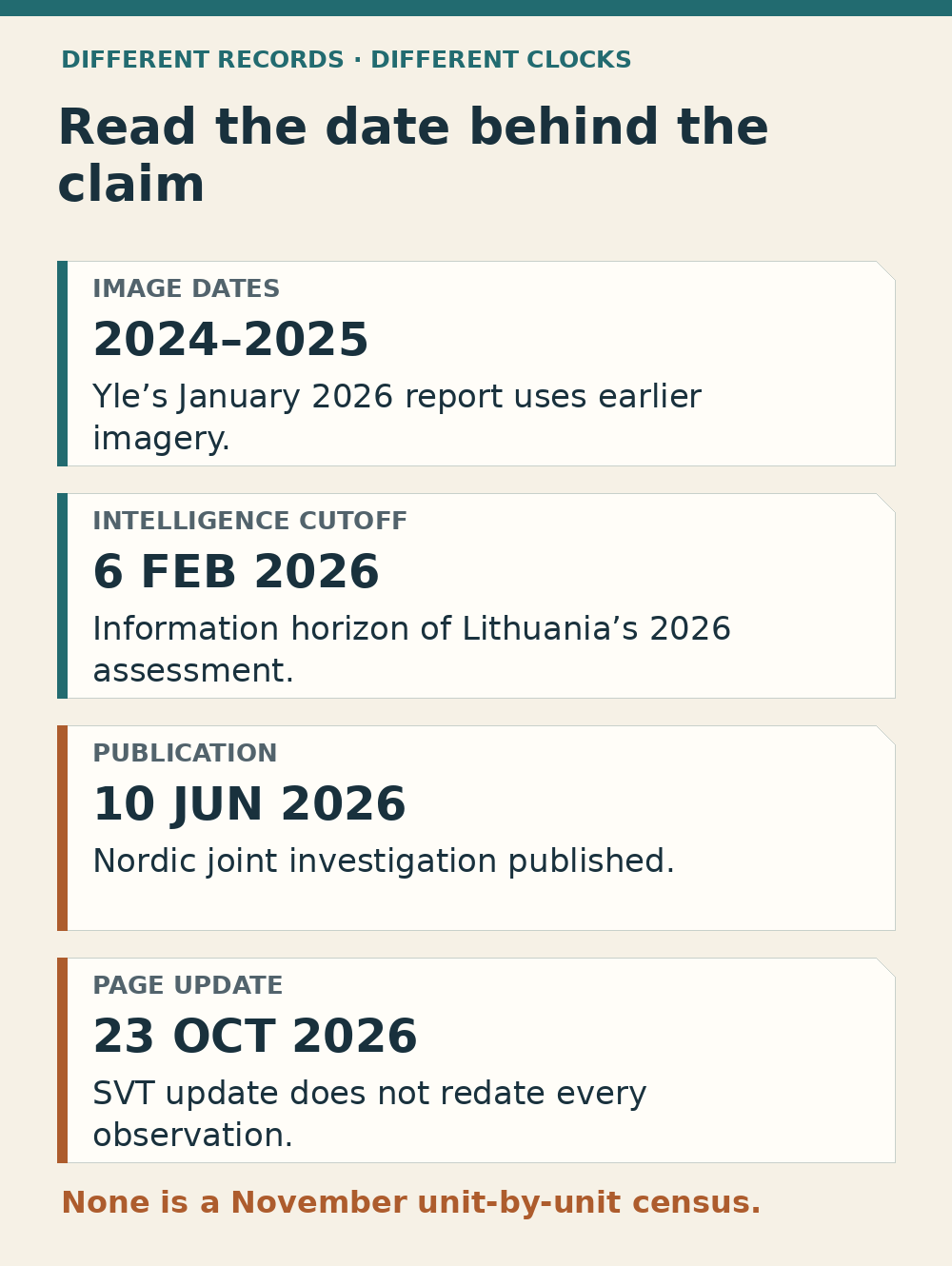
Yle’s January 2026 report uses 2024–2025 imagery. Lithuania’s 2026 assessment has a February 6 collection cutoff. The Nordic investigation was published June 10 and SVT updated its page October 23. These dates do not establish a November unit census.
Satellite evidence has its own calendar
Yle’s January 31 report on Petrozavodsk provides a particularly useful example of why construction and troop presence need separate treatment. Its reporting describes renovation of an old garrison and plans for further accommodation, while distinguishing those developments from the ground forces then present.
The accompanying comparisons use imagery from 2024 and 2025. Those dates are part of the evidence. They cannot be replaced by the date on which someone shares the article in November.
A satellite image can document a visible change between observations. Expert interpretation can help explain what that change may mean. Neither step turns a completed roof into a verified number of trained personnel, a vehicle into proof of serviceability or an accommodation plan into a deployed combat formation.
There is no need to dismiss the construction to preserve that distinction. Infrastructure can make a later force expansion easier. The useful reading is that Russia is creating capacity with potential military consequences, while the number of troops available at a particular moment requires additional evidence.
The harder question is how much of that potential has become usable capability. A picture can contribute to the answer without supplying all of it.
A false count does not make the wider buildup false
In September, Delfi/Eastflank examined a claim that 80,000 Russian troops were concentrated near Latvia and Estonia. The fact-check addressed the attribution and geography of the claim, including imagery associated with a different location and period.
Correcting that story does not establish that Russian expansion is imaginary. It removes a particular piece of supposed evidence from the case.
This is where online discussion often becomes less useful than the documents. One exaggerated claim is treated as proof that every warning is fabricated. Or a genuine construction project is used to rescue a troop total it never established. Both approaches discard the distinctions needed to understand what is changing.
The questions should remain separate. Is there evidence of new infrastructure? Is the quoted number current? Does it concern this border? Are the people assigned to a formation actually available there? A strong answer to the first question cannot cover missing answers to the others.
Conventional force readiness also requires different evidence from nuclear-use risk. Treating every military development as a measurement of the same danger makes both questions harder to answer.
The course of the Ukraine war changes the rebuilding problem
The Lithuanian assessment does more than describe shortfalls. It sets out conditional rebuilding scenarios.
Continued high-intensity war consumes resources and constrains forces available for other purposes. A ceasefire or frozen conflict could allow Russia to replenish forces and ammunition more quickly. A peace agreement combined with the removal of international sanctions could provide additional freedom to redirect personnel, money and technology toward military development.
These are the intelligence service’s conditional assessments, based on its stated information horizon. They are not three settled stages in a timetable, and they do not establish that a particular diplomatic outcome is about to happen.
The distinction explains why current limitations and concern about future capability can coexist. A formation that is incomplete during an ongoing war may become a more substantial force under different conditions. Conversely, identifying a path to rebuilding does not prove that its necessary conditions have already been met.
An honest account should keep the word “if” attached to the argument. Removing it makes the warning sound clearer by changing what the source actually says.
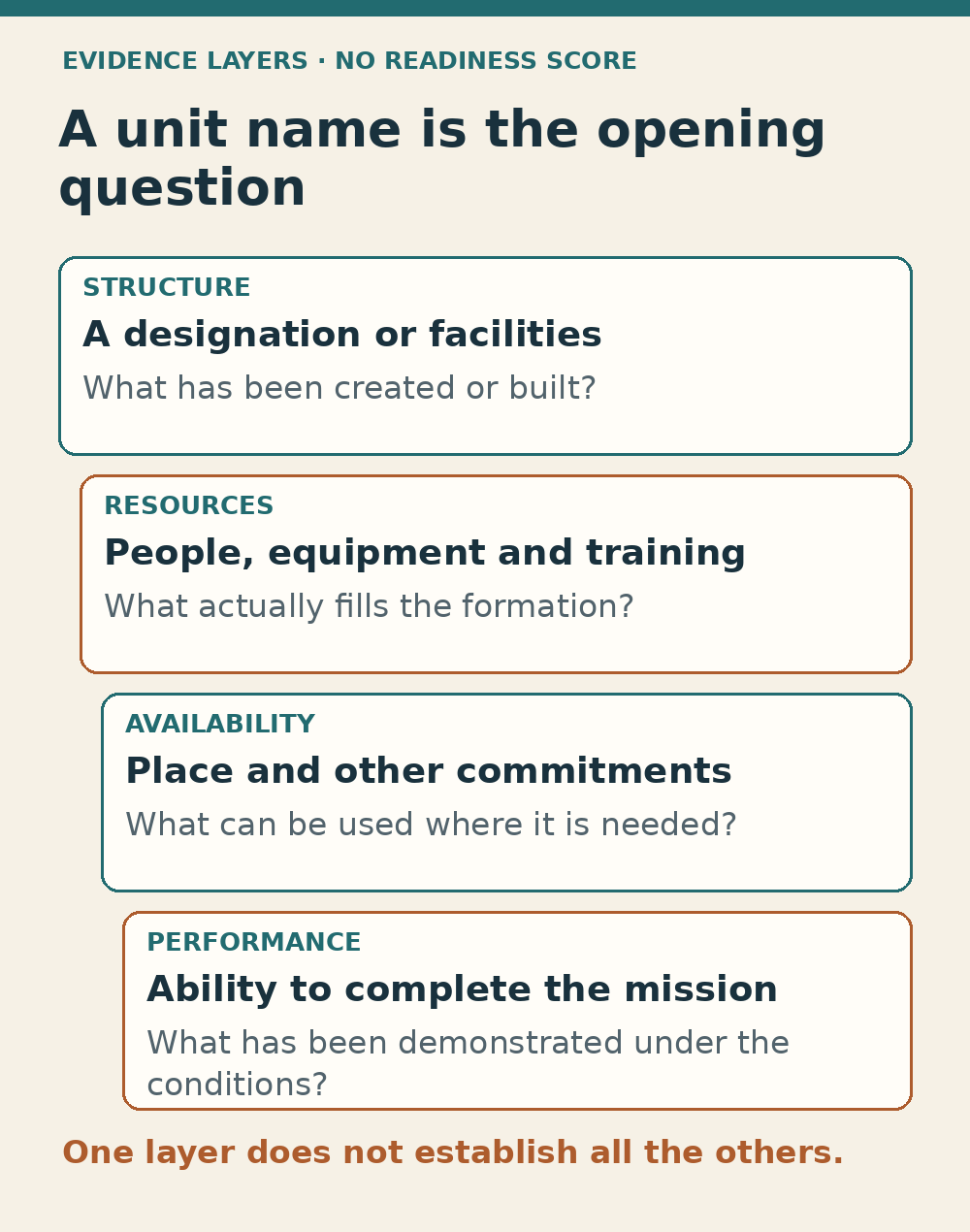
A designation or facility establishes structure. People, equipment and training concern resources; location and other commitments affect availability. Demonstrated mission performance requires further evidence. A finding at one layer does not establish all the others.
An assessment of intent is not a guarantee about capability
Estonia’s summary of its 2026 intelligence report assesses that Russia has no intention of attacking Estonia or another NATO state in the report’s coming-year horizon. It also discusses deterrence and the development of Russian military capability.
That is an annual assessment with a particular context. Retrieving it in November does not restart its horizon or turn it into a newly issued guarantee about the following twelve months.
Intent and capability are related questions, but they are not interchangeable. A force can be developed without a decision to use it. An assessment that an attack is not intended does not make future force growth irrelevant. The point of examining both is to understand the warning, rather than force every fact into either panic or reassurance.
Incomplete units should not become a comforting synonym for harmless units. The Nordic reporting itself treats the developing infrastructure as a serious future concern. Equally, that concern does not justify an invented current headcount or a precise attack countdown.
The missing information is specific
The public sources inspected here do not provide a complete November unit-by-unit census of Russian personnel, equipment and available formations near NATO. They do not reveal every private command decision or establish the combat effectiveness of each newly designated unit.
Those are specific information limits. They are not evidence that governments have concealed an already decided invasion, and they are not proof that no threat exists.
The most revealing next evidence would connect the layers: dated and corroborated force presence, equipment availability and training, tied to the formation and geography being discussed. Another photograph of a building may add to the construction record while leaving the readiness question largely open.
Russia’s expansion deserves attention because creating the structures for a larger force can matter before that force is fully available. Understanding how far the process has gone requires more care than counting names, roofs or repeated headlines.