A yeast conversion starts with a choice that many calculators hide: which instructions are you following? Fresh, active dry and instant yeast can be substituted in bread recipes, but published recommendations do not all use one universal, reversible factor.
Keep the source beside the calculation. Ordinary yeast bread has separate home-baking, professional fresh-to-dry and branded Fleischmann’s RapidRise recommendations. Your exact product’s packaging and recipe instructions take priority.
Choose the instructions before the amount
Use the yeast weight specified by the recipe, identify the form it calls for and the form you have, then find the relevant source and direction below. Multiply or divide the grams by that source’s stated factor. The result is an approximate substitution, rather than a measurement of biological strength or a promise that the dough will rise on the same timetable.
King Arthur’s professional reference states fresh-to-dry directions; do not invent the opposite instructions merely by reversing its numbers. Fleischmann’s RapidRise advice is specific to that branded product, rather than a blanket rule for everything labelled instant. The worked examples keep those distinctions visible.
The home-baking route
King Arthur’s home guide says active dry and instant yeast can replace one another 1:1. It notes that active dry may start more slowly and advises watching the dough rather than treating a listed rising time as an unbreakable deadline.
That is a recommendation within a baking context. The same guide gives a bread-machine exception: when replacing active dry with instant in that setting, it recommends reducing the instant amount by 25%. Keep that machine-specific adjustment separate from the conventional-bread guidance below.
For fresh yeast, King Arthur’s home Hotline guide explicitly gives both directions. Multiply fresh yeast by 0.33 to obtain either instant or active dry. Divide either dry quantity by 0.33 to obtain fresh yeast.
A recipe calling for 20 grams of fresh yeast therefore gives approximately 6.6 grams of dry yeast under that home guidance: 20 × 0.33. The reverse example, 6.6 ÷ 0.33, returns 20 grams fresh. That reverse is supported because the source actually states it.
The professional reference makes a distinction
King Arthur’s professional yeast reference gives different fresh-to-dry guidelines. Fresh to active dry uses a factor of 0.4; fresh to instant uses 0.33. It also recommends following the manufacturer’s conversion when one is supplied.
Using that reference, 20 grams fresh becomes 8 grams active dry, or 6.6 grams instant. The source also discusses hydration and mixing considerations. A number without its method would leave out part of the substitution.
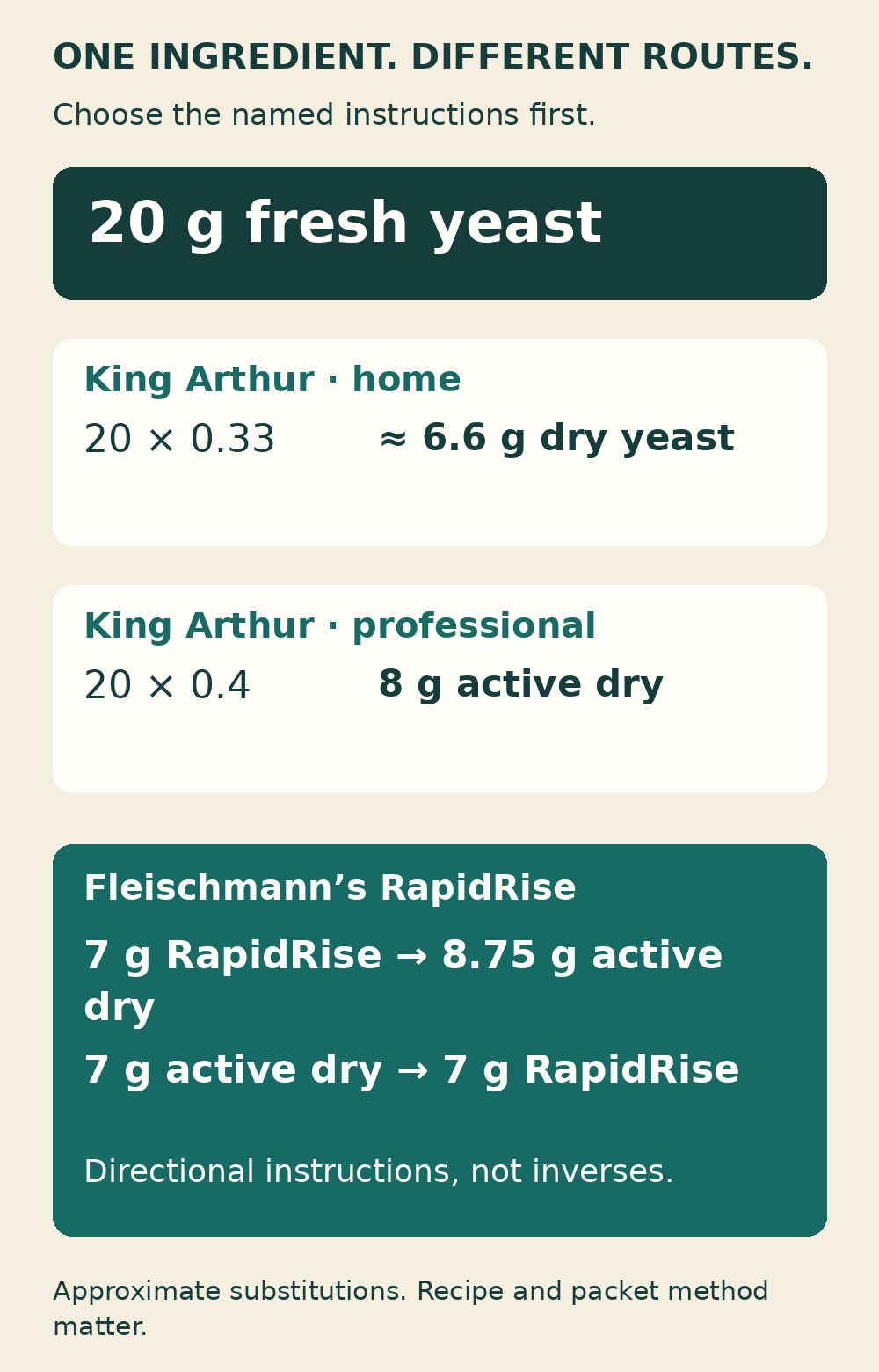
Each panel follows a named source. The home and professional fresh-to-active recommendations differ; the two branded RapidRise directions are not inverses.
The useful response to that difference is to keep the guidance visible. Averaging the factors would create another recommendation without establishing that it suits your recipe. Choose the context you intend to follow instead of disguising the disagreement with a single “correct” answer.
RapidRise instructions work in stated directions
Fleischmann’s guide directs 25% more active dry when replacing RapidRise: 7 grams becomes 8.75 grams. In the other direction, it specifies an equal amount of RapidRise: 7 grams active dry becomes 7 grams RapidRise.
Follow its preparation changes, too. Dissolving active dry and mixing RapidRise into dry ingredients use different methods. Read the full instructions; these directional substitutions are not algebraic inverses.
A cake or packet is not a universal unit
Fresh yeast has been sold in different cake sizes. Red Star’s chart specifically tells readers to establish the weight when an old recipe does not identify its cake size. Its displayed cake fractions and rounded equivalents also contain discrepancies, so do not turn that chart into a precise continuous mass formula.
Read your own package rather than treating “one cake” as a fixed weight across brands and recipes. Likewise, a packet is a product quantity, not another name for a teaspoon. Keep those units separate. If your recipe uses volume, establish the appropriate weight from its named product instructions before doing the calculation.
Changing the form does not answer whether an old yeast supply is active, whether the dough’s conditions are suitable or whether a specialized product is needed. Those are different questions from converting the stated amount.
Give the recipe the final say
Bread machines, sourdough starters, heavily enriched doughs and specialty pizza yeasts can involve instructions beyond these ordinary-bread examples. Consult the product and recipe rather than borrowing whichever multiplier produces a convenient number.
Keep the result approximate, weigh what your equipment can meaningfully measure and retain the source’s mixing and rising instructions. If the calculation gives a tiny amount, extra decimal places are not evidence that your scale can resolve it. The most useful conversion is the one whose assumptions you can still see when you reach the mixing bowl.
Sources
King Arthur: fresh yeast in home recipes
King Arthur: professional yeast reference