
A&W’s Double Buddy Burger and McDonald’s Canadian McDouble each list 21 grams of protein. In this two-store Toronto online-menu sample, each also costs CAD $4.99. On protein per listed dollar, they tie.
That is a more useful starting point than picking a winning logo. Among the nine burgers compared here, A&W’s Papa Burger has the highest sampled protein-per-dollar ratio: 40 grams at $8.99, or about 4.45 grams per Canadian dollar. It also requires a larger purchase than either $4.99 burger.
These results come from published Uber Eats item listings at two named Toronto locations, checked October 31, 2026. They exclude tax, fees and tip. The comparison uses the chains’ official Canadian nutrition figures, rather than treating the platform’s calorie labels as the nutrition source.
Use it as a transparent local sample and a method for comparing your own menu. It does not establish national pickup prices or the final delivered cost of an order.
The two menus behind the prices
The A&W listing is for 167 Church Street in Toronto. The McDonald’s listing is for 123 Yonge Street, at Yonge and Temperance.
The prices below are individual burger listings, with their exact names checked against the menu records. Combos, kids’ versions and similarly named chicken products are different purchases. No order was placed to verify a checkout total.
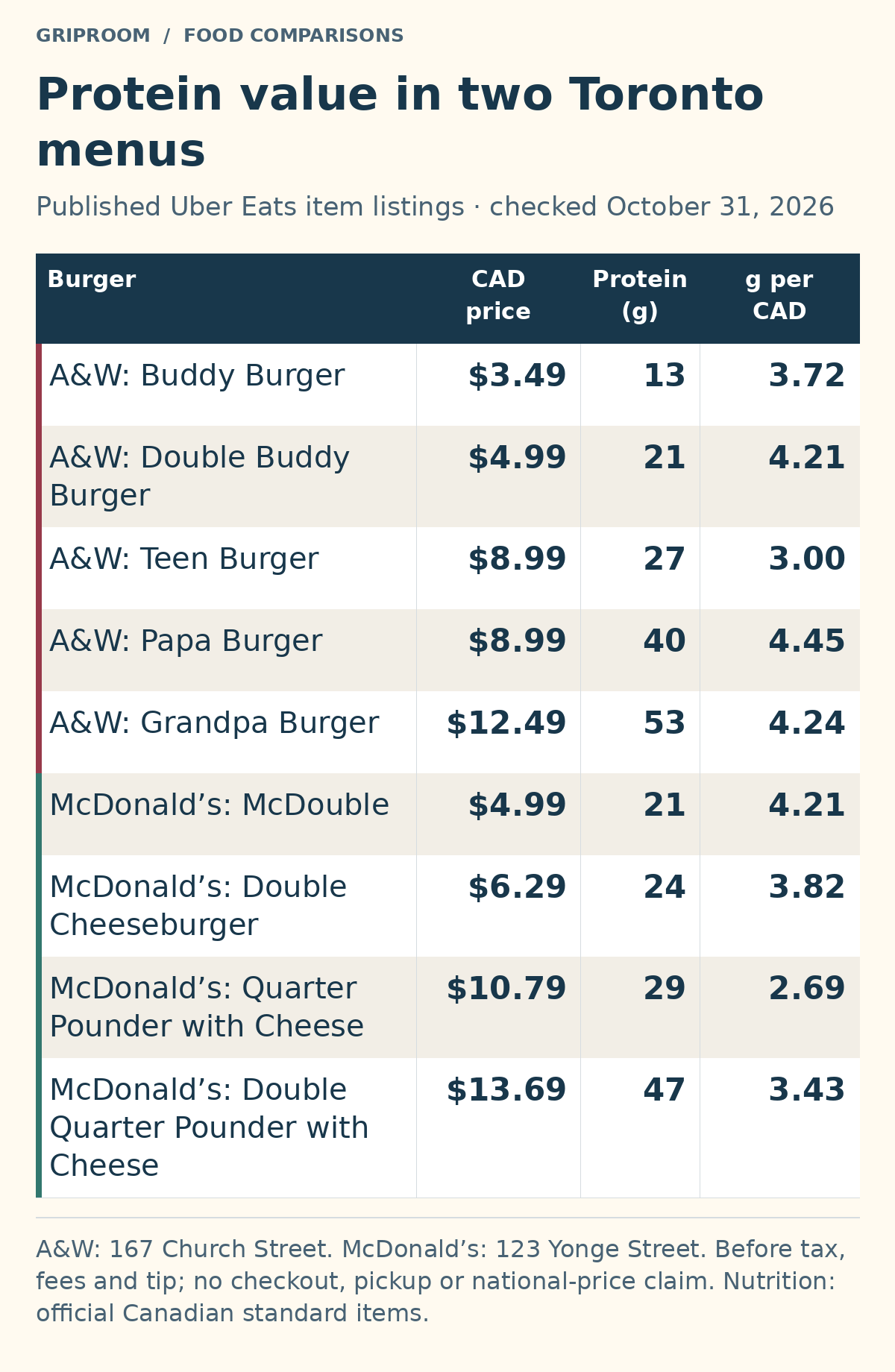
The nutrition country matters. The Canadian McDouble used here has 380 calories and 21 grams of protein. A U.S. McDouble figure would change the ratio and mix two different product records into a Canadian price comparison.
A&W’s current published Buddy Burger row is 310 calories and 13 grams of protein. Some marketplace or older labels differ. Keeping price and nutrition provenance separate makes that discrepancy visible instead of silently combining whichever numbers are easiest to find.
Protein per dollar answers one specific question
The calculation is straightforward: divide the burger’s protein grams by its listed price. Higher means more published protein per dollar spent on that item.
For the Double Buddy and McDouble, 21 divided by $4.99 is about 4.21 grams per dollar. For Papa, 40 divided by $8.99 is about 4.45. For Grandpa, 53 divided by $12.49 is about 4.24.
That separates three useful distinctions. The Buddy Burger has the lowest ticket price among the nine sampled items, at $3.49. Papa has the highest sampled protein-per-dollar ratio. Grandpa has the most total protein in this selection, at 53 grams. Those are three different reasons a diner might choose an item.
The ratio does not measure taste, fullness or overall nutritional quality. It also does not make a larger item affordable within a smaller cash budget. A stronger unit value can still require spending more at the counter.
The sampled Teen and Papa prices make the difference between goals especially clear. Both are $8.99, but Teen lists 27 grams of protein at 500 calories, while Papa lists 40 grams at 580. Papa supplies more protein for the same listed price; Teen has the lower published calorie total. Different ingredients and portions remain part of the choice. A ranking built only around protein per dollar would miss the reason a diner might prefer the other burger.
Near-ties deserve modest conclusions
Grandpa and McDouble land close together on this metric, at roughly 4.2 grams per dollar. The unrounded sample difference is less than 1%. A small price change, promotion or difference hidden by rounded protein values could reverse it.
Calling one chain decisively better from that gap would give the arithmetic more authority than the evidence supports. The exact Double Buddy–McDouble tie is a clearer finding: both publish 21 grams, so the lower-priced one on a local menu would have the higher protein-per-dollar ratio. Equal prices tie.
That rule survives a location change better than a dated national-sounding ranking. Recheck the local prices and apply the same calculation to the same Canadian products.
Whole burgers matter more than a theoretical serving
Unit-cost tables sometimes convert everything to the price of 20 grams of protein. In this sample, that normalized cost is about $4.75 for Double Buddy or McDouble and $4.50 for Papa.
Those are ratios, not purchasable 20-gram portions. You cannot order a fraction of the standard Papa Burger for the normalized price. Keep the actual item price and its complete protein amount beside any conversion.
Buying two value burgers also changes the food order. Two Double Buddy burgers cost $9.98 in the sample and provide 42 grams of protein at 870 calories. One Papa costs $8.99 and provides 40 grams at 580 calories. The two-burger order supplies slightly more protein, but costs more and has a different calorie total and portion.
At McDonald’s, two sampled McDoubles total $9.98, 42 grams of protein and 760 calories. One Double Quarter Pounder with Cheese is $13.69, 47 grams and 750 calories. Comparing their cost and protein is useful, but the recipes and portions differ. The small difference in published calories also rests on rounded standard values.
These complete-order examples answer what a ratio alone cannot: what is actually bought, how much it costs, and what comes with that amount of protein.
Calculate the local break-even price
Papa lists 40 grams of protein; McDouble lists 21. Papa therefore ties McDouble on protein per dollar when its price is 40 ÷ 21, or about 1.905 times the McDouble price.
With a McDouble at $4.99, the calculated Papa tie price is about $9.50. The unrounded threshold is approximately $9.5048. Below that threshold, Papa has the higher ratio; above it, McDouble does, using these standard protein values.
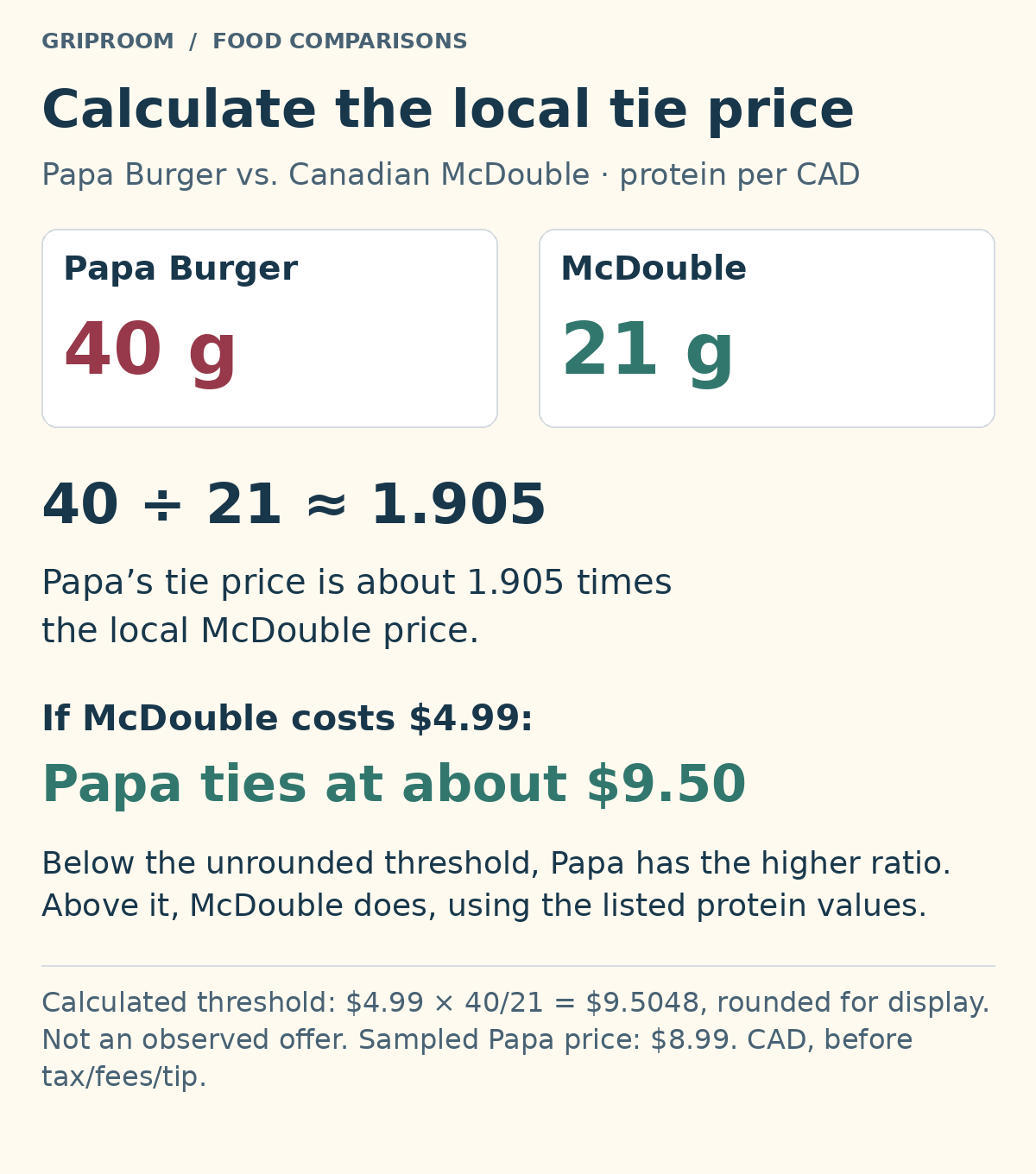
The method is reusable. If your McDouble price changes, multiply that local price by 40/21 rather than carrying the old $9.50 figure forward. The threshold is a calculation for the named products, not a promise that either restaurant offers a particular price.
For Double Buddy versus McDouble, the calculation is even simpler because both have 21 grams of protein. Compare the actual item prices directly.
Check the complete bill before choosing
A listed burger ratio is only one part of a purchase. Different tax treatment, order fees, tips or promotions can change the bill; adding fries and a drink creates a different comparison. A national McValue offer should not be inserted into this table while the A&W side keeps its platform listing price.
The best-supported result here is specific: at the two sampled online menus, Double Buddy and McDouble tie, while Papa has the highest protein-per-listed-dollar ratio among the nine compared burgers. For a different location or channel, use the current prices and the same named Canadian nutrient records. That keeps the answer attached to the order you can actually buy.