The field kitchen belongs in the story about Canadian troops near Russia.
In a November 2 report from eastern Latvia, Latvian public broadcaster LSM described cooks preparing meals, military vehicles being refuelled and personnel supporting units away from their permanent bases. A logistics commander discussed deliveries of fuel and rations. Medics and repair personnel were part of the support operation too.
Those are less spectacular images than a tank on a road. They help explain what the Canadian-led NATO brigade is doing: rehearsing how to move across Latvia and keep operating once it gets there.
The exercise is real, and its declared purpose is defensive. The public evidence does not establish that Canadian troops have received a secret order to start a war. It also does not tell us how well the brigade would perform if its supply lines, communications and people came under attack. That gap between a visible rehearsal and proven combat capability is the part worth examining.
The exercise was announced before the vehicles moved
Latvia’s advance notice, published October 21, set out an October 26–November 8 window for Resolute Reforger 2026. It described roughly 3,000 multinational personnel and 1,000 items of military equipment taking part in the brigade’s largest force-deployment exercise to date.
The stated tasks included deploying over distance, sustaining forces in the field and maintaining command and communications outside permanent bases. The schedule put the movement phase between October 26 and November 2, followed by a planned clean-up and return to bases on November 4–8.
As of November 3, that return window was still ahead. An announced timetable is evidence of the plan, not proof that every movement will happen exactly as advertised.
The notice matters because it supplies context for images that can otherwise seem ominously unexplained. Vehicles moving east during the declared exercise are consistent with the purpose published beforehand. Calling the activity a rehearsal does not make the equipment imaginary or the defence task trivial. It tells us what the available evidence identifies the activity as.
Three thousand exercise participants does not mean three thousand Canadians
Several different personnel figures appear around this story. They answer different questions.
The exercise’s approximately 3,000 participants are multinational. Its equipment total includes different kinds of military equipment; it is not an announcement of 1,000 tanks.
Canada’s Operation REASSURANCE page describes more than 3,000 Canadian Armed Forces members participating throughout the year in the wider operation, across land, air and maritime activities. It separately describes approximately 2,000 Canadian personnel in Latvia, including several headquarters and task-force roles.
Then there is the future commitment. In a July 8 announcement, the prime minister’s office said Canada would extend the operation to 2031 and deploy up to 2,600 personnel persistently. That is an announced commitment, not an independently counted November headcount.
These numbers should not be added together, subtracted from one another to manufacture a sudden surge, or presented as interchangeable versions of the same total. A multinational exercise, annual participation in a wider mission, an approximate presence in one country and a future deployment ceiling have different populations and time bases.

About 3,000 refers to multinational exercise participants. About 2,000 is an approximate Canadian presence in Latvia, while up to 2,600 is an announced persistent-deployment commitment. None of these numbers measures combat readiness.
This is an evolution of the mission, not its first field exercise
The brigade’s work away from its established bases is significant. It is also part of a publicly discussed development, rather than a doctrine discovered only when this exercise began.
Canada’s account of Resolute Warrior in November 2024 describes the formation’s first major field exercise as a complete brigade. That exercise ran November 1–14 and involved personnel from 13 NATO member states at the time. It provides a straightforward correction to any suggestion that the Canadian-led brigade has never trained together in the field before.
In a May 2026 interview with Defense News, the brigade’s then-commander discussed moving beyond the older tripwire role toward a force able to conduct credible tactical defence. The interview also addressed operating across different areas and becoming familiar with the terrain.
A tripwire force is meant, in part, to make an attack inseparable from a confrontation with other allies. A force expected to conduct more substantial defence needs the practical ability to move, communicate and sustain itself. The reported posture change makes the current exercise understandable without requiring an undisclosed strategic turning point this week.
The older interview is a commander’s account of the intended capability. It does not independently certify that the formation has achieved everything described. That distinction remains useful even when the public message is reassuring.
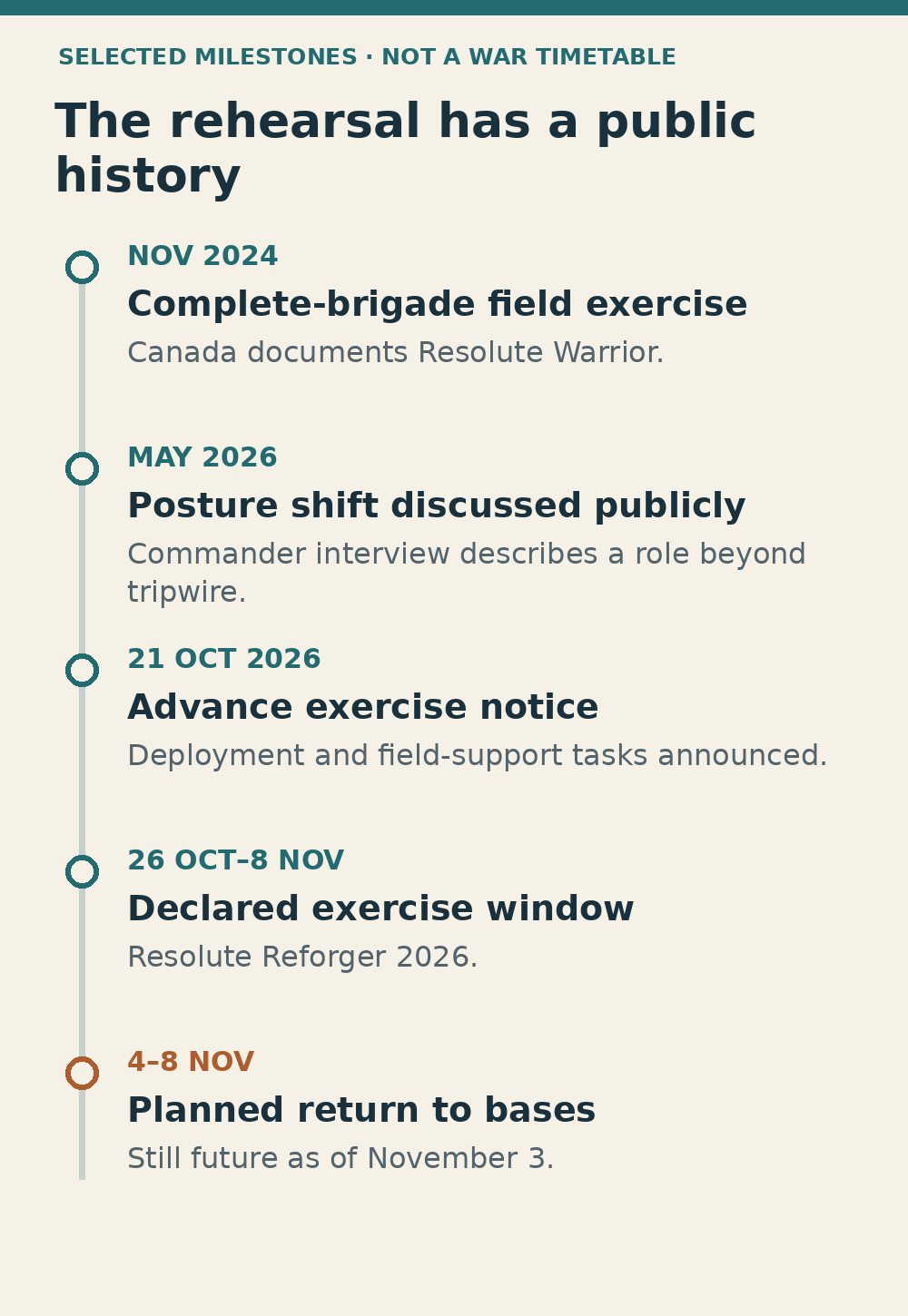
Canada documented complete-brigade field training in November 2024, and its then-commander discussed a broader defence role in May 2026. Latvia announced the autumn exercise on October 21; its November 4–8 return window was a plan rather than an observed completion as of November 3.
Getting there is only the opening task
Much of the interest in a troop movement centres on its destination. The harder practical question is what happens after arrival.
A unit operating beyond its permanent base still needs meals, fuel, maintenance, medical support and reliable communication with the people directing it. The November 2 LSM report puts some of those ordinary requirements in view. It is a useful antidote to the idea that the important part of a deployment is finished once a line of vehicles reaches the right place.
The logistics commander’s delivery figures are evidence of what he reported supplying during the exercise. They are not independently audited totals or a measure of how the system would cope with an opponent disrupting it. Likewise, a public demonstration of medical support establishes that the function is being exercised; it does not establish a treatment capacity under wartime casualties.
That is a narrower conclusion than either “NATO is ready” or “the brigade cannot fight.” It is also the conclusion the evidence can carry.
An exercise can expose practical problems and give personnel experience dealing with them. To judge its results, we would need to know more about the tasks attempted, the conditions imposed and the standards met. A successful public demonstration supplies less information than a detailed assessment of performance under demanding conditions.
Canada’s national readiness figures do not score this brigade
There is another tempting shortcut: take a troubling Canadian military readiness statistic and apply it directly to Latvia.
Canada’s 2026–27 Departmental Plan includes national indicators for the 2024–25 fiscal year, along with information about equipment serviceability and pressures from ageing fleets and operational demands. Those figures are relevant to the wider institution providing the troops and equipment.
They do not reveal this brigade’s current readiness. A national measure can cover a different collection of units, equipment and mission requirements, observed in an earlier fiscal period. Presenting it as a percentage score for the formation exercising in Latvia would create precision the source does not provide.
The same caution applies in the other direction. Seeing this brigade conduct an exercise does not erase the wider institution’s equipment or personnel constraints. National pressures and local activity can both be real without either one supplying a complete answer about combat effectiveness.
The useful questions are more specific: which capabilities were tested, how demanding were the conditions, and what shortcomings were found? A broad institutional statistic cannot substitute for those answers.
The unanswered question is performance under pressure
The strongest public explanation is that the Canadian-led brigade is rehearsing a more demanding field-defence task in Latvia. Advance notices, previous training and observed support activity fit that explanation. None requires a secret attack date to make sense.
There are limits to reassurance as well. NATO Secretary General Mark Rutte’s October 14 statement that there was no imminent threat was a dated official assessment. It is not a guarantee covering every later development, just as an exercise announcement is not proof that risk has disappeared.
What the public record leaves unresolved is the brigade’s full performance under combat conditions and the private threat assessments behind particular planning choices. The absence of a public scorecard cannot establish failure. It cannot establish success either.
That is a better place to direct curiosity than the mere existence of military vehicles near a border. The revealing evidence would show how the force performs when movement, supply and communication become difficult—and which weaknesses the rehearsal actually helps it fix.