
Iran Appears to Be Moving Naval Mines Into Hormuz Shipping Lanes
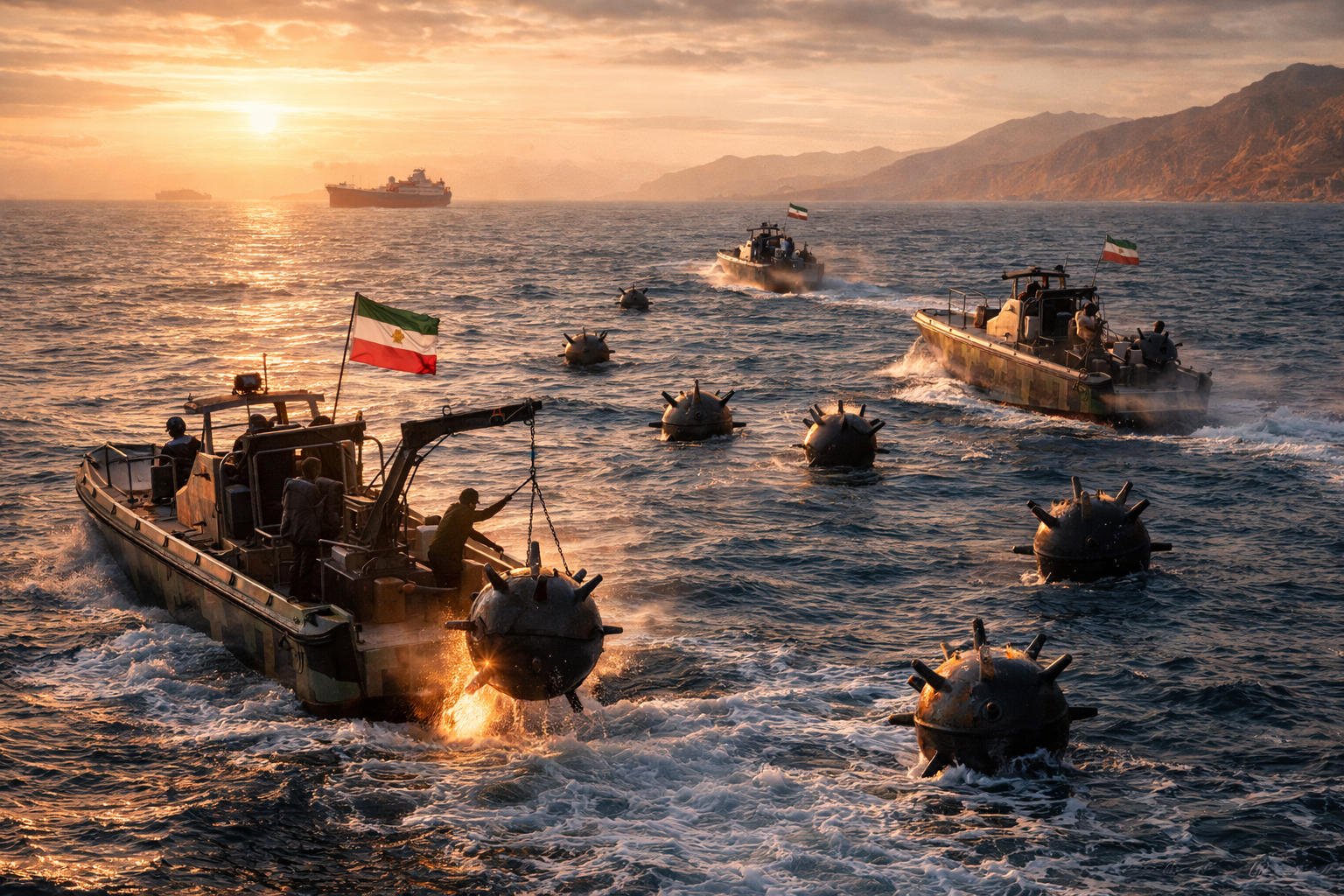
For days, the most reassuring argument about the Strait of Hormuz was that the nightmare scenario had not fully arrived yet. Iran had threatened, shipping had slowed, insurers had panicked, and oil had spiked, but there was still a gap between a dangerous blockade atmosphere and the specific escalation that terrifies navies and energy markets most: mines in the water. That gap now looks much smaller. The Pentagon said Tuesday that U.S. forces are already hunting and striking Iranian mine-laying vessels and mine storage facilities, while also reviewing options to escort ships through the strait. That is not how governments talk when a risk is merely theoretical. It is how they talk when they believe the threat has become operational.
The most important fact is that the chairman of the Joint Chiefs of Staff said U.S. Central Command is continuing to hunt and strike mine-laying vessels and mine-storage sites, while the Pentagon warns Iran harder consequences will follow if Hormuz cannot function. Once the U.S. military is shaping operations around mine threats, the burden of proof shifts. This is no longer “what if Iran mined Hormuz?” It is “how far into the mining phase is this crisis already moving?”
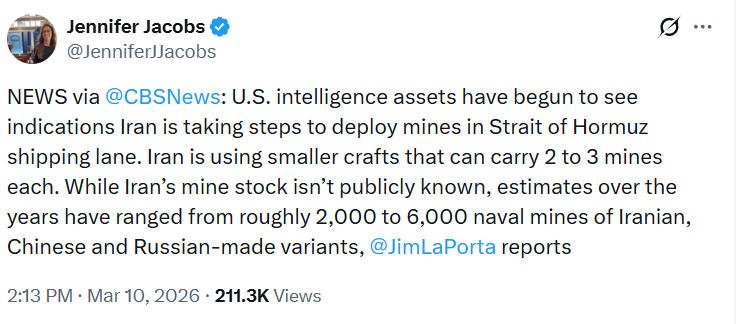
That distinction matters because mines change the nature of a chokepoint crisis. Missiles and drones create bursts of danger. Mines create lingering paralysis. A tanker company can try to price around one missile salvo or reroute around one night of strikes. It is much harder to keep sailing normally when a narrow channel may contain bottom mines, drifting mines, or moored mines that cannot be ruled out without time-consuming counter-mine work. Reuters reports the shipping lanes through Hormuz are only two nautical miles wide in each direction and that vessels must navigate near Iranian-controlled islands and coastlines that provide cover for Iranian forces. In a corridor that tight, a limited mine threat can function like a much larger blockade.
The economic stakes are enormous because Hormuz is not just another busy shipping lane. The U.S. Energy Information Administration says flows through the Strait of Hormuz in 2024 and the first quarter of 2025 accounted for more than one-quarter of total global seaborne oil trade and about one-fifth of global oil and petroleum product consumption. The EIA also says around one-fifth of global LNG trade moved through the strait in 2024, primarily from Qatar. The International Energy Agency puts the 2025 total at nearly 20 million barrels per day of oil moving through Hormuz, roughly 25% of the world’s seaborne oil trade, with only limited alternative export capacity available outside the strait.
That is why this is already more than a naval story. Reuters reports traffic through Hormuz has dropped 97% since the war began on February 28. At least 11 ships have been attacked since the conflict began, and insurance premiums have risen by as much as 300%. Put differently, the strait is already barely functioning like a normal commercial artery before the world has even had public, universally accepted confirmation of a full mine-laying campaign. If mines are now part of the active operating picture, they are landing on top of an already half-frozen system.
Iran appears to be moving decisively into a mine-deployment posture. The article does not need to claim omniscience about every mine location to make that case. The operational evidence is already strong enough. The U.S. military says it is striking mine-laying vessels. Reuters says Iran has effectively closed the strait. Shipping has nearly vanished. Escort options are under review. Gulf producers are already adjusting production because exports cannot move normally. Those are not disconnected warning lights. They are different ways of describing the same escalation.
There is also an important precedent here. Reuters reported in July 2025 that U.S. intelligence detected Iran loading naval mines onto vessels in the Persian Gulf after Israeli strikes, even though those mines were not ultimately deployed. In that earlier episode, two U.S. officials told Reuters that the preparations were serious enough to raise fears Tehran was preparing to blockade Hormuz. Reuters also reported that Iran had more than 5,000 naval mines as of a 2019 DIA estimate and could rapidly deploy them using small, high-speed boats. So when officials and analysts now warn that mine moves are underway again, they are not pulling a brand-new theory out of thin air. They are reacting to a known capability and a precedent that has already shown up in U.S. intelligence reporting before.
The immediate oil-market consequence is not just about barrels physically lost today. It is about what traders suddenly have to believe about tomorrow. When the market thinks a disruption is temporary, prices can spike and then fade. When the market starts to believe the disruption may be persistent, physical, and difficult to reverse, the pricing regime changes. Reuters reported Saturday that Brent and WTI reached their highest settlement levels since 2022, and that Brent briefly hit $119.50 intraday. On Tuesday, the EIA said Brent is now expected to trade above $95 a barrel for the next two months because the Iran war is disrupting supply, with blocked Hormuz traffic expected to reduce Middle East output further in the coming weeks.
That is before fully pricing a mine-clearing problem. Mines are different from a simple diplomatic closure threat because they are slow to neutralize and expensive to insure against. Reuters notes that even if convoy protection is possible, it would be resource-intensive and difficult to sustain. Aramco’s CEO warned Tuesday that the longer Hormuz remains blocked, the more “catastrophic” the consequences will be for global oil markets and the wider economy. He said Aramco is not currently exporting oil from the Gulf because ships cannot load there, and that even maximum use of the East-West pipeline still leaves roughly 350 million barrels disrupted. That is the sort of industry language used when the system is under real physical strain, not just emotional market stress.
The reason this could still get worse is that bypass options are limited. The EIA estimates Saudi Arabia and the UAE together have about 2.6 million barrels per day of pipeline capacity that could be available to bypass Hormuz in a disruption. The IEA offers a somewhat broader 2025 estimate of 3.5 to 5.5 million barrels per day of available alternative export capacity through Saudi and UAE routes, but either way it is nowhere near enough to fully replace the almost 20 million barrels per day that normally transit the strait. That means any prolonged mining crisis would leave a very large hole that pipelines alone cannot fill.
The knock-on effects would spread far beyond crude. Reuters says about 33% of global fertilizers, including sulphur and ammonia, pass through Hormuz. Aramco warned of downstream consequences for aviation, agriculture, automotive supply chains, and other industries if the strait remains blocked. That is how a naval escalation turns into a consumer crisis. First crude rises. Then diesel and jet fuel stay elevated. Then fertilizer inputs tighten. Then food, shipping, air travel, and manufacturing costs climb. In the United States, Reuters reports the nationwide average gas price Tuesday had already risen to $3.54 a gallon, up about 19% since the war began.
There is also a military reality that should make markets uneasy even if diplomats start talking about de-escalation. Reuters reported Tuesday that the United States has already struck more than 5,000 targets since the war began and destroyed or damaged more than 50 Iranian naval vessels. That is a sign of scale, but not necessarily of control. Counter-mine operations are painstaking. Convoys are vulnerable. Fast boats, mini-subs, drones, and hidden coastal launch points can keep a threat alive even after large numbers of platforms have been hit. Reuters’ own reporting on the challenges of securing Hormuz makes clear that the geometry of the strait favors disruption. This is not the kind of problem where a few dramatic airstrikes automatically restore confidence.
It looks like the mine threat has become real enough to alter U.S. military behavior, freeze shipping, scare insurers, constrain Gulf exports, and force oil analysts to think in terms of sustained disruption rather than a momentary war premium. Even if the public record still lacks neat photographic proof of every mine placed in every lane, the broader pattern is already visible. If the Pentagon is hunting mine-layers, if traffic is down 97%, if oil producers are shutting in barrels, and if the world’s largest exporter is warning of catastrophic consequences, then the Strait of Hormuz is no longer merely threatened. It is in crisis.
And that is why this story matters so much right now. The scary part is not simply that mines are a nasty weapon. It is that they can transform a high-drama geopolitical event into a persistent economic emergency. Oil traders can live with a scare. They can even live with a spike. What they fear is a scenario in which the world’s most important energy chokepoint becomes so dangerous, so uncertain, and so operationally contaminated that “open” and “usable” are no longer the same thing. That is the threshold Hormuz appears to be approaching now.
What could this do to the price of oil?
Quite a lot, and fast. The baseline is already elevated: the U.S. Energy Information Administration said on March 10 that Brent is expected to trade above $95 per barrel for the next two months because the war is already disrupting supply, especially through the Strait of Hormuz.
If the mine threat keeps looking real, oil could jump for a simple reason: traders would no longer be pricing just a war premium, but a physical chokepoint crisis. Hormuz normally carries about 20% of the world’s oil transit, and Reuters reported that shipping traffic through the strait has already plunged 97% since the war began. If markets start believing that reopening the lane will require mine-clearing, naval escorts, and weeks of uncertainty, crude could surge again because the disruption stops looking temporary and starts looking operationally sticky.
The really dangerous part is that oil does not need a full, proven, long-term closure to spike. It only needs traders, insurers, and shipowners to act as though Hormuz is unsafe. Reuters reports insurance premiums have risen by as much as 300%, and Aramco warned that a prolonged Hormuz blockage could have “catastrophic consequences” for oil markets. That is the kind of environment where Brent can lurch upward on each new escalation headline, especially if buyers think Gulf barrels may remain stranded longer than expected.
So the cleanest way to put it in the article is this: if Iran appears to be moving mines into Hormuz, oil is no longer just trading on fear — it is trading on the possibility of a real, prolonged supply shock. That is how you get back toward, or above, the recent war highs.