
How to Read the VIX During a Geopolitical Crisis
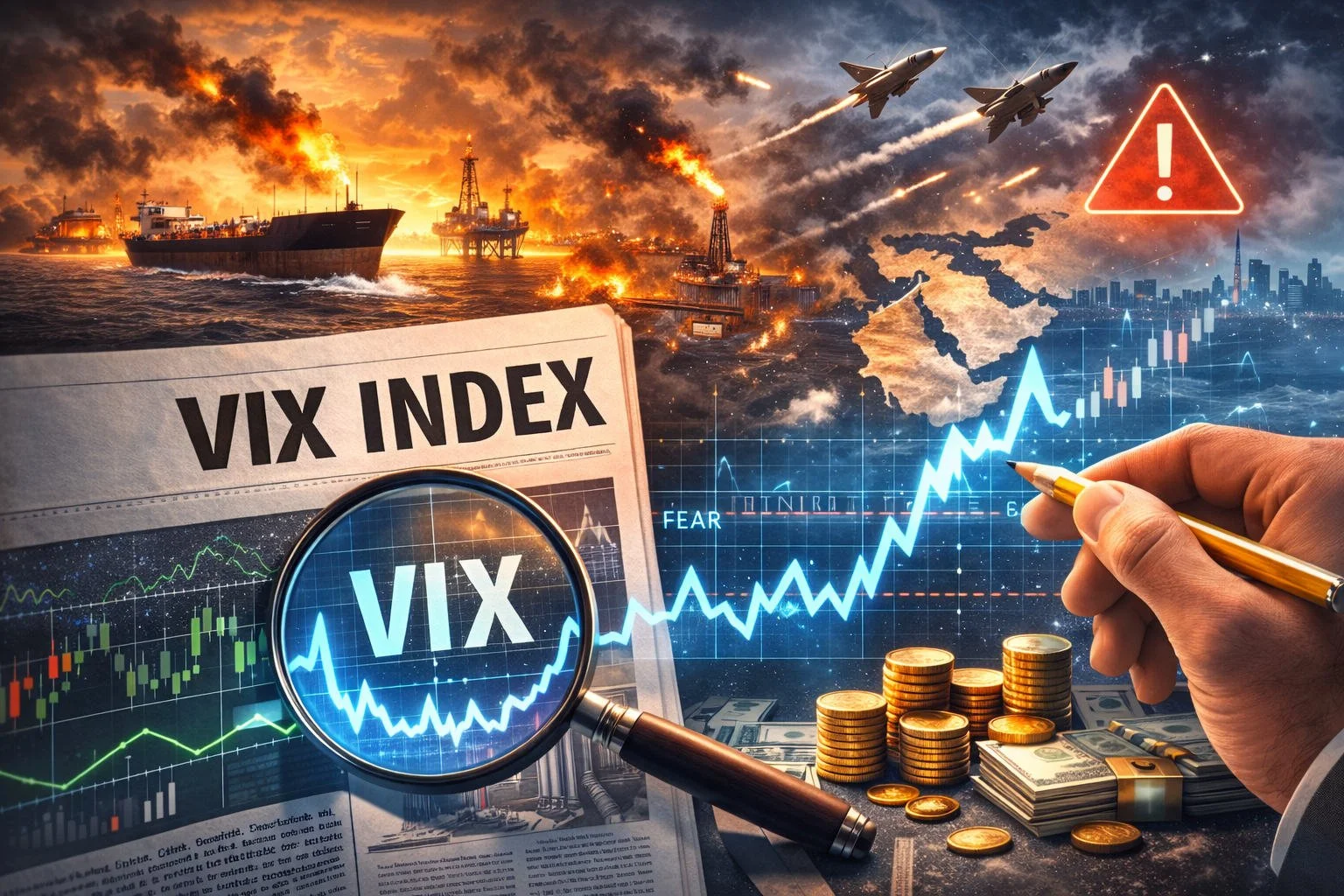
When a geopolitical crisis hits—war headlines, shipping chokepoints, surprise attacks—the VIX tends to jump and everyone calls it the “fear index.” That’s not wrong, but it’s incomplete.
A better way to think about the VIX is:
The VIX is the market’s price for 30-day S&P 500 “uncertainty insurance.”
During a crisis, that insurance can reprice brutally fast—sometimes before stocks even move much.
Here’s how to interpret what the VIX is really telling you when the world feels unstable.
1) First, know what the VIX actually measures (and what it doesn’t)
The VIX is not “how scared people are” in a vague emotional sense. It’s a number derived from S&P 500 option prices that reflects the market’s expected volatility over roughly the next month.
What it does measure
The market’s implied expectation of how big S&P 500 moves could be over the next ~30 days (up or down).
What it does not measure
The probability of a specific event (like a ceasefire, a strike, a recession).
The direction of the market (VIX can rise even if stocks are up on the day).
A guarantee that “a crash is coming.”
Key mindset shift:
VIX is about magnitude (how wide the range is), not direction (up vs. down).
2) The quickest read: level + speed
When crisis news breaks, people focus on the VIX level (“it’s at 25!”). That’s only half the story.
You want two things:
A) The level (the “temperature”)
A simple, practical mental map many investors use:
Below ~15: calm / complacent
15–20: normal-ish
20–30: elevated stress
Above ~30: high fear / disorderly conditions
Above ~40: crisis-style volatility
B) The speed (the “fever spike”)
A sudden jump matters even if the level isn’t extreme yet.
Example:
VIX from 14 → 20 is a huge repricing (big percent change).
VIX from 28 → 34 is also serious, but the market was already nervous.
Rule of thumb: In crisis moments, the rate of change often tells you more than the level for the first day or two.
3) Convert VIX into “what the market is pricing” (the most useful trick)
This is the part almost nobody does—but it’s the most practical way to read the VIX.
Because VIX is an annualized volatility number, you can convert it into a 30-day expected range for the S&P 500 (roughly a one-standard-deviation move).
Simple conversion:
30-day implied move ≈ VIX ÷ √12
So:
VIX 20 ≈ 20 ÷ 3.46 ≈ 5.8% expected 30-day move (up or down)
VIX 30 ≈ 30 ÷ 3.46 ≈ 8.7%
VIX 40 ≈ 40 ÷ 3.46 ≈ 11.6%
Now the VIX becomes legible:
If the S&P 500 is 5,000 and VIX is 30, the market is roughly pricing a ±8.7% 30-day range (about ±435 points).
During geopolitical shocks, this helps you separate:
“scary headlines”
from“the market is pricing truly massive movement.”
4) The biggest crisis tell: look at the VIX term structure (not just spot VIX)
In geopolitical crises, event risk is usually front-loaded:
immediate strikes / retaliation
insurance and shipping disruptions
emergency decisions and miscalculations
That’s why the VIX term structure can be more informative than the headline VIX number.
What you’re looking for
Contango (normal): Longer-dated volatility priced higher than near-term
→ market expects stress to fadeBackwardation (stress): Near-term volatility priced higher than longer-term
→ market is urgently bidding up protection right now
How to interpret it in a crisis:
If the front of the curve spikes but the back end doesn’t move much, the market is saying:
“This is a near-term shock, not a long-term breakdown.”If the whole curve shifts up, the market is saying:
“This uncertainty could stick around.”
This is how you tell the difference between:
headline panic
andsystemic fear creeping into future months.
5) Crisis nuance: VIX can fall even while the news gets worse
This sounds counterintuitive, but it’s common.
VIX rises when uncertainty is high. Sometimes a situation becomes “worse” but also becomes clearer—and clarity can reduce implied volatility.
Examples of why VIX might drop during ugly headlines:
A clear escalation path becomes priced in (less uncertainty)
Markets believe the worst-case scenario is off the table
Governments signal stability measures (liquidity support, escorts, diplomacy channels)
The market realizes the crisis is “contained” even if it’s still tragic
Translation:
VIX is the price of uncertainty, not a moral score of how bad events are.
6) Use “tail risk” indicators to see if the market fears a sudden crash vs. a choppy mess
During geopolitical crises, the fear isn’t only “volatility.” It’s often “a one-day air-pocket drop.”
Two helpful companions to the VIX:
A) Skew / tail-risk gauges
If tail-risk pricing spikes while VIX is only moderately elevated, that can signal the market is paying up specifically for crash protection, not just general chop.
B) VVIX (“volatility of volatility”)
VVIX is essentially: how volatile the market expects the VIX itself to be.
In plain English:
VIX tells you the market expects movement.
VVIX tells you the market expects volatility to become unstable and jumpy.
During a geopolitical crisis, a rising VVIX can mean “the volatility regime itself is uncertain”—often a sign the market is bracing for more sudden headline shocks.
7) A simple “geopolitical crisis” VIX checklist
When you see a big headline event, run this quick checklist:
What’s the VIX level? (temperature)
How fast did it move today? (fever spike)
What 30-day move is priced? (VIX ÷ √12)
Is the curve in backwardation? (urgent near-term fear)
Is tail risk getting bid? (crash insurance demand)
Is VVIX rising too? (volatility instability)
Does VIX stay high into the close?
If VIX fades hard late-day, that can signal panic cooling.
If it closes near highs, the market is still paying up for overnight/next-day uncertainty.
8) Common mistakes people make with VIX in crises
Mistake 1: “High VIX = sell everything”
High VIX can appear near bottoms because fear peaks when people capitulate. You can’t use it as a simple on/off switch.
Mistake 2: “Low VIX = safe”
Low VIX can mean complacency, and complacency can break suddenly in geopolitical shocks.
Mistake 3: Reading VIX without context
A VIX of 22 can be terrifying in a calm year and totally normal in a volatile year. Always compare:
recent range
trend
term structure
Mistake 4: Confusing VIX products with the VIX index
Many volatility ETFs/ETNs track VIX futures, not spot VIX, and behave differently over time—especially because of the futures curve (roll yield).
Bottom line
During a geopolitical crisis, the VIX is best read like a dashboard, not a single number:
Level tells you how expensive “uncertainty insurance” is right now.
Speed tells you how abruptly the market is repricing risk.
Converted range (VIX ÷ √12) tells you what the market is implicitly bracing for in the next month.
Term structure tells you whether fear is a short shock or a longer regime.
Tail risk + VVIX tells you whether traders fear a crash-like event or just violent chop.
If you read it that way, VIX becomes less “fear porn” and more useful information—especially when headlines are moving faster than emotions can keep up.