
What Marcella Hazan’s Tomato Sauce Teaches About Cheap Food That Tastes Expensive
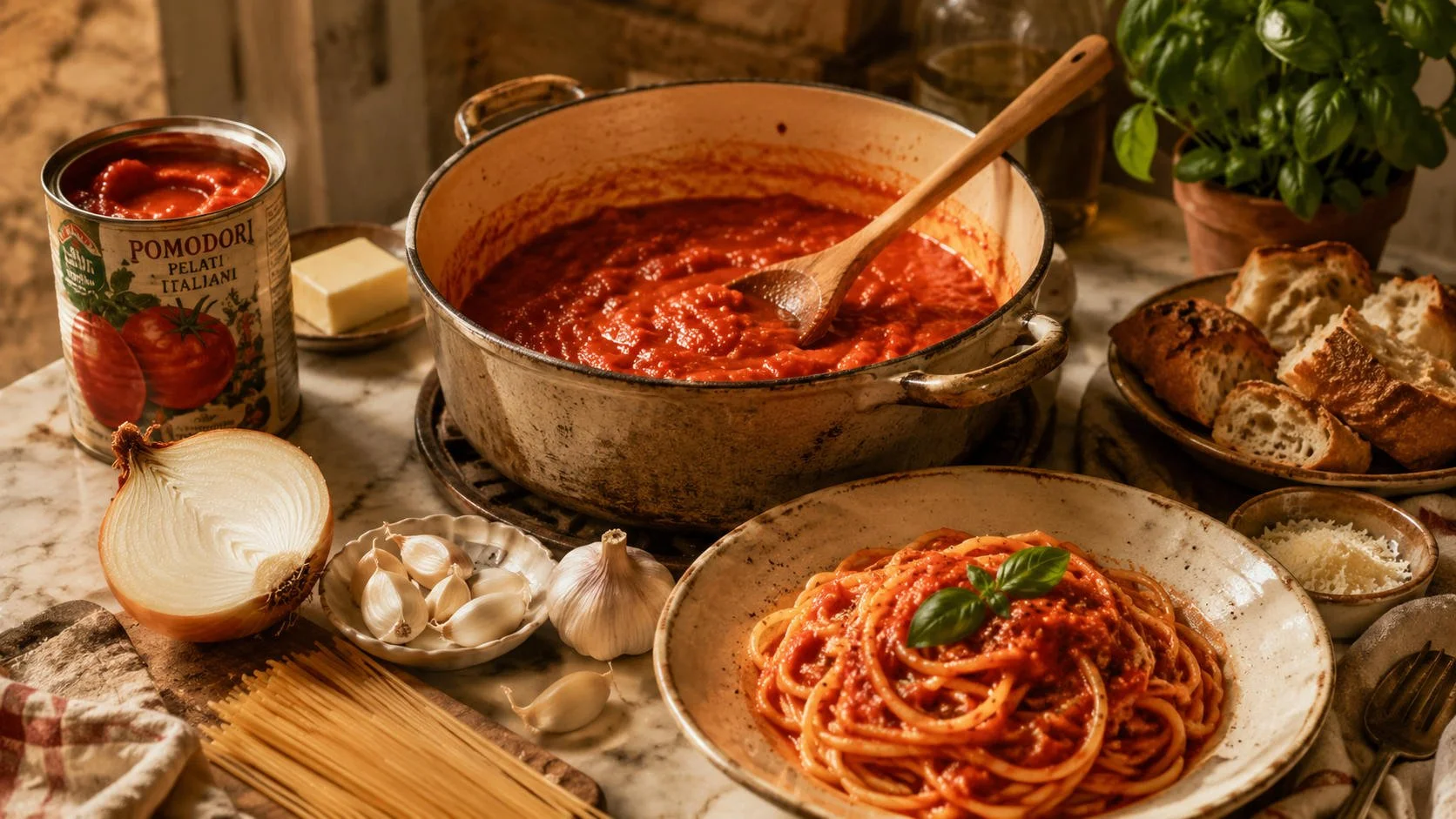
There are recipes that ask you to buy saffron, imported cheese, three obscure vinegars, and a jar of preserved lemons with the emotional availability of a hedge fund manager. Then there is Marcella Hazan’s tomato sauce, a culinary thunderclap made from tomatoes, butter, onion, and salt. That’s basically four ingredients standing in a pot looking unemployed, and somehow the result tastes like a grandmother with a villa, a linen tablecloth, and strong opinions about your life choices.
Marcella Hazan’s famous Tomato Sauce with Onion and Butter first appeared in The Classic Italian Cook Book in 1973 and later in Essentials of Classic Italian Cooking in 1992. Food & Wine’s version notes that the sauce uses just tomatoes, butter, onion, and salt, then simmers until it becomes rich, glossy, and dramatically better than it has any right to be.
And that is the lesson: expensive-tasting food is not always expensive food. Sometimes it is cheap food treated with enough respect that it stops acting like it came from a pantry shelf and starts acting like it summers in Liguria.
Marcella Hazan Tomato Sauce: The Luxury of Not Trying So Hard
The modern food world has a sickness, and no, it is not just people calling everything “elevated” because they put microgreens on a hot dog. It is the belief that deliciousness must be complicated. We have been bullied by restaurant menus into thinking that a dish is only serious if it contains a foam, a reduction, a crumble, a drizzle, and at least one ingredient described as “foraged,” which is a charming way to say “found outside.”
Hazan’s tomato sauce walks into that nonsense wearing sensible shoes and carrying a wooden spoon.
The sauce is stupidly simple: tomatoes go in a pan with butter, a halved onion, and salt. It simmers. The onion is removed. The sauce is tossed with pasta. That is basically it. No garlic. No basil confetti. No chili flakes doing jazz hands in the corner. No twelve-minute lecture about how your great-aunt once ate a tomato in Naples and therefore you understand authenticity.
The brilliance is restraint. Hazan understood that a good ingredient does not need a marching band. It needs heat, fat, salt, and time. The tomatoes bring acidity and sweetness. The butter rounds the edges and adds silk. The onion perfumes the sauce like a background singer who knows the assignment and does not try to steal the Grammy.
This is what cheap food that tastes expensive usually has in common: somebody had the decency to stop before ruining it.
Cheap Food That Tastes Expensive Starts With Ruthless Simplicity
Cheap cooking goes wrong when people panic. They see affordable ingredients and assume they must bury them under a landslide of seasoning, like a landlord covering mold with beige paint.
But budget food does not need to look busy to be good. It needs clarity.
Hazan’s tomato sauce is a masterclass in letting each ingredient do one job extremely well. Tomatoes are not asked to impersonate barbecue sauce. Butter is not asked to be “heart healthy,” poor thing. Onion is not diced into little bureaucratic cubes and forced to mingle with garlic, celery, carrot, and the rest of the flavor committee. It is cut in half, dropped in, and later thrown out like a consultant who somehow fixed everything without anyone understanding what he did.
Food & Wine describes the sauce as cheap, available in any season, easy to double, and made with ingredients available at ordinary supermarkets. It also points out that canned tomatoes can be preferable when fresh tomatoes are out of season because they are preserved at peak freshness and tend to be more consistent.
There it is. The holy budget-cooking truth: consistency beats romance. A canned tomato that tastes like a tomato is better than a fresh winter tomato that tastes like wet conference room carpet.
Butter Tomato Sauce: Why Fat Makes Budget Food Feel Rich
Let us speak plainly about butter, because apparently society still needs help.
Butter is not just “extra calories,” the dreary phrase used by people who eat plain chicken breast with the defeated silence of a medieval prisoner. Butter is flavor, texture, aroma, and luxury. In Hazan’s sauce, it does not scream “dairy.” It softens the tomatoes. It turns sharp acidity into something plush. It gives the sauce body, gloss, and that restaurant-y feeling people normally attribute to secret techniques, when the secret technique is often “more fat than you emotionally prepared for.”
This does not mean you need to drown everything in butter like you are trying to baptize pasta into a cholesterol cult. It means a small amount of the right fat can make cheap food taste expensive because fat carries flavor and changes mouthfeel. A watery tomato sauce tastes like a punishment ladled by a tired cafeteria worker. A buttery tomato sauce tastes intentional.
That is the difference between “I am eating pasta because rent exists” and “I am enjoying a rustic Italian meal,” which is the same pasta, but with better branding and fewer tears.
The Onion Trick: Flavor Without the Tiny-Chop Circus
One of the most elegant parts of Marcella Hazan’s tomato sauce is the onion. Not minced. Not sautéed. Not caramelized for forty-five minutes while you reconsider every decision that brought you to this stove. Just peeled, halved, simmered, and removed.
This is deeply funny because it rejects so much performative cooking labor. The internet has convinced people that unless they dice onions into microscopic cubes, crush garlic under a knife, and narrate the whole thing like a haunted cooking show host, they are not really cooking. Hazan says: cut it in half, drop it in, move on with your finite human life.
The onion gives the sauce sweetness and savory depth without dominating it. It is flavor by infusion, not invasion. This is a budget-cooking lesson worth tattooing on the inside of your pantry door: you do not always need more ingredients. Sometimes you need the same ingredients behaving better.
A whole onion simmered in sauce is also useful because it avoids the raw-allium harshness that can make cheap sauces taste like someone shouted into a salad. It gives warmth without turning the whole pot into an onion convention.
Expensive-Tasting Food Requires Patience, Not a Trust Fund
The true luxury ingredient in Hazan’s tomato sauce is not imported tomatoes, although nice tomatoes help. It is patience. Annoying, smug, inexpensive patience.
The sauce simmers uncovered until it thickens and the butter integrates. During that time, water evaporates, flavors concentrate, and the whole thing stops tasting like separate ingredients and starts tasting like dinner. This is where cheap food becomes expensive-tasting: not in the shopping cart, but in the pot.
Cheap ingredients often contain plenty of flavor. They are just trapped under water, rawness, blandness, or neglect. Heat liberates them. Time focuses them. Salt wakes them up. Fat gives them a tailored jacket.
The problem is that many home cooks cook like they are fleeing a small kitchen fire. They under-simmer sauce, under-salt beans, under-brown vegetables, and then wonder why everything tastes like a beige apology. Hazan’s sauce is not difficult. It simply refuses to be rushed, which in modern cooking feels almost rude.
Budget Cooking Tip: Buy Better Versions of Fewer Things
Marcella Hazan’s tomato sauce is cheap, but it is not careless. There is a difference. Cheap cooking is strategic. Miserly cooking is how you end up eating noodles in ketchup and telling yourself it is “fusion.”
Because the recipe has so few ingredients, each one matters. This does not mean you need the most expensive can of tomatoes in the store, the one with a label designed by an Italian monk and priced like printer ink. It means buy the best tomatoes you can reasonably afford. Use real butter. Salt properly. Choose pasta that does not collapse into sadness.
The trick is not to spend wildly. It is to concentrate your spending where it counts. Five mediocre add-ons will not rescue a bad sauce. One good can of tomatoes might.
Here is the cheap-food math, since apparently adulthood is just arithmetic with groceries: skip the jarred sauce, the bagged salad you will forget in the crisper, and the novelty snack shaped like a farm animal. Buy tomatoes, butter, onion, pasta, and cheese if the budget allows. Congratulations, you have dinner and a tiny personality upgrade.
The Marcella Hazan Method Works Beyond Tomato Sauce
The reason this sauce matters is not just that it tastes good. It teaches a whole philosophy of cooking.
Hazan was famous for precise, pared-back recipes. Vogue notes that she trained as a scientist before becoming one of the most influential voices in Italian cooking in America, and that her work emphasized taste over novelty. That scientific precision shows up in the sauce. Nothing is there to decorate the recipe’s résumé. Every ingredient has a function.
You can steal this method for other cheap foods:
Beans do not need seventeen toppings; they need salt, fat, aromatics, and enough time to become creamy instead of chalky little pellets of disappointment.
Rice does not need to be buried under sauces; it needs proper seasoning, steam, and maybe butter or olive oil so it stops acting like packing material.
Eggs can taste luxurious with slow cooking, salt, and a little fat. They do not require truffle oil, which usually tastes like a chemical plant remembering a mushroom.
Potatoes become expensive-tasting when roasted hard enough to brown, mashed with enough butter to silence their peasant ancestry, or simmered until they absorb broth like tiny edible sponges.
The method is: fewer ingredients, better treatment, no panic.
Why Restaurant Food Tastes Expensive Even When It Isn’t
A painful truth: a lot of restaurant food tastes expensive because restaurants are not afraid of fat, salt, heat, and time. Home cooks are often afraid of all four, then blame themselves for lacking talent. Talent is nice, but salting the pasta water would also be a promising start.
Hazan’s sauce uses restaurant logic without restaurant pricing. It takes humble ingredients and applies the unglamorous techniques that make food good: simmering, reducing, seasoning, finishing with fat. It does not require tweezers, a culinary degree, or a chef named Luca who scowls at you for using the wrong spoon.
This is why the sauce feels fancy. Not because it is fancy. Because it is balanced. The acidity is softened. The texture is smooth. The sweetness is subtle. The salt is doing its job. The fat makes it linger.
Expensive-tasting food is often just food with no obvious mistakes.
The Emotional Power of a Cheap, Beautiful Meal
There is also something psychologically satisfying about a dish that costs little and delivers big. It feels like beating the system, which is important because the system has been beating us with grocery receipts the size of medieval scrolls.
A pot of tomato sauce made from pantry ingredients says: no, you do not need takeout. No, you do not need a meal kit with twelve plastic packets and instructions written for a golden retriever. No, you do not need to spend $24 on “rustic pasta” served in a bowl large enough to bathe a toddler.
You can make something warm, rich, and deeply comforting with a can, an onion, butter, salt, and time. It is not glamorous in the influencer sense. There is no overhead shot of seventeen matching ceramic bowls. But it is glamorous in the better sense: it makes ordinary life feel briefly less like a poorly managed subscription service.
That is the real genius of Marcella Hazan’s tomato sauce. It gives dignity to cheap food without pretending it is something else.
Practical Tips for Making Cheap Food Taste Expensive
Start with one dominant flavor. Hazan’s sauce is about tomato. Not tomato plus garlic plus oregano plus basil plus red pepper plus whatever spice jar is fossilizing near the stove. Pick the main event and stop inviting random guests.
Use fat deliberately. Butter, olive oil, chicken fat, coconut milk, cream, or cheese can turn lean ingredients into something rounded and satisfying. Fat is not a personality flaw. It is a tool.
Cook off water. Many cheap meals taste cheap because they taste diluted. Simmer sauces uncovered. Roast vegetables until browned. Let beans thicken. Watery food has the charisma of a wet sock.
Salt in stages. Salt early enough to season the food, then adjust at the end. Under-salted cheap food tastes poor in the Dickensian sense. Properly salted cheap food tastes like someone knew what they were doing.
Remove what has done its job. Hazan removes the onion. This is a power move. Not every ingredient needs to be eaten to matter. Bay leaves know this. Parmesan rinds know this. Tea bags built an entire career on this.
Cheap Pasta Sauce, Expensive Lesson
Marcella Hazan’s tomato sauce is not just a recipe. It is an insult to culinary overcomplication. It stands there with four ingredients while elaborate sauces with thirty-seven components collapse into mediocrity, sweating under the weight of their own ambition.
It teaches that cheap food can taste expensive when it is focused. It teaches that canned goods are not moral failures. It teaches that butter is cheaper than therapy and sometimes more immediately effective. It teaches that patience can do what extra ingredients cannot. It teaches that simplicity is not laziness; it is discipline wearing an apron.
Most of all, it teaches that cooking well on a budget is not about pretending cheap ingredients are luxurious. It is about finding the luxury already hiding inside them and then not ruining it like a clown with a garlic press.
So make the sauce. Simmer the tomatoes. Add the butter. Let the onion do its quiet little magic trick. Toss it with pasta. Sit down. Eat something cheap that tastes expensive.
And when someone asks what your secret is, just say “restraint,” because it sounds elegant and hides the fact that the recipe is basically a can of tomatoes having a very productive meeting with half an onion.