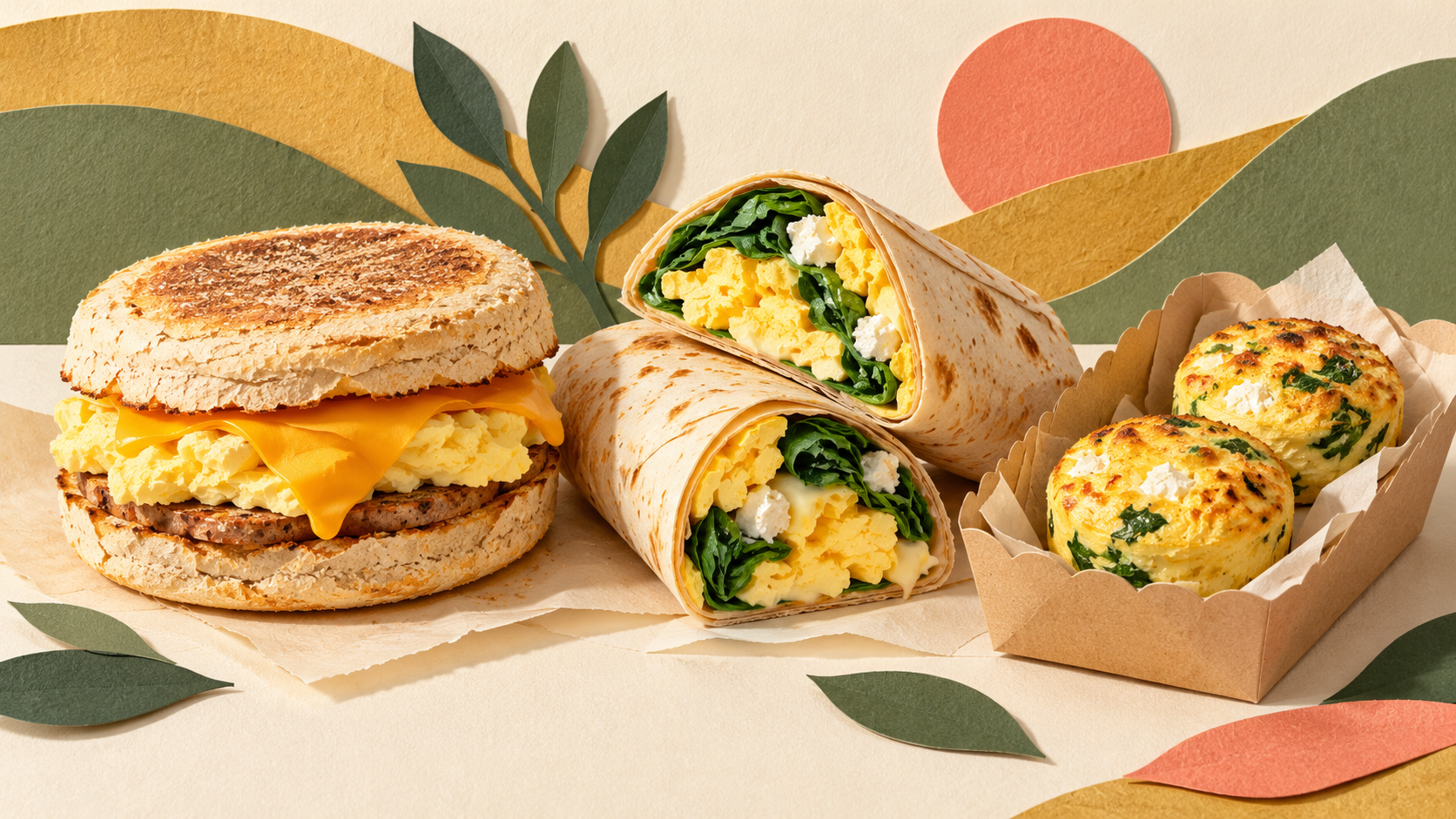
Dunkin’s Turkey Sausage Sandwich has more protein than Starbucks’ Turkey Bacon, Cheddar & Egg White Sandwich: 22 grams versus 17. The calorie comparison goes the other way: 460 versus 260.
Both statements can be true. One answers how much protein comes in the sandwich. The other helps a reader comparing calorie totals. Divide protein by calories and a third answer appears: the Starbucks sandwich supplies about 6.5 grams of protein per 100 calories, compared with about 4.8 at Dunkin’.
That is the useful way to approach Dunkin’ vs. Starbucks breakfast. Decide whether you want fewer calories, more protein in one order, or more protein relative to calories. Those goals can point to different foods.
This comparison uses U.S. food portions, including sandwiches, wraps and orders of egg bites. Dunkin’ figures come from its September 2026 nutrition guide; Starbucks figures use its published standard product records checked in October. Drinks and prices are separate decisions.
Start with calories and protein per actual order
A breakfast comparison needs a serving count. One Wake-Up Wrap is one wrap. A two-bite serving is two bites. Ordering a second item changes both the protein and the calories, even when each item looks small.
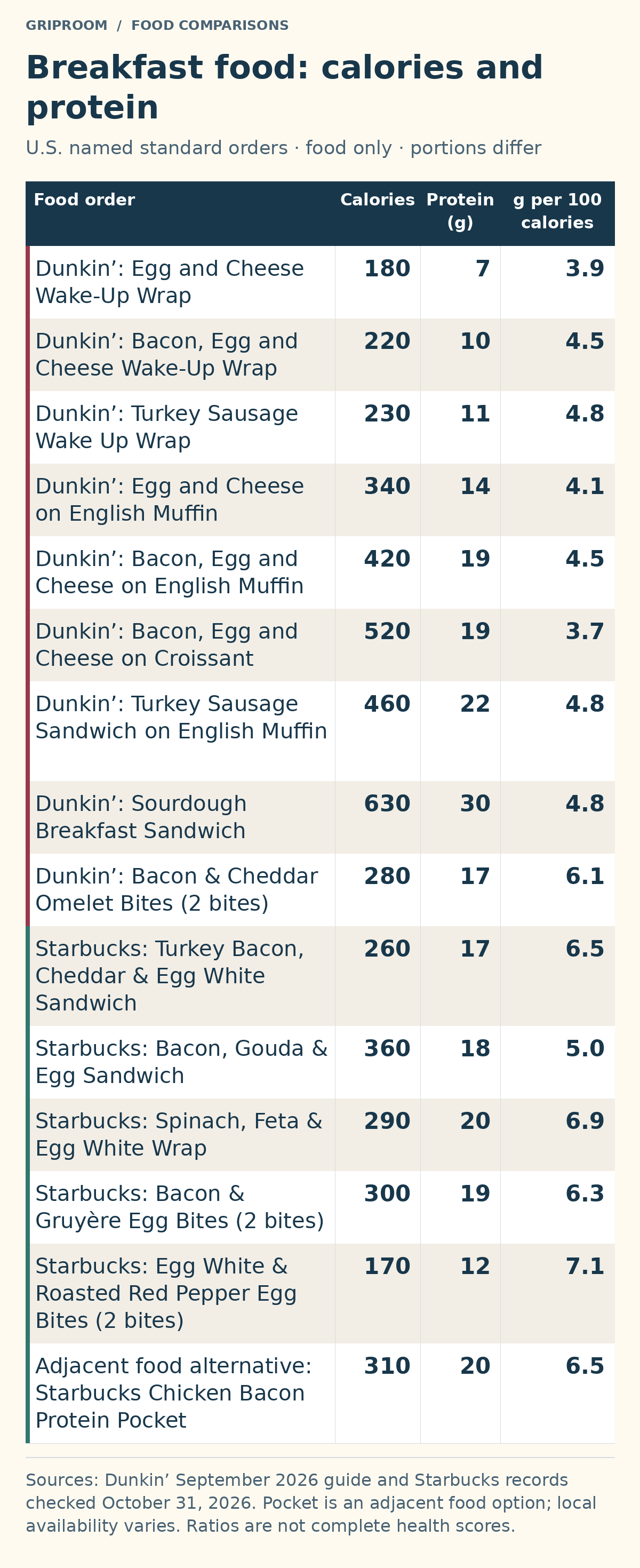
Standard U.S. food portions; drinks and modifications excluded. Published rounded figures, with density calculated from the listed calories and protein.
For someone choosing a turkey sandwich, the first decision is straightforward. Dunkin’ supplies five more grams of protein in its larger-calorie order. Starbucks supplies fewer calories and more protein per calorie. The names do not describe the same recipe or weight: turkey sausage and turkey bacon are different ingredients in different sandwiches.
That distinction prevents a misleading result. Calling either sandwich the winner without specifying the goal would conceal the reason a reader might prefer the other one.
More protein per order favors a larger breakfast
Dunkin’s Sourdough Breakfast Sandwich provides 30 grams of protein at 630 calories. It has more total protein than the 22-gram Turkey Sausage Sandwich, but also adds 170 calories to the listed order.
The extra protein may be relevant if a diner wants one food item with a larger protein total. It does not automatically make the sourdough sandwich more protein-dense. Its ratio is about 4.8 grams per 100 calories, close to the turkey sausage sandwich after rounding.
The same principle applies when a small item is doubled. Two 10-gram wraps become a 20-gram order, but their calories double too. A menu’s smallest-looking item does not remain a small order after two are purchased.
Use the whole serving you intend to eat. A comparison between one sandwich and one bite from a two-bite package would make the package look artificially light.
Fewer calories and higher protein density are different goals
Among the foods selected here, Starbucks’ Egg White & Roasted Red Pepper Egg Bites have the lowest calorie total: 170, with 12 grams of protein. Dunkin’s Egg and Cheese Wake-Up Wrap is close on calories at 180, with 7 grams of protein.
They are different foods, so that comparison does not establish equal portions, taste or fullness. It shows what the published orders contain.
Starbucks’ Spinach, Feta & Egg White Wrap offers another useful combination: 20 grams of protein at 290 calories, or about 6.9 grams per 100 calories. The egg-white bites supply about 7.1 grams per 100 calories.
Protein density is simply protein divided by calories, scaled to 100. It is helpful for this particular goal, but it leaves out other features of a meal. It does not rate the entire diet, predict how long breakfast will keep someone full, or turn different recipes into equivalent purchases.
Bread choice can change calories without changing protein
Dunkin’s Bacon, Egg and Cheese on an English Muffin is listed at 420 calories and 19 grams of protein. The croissant version has 520 calories and the same 19 grams. For these standard builds, changing the bread changes the listed calories by 100 without changing the rounded protein total.
Starbucks’ Bacon, Gouda & Egg Sandwich has 360 calories and 18 grams of protein. It supplies slightly less total protein than either of those Dunkin’ bacon sandwiches, with fewer calories. Different bread, cheese and egg preparations remain part of that comparison.
The egg-bite options also separate the goals. Dunkin’s two Bacon & Cheddar Omelet Bites provide 280 calories and 17 grams of protein; Starbucks’ Bacon & Gruyère Egg Bites provide 300 and 19. The Starbucks order has more protein, while the Dunkin’ order has fewer calories. Neither result measures which one an individual diner will enjoy more.
Equal protein makes portion differences easier to see
One particularly clear comparison reaches the same protein total in two different ways: two Dunkin’ Bacon, Egg and Cheese Wake-Up Wraps or one Starbucks Spinach, Feta & Egg White Wrap.
Both supply 20 grams of published protein. The two Dunkin’ wraps total 440 calories; the Starbucks wrap has 290. Their published sodium totals also differ: 1,180 milligrams versus 840.
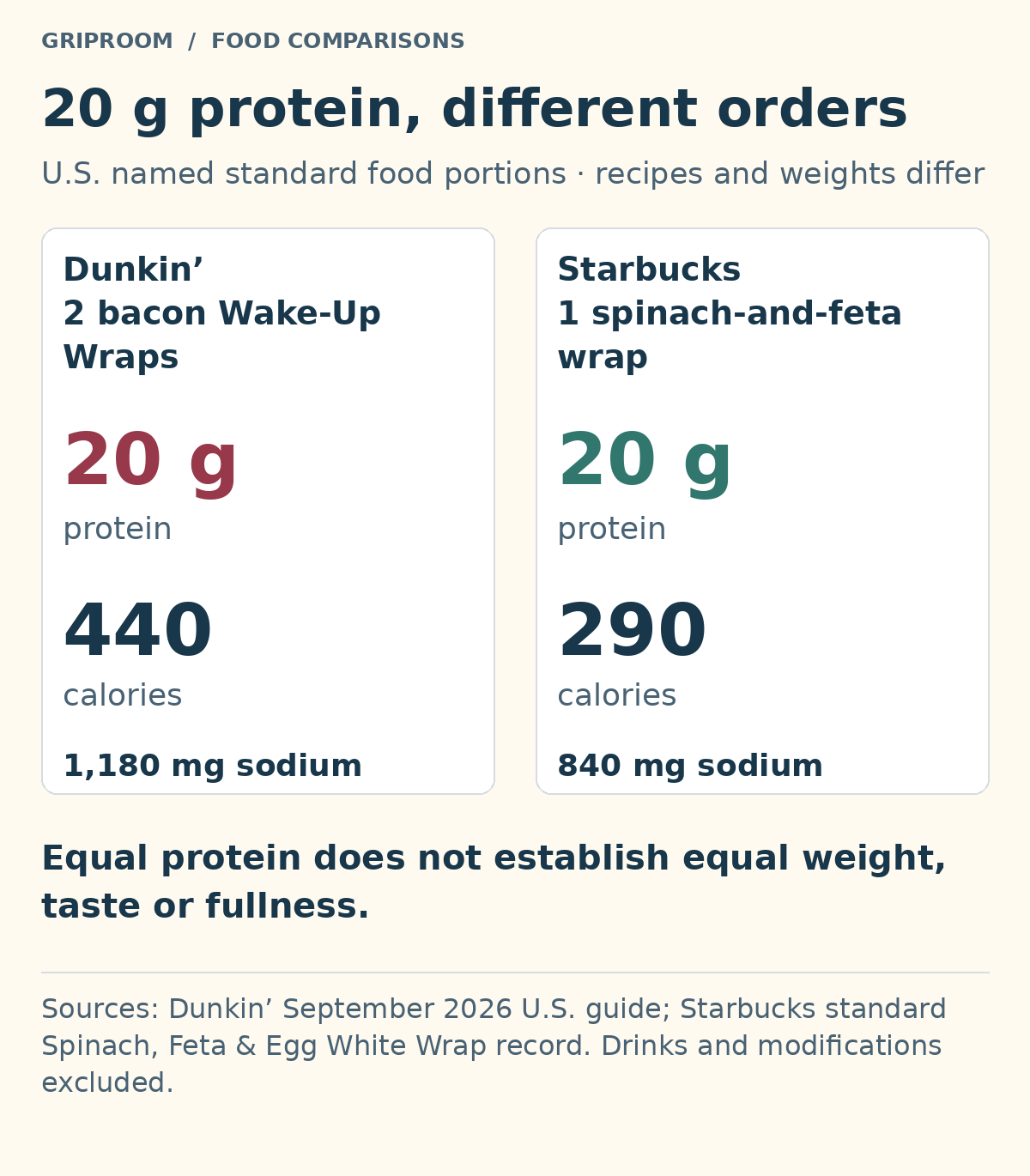
This example is useful because it holds one target constant. It makes the different calorie and sodium totals visible without pretending the recipes are identical. It also keeps the two-wrap serving explicit, rather than comparing its protein with a single wrap’s calories.
An explicit protein target also changes the shortlist. If the task is reaching 20 grams in the food order, the egg-white bites’ 12 grams do not meet it alone, despite their higher protein density. The spinach-and-feta wrap reaches that amount in one item, while the two bacon Wake-Up Wrap example reaches it in two. The 30-gram sourdough sandwich goes beyond the target with a different calorie total. This is why a ratio and an actual order both belong in the comparison.
A few smaller orders round out the choice
Dunkin’s Turkey Sausage Wake-Up Wrap has 230 calories and 11 grams of protein. Its Egg and Cheese on an English Muffin has 340 calories and 14 grams. Those are additional portion options if the larger sandwich is more food than the comparison requires.
On Starbucks’ wider U.S. food menu, the Chicken Bacon Protein Pocket is listed at 310 calories and 20 grams of protein. It belongs beside the comparison as an adjacent alternative; its presence in the published food catalog does not guarantee every store offers it as a traditional breakfast item. Check the local menu before building an order around it.
Our Dunkin’ high-protein ordering guide covers more choices within that chain. For this cross-chain decision, keep the goal and actual number of items fixed.
Published figures describe rounded standard recipes, with availability and preparation capable of varying. Choose the protein goal first, then compare the complete food portions that meet it. The chain name on the bag tells you much less than the specific breakfast inside.
Sources