
A real exchange breach can make an unrelated message sound convincing. Someone offers a refund, a faster withdrawal or help “protecting” your crypto, and suddenly an unsolicited request feels connected to something you know has happened.
A useful starting point is a checking process you control: leave the message, open the platform through a trusted route and verify the request there. This is preventive guidance based on established scam patterns, rather than a report of a newly verified Binance-specific campaign.
Binance’s incident updates tell users to rely on official channels. A person who mentions the hack has not established a connection to the exchange, an entitlement to information or an ability to return money.

Begin with what the sender wants
A polished logo and the right vocabulary are easy to copy. The more useful question is what the message asks you to do.
Be especially cautious about an unexpected contact demanding an advance payment, a recovery phrase, a private key, a security code or a transfer to an outside wallet. Bitcoin.org describes fake support and recovery approaches that seek sensitive credentials or permissions. A claim that an action is needed to “verify” an account does not make it harmless.
Urgency adds pressure to an already worrying situation. An instruction to act before a refund expires or before funds become inaccessible deserves an independent check. You do not have to solve the sender’s problem on the sender’s timetable.
Verify the request as well as the identity
Binance Verify describes checking whether contact details are officially associated with Binance. Its published limit is just as important: identity verification does not authorize actions or listings. The page also says Binance does not request funds or tokens through private communications.
That makes verification a useful step with a defined job. It does not turn every instruction attributed to a verified contact into an instruction you should follow.
Navigate to the official service yourself. Confirm that the proposed action appears in the relevant notice or can be explained through the support route you independently opened. Avoid using the message’s own link or telephone number as the only way to establish that the message is genuine.
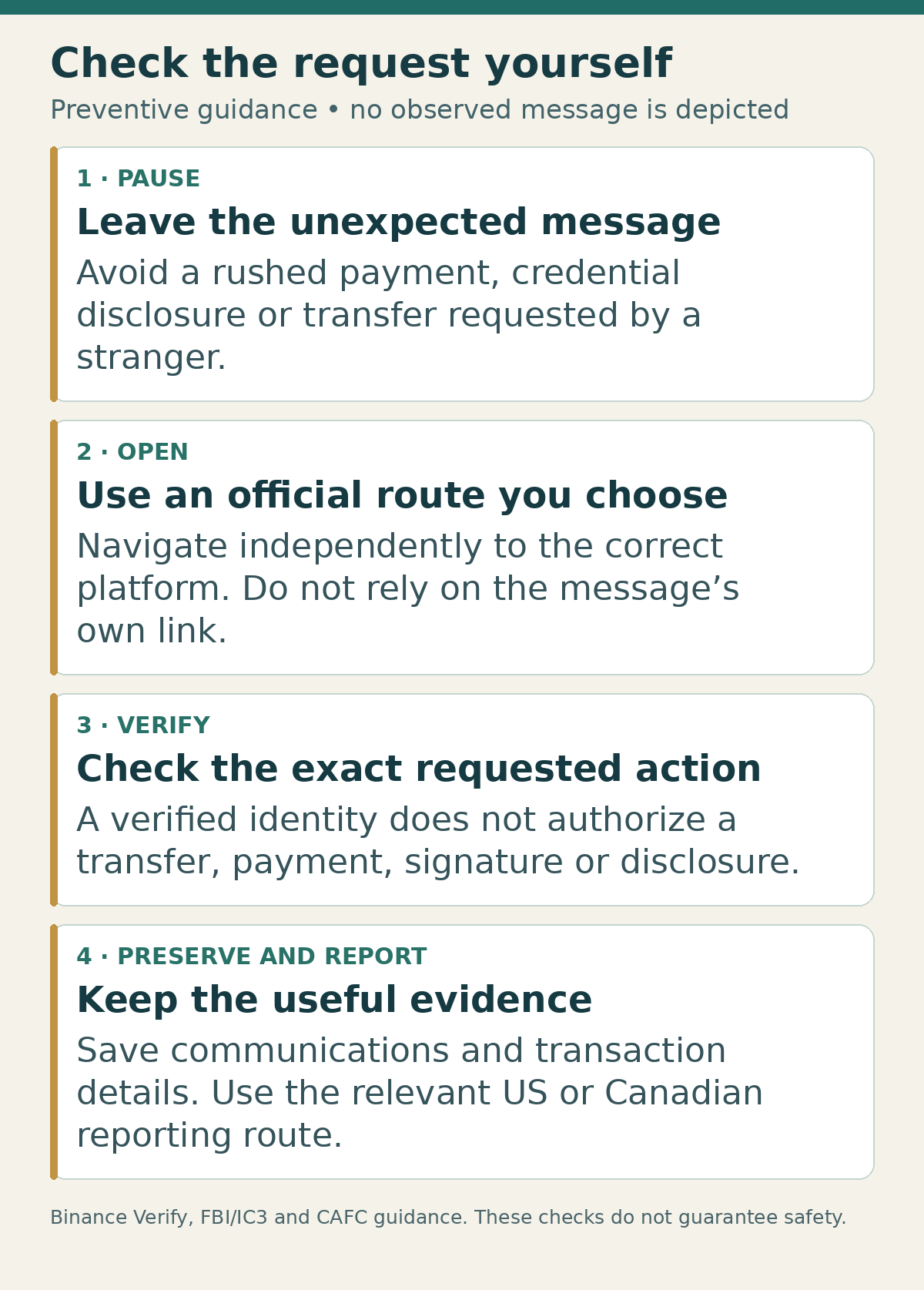
Pause before acting, open the official route yourself, verify the exact request and preserve useful evidence if something is wrong. These steps reduce reliance on an unsolicited sender; they do not guarantee that a contact or transaction is safe.
A recovery fee does not establish a recovery service
The FBI’s cryptocurrency-recovery warning describes fraudulent businesses that take an upfront payment, disappear or return with demands for more fees. It also explains that private recovery companies cannot issue seizure orders.
The FTC’s refund-and-recovery guidance describes a familiar pattern: a person claiming to help recover a loss first demands money or sensitive information. Prior knowledge of your loss can be part of the persuasion.
This does not mean that every legitimate lawyer or forensic professional works for free. It means that a stranger’s promise, an impressive title or a tracing report is not proof that the person can compel an exchange to freeze assets or return them to you. Recovery claims need their own verification.
Use the correct support route
Platforms do not all publish the same contact options. Binance.US’s support instructions describe customer-initiated chat and telephone support while warning against unsolicited calls and messages. A blanket claim that no legitimate phone support exists would therefore be misleading.
Check the contact page for the actual business holding your account. A caller’s displayed name or knowledge of the headlines does not replace that step.
The same care applies to someone claiming to represent law enforcement. The FBI’s July 2026 IC3 impersonation warning distinguishes IC3 from legitimate follow-up by local FBI or other law-enforcement personnel. Verify claimed affiliations independently rather than assuming either that every contact is genuine or that the FBI never contacts victims.
Preserve evidence and report through the right channel
If you suspect fraud, keep the communications and relevant transaction details. IC3’s cryptocurrency guidance identifies useful information such as transaction hashes, addresses, amounts, dates and the platforms used to communicate.
In the United States, navigate independently to IC3. In Canada, the Canadian Anti-Fraud Centre directs victims to local police and links to the official online fraud-and-cybercrime reporting service. Its information helps law enforcement; filing a report does not promise an investigation, response or recovery.
If account credentials or a wallet may already be compromised, use the provider’s independently opened support and recovery documentation for the specific problem. Experimenting with a suspicious “fix” adds another uncertain step.
You can take a real incident seriously while keeping control of the response. Let a check through the proper channel set the pace of your response.
Sources