
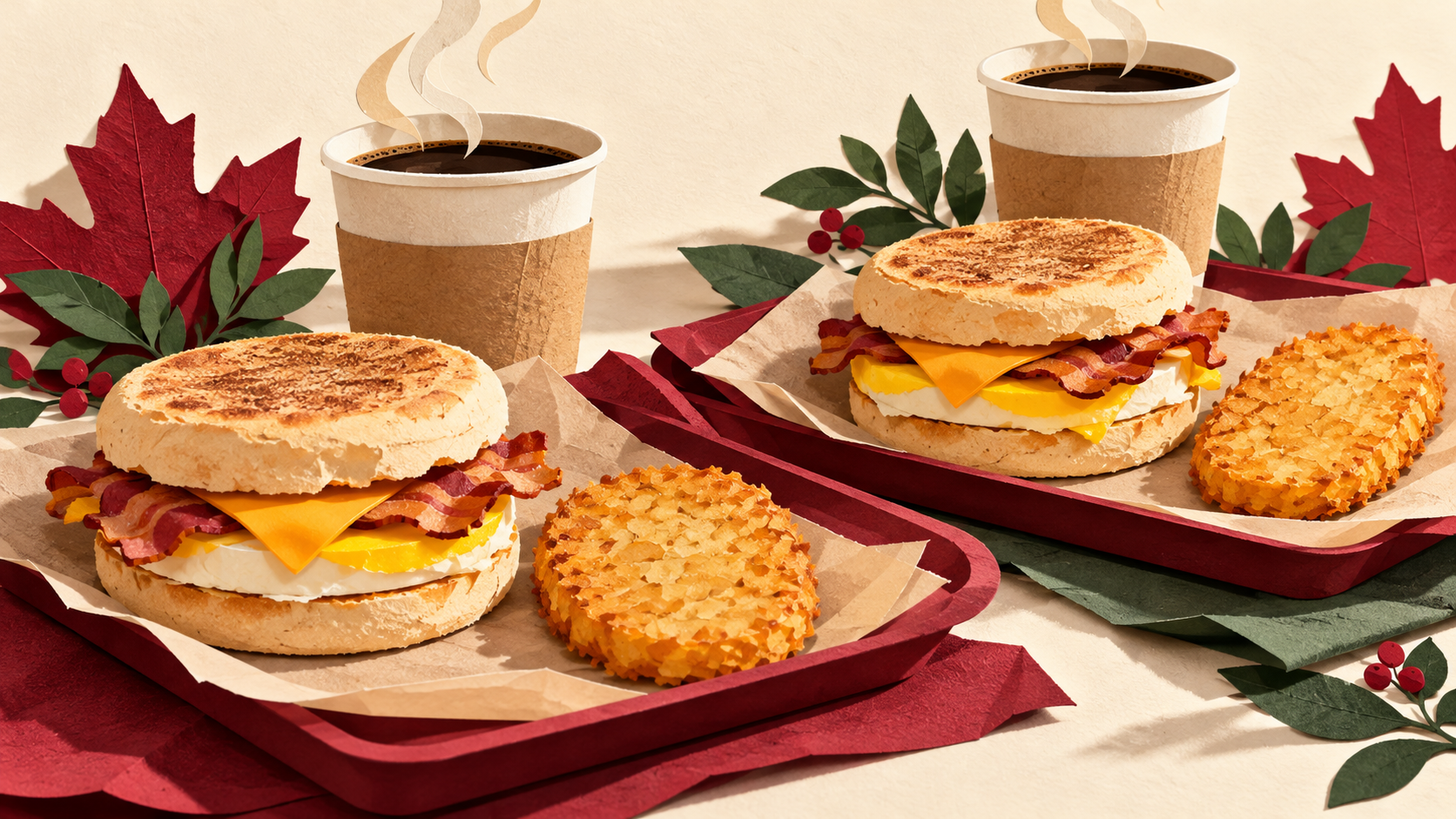
McDonald’s has the lower-calorie bacon English muffin sandwich in this Canadian comparison. Add each chain’s hash brown, and Tim Hortons has the lower-calorie food order.
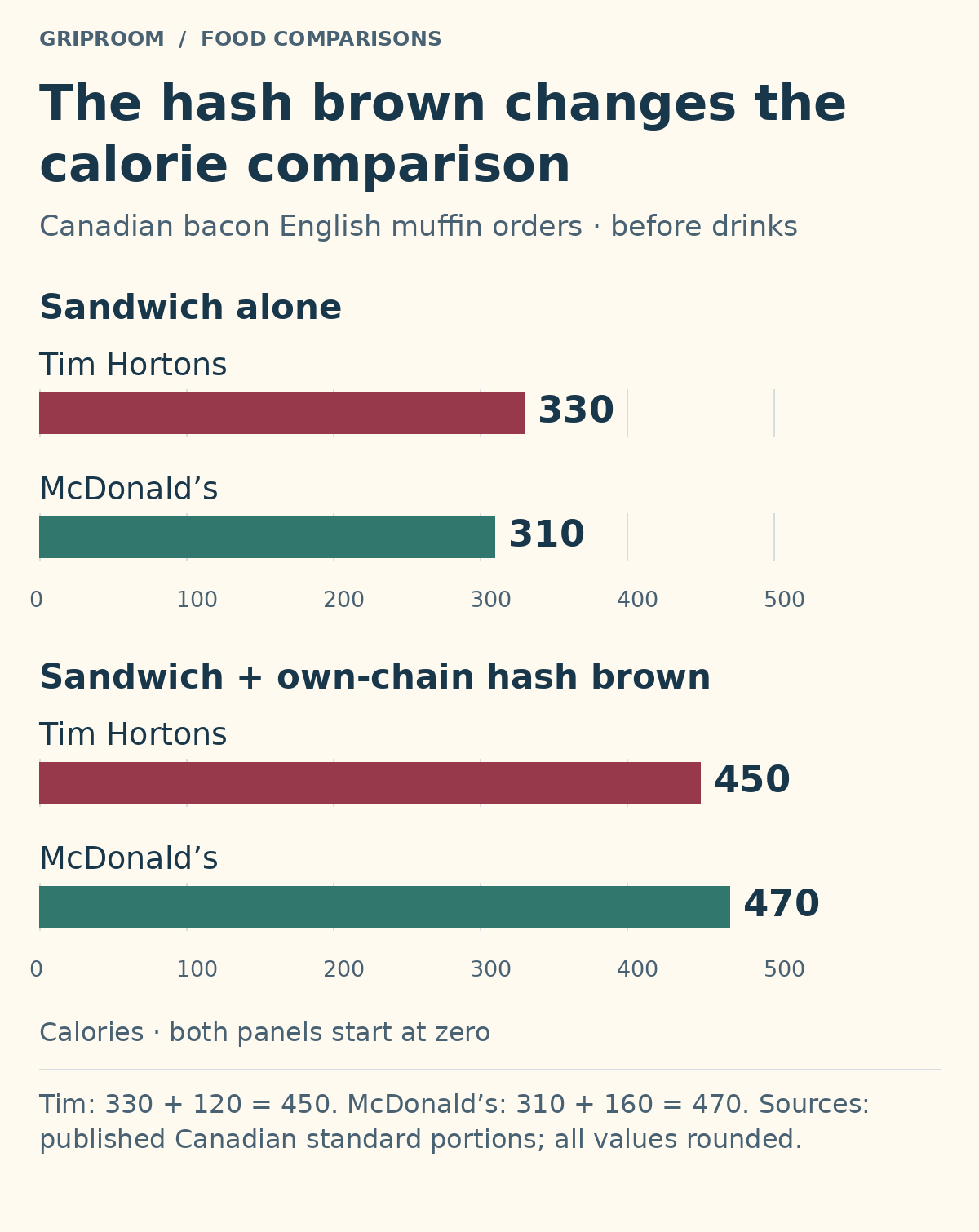
The published figures explain the switch. Tim’s Bacon English Muffin has 330 calories and 17 grams of protein; the Canadian Bacon ’N Egg McMuffin has 310 calories and 16 grams. Tim’s hash brown adds 120 calories, while McDonald’s adds 160. The resulting food totals are 450 calories at Tim’s and 470 at McDonald’s, before drinks.
That is a 20-calorie difference between rounded standard orders, rather than a sweeping health verdict. Its value is the reminder that the side can change the comparison you thought you had finished at the sandwich.
For prices, the evidence answers a narrower question. McDonald’s announced a specific $5 McValue breakfast offer for 2026. Two Toronto Tim Hortons price reports show local sandwich prices. Those sources describe different products and purchase contexts, so they belong in a separate price discussion.
Compare named sandwiches before comparing chains
The nutrition figures here are Canadian. Tim’s come from its July 2026 nutrition guide; McDonald’s figures come from its Canadian bacon-sandwich record and hash-brown record, checked in October. Each row is one named sandwich, with sides and drinks excluded.
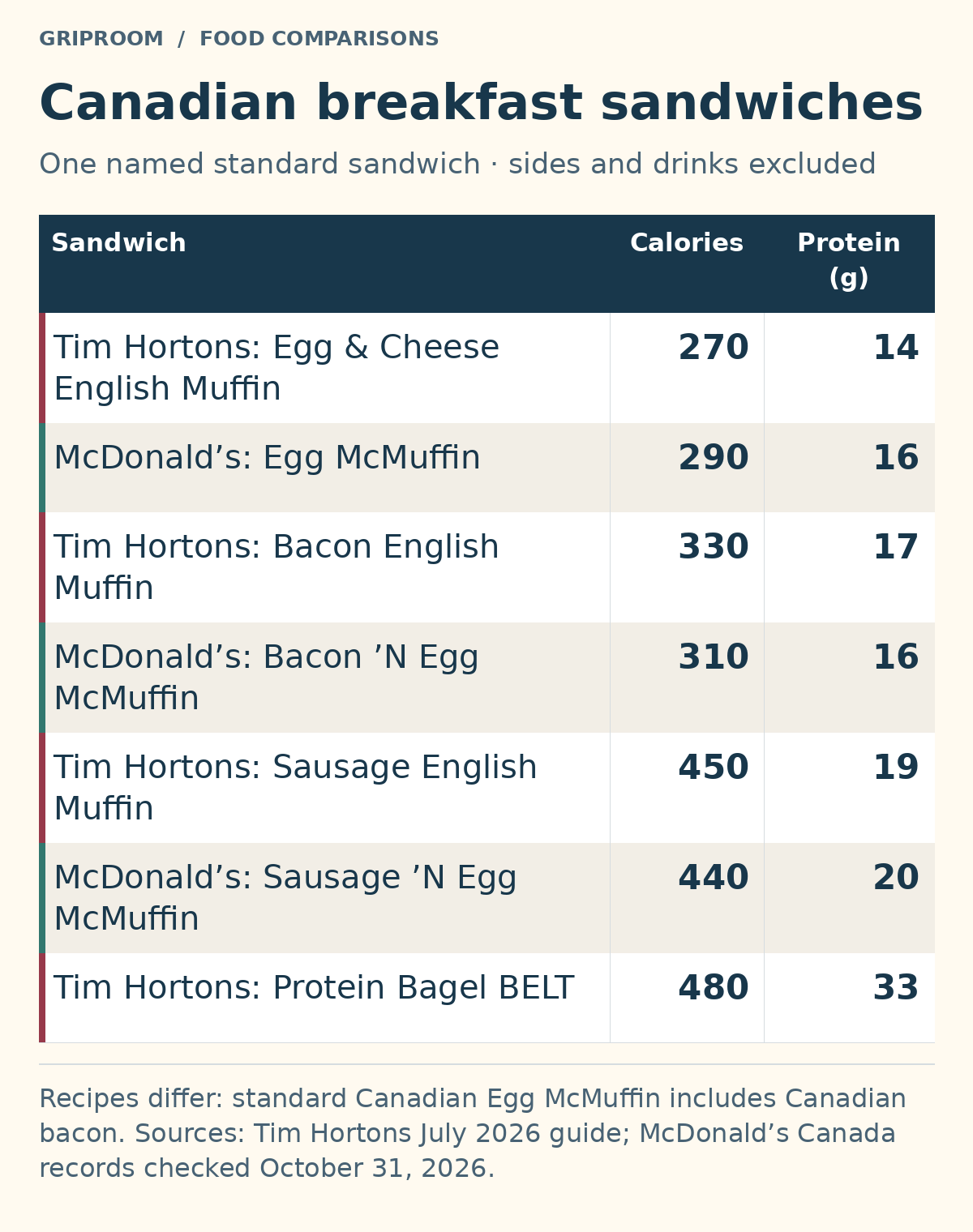
The bacon sandwiches illustrate a modest trade-off: McDonald’s has 20 fewer published calories, while Tim’s has one more gram of protein. With the sausage options, McDonald’s lists 10 fewer calories and one more gram of protein.
Those small differences should stay small in the explanation. The recipes and portions differ, and published nutrient amounts are rounded. A one-gram distinction is useful information, but it cannot establish which breakfast is better for every diner.
Names need attention too. McDonald’s describes its standard Canadian Egg McMuffin as including Canadian bacon. It should not be treated as a meat-free equivalent of a sandwich simply because both names start with “egg.” Check the actual build whenever an ingredient matters to the order.
Hash browns change the bacon breakfast comparison
Tim’s Bacon English Muffin plus its hash brown totals 450 calories and 18 grams of protein. The Canadian Bacon ’N Egg McMuffin plus McDonald’s hash brown totals 470 calories and 17 grams.
The lower-calorie order therefore switches after the side is included. The protein comparison does not switch: Tim’s has one more published gram in both the sandwich-only and sandwich-plus-side examples.
Sodium tells another part of the same food order. The Tim’s combination totals 930 milligrams; the McDonald’s combination totals 1,030. These figures describe the standard items, rather than a customized sandwich with an ingredient removed.
A drink would make this a different calculation. Milk, cream, sugar and other additions need their own values. The two food totals above are deliberately labeled before drinks, so neither is mistaken for every possible breakfast combo.
At Tim’s, changing the bread can matter more
The July guide lists Tim’s Bacon Homestyle Biscuit at 410 calories and 18 grams of protein, compared with 330 and 17 for the Bacon English Muffin. The biscuit version adds 80 published calories and one gram of protein.
The sausage comparison follows the same pattern in these listed builds: 530 calories and 20 grams on the Homestyle Biscuit, against 450 and 19 on the English Muffin.
That bread choice changes calories more than the 10- or 20-calorie gaps between the named English muffin alternatives. It is a larger lever inside the order, although the finished sandwiches remain different recipes rather than interchangeable measured servings.
Tim’s Protein Bagel BELT answers a different priority. Its listed 33 grams of protein at 480 calories puts more protein into one sandwich than the English muffin options shown here. A diner looking for a larger protein total may find that relevant even though the lowest calorie total points elsewhere.
Choose the goal before calling the result a win. A smaller calorie number, a larger protein total and a preferred bread are separate reasons to order something.
Protein per calorie also puts small sandwich differences in perspective. Dividing protein by calories gives both bacon English muffin options about 5.2 grams per 100 calories after rounding to one decimal place. A longer calculation produces a tiny gap between them, but that gap depends on already-rounded menu inputs. It would be a poor foundation for declaring one sandwich nutritionally superior.
The bread and side examples give the reader a clearer distinction. They identify a specified change to a real order, with its accompanying serving and recipe differences, rather than elevating an almost identical ratio into a major finding.
The $5 McDonald’s offer needs its own sandwich name
In its January 2026 price-promise announcement, McDonald’s Canada described eligible $5 McValue breakfast meals with a hash brown and small coffee. The terms specify breakfast service until 11 a.m., prices before tax and exclusions for delivery, with participation and availability limits.
The eligible Sausage McMuffin is not the Sausage ’N Egg McMuffin in the nutrition comparison above. Nor does that offer establish a $5 price for the Bacon ’N Egg example.
That difference is important when comparing screenshots or meal deals. A familiar-looking product name can conceal a different build. Before assigning a calorie total or value ratio to a promotion, match the full sandwich name, side and drink to the offer.
The Tim Hortons price examples are local reports
Drive Thru Index’s October 31 reports list generic Bacon Breakfast Sandwich and Sausage Breakfast Sandwich prices of CAD $4.49 at 547 Gerrard Street East and CAD $5.39 at 218 Yonge Street, both in Toronto.
These are attributed pickup-price reports, rather than our checkout purchases. More importantly, the generic names do not confirm which bread was selected. The figures cannot be confidently attached to the exact English muffin or biscuit rows above.
A reported sandwich price also cannot be directly compared with a promotion including a sandwich, hash brown and coffee and then called a like-for-like saving. Quantity, ingredients, local participation and price channel all need to line up first.
The reports are useful price context because they show the actual limitations of a chain-wide answer. For a practical purchase, compare the exact builds at the two locations you would use, through the channel you intend to order from, with the same treatment of tax and extras.
Build the breakfast comparison in three steps
First, choose the specific sandwich and bread. Then add the side you actually want. Finally, add the drink and its modifications, and check the price of that complete order.
This sequence keeps a good sandwich comparison from becoming a misleading meal comparison. The bacon example makes the point neatly: McDonald’s has the lower published sandwich calories, but Tim’s has the lower food total after each hash brown is added.
The useful answer is attached to that named order. Once the bread, side or promotional sandwich changes, calculate the new breakfast rather than carrying the old winner into it.