
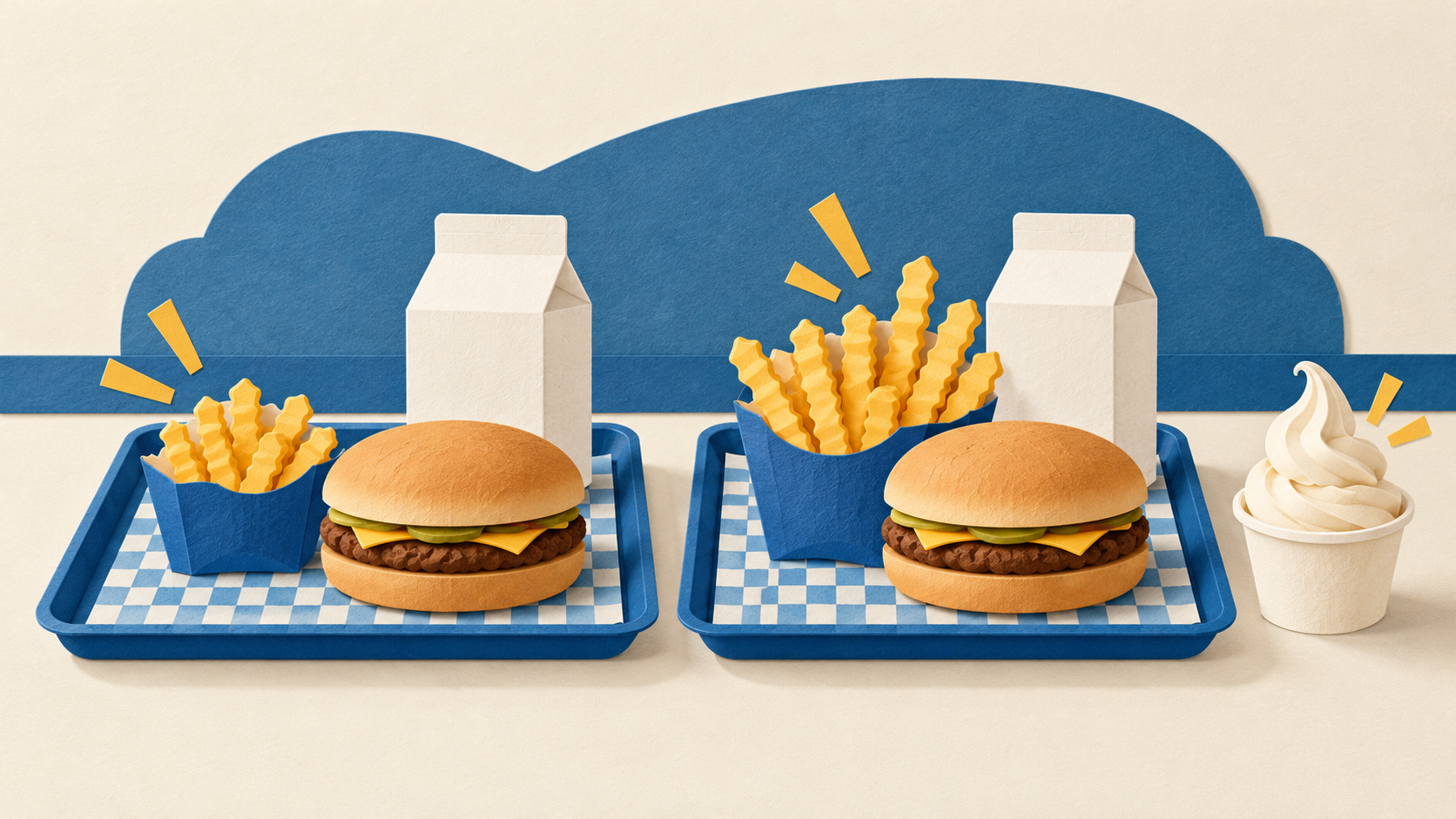
The useful Culver’s Kids’ Meal vs. Value Basket comparison starts with the same burger. Comparing a single-patty kids’ order with a double-patty basket changes the amount of beef before the side, drink or dessert enters the discussion.
A reported Madison menu offers a clear local price example. Its plain single Kids’ Meal is listed at $6.69, while the plain single Value Basket is $8.89: a $2.20 listed-price gap. That does not make the meals identical. Their included portions and extras still matter.
For calories, a controlled food example is more informative than a vague “meal” total. A plain single burger, small fries and white milk adds up to 720 calories before custard. Keep the same burger and milk but use medium fries, and the sum is 850 calories before custard.
The price example and calorie example are separate. The Madison listing does not establish a checkout price for that specific milk-held-fixed comparison or for upgrades.
What comes with the Kids’ Meal
Culver’s official Kids’ Meal description describes a choice of entrée, small crinkle-cut fries or applesauce, and white milk, chocolate milk or a small soft drink. It also describes a free scoop of Fresh Frozen Custard and a Scoopie Token.
That makes the side and drink choices part of the comparison. A burger meal with applesauce and milk is a different food order from one with fries and a soft drink. The phrase “Kids’ Meal” alone cannot supply one calorie total for both.
The Value Basket format combines an entrée with fries and a drink. Check the exact burger, side and drink selections on the local menu rather than assuming every basket represents the same patty count or serving sizes.
The custard and token are also different features. A free dessert portion contributes food to the order; a token has its own redemption use. Treating either as a generic dollar discount would require assumptions about how it is used.
One reported local price check
Drive Thru Index’s Madison report covers the restaurant at 7206 Mineral Point Road, Madison, Wisconsin. The report body dates its pickup-price check to October 30, 2026.
It lists the plain single Kids’ Meal at $6.69 and the plain single Value Basket at $8.89. With cheese, the corresponding listed prices are $7.09 and $9.29. The gap is $2.20 in either pairing.
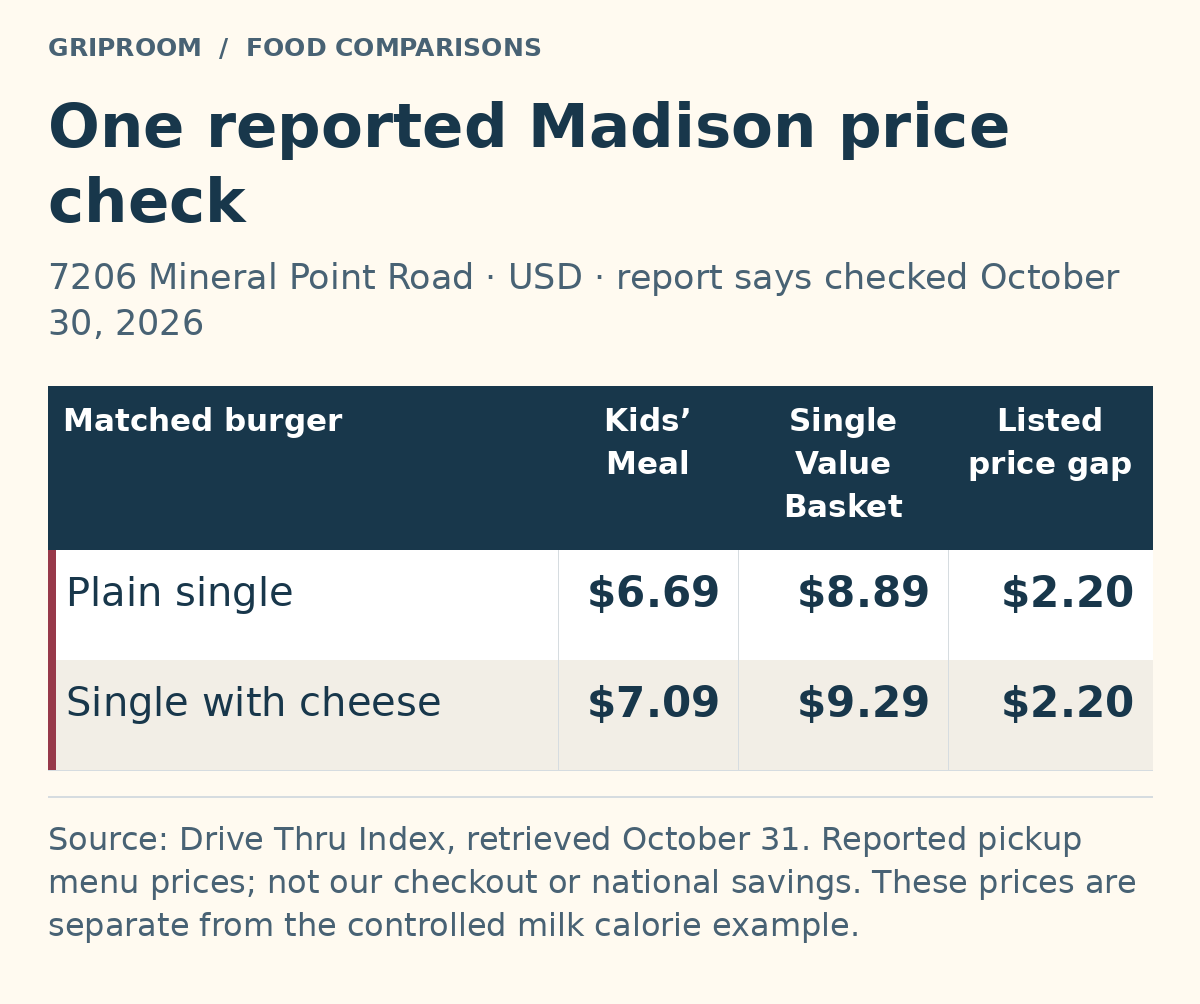
The same-patty comparison fixes one common problem, but it does not fix every difference. Side and drink portions can still vary, and the Kids’ Meal’s custard inclusion has a separate food value.
Use the $2.20 as an attributed local price gap. A different location, an upgraded side, a different drink or another ordering channel can change the practical comparison. The published example does not establish what all those changes would cost.
Compare calories before adding custard
The cleanest component example uses the plain single ButterBurger. Culver’s printed nutrition guide, marked July 2025, lists it at 390 calories and 20 grams of protein. The printed Kids’ plain-single row and regular plain-single row agree on those figures.
Small crinkle-cut fries add 220 calories and 3 grams of protein. White milk adds 110 and 8. Their sum is 720 calories and 31 grams of protein before custard.
Using medium fries instead adds 350 calories and 4 grams of protein. With the same plain burger and milk, the result is 850 calories and 32 grams of protein before custard. The side change accounts for the 130-calorie difference.
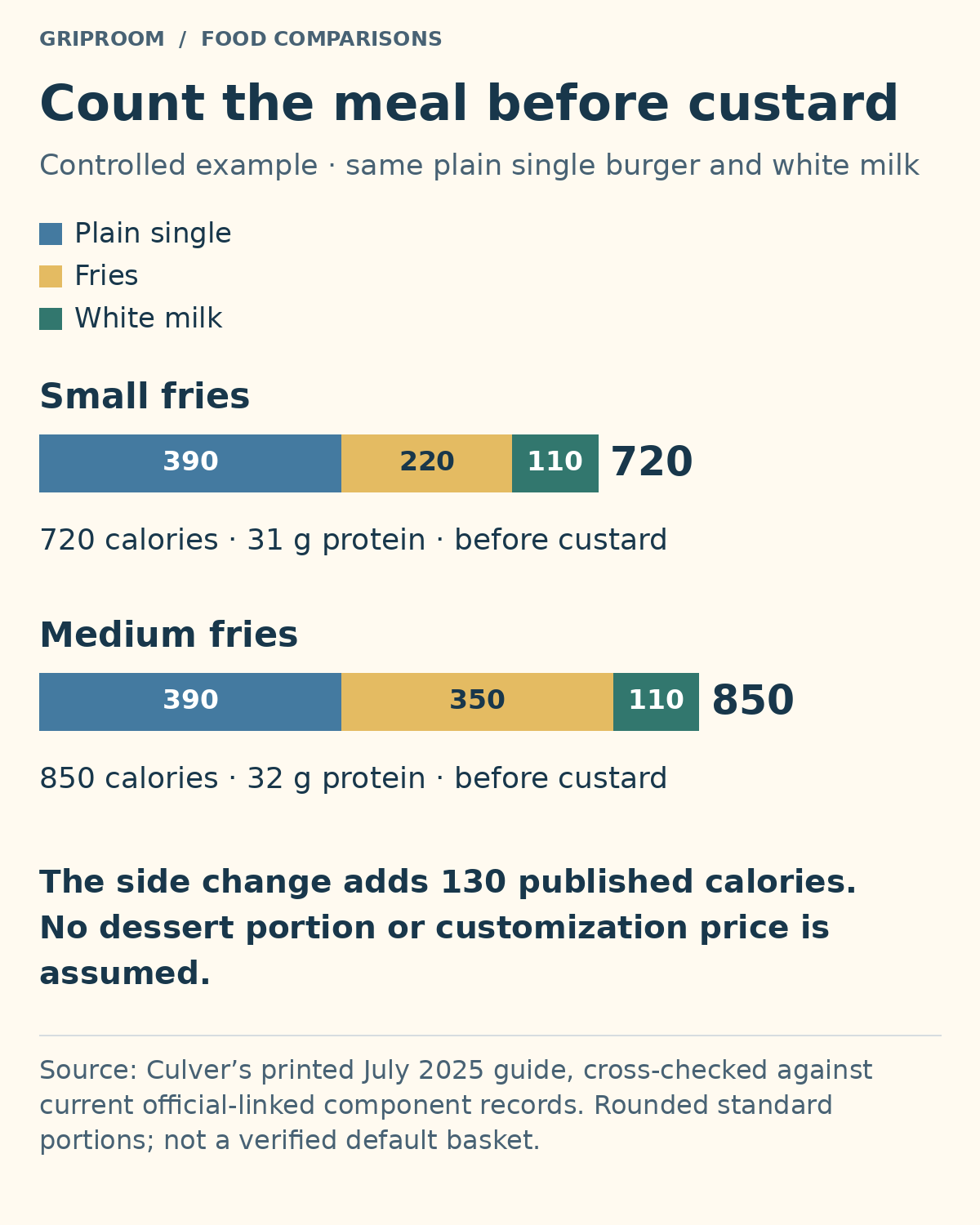
Changing the burger would require a new sum. The single-burger result cannot be carried over to a double just because both are sold in a basket.
Holding the milk fixed is deliberate. It lets the reader see the effect of the fries without simultaneously changing the drink. It does not establish that every restaurant sells that customized basket at the reported base price.
The current official-linked nutrition provider was checked against these rounded components. That cross-check supports the component arithmetic, while the explicit Kids’ row comparison still comes from the dated printed guide. These are published standard portions, not weighed restaurant servings.
The dessert needs a specific portion
Every calorie example above stops before custard. Culver’s official story describes a free scoop with the Kids’ Meal, but that alone does not identify the exact redemption portion, flavor and toppings needed for a complete nutrient calculation.
It would be misleading to take the calories from an ordinary one-scoop dish and automatically assign them to every free dessert redemption. The actual option needs to match first.
If you redeem the custard, it belongs in the total food comparison. If you are comparing the meal before dessert, keep that condition visible. A smaller fries portion can reduce the before-dessert total while the dessert still changes what is ultimately eaten.
The cheese versions need care too. The printed Kids’ cheese and regular single-cheese entries differ in protein and sodium. A matching name or patty count does not justify silently treating those nutrient rows as identical. The plain-burger example avoids that unresolved mismatch.
Compare the order you actually want
The Kids’ Meal format may be appealing when its available entrée, smaller side, drink choice and dessert fit the purchase. A Value Basket may be the more relevant comparison when the desired order has a different entrée or larger portions.
The base-price gap cannot answer whether upgrading a Kids’ Meal still leaves a saving. That requires the current price of the exact upgraded order. Nor does this price comparison establish a universal adult-ordering policy; check the local ordering terms if adult eligibility matters.
Start with the patty count, then name the side and drink. Compare the local prices for those actual choices, and count dessert when it is included in what you eat. That is how a useful local bargain remains a clear comparison instead of becoming an unsupported rule about every Culver’s meal.