
The Binance breach does not, on the evidence published so far, demonstrate that Bitcoin’s transaction rules or cryptography were defeated. The exchange’s second incident update describes compromised infrastructure and unauthorized withdrawals, with its investigation still continuing.
That distinction gives holders a reason to pause before assuming every wallet has been compromised. It also leaves a necessary question: which part of the system protects your own money?
“Crypto was hacked” compresses several different failures into three words. An exchange can lose control of its systems. A thief can obtain a person’s keys. Software can contain a vulnerability. Those problems can produce the same frightening headline while requiring very different responses.

An exchange sits between you and the network
When you use a custodial exchange, the account you see belongs to a service with its own systems and controls. You depend on that service to secure the assets it holds and to process requests to move them.
Binance’s account initially pointed to a compromised engineer’s laptop and later described additional points of breach. It said it had found no evidence of leaked wallet private keys at that stage. These are preliminary company findings, rather than a complete forensic explanation.
The important distinction is between obtaining permission to make a system act and defeating the mathematics used to check a transaction. Compromised systems can produce activity that the account holder never intended.
That is why a transaction appearing on a blockchain does not establish that every earlier step was legitimate. The network checks transactions under its rules. It does not conduct an interview with the exchange customer about what they meant to authorize.
Bitcoin software answers a different question
Bitcoin Core describes its software as including a full node that validates the blockchain and a wallet. Those functions are different from running an exchange’s accounts, customer support or withdrawal controls.
Bitcoin.org’s FAQ explains how wallets manage the keys used to control spending, and how digital signatures support transaction authenticity. That helps explain how a theft involving Bitcoin can happen without demonstrating that Bitcoin’s validation rules have failed.
It would still be a mistake to turn that explanation into “Bitcoin software cannot be hacked.” The Core project’s security advisories document real historical vulnerabilities, including serious examples involving network integrity and availability. Software needs maintenance, review and fixes.
Those advisories are a counterexample to absolute safety language. They are not evidence that the Binance incident exploited one of the listed bugs. A careful explanation can preserve both points without making the reader choose between panic and invulnerability.
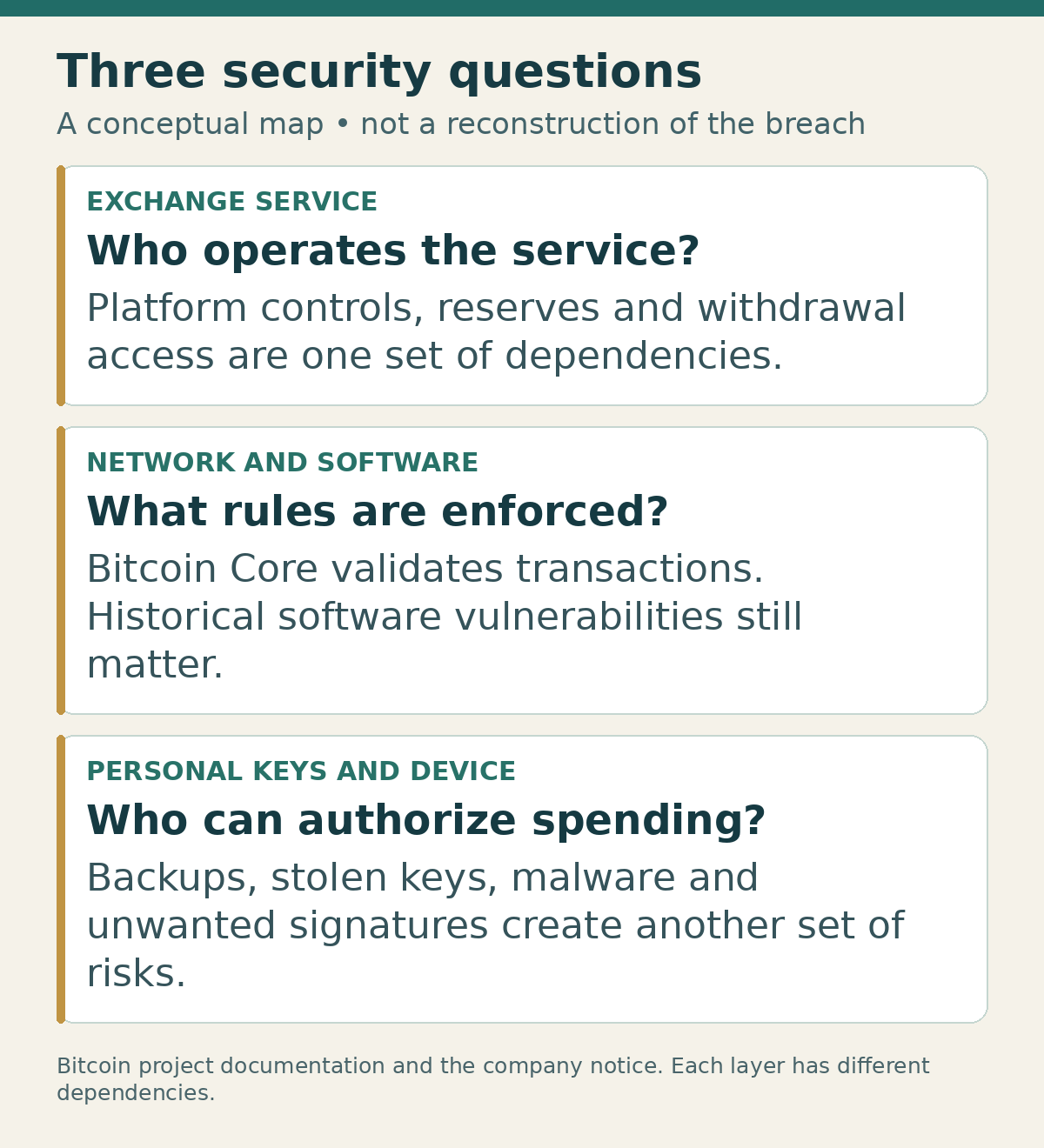
Exchange controls, network software and personal signing keys answer different security questions. Identifying which layer is involved helps you find the relevant status notice, software guidance or account-support route.
Your wallet adds a third layer
A wallet is a tool for managing the credentials and actions that control spending. It is not a box containing little digital coins. Losing control of the credentials can matter even when the network keeps processing transactions correctly.
Bitcoin.org’s wallet-security guidance describes the trade-offs. With a custodian, you depend on the operator’s security and honesty. With self-custody, backup, key, device and software responsibilities move much closer to you.
A hardware device can be part of a security arrangement, but owning one does not remove the consequences of losing a backup, exposing a recovery phrase or approving an action you do not understand. A strong-looking piece of equipment cannot make every surrounding decision safe.
That makes a rushed custody change a poor substitute for understanding your current setup. First identify who controls the keys, how recovery works and which official instructions apply. The right question is about the responsibilities you can manage, rather than which label sounds reassuring.
Where the North Korea claims fit
TRM Labs and Chainalysis have attributed the Binance attack to North Korean actors in their published assessments. That attribution should stay attached to the analysts making it; it does not complete the company’s investigation or diagnose a reader’s wallet.
The FBI’s 2024 warning about North Korean targeting of crypto businesses describes sophisticated social engineering aimed at industry personnel. It shows why the people and devices around financial systems matter, even when those people understand technology.
It does not establish the probability that a small personal account will be attacked. Nor should Ethereum-specific authorization mechanics described in analysts’ reports be treated as instructions for how Bitcoin wallets work. Different chains and services have different mechanisms.
What a holder can check
If an exchange holds your assets, start with the correct platform’s current service notices and independently opened support route. A different exchange’s problem does not automatically establish the status of yours.
If you control your own keys, use your wallet provider’s documentation to review backups, software and signing practices. Bitcoin.org’s scam guidance describes fake support and recovery requests aimed at obtaining keys or dangerous permissions. A frightening exchange headline is a poor reason to trust a stranger offering to “secure” a wallet.
The useful reassurance is a clearer map. The incident does not show that every Bitcoin holder has lost control of their money. Your next step depends on the service, software and credentials you actually rely on—and that is something you can investigate without guessing where the price goes next.