
The consequences of an attack on Gulf internet cables would depend heavily on which connections were damaged and what capacity remained elsewhere. The credible concern is regional disruption, with effects that could differ sharply between countries, operators and services.
The October 23 threat report describes possible action, not an observed cable attack. Dated network and operator disclosures help explain the exposure, but they supply neither a live audit of spare capacity nor a reliable national outage forecast.
The most useful question is therefore more specific than whether Iran could “cut the internet”: which routes could fail, which alternatives exist, and which announced connections are still plans?
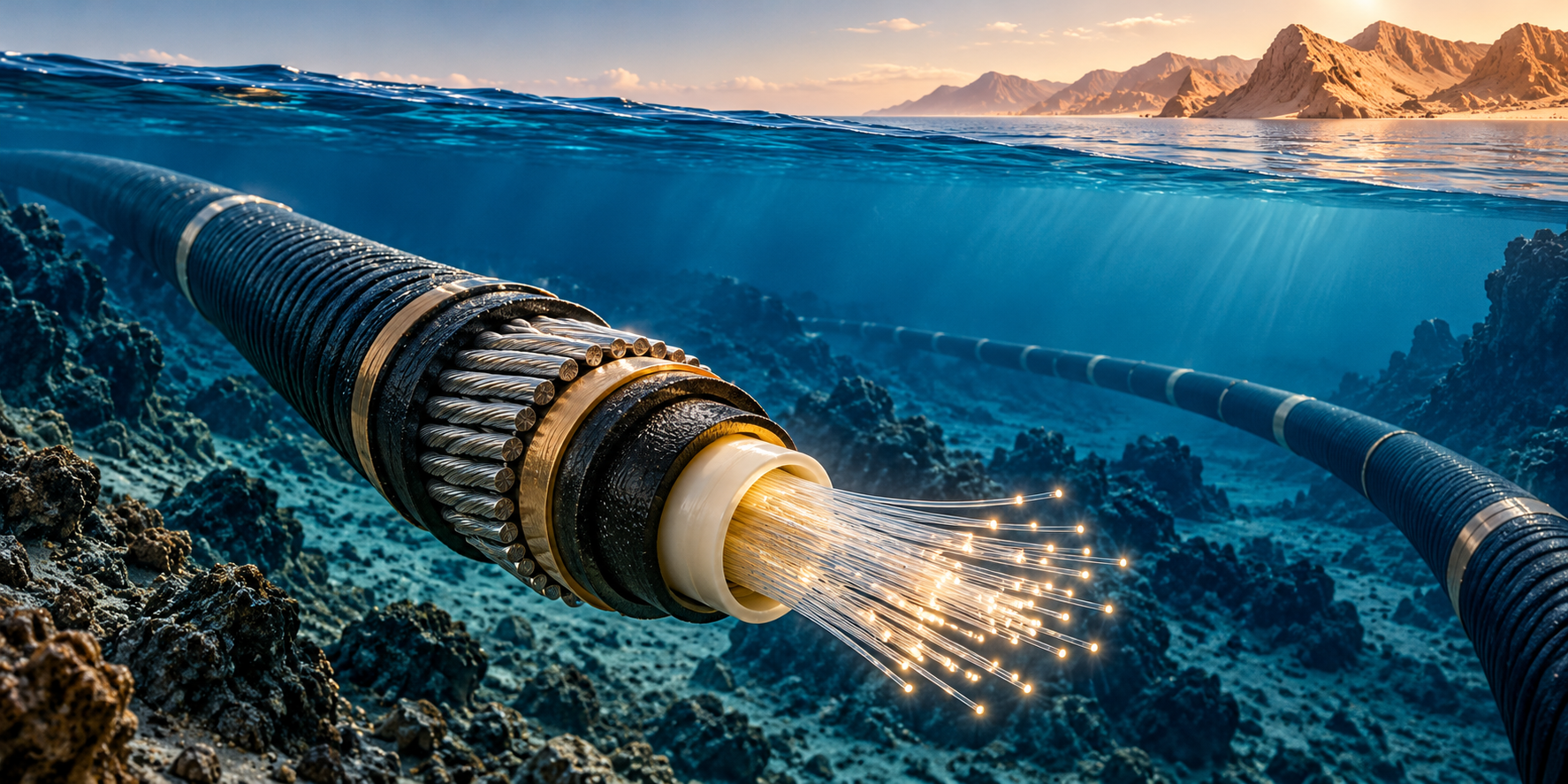
Conceptual cutaway of a fiber-optic cable and an alternative connection.
What Iran has been reported to threaten
Reuters reported on October 23 that Iranian officials described detailed plans to target Gulf undersea cables if U.S. and Israeli attacks resumed. The account attributes a contingent threat to officials. It does not independently demonstrate their ability to execute every part of it.
That distinction matters because a warning can have political value before anyone acts on it. A capability claim, an operational attempt and successful disruption are three separate propositions. The Reuters account establishes what its sources threatened, rather than a resulting outage.
The stakes are nevertheless concrete. International connections support communications and access to services hosted beyond a user's immediate network. Losing an important route can create a serious operational problem even when some connections continue working.
“The internet still exists” would be little comfort to a business whose necessary service is slow or unreachable. Equally, a damaged cable does not by itself tell us that everyone in a country loses access. The useful answer sits at the level of networks and services, rather than one dramatic global switch.
Why the geography changes the answer
TeleGeography's March 13 explanation of Gulf connectivity identifies terrestrial alternatives for Bahrain, Kuwait and Qatar through neighboring networks. It also distinguishes UAE landings at Fujairah, outside the inner Gulf, and Saudi Arabia's important Red Sea connectivity.
That March description explains structural differences; it is not an exhaustive October inventory. Individual operators may have different routes, contracts and available capacity even within the same country.
A route map can show different ways out. It cannot reveal how much traffic a particular operator can move onto them at a moment's notice. A line on a map is not a reservation for bandwidth.
That is the limitation behind broad statements such as “there are land routes.” An alternative may be physically present while its usable capacity, commercial availability or dependence on other infrastructure remains unclear. The existence of an option and the strength of that option are different facts.
The same distinction applies in the other direction. A country with exposed submarine routes is not automatically isolated if one fails. Its exposure depends on the combination of connections it actually uses and the alternatives it can access.
That leaves Bahrain, Kuwait and Qatar with a different geographic starting point from UAE networks using Fujairah or Saudi networks using Red Sea landings. TeleGeography's dated account explains that difference without ranking the reliability of every provider. A country-level label cannot replace the routing details of a bank, a cloud customer or a household's internet provider.
An existing route and a promised route are different assets
Operator announcements help answer a narrower question: what has a company reported establishing, and what is it still working to build?
In its 2025 annual report, Omantel describes ZOI establishing a terrestrial corridor through Iraq and Türkiye toward Europe. That is an operator's report of an established connection. It is not a public demonstration that every Gulf provider can transfer all of its traffic onto that corridor during a crisis.
Ooredoo's October 7 announcement concerns work linking its planned Fibre in Gulf (FIG) system with an Iraq transit corridor toward Türkiye and Europe. The integrated project remains subject to approvals and development. The agreement does not establish that the complete connection is available as a backup service.
The two announcements describe different stages of development.
Usable spare capacity remains unknown in both examples. That is not a verdict that an alternative will fail. It identifies the missing measurement needed before promising that it will succeed. A provider would need access to a suitable connection with enough available capacity, not simply evidence that someone has built or announced one.
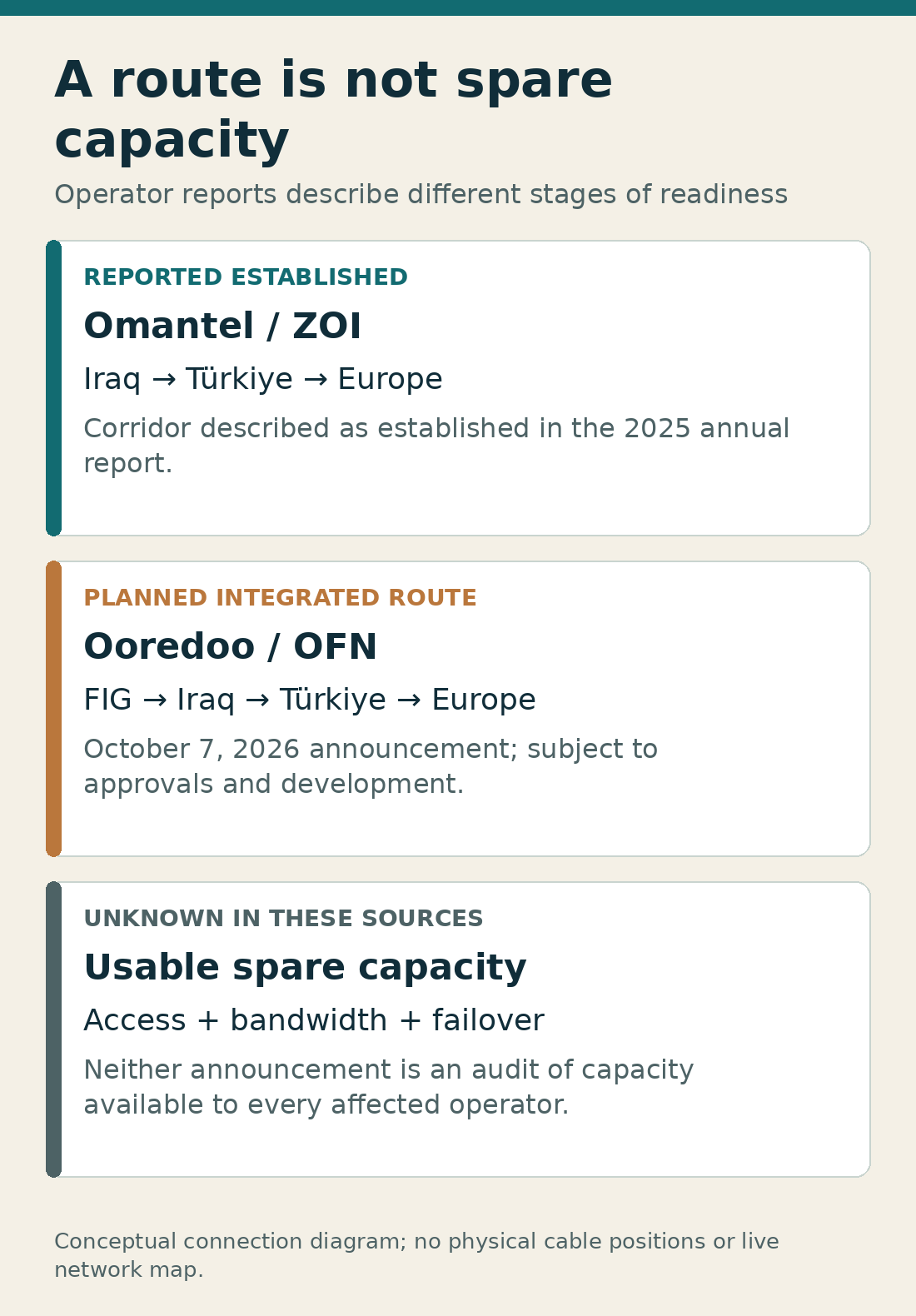
Route-status comparison based on Omantel's 2025 report and Ooredoo's October 7, 2026 announcement. The diagram is conceptual and does not plot physical cable positions.
Omantel reports an established Iraq–Türkiye–Europe corridor. Ooredoo describes a planned integrated connection. Neither source supplies a network-wide audit of spare capacity available to every affected operator.
Why the global traffic number can mislead
The International Telecommunication Union's connectivity report says submarine cables carry more than 99% of international data flows. That explains their importance. It does not identify the share passing through the Strait of Hormuz.
The denominator is doing substantial work. International data flows are not all internet activity, and all submarine cables are not the cables crossing one particular waterway. Using the global figure to describe the reach of a Gulf attack would replace one geographic system with another.
A small share of worldwide traffic can still be important to the networks that depend on it. The relevant question for an affected user is whether their necessary connections remain available, rather than whether global traffic has crossed a dramatic percentage threshold.
The consequences depend on the damaged route and the networks using it. Which alternatives can those operators access? Which services remain reachable? The global statistic supplies context, not answers to those questions.
Repairing the cable and restoring service are separate clocks
The ITU's July 2026 resilience work emphasizes repair coordination, permits and geographic diversity. These constraints help explain why resilience involves more than owning additional fiber.
A repair operation needs access and coordination. The availability of a vessel does not establish safe access to a damaged section during a conflict. Permits, security conditions and the ability to work at the fault can all affect the repair, even when a ship and crew are available.
Service may return before a cable is physically repaired if traffic can be rerouted. Some service may also remain degraded while a replacement path carries traffic differently. Repair duration and customer disruption should therefore be described separately.
Consider a simplified example: an operator loses a route but can move essential traffic onto an alternative. Some connections may recover while the original cable is still awaiting repair. Another operator facing the same physical break may have a different outcome because it cannot access the same alternative. This illustrates the mechanism; it is not a forecast for any named carrier.
Without an operator-by-operator capacity and access audit, a precise restoration date would be guesswork. A statement that a cable could take time to repair is not a defensible estimate of how long a particular customer's service would be unavailable.
What would show the threat becoming a disruption
The first important change would be verified damage, rather than another account of threatened action. The next would be evidence from affected operators identifying the services or routes involved and the alternatives they are actually using.
A carrier describing rerouting would answer a more useful question than a map showing that a backup path exists somewhere. A confirmed restoration notice would be stronger than an estimate repeated without a source. Even then, a notice about one operator or service should retain that scope.
Damage and responsibility are separate questions. A confirmed fault would establish a network problem; identifying its cause would require additional evidence. Vessel proximity or unusual movement alone would not establish sabotage. The response for affected users would still depend on operator notices, usable alternatives and the services that could be restored.
The Gulf cable threat deserves attention because regional networks can be exposed in different ways. The most useful picture combines physical routes, project status, accessible capacity and repair constraints. Announcing another route adds to that picture. Demonstrating that it can carry displaced traffic is the harder, more consequential test.