
What Happens to Oil Prices If the Strait of Hormuz Stays Disrupted?
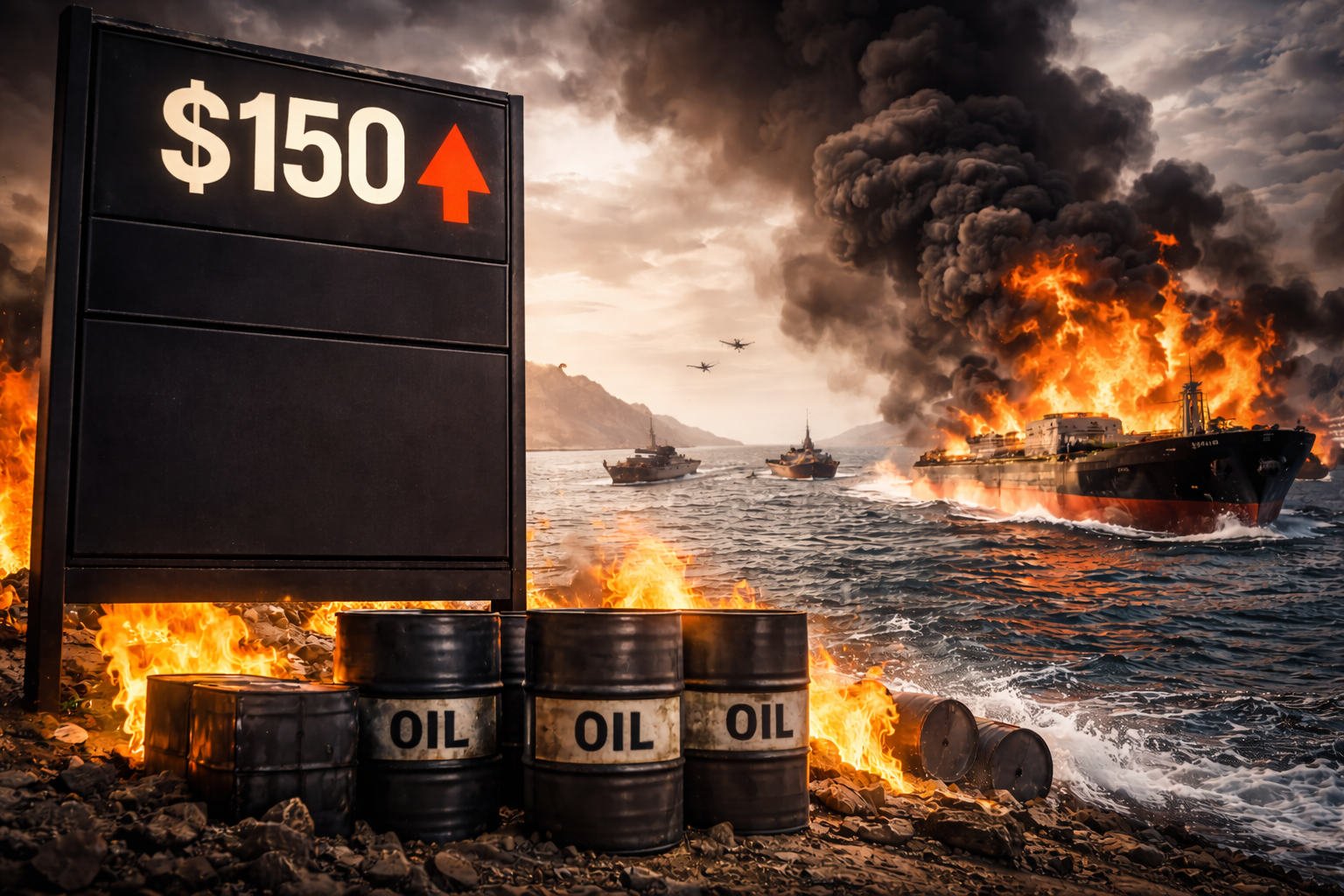
Oil prices don’t need a full-on global shortage to explode. They just need one thing: credible fear that supply might be trapped, delayed, destroyed, or suddenly too dangerous to ship.
That’s why the Strait of Hormuz is such a big deal right now. It’s not just another shipping lane—it’s the world’s most important energy chokepoint. In 2024 and early 2025, flows through Hormuz represented about one-fifth of global oil and petroleum product consumption and more than a quarter of global seaborne oil trade, plus roughly one-fifth of global LNG trade.
And as of March 2, 2026, the disruption is no longer theoretical: reporting describes damaged tankers, fatalities, and around 150 vessels stranded, with major marine insurers canceling war-risk coverage in parts of the Gulf.
So what happens to oil prices if this disruption doesn’t clear up?
First: why prices can rip higher even before “real” shortages show up
Oil prices are set in a market that reacts to expected future scarcity, not just today’s physical barrels. When Hormuz is unstable, several price-boosting forces pile on at the same time:
1) Fear becomes a “risk premium”
Even if oil still flows, traders price in the chance that tomorrow it won’t. That’s the “war premium”—and it can add $10, $20, $30+ per barrel surprisingly fast when the headlines are bad.
2) Insurance and shipping costs can create a de facto shutdown
If insurers pull war-risk coverage, ships don’t sail—or they demand extreme rates to do it. That’s not politics; it’s logistics. Reuters and other reporting this week has described war-risk cancellations and surging freight rates tied to the conflict.
3) A few incidents can freeze the whole corridor
In narrow lanes, you don’t need to sink “lots” of tankers to cause havoc. A handful of attacks or mine scares can be enough to make shipowners wait offshore—creating a traffic jam that quickly becomes a supply delay.
4) Refineries panic-buy, governments consider releases, and everyone hoards
Refiners and importers don’t want to be the ones who “waited for a better price” right before supplies got cut. Precautionary buying can amplify moves.
Where oil is starting from right now
In the first wave of market reaction to the Iran war escalation, Brent crude has recently been trading in the high-$70s to low-$80s range, with sharp intraday spikes—classic “panic bid” behavior.
That matters because when people say “oil could double,” they’re talking about something like:
Brent ~$80 → $160
WTI ~$75 → $150
That’s not a normal year. That’s a global shock.
The big question: what would have to happen for oil to double?
Oil doubling is not the “base case.” But it’s also not fantasy. Historically, oil has doubled (or more) during major geopolitical supply shocks—especially when fear spreads faster than barrels can be replaced.
Here are three pathways that could realistically get you there if the Strait of Hormuz stays disrupted.
Scenario A: The “Slow Bleed” (Partial disruption that won’t stop)
Most likely path to very high prices, even without a total closure.
This is the nightmare where Hormuz isn’t 100% shut—but it’s unreliable enough that flows drop, shipping slows, insurance stays tight, and buyers bid up replacement barrels from farther away.
What this looks like:
Tanker traffic stays well below normal for weeks.
War-risk insurance stays restricted and expensive.
Freight rates stay elevated, making delivered oil meaningfully pricier.
Some Gulf exports reroute, but not nearly enough to restore confidence.
Why it pushes prices hard:
Hormuz handles an enormous share of seaborne oil trade, and bypass options are limited relative to that scale. The EIA estimates around 2.6 million b/d of Saudi/UAE pipeline capacity could be available to bypass in a disruption—helpful, but small compared to typical Hormuz flows.
In this scenario, you often see Brent grind higher toward:
$95–$120 on persistent uncertainty
…and then spike above that on any fresh escalation headline.
Could this alone double oil?
Not usually. But it can set the stage. It keeps the market tight and nervous—so the next shock hits like a hammer.
Scenario B: The “Effective Closure” (Hormuz is open on paper, closed in practice)
This is one of the cleanest ways to get a doubling.
A true closure isn’t required. An effective closure happens when:
mines are laid (or feared),
multiple tankers are hit,
naval escorts can’t guarantee safety,
insurers and crews refuse,
traffic collapses to a trickle.
If a meaningful share of the roughly 20% of global petroleum liquids consumption tied to Hormuz can’t move, the market has to ration demand through price.
And demand rationing doesn’t happen politely. It happens with sticker shock.
In a sustained effective-closure scenario, it becomes plausible for Brent to print numbers like:
$130–$160+, especially if the market believes the disruption is measured in weeks, not days.
That’s your doubling pathway.
Scenario C: The “Worse” Shock (Energy infrastructure gets hit, not just shipping)
This is the fastest route to a violent spike.
If the war expands in a way that damages:
export terminals,
processing facilities,
or LNG infrastructure,
then the issue is no longer “delays.” It’s lost supply.
Recent reporting has already pointed to disruption risks and knock-on effects in regional output and gas markets.
Why this is so explosive:
If markets fear both shipping disruption and production/export capability loss, prices can gap up violently because the world can’t replace big volumes quickly.
Spare capacity is not infinite, and some producers are already near operational limits (even if they can increase somewhat).
This is the scenario where “oil doubles” moves from “possible” to “on the table,” because the market stops debating if there will be shortages and starts debating how bad they will be.
Why doubling is psychologically plausible (and markets have done it before)
Oil doubling sounds extreme—until you remember history:
In 1973–74, oil prices surged dramatically during the embargo period (often described as near-quadrupling).
In 1979–80, oil prices more than doubled over roughly a year during the shock around Iran and broader market dynamics.
In 1990, prices roughly doubled in a short window after Iraq invaded Kuwait (from the high teens to mid-30s).
Those weren’t “normal” markets. They were fear markets—exactly what Hormuz disruption can create.
What to watch if you’re trying to gauge “how bad could this get?”
If you see several of these at once, the odds of an extreme spike rise:
Insurance withdrawals expanding, or war-risk premiums surging (making voyages financially impossible).
Large numbers of tankers waiting rather than transiting (a real-time indicator of fear).
Confirmed attacks or mines that shift from isolated incidents to a sustained pattern.
Export terminals / processing plants becoming targets (a jump from “risk premium” to “lost barrels”).
Governments discussing emergency measures (strategic stock releases, escorts, rationing language)—which often signals they think the market is breaking.
Bottom line
If the Strait of Hormuz stays disrupted, oil prices can remain elevated simply from risk premium and shipping paralysis. But for oil to double, you typically need sustained effective closure or damage to key energy infrastructure—something that convinces markets the disruption is lasting and large enough that demand must be rationed through price.
Right now, the warning sign isn’t just “oil up.” It’s the combination of shipping disruption + insurer retreat + chokepoint scale—the kind of setup where one more escalation headline can turn a spike into a stampede.