A seven-mana Star Trek card, a Marvel wish merchant and a real printing rebound make a compelling theory. Wizards still has a consequential choice to make.
Conceptual illustration: a larger world of cards can sit just beyond a deck's boundary.
Seven mana buys you The Holodeck. What it can reach depends on which side of Commander's boundary you look.
The Star Trek artifact lets you play a permanent card from your graveyard or from outside the game once during each of your turns. In ordinary Commander, the graveyard option works. The general outside-game option remains restricted.
The same card could be a recycling engine or the entrance to a prepared toolbox. That gap makes the wishboard question interesting.
We put the chance at 12% that Wizards of the Coast will enable at least one existing generic Wish effect in ordinary multiplayer Commander by the end of 2027.
Darkhold Destiny, announced for April 9, 2027, offers a particularly good occasion. The evidence deserves a closer look than either “Wizards keeps printing them” or “Commander has always said no.”
What The Holodeck actually offers
The official Star Trek gallery shows a seven-mana legendary artifact with repeatable access to permanent cards. That includes creatures, artifacts, enchantments and lands. Its permission applies once during each of your own turns, rather than on every player's turn.
It also leaves the bill with you. You still pay the normal costs to cast a spell. Playing a land still uses an available land play. Seven mana buys access, followed by the cost of whatever you choose.
The graveyard fallback matters. After release, a Commander player can use The Holodeck to replay suitable cards already used or discarded, without any wishboard reform. With eligible outside targets, it could also reach for something the player never had to draw. That is a much larger change in what the card offers.
The preview discussion therefore raises a useful question: is Wizards building toward broader permission, or making flexible cards that work in several environments?
Are Wishes actually coming faster?
There is a real cluster. Official release notes document North Wind Avatar and Turtles Forever, followed by Extrapolate the Impossible. The Holodeck adds a fourth known design across three 2026 releases, though Star Trek has not yet released.
We tested that impression against a first-printing card census. We counted new paper designs that retrieve or play owned outside cards. Reprints, alternate treatments, joke and nontraditional cards were excluded. Companions, Learn/Lesson and cards that fetch only another copy of themselves were kept separate.
The result: eight new qualifying designs across 2015–2025, followed by three released in 2026 and the previewed Holodeck. The rebound is substantial against that earlier average.
But 2019 also produced three: Karn, the Great Creator; Vivien, Arkbow Ranger; and Fae of Wishes. That cluster came from three sets too.
Overall card output changes the comparison. Our catalogue contains 1,205 new eligible paper cards in 2019 and 2,069 released through October 24, 2026. That is about 2.49 Wishes per thousand new cards in 2019, versus 1.45 in partial 2026. The 2015–2025 rate was 0.50.
Today's concentration is above the long-period average. It is not an unprecedented released-card count or a steadily rising share. Because The Holodeck is still a preview, it stays outside the released-card rate.
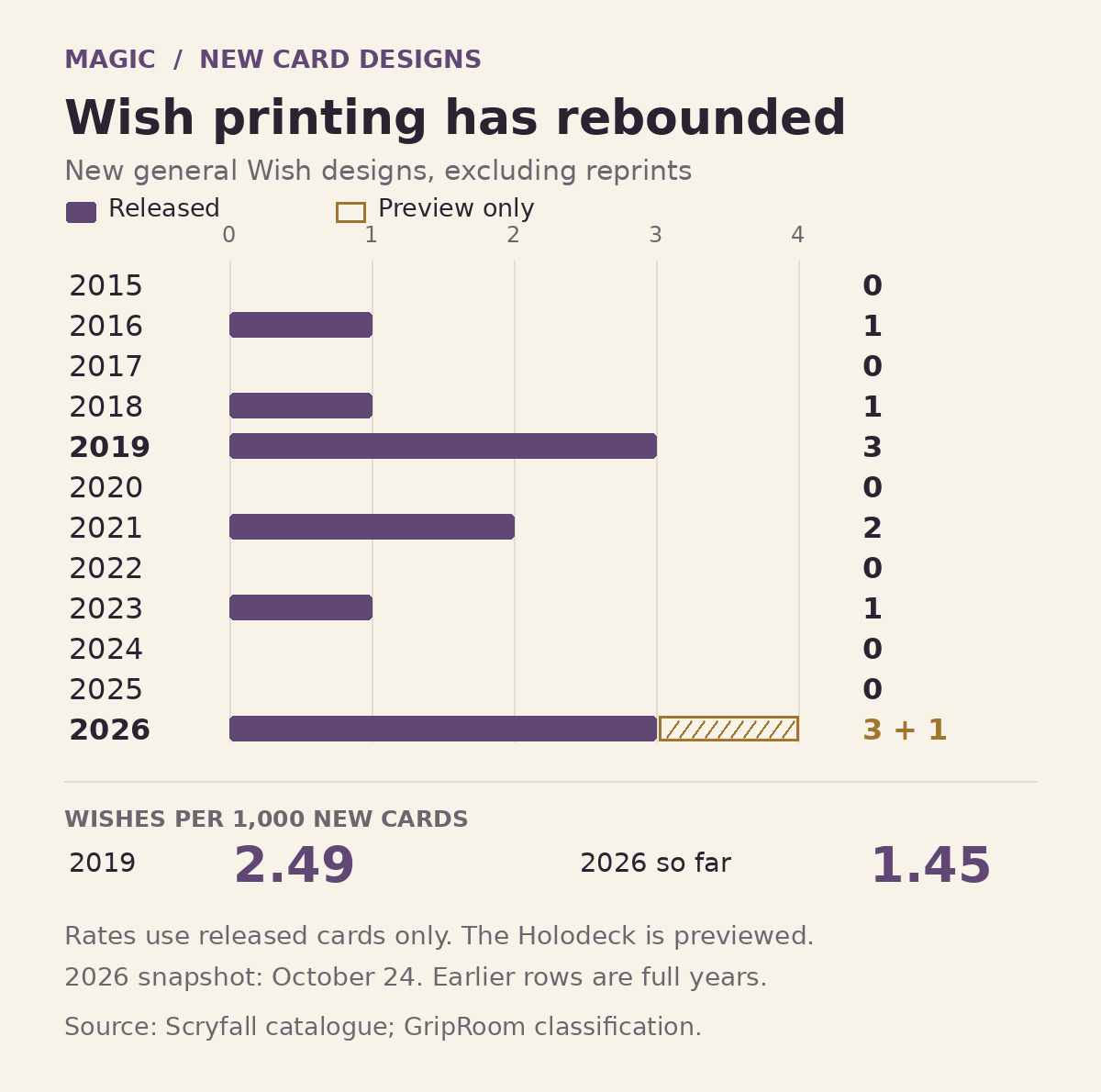
The printing rebound is real. Three released 2026 designs match 2019; the outlined addition is the previewed Holodeck. Rates use released cards only. Source: captured Scryfall catalogue and GripRoom classification.
Why Wizards might want to open the door
Wizards took over Commander management in September 2024. The company making the cards now controls the relevant format decision. That creates a practical route for coordinating a product with a rule.
There are reasons it might want to. General permission could make more printed abilities work in Commander, let designers explore outside-game effects, and give players access to cards too narrow for a normal deck slot.
A preconstructed deck could make the system easier to learn. Imagine opening a deck with a Wish, a small set of eligible targets and clear instructions. Players could try the mechanic without first negotiating a house rule or searching their whole collection. That is a possible product advantage, rather than evidence that Wizards has chosen the plan.
The company has also reconsidered a wishboard restriction before. In February 2026, Arena restored best-of-one sideboards from seven cards to fifteen. Wizards said its earlier concern about a wishboard imbalance between best-of-one and best-of-three had not borne out in its data.
That is useful evidence of flexibility. Arena was expanding access already allowed, while Commander would be introducing general permission. The multiplayer decision still has to stand on its own.
Strange Academy has a wish merchant
Darkhold Destiny's original Marvel story involves conflict across dimensions. Strange Academy supplies a more specific connection than magical doorways alone.
The character Gaslamp deals in wishes. In an actual comic excerpt reproduced alongside contemporary reporting, a customer approaches him to buy one. Strange Academy even has a collection titled Wish-Craft.
A wish-selling character gives designers a natural way to put a Wish effect into this setting. His appearance as a Magic card remains unconfirmed.
The known Strange Academy Commander deck description emphasizes blinking spellcasters: sending them away and bringing them back to reuse their entrance effects. That theme already works within existing rules. Wizards could also create a card with a narrow exception, meeting a story goal while leaving general Wishes restricted.
What changes at your table
Imagine an official board containing a few eligible cards, with its size and restrictions set before play. If the relevant Wishes and targets were permitted, Living Wish could fetch a prepared creature or land. Karn could select an artifact from a small toolbox. The Holodeck could play an eligible outside permanent on successive turns.
For players, that means more useful old cards and more room for unusual answers. It also changes the cost of having the right answer.
Inside a normal deck, a narrow card can become an awkward draw. Outside it, the card can wait until the access effect wants it. The Wish still costs a slot and mana, but its targets no longer compete for draws.
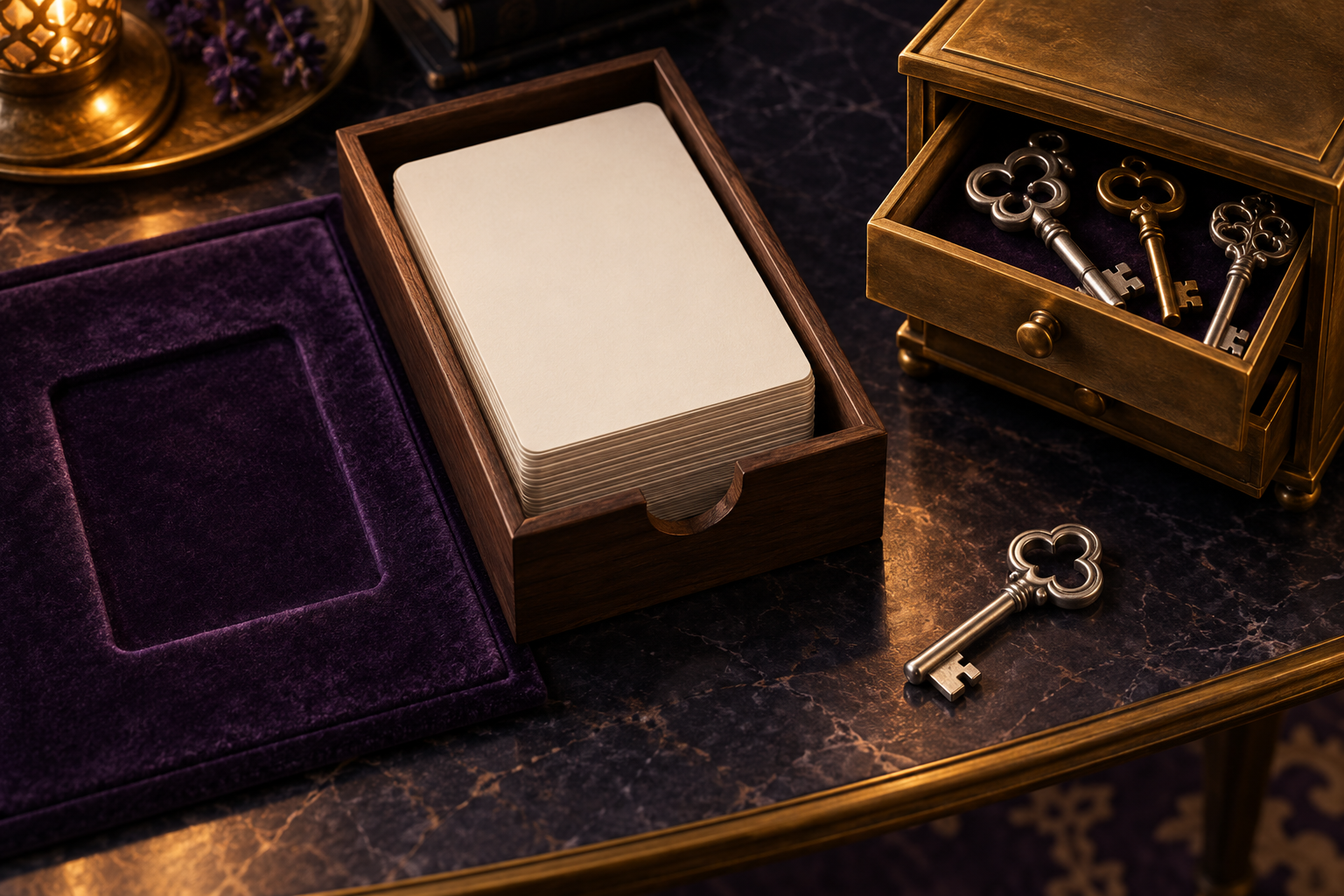
Conceptual illustration: access to a useful tool is different from having to draw the tool itself.
Making the board small and public helps players understand what is available. It does not necessarily prevent a powerful interaction. Two particular cards can be enough.
Wizards supplied a concrete warning when it banned Mycosynth Lattice in Modern in January 2020, citing its lock with Karn, low deckbuilding cost and unfun play. That was a different format. It illustrates both a risk and a possible compromise: restrict a problematic card while allowing other Wishes to function.
A tiny board, an artifact restriction and an unrestricted pool would produce very different games. The details of permission matter as much as the headline change.
Why we land at 12%
The positive case combines a measured printing rebound, unified decision authority, a practical way to teach the mechanic through precons and a documented willingness to revisit wishboard limits.
The reason we keep the estimate low is the gap between those incentives and a general Commander policy. The 2019 cluster coexisted with the restriction. New cards can serve other formats or retain useful modes. The Holodeck demonstrates that alternative directly.
Wizards has also preserved the boundary while changing other rules. Its 2025 Edge of Eternities bulletin allowed eligible legendary Vehicles and Spacecraft as commanders, while describing its outside-game wording changes as nonfunctional clarifications.
That is evidence from Wizards' time in charge, though it predates the newest printing wave. The old Rules Committee's views are no longer a permanent veto; the practical choices behind the restriction still matter.
We judge that combination at roughly one chance in eight, expressed as 12%. Counting Wish cards cannot reveal private plans or measure how often Wizards changes a rule. Reasonable alternative assumptions put our scenarios between about 4% and 30%; that is sensitivity to judgment, not a statistical confidence interval.
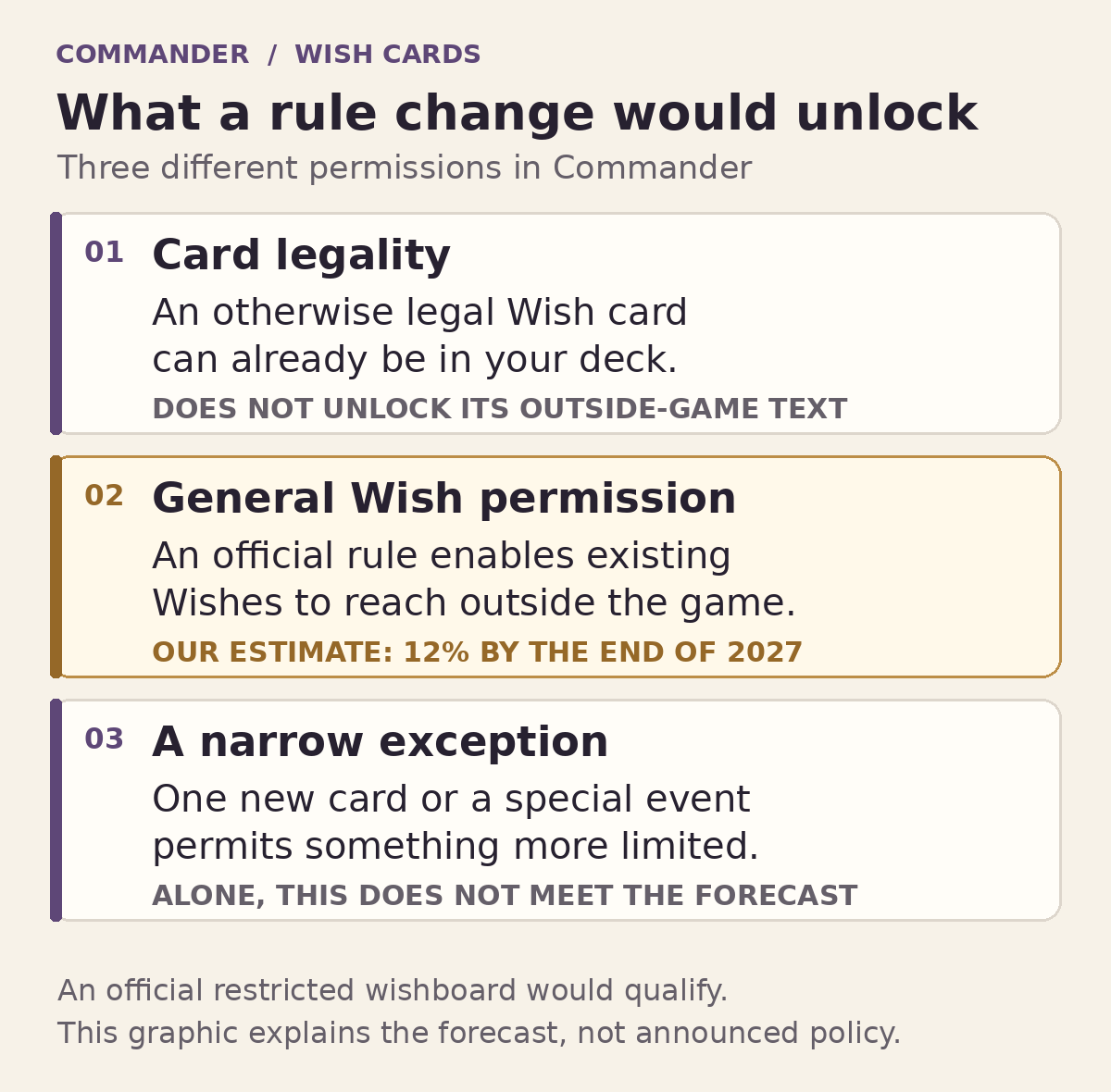
Deck legality, general Wish permission and a narrow exception are different outcomes. Our forecast concerns the general permission.
Darkhold is one opportunity, not the whole deadline
The 12% covers implementation through the end of 2027. It is not a separate forecast that the April launch will introduce wishboards.
If Darkhold previews end with no general Wish proposal, that would weaken the release-specific case and give us reason to lower the remaining-year outlook. A blink deck or a bespoke enabling commander would answer a different question. Later official reforms in 2027 could still meet our forecast.
Darkhold can supply a fitting story for opening the door. The decisive reveal would be permission for existing cards to reach through it.
…or maybe we’ll see a new Rulebreaker card that allows wishes. Wouldn’t that be neat?