
A new majority can buy an investigation. A successful impeachment vote is another story—and June arrives quickly.
Our estimate: approximately 9% probability that the U.S. House adopts at least one new article impeaching Donald Trump by June 30, 2027, as of October 24, 2026. This is an unconditional forecast: it does not assume Democrats win control of the House.
The tempting story writes itself. Democrats win the House. The gavels change hands. Investigators open the drawers. Trump gets impeached again. Each scene seems to lead neatly to the next, which is a useful quality in television and a dangerous one in a forecast.

AI-generated editorial illustration.
Our call is that the House is much more likely to reach the end of June without adopting a new article. The key question is whether lawmakers build a coalition for that vote in time. Anger, allegations and a hearing calendar can all exist without it.
We have not verified a comparable outside probability with matching rules and timing, so we are not claiming a measured market gap. Our disagreement is with the easy chain of assumptions: a change in House power can make impeachment possible without making it the next item of business.
The vote that looks closer than it is
Start with a number that is already real. On September 15, the House voted 232–147 to table an impeachment resolution. Another 47 members voted present. The proposal was stopped.
There is an encouraging way for impeachment supporters to read that record: 147 lawmakers voted against shelving it. There is a much less encouraging detail. Those were all Democrats. No Republican voted against tabling. Eighteen Democrats voted to table, and 46 voted present.
Even the 147 cannot be put straight into an impeachment whip count. A member can want debate, object to shutting down a colleague or support an investigation without promising to adopt a particular charge. Keeping the door open is not the same as walking through it.
This is where the story can get ahead of the votes. A filed resolution is a visible object. It has a sponsor, a title and official stationery. A floor coalition is harder to see, and far harder to assemble. The stationery arrives first.
The distinction cuts both ways. Opponents should not confuse a failed effort with permanent safety. The present House is only one stage of the forecast. The election could change who controls committees and which evidence they can demand.

Paper is easier to assemble than a majority. AI-generated conceptual illustration.
Winning a gavel buys an investigation
A new majority could gain tools the minority lacks. That is a serious change in power. It still leaves decisions about what to investigate, which witnesses to call, what documents can be obtained and whether the resulting case can hold a majority together.
Reuters reported in August that Democrats were planning investigations rather than an immediate rush to impeachment if they won. Its September account described possible probes beginning as early as February and the prospect of legal fights over access to evidence.
February is early in a Congress. It is not especially early in a forecast that ends in June.
That leaves time for hearings and a vote, but little room for a leisurely sequence of requests, refusals, subpoenas, court fights and fresh requests. Oversight can produce important findings while moving too slowly to deliver this particular outcome by this particular date. Failure to meet our deadline would not prove that an investigation had failed at its broader job.
Hakeem Jeffries has also avoided a promise to impeach. In an October 21 interview, he left the question open and emphasized facts, law and the Constitution. The interviewer’s question looked toward 2028. Turning that exchange into a commitment for June 2027 would give the answer a deadline it never had.
There is a perfectly ordinary explanation for that caution. A leader can believe oversight is needed, want to preserve the option of impeachment and prefer to see what investigators actually find before asking members to commit. We do not need to invent a secret strategy to explain a public noncommitment.
The historical surprise arrives before January
To check the pace, we looked at all 13 completed midterm windows from 1974 through 2022. Each window runs from late October through June 30 of the following year. The question is whether the House adopted a presidential impeachment article during that span.
There was one YES: Bill Clinton, on December 19, 1998.
That date is easy to overlook. A study beginning with the new Congress in January would miss it, even though our current forecast includes the months before January. The outgoing House can act. The calendar does not politely wait for a new cast.
Clinton’s case also shows why a historical match needs more than a month and a day. The House had already authorized an inquiry on October 8, before our comparison window began. That case entered late October further along the formal path. We keep it in the count, rather than deleting the awkward success, and keep the difference in view.
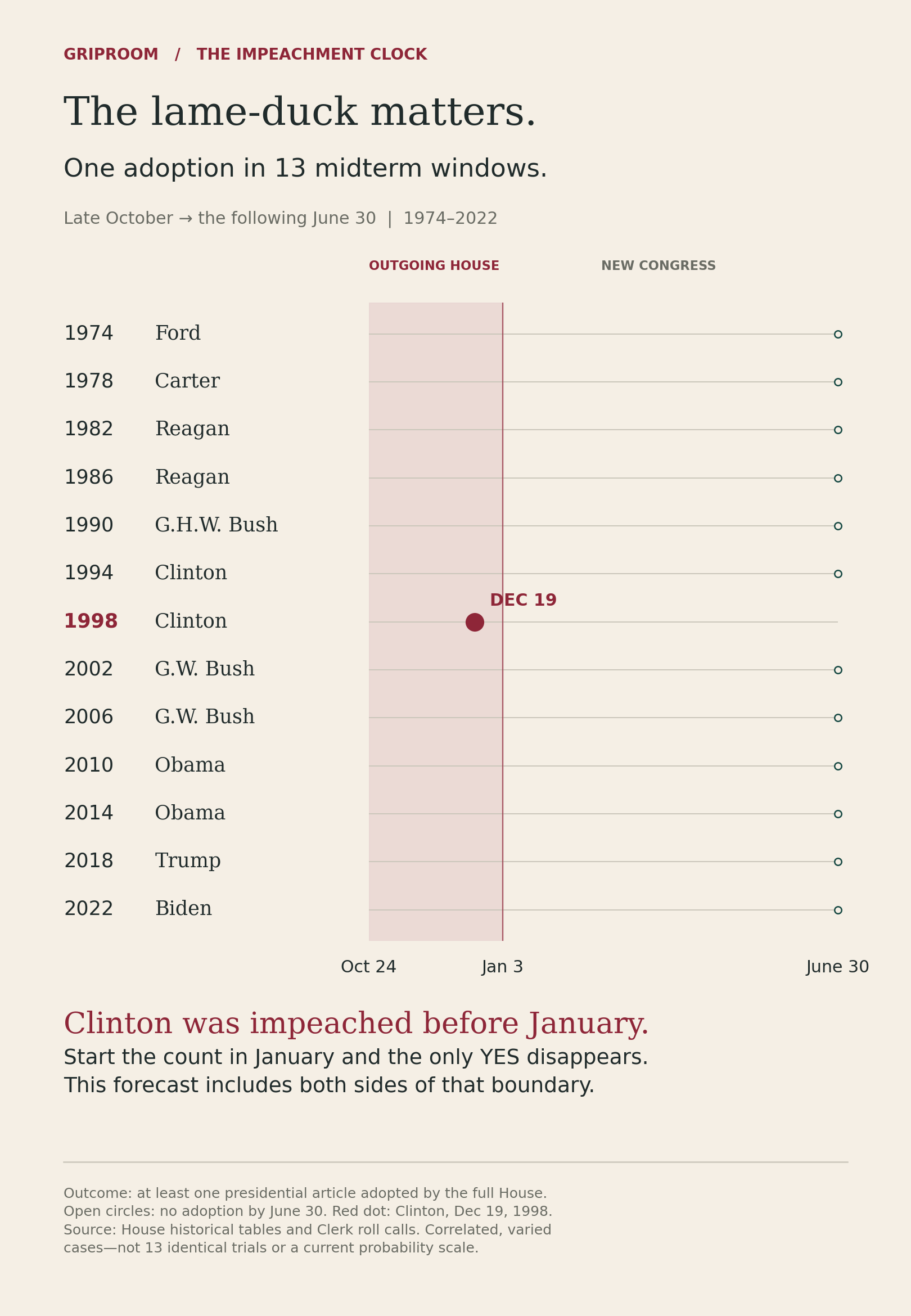
The lame-duck months count. All 13 completed midterm windows, 1974–2022; one qualifying House adoption. Source: House historical tables and Clerk roll calls. These are historical outcomes, not 13 identical trials.
Seven of the 13 windows began with the president’s own party controlling the House, as Republicans do in the current dated membership record. None of those seven produced adoption by the following June. That is a useful restraint on enthusiasm, not proof that this time must follow the script.
How we reach nine
We give those seven same-party starting cases more weight because they match a fact known before this election. We still retain the six cases that began with opposition control, including Clinton’s impeachment, at half that weight.
Then we add a small allowance for the limits of such sparse history. That produces a starting judgment of about 8.5%, which we round to 9%. The exact calculation and all 13 cases are in the accompanying research files. The important choice is visible here: greater weight for the matching starting position, without pretending the other cases never happened.
Different reasonable weighting and small-sample choices put the estimate around 6% to 13%. That range tests our assumptions; it is not a statistical confidence interval. Repeated presidents, changing political habits and very few actual impeachments make this a rough starting guide, not a calibrated machine.
The current record supports keeping the call low: a defeated procedural effort, no Republican votes against tabling, no leadership promise and reported plans to investigate first. We do not attach a fresh numerical penalty to each one. They partly describe the same political problem, and counting that problem several times would create false precision.
Crucially, we have not turned a national vote-preference poll into a probability of House control, then multiplied it by a guessed passage rate. The election is still uncertain. The adoption vote is another uncertainty after it.

The decision is behind the doors. AI-generated fictional setting.
The case against our call can move fast
There is no legal rule that impeachment must consume most of a year.
On January 13, 2021, the House impeached Trump seven days after January 6. Ten Republicans voted YES. That was an acute event followed by a rapid coalition, rather than a slow investigation gradually finding its way to a vote.
It is the strongest warning against treating our June deadline as a shield. A major new event, decisive evidence or a sudden shift among members could change the timetable quickly. A new opposition majority could also inherit more developed evidence than the current public record reveals.
The House’s procedural guide allows routes that do not require a long committee inquiry first. Proceedings can also resume across Congresses. January does not legally wipe the slate clean. Our low estimate rests on political willingness and readiness, not an imaginary rule requiring months of paperwork.
What would change the number
Watch for commitments attached to an actual article: leadership backing a vote, enough members supporting adoption and evidence that moves beyond allegations into a documented case. Control of the House matters, but the first hearing alone would not settle the forecast.
We would raise the estimate for a credible, near-term route to a majority. Republican retention of control, continued leadership restraint or prolonged evidence-access fights would weigh the other way. A new crisis could move the number beyond our current sensitivity range; pretending otherwise would make the range less honest, not more useful.
For this call, impeachment means House adoption of at least one new article by June 30, 2027. Introducing charges, opening an inquiry, winning a committee vote or trying and failing on the floor does not count. Senate conviction and removal are separate events. The Clerk and Congressional Record control the result, with Congress.gov next in the hierarchy.
Nine percent leaves room for Washington to surprise us. It does not confuse a busy stage with a finished act.
Sources
Reuters: investigation-first plans, August 8, 2026, and possible probe timing, September 28, 2026.
House Clerk: Clinton inquiry, 1998 adoption and Trump’s 2021 adoption.