The electricity bill arrives as one number, but that number has a surprisingly crowded backstage: power plants buying fuel, utilities rebuilding wires, regulators weighing requests, and increasingly, enormous buildings full of computers looking for somewhere to plug in.
The question is whether all that pressure can produce a jump big enough to show up across the country. We estimate a 9% chance that the U.S. annual average residential electricity price per kilowatt-hour in 2027 will be at least 10% higher than the annual average in 2026. That is our judgment, not a government forecast, and it means a smaller increase or a decline is considerably more likely.
This is an unusually large hurdle. The national residential rate rose by about 10.1% in 2022. It has risen in every completed year since, but not by as much in any of those years. The uncomfortable part is that another exceptional jump does not require every piece of the power system to fail. It could come from several expensive things happening at once.
What a national jump would mean
The figure we are watching comes from the U.S. Energy Information Administration, or EIA. It divides residential electricity revenue by the electricity sold to residential customers. Think of it as a national average price per unit, weighted by electricity sales. It is not a prediction for every household, and it is not the same as an average monthly bill.
That distinction matters. A household's bill depends on where it lives, how much power it uses, the charges on its rate plan, and how cold or hot the weather gets. A family can pay more in a hot summer even if its price per kilowatt-hour does not change. Another can see a larger increase than the national average because its local utility has different costs.
For a simple illustration, imagine a household whose electricity charge is $150 a month. If it used the same amount of power and its own effective price and relevant charges all rose by 10%, the charge would become $165: an extra $15 a month, or $180 over a year. The national average reaching our threshold would not, by itself, mean that this household's bill rose that way.
Prices are climbing, but the official forecast is lower
The pressure is real. In the latest EIA monthly figures, the national residential price for January through August 2026 averaged 18.19 cents per kilowatt-hour, compared with 17.03 cents over the same months of 2025. That's an increase of about 6.8%.
Those 2026 numbers are preliminary, and eight months do not make a full year. They also describe 2026 against 2025. Our question is a separate comparison: the whole of 2027 against the whole of 2026.
The EIA's October short-term outlook gives a useful baseline. It projected an average residential rate of 18.21 cents per kilowatt-hour in 2026 and 18.68 cents in 2027. That works out to an increase of roughly 2.6%, well below our 10% threshold.
If the 2026 projection turned out to be exactly right, a 10% jump would put the 2027 average at about 20.03 cents per kilowatt-hour. The actual threshold will move with the final 2026 rate.
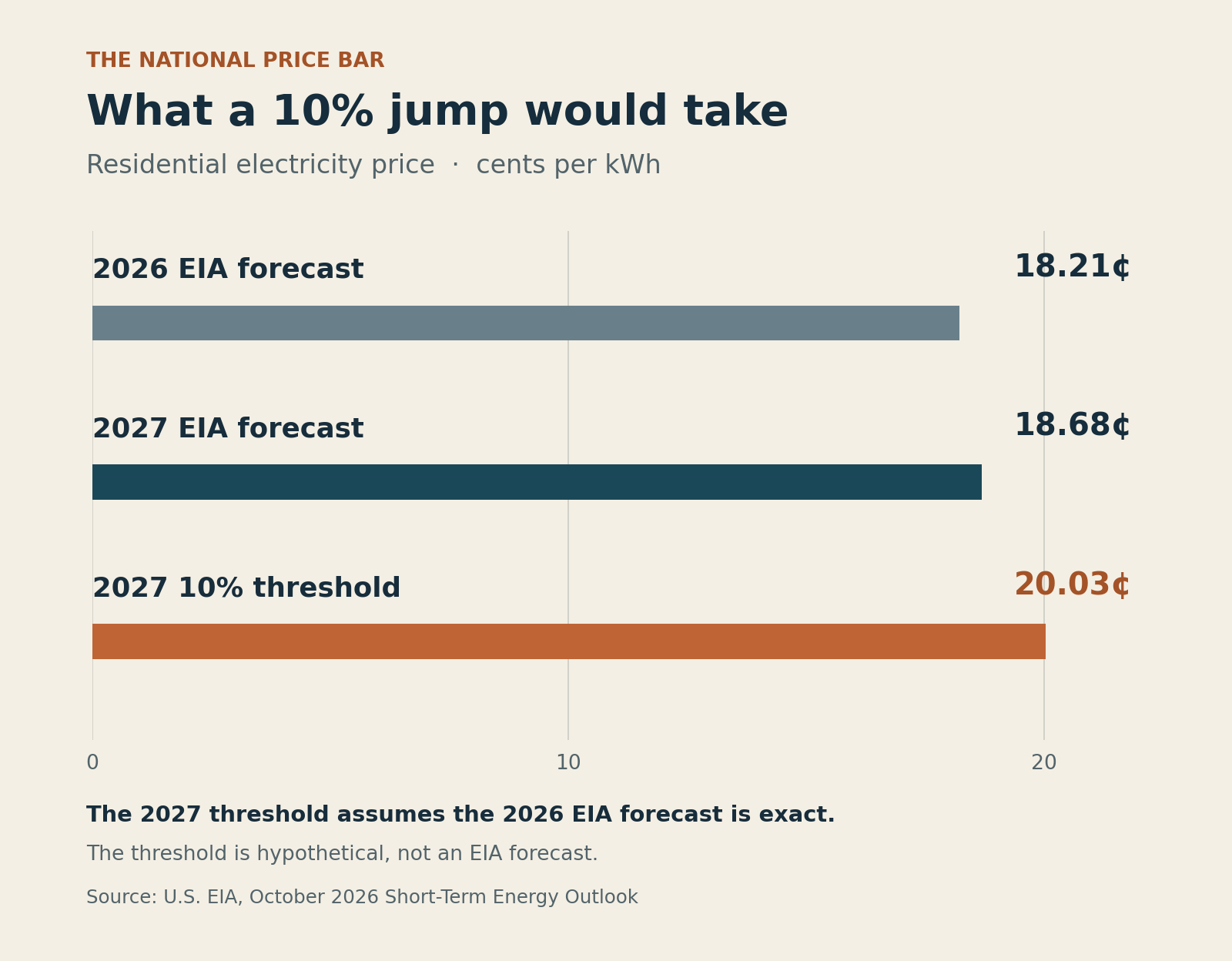
EIA projects 18.21 cents/kWh in 2026 and 18.68 in 2027. If the 2026 projection proves exact, the threshold for a 10% increase in 2027 is 20.03 cents/kWh. The threshold is hypothetical, not an EIA forecast.
The EIA's forecast and our estimate are answering different questions. Its figures describe a central path for prices. Our 9% concerns the chance of a much larger outcome. A forecast of mild rain can coexist with a smaller chance of a storm; the rain forecast does not tell you exactly what that storm chance is.
There is another wrinkle: the EIA outlook was completed before the agency published its final 2025 annual electricity data. The outlook used an earlier 2025 estimate of 17.30 cents; the later final figure is 17.23 cents. The EIA explicitly lists the two in its preliminary-versus-final comparison. Forecasts and historical data can both be revised.
A rare event with a recent example
We looked at 41 annual comparisons from 1985 through 2025, using EIA historical and more recent series. Two years stand out: 2006 and 2022. The 2022 increase is clear in the current annual prices. For 2006, the EIA's annual report gives enough detail on residential revenue and sales to calculate an increase of about 10.1% in that report's historical data.
Two years out of 41 is roughly 5%. But using only the past five completed annual comparisons gives one qualifying year out of five, or 20%. Neither slice should be mistaken for a scientific answer about 2027. The country, the fuel mix, inflation, the grid and the rules governing it have changed. The historical tables also come from different data vintages.
Our 9% gives more weight to the long record while giving some extra weight to the recent period. That recent period is already inside the long record, and the 2022 jump does a lot of work in the calculation. Change the time window or the weight and the answer moves. The estimate is a reasoned judgment, not a proven model with an exact margin of error.
The history is still useful: it tells us that a nationwide 10% annual increase is exceptional, and that “exceptional” is not the same thing as “unprecedented.”
The surprising thing about more electricity demand
Data centers are an obvious suspect when people talk about future power bills. Their appetite for electricity is growing, and connecting large new customers can require new generation, substations and transmission lines. Those projects cost money long before anyone asks an AI chatbot for a better recipe.
But demand growth does not automatically make everyone else's electricity more expensive. A grid has large fixed costs. If there is room to serve new customers using existing infrastructure, more electricity sales can spread some of those costs across more units of power. In that case, average costs can fall.
If the system is already tight, the same new demand may require expensive additions. Then the question becomes who pays for them. As Lawrence Berkeley National Laboratory and the Brattle Group explain, the result depends on available capacity, the cost of new supply and delivery, and how tariffs allocate those costs.
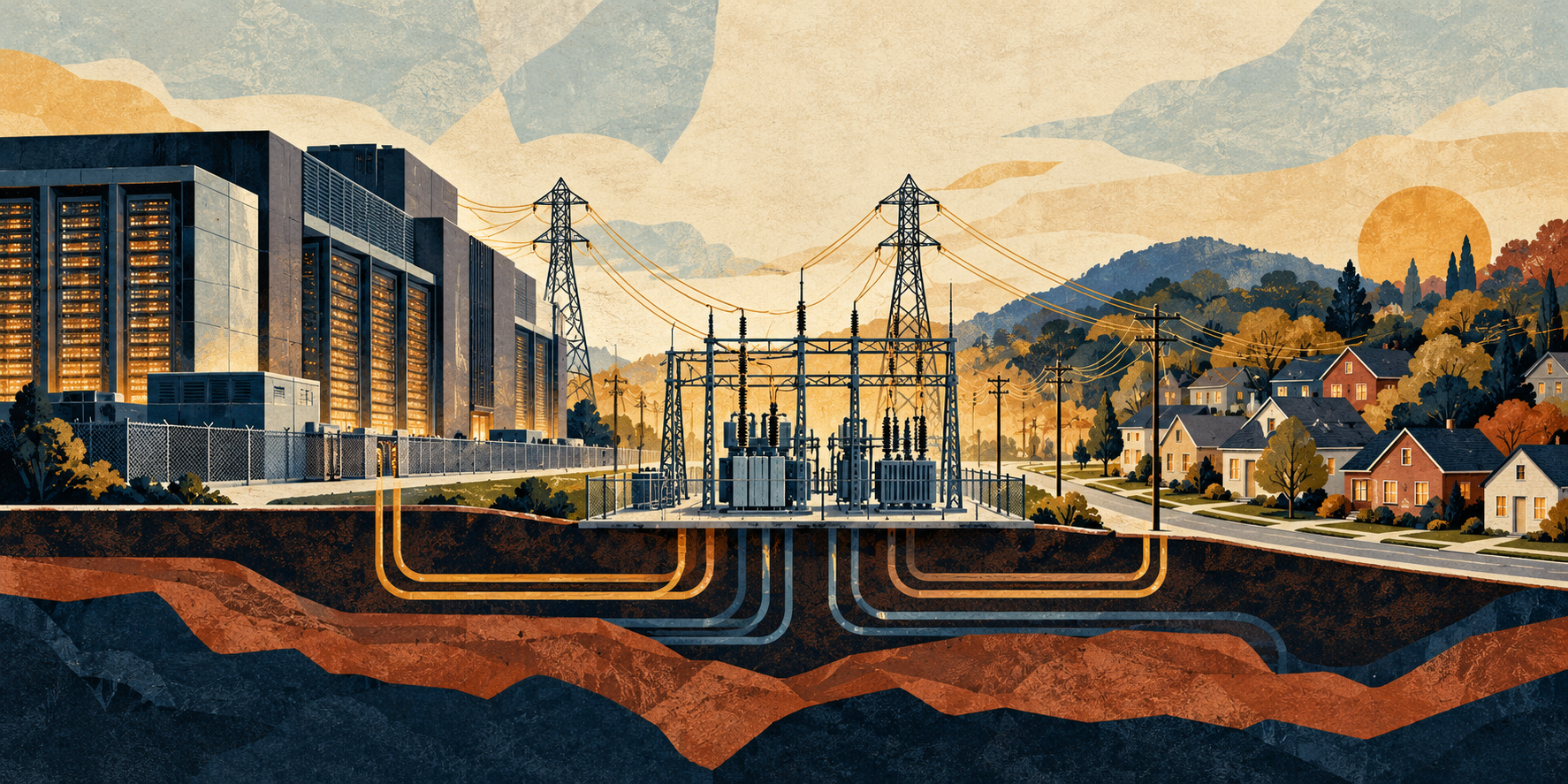
A shared grid can spread costs across more sales, but new demand can also require expensive infrastructure.
The laboratory's state-level research found that faster load growth was often associated with lower overall, inflation-adjusted retail prices from 2019 to 2025. The relationship for residential prices was less clear. That is not proof that a new data center will reduce a particular homeowner's bill, and the researchers warn that the future may look different.
At the utility level, an MIT working paper links data-center entry to higher residential rates in its historical sample. That is a different question from the state-level comparison and does not tell us the national increase in 2027. Together, the studies point to a less satisfying but more useful answer: location and cost-sharing rules matter.
The price of being ready
One of the costs that can rise before a household uses an extra kilowatt-hour is the cost of keeping enough generating capacity available.
In the PJM region, which serves a large part of the eastern United States, a capacity auction for the 2027–2028 delivery year cleared at $333.44 per megawatt-day, compared with $329.17 for 2026–2027. Both are much higher than several earlier auction years.
That is a sign of pressure in one important regional market, not a direct percentage increase on a national household bill. Capacity is only one component of retail electricity costs, and PJM's delivery year does not line up neatly with the calendar-year average in our forecast. Utilities also pass costs through under different local rules.
Those rules are becoming part of the story. In June 2026, the Federal Energy Regulatory Commission directed six regional grid operators to justify or propose changes to rules for connecting very large users. Among the issues it identified were cost shifting and transparency around transmission expenses. A direction to address those questions is not a guarantee that every future customer will be protected.
State regulators matter, too. In Michigan, DTE requested $474.3 million in additional annual electric revenue, while the state's attorney general argued for a much smaller increase. That is one contested case, not a national forecast. It illustrates why a utility request, a regulator's final decision and the amount appearing on a residential bill are three different things.
What could change the picture
For a 10% national jump in 2027, the forces pushing prices higher would probably need to reach beyond a handful of local rate cases. A sharp fuel-cost shock, costly grid projects, tight regional capacity and unfavorable cost allocation could reinforce one another. Extreme weather can add pressure, though its effect on a particular annual average depends on when and where it occurs.
The countercase is substantial. The EIA expects the average wholesale electricity price across the hubs it tracks to ease from $52 per megawatt-hour in 2026 to $49 in 2027, with differences by region. It also expects a lower national natural-gas benchmark price in 2027. Those projections could be wrong, but they help explain why the agency's central path is nowhere near a 10% residential increase.
More generation and transmission, better use of existing equipment, slower growth in large new loads, and regulators assigning more costs to the customers who create them could also soften the outcome. Some of those changes take years; others can affect how costs are divided sooner.
The next thing to watch is therefore not just how much electricity data centers consume. It is the bill for the power system being built around them: what gets approved, when it enters rates, and how much of it lands on homes. A switch on the wall may feel like a private transaction. The price behind it is negotiated across a much larger grid.