The Trump administration describes Jared Kushner as a private citizen volunteering his diplomatic help. Citizens for Responsibility and Ethics in Washington argues that the work he performs carries legal obligations that cannot be avoided with a volunteer label.
That dispute does not have a useful one-word answer. Informal adviser, government employee, special government employee and constitutional officer are different categories. Public financial-disclosure requirements introduce another question. Someone’s pay status cannot resolve all of them at once.
The lawsuit CREW filed on October 14 challenges Kushner’s arrangement and seeks court intervention. It is an argument about the legal consequences of his role, not itself a finding that he has violated the law.
Why the volunteer description matters—and where it stops
According to Associated Press reporting on the filing, the White House characterizes Kushner as a private citizen providing assistance. His lawyer says the arrangement has received ethics review and disputes CREW’s ability to bring the case.
That is a substantive defense. It should sit beside the challenge, rather than disappear beneath the lawsuit’s allegations. But “unpaid” and “outside government employment” are not synonyms in the statute.
The special government employee definition in 18 U.S.C. § 202 expressly includes qualifying temporary service with or without compensation. A person can therefore receive no government salary while still occupying a legally significant government role.
The useful inquiry is about the actual arrangement: the duties undertaken, the authority exercised, how the person was retained and what the relevant appointment records show. A badge or a job description might help explain the facts. Neither a flattering title nor a refusal to use one supplies the whole legal analysis.
Informal advice and assigned duties are different questions
A 1977 Justice Department opinion on informal presidential advisers illustrates the distinction. Informal personal advice did not automatically make the adviser a government employee. Taking on government coordination responsibilities could change the analysis and require an appointment.
The opinion is a dated executive-branch interpretation, not a judgment about Kushner’s present work. Its value here is the question it makes readers ask: has someone merely offered the president an opinion, or assumed duties on the government’s behalf?
Those situations can look similar in a photograph. A person sitting at a conference table might be giving advice, communicating a message or exercising delegated authority. The legal significance depends on what they were actually authorized and expected to do.
That is why the underlying records matter more than a debate over whether “envoy” sounds official enough. The label identifies the dispute. It does not settle the duties.
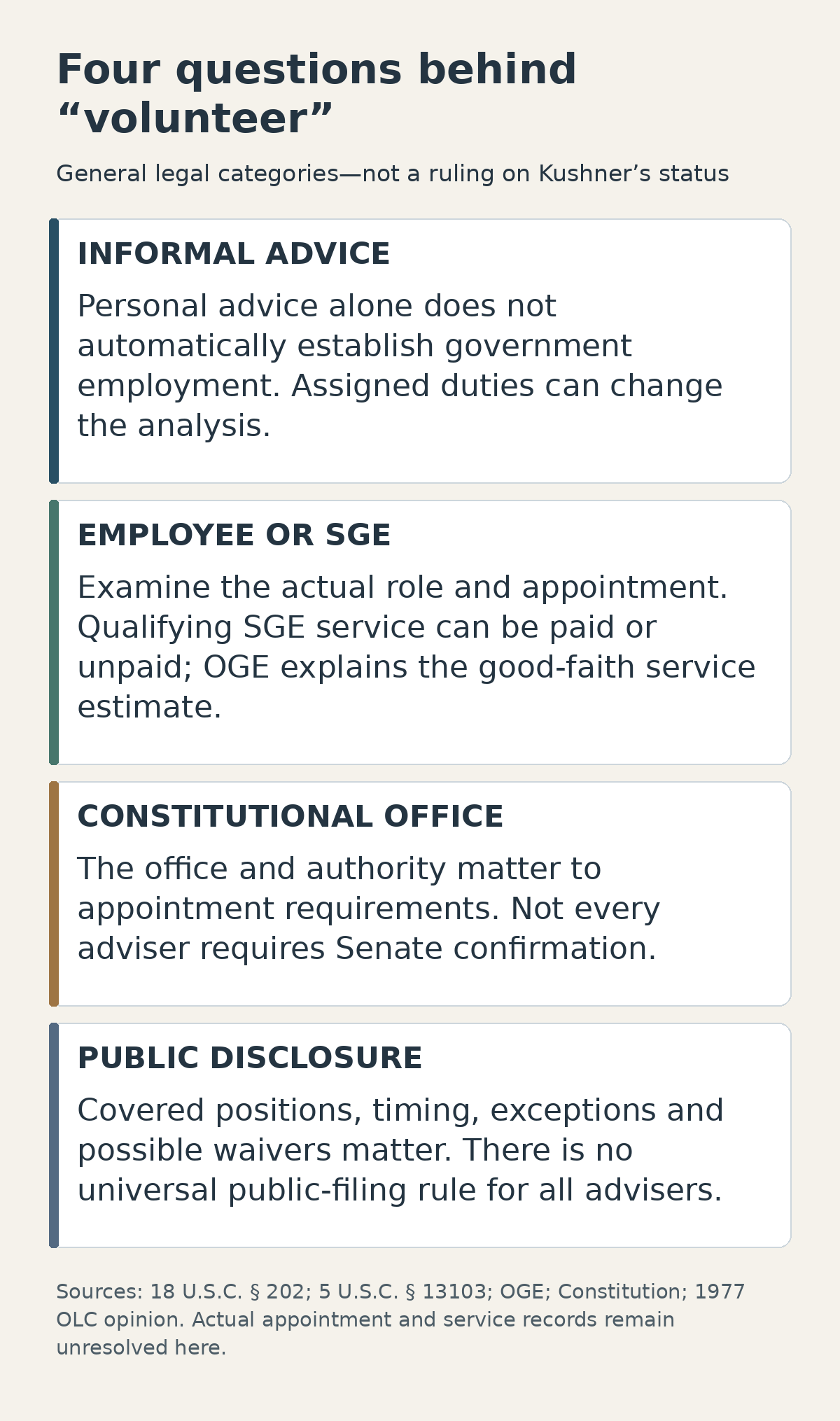
The four general questions concern informal personal advice, employee or special government employee status, constitutional office and public disclosure. Unpaid service can qualify as SGE service. OGE preserves a good-faith designation for the relevant period when service unexpectedly exceeds the estimate. Public filing depends on covered-position rules, timing, exceptions and possible waivers. This graphic does not classify Kushner.
The 130-day rule does not create an automatic day-131 cliff
The special government employee definition refers to temporary duties expected to occupy no more than 130 days during a 365-day period. That number is often easier to repeat than to explain.
The Office of Government Ethics explains the appointment estimate. If an agency makes a good-faith SGE designation and service unexpectedly exceeds 130 days, the individual can remain an SGE for the rest of that period. The agency should reassess the designation for the next 365-day period.
Counting appearances in news stories would not establish the original estimate, the complete service record or whether an excess was unexpected. Nor does the rule mean every occasional adviser is automatically an SGE: the underlying employment or appointment question still matters.
The distinction has a practical consequence for coverage. “He worked on diplomacy for months” and “his SGE designation was legally improper” are different claims. The second requires facts about the arrangement that the first does not provide.
Public financial disclosure is a separate test
The financial-disclosure statute identifies covered positions and timing rules. Its provisions concerning service of 60 days operate within that framework, alongside exceptions and possible waivers. They do not impose one universal public-filing rule on everyone who advises a president.
The OGE disclosure program distinguishes the relevant reporting obligations. A claim that someone must file a public report needs an explanation of why their position is covered. An assertion that they are unpaid does not, by itself, establish an exemption.
The 60-day and 130-day provisions consequently should not be joined into an improvised countdown. One concerns filing requirements for covered positions; the other is part of the SGE definition and designation framework. They answer different legal questions, even when the same person’s service makes both worth examining.
An officer appointment raises another issue
The Constitution’s Appointments Clause governs appointments to federal offices. It also permits Congress to provide alternative appointment routes for certain inferior officers. “Every adviser needs Senate confirmation” would therefore be too broad a description.
CREW argues that Kushner’s continuing diplomatic responsibilities and authority bring his arrangement within constitutional requirements. The administration’s characterization contests the premise that he occupies the kind of position CREW describes.
That disagreement needs to be resolved through the applicable legal tests and the facts of his duties. Neither the importance of a diplomatic assignment nor the president’s trust in a relative automatically decides the constitutional category.
The 2017 OLC opinion allowing a presidential appointment to the White House Office concerned a narrower anti-nepotism issue. It is not a general approval of every later diplomatic arrangement, disclosure practice or exercise of authority.
What CREW wants, and what a court would still have to decide
It also helps to separate the questions readers want answered. Was a role properly created or filled? Which ethics or disclosure requirements apply to that role? Did a particular action violate a rule? Evidence addressing one question may leave the others open. A statement that counsel reviewed an arrangement should be reported as that statement, with its scope intact; it does not reveal the contents of unpublished advice or replace a court’s decision on the issues the lawsuit raises.
CREW asks the court to stop Kushner from exercising the challenged official powers unless he is appointed and confirmed under the Appointments Clause, and to require the financial disclosures it says the law demands. If the court finds no Appointments Clause violation, CREW alternatively seeks disclosure relief. If it treats him as a private citizen outside those requirements, CREW asks it to block his exercise of government authority under a private-nondelegation theory. These are requested remedies and contested theories, not orders already entered.
There is a threshold dispute as well. CREW invokes an injury tied to financial information it says the law requires. Kushner’s side challenges standing—the plaintiff’s legal entitlement to have the court decide the dispute. A ruling on that threshold question would need to be distinguished from a decision endorsing either side’s full account of Kushner’s status.
The public case-tracker snapshot inspected for this article was last updated October 29. It supplies dated procedural history, not certification of the latest docket. It should not be used to infer that no later filing or decision exists.
The records that would clarify the central questions include any appointment documents, the actual allocation of duties, service records, underlying ethics advice and relevant court orders. Until those establish more, the defensible description is a disputed volunteer arrangement facing a legal challenge. The November election does not itself decide the case—or change the legal category of the work.
Sources
CREW v. Kushner: October 14, 2026 complaint; CREW filing announcement.
Associated Press: October 14 reporting including the administration and counsel response.
18 U.S.C. § 202; 5 U.S.C. § 13103; OGE definitions and disclosure guidance.
National Archives: Constitution transcript.
DOJ Office of Legal Counsel: 1977 informal-adviser opinion and 2017 White House appointment opinion.
Civil Rights Litigation Clearinghouse: dated October 29 case-tracker snapshot.