Jared Kushner could face congressional subpoenas, including after the 2026 midterms. Congress already has that power. An election could change who controls House committees and which investigations they pursue; it would not automatically issue a subpoena, compel immediate cooperation or establish wrongdoing.
That distinction matters because several different events are being folded into one political story: a demand for records, the November 3 election, the start of new congressional terms and the possibility of a legal fight over compliance. Each has its own consequences. None can stand in for the others.
For readers watching Kushner’s business interests and diplomatic role, the useful question is what would turn political pressure into a legally authorized demand—and what could happen after that demand arrives.
What Raskin has actually requested
In an October 30 announcement, House Judiciary ranking member Jamie Raskin demanded Kushner’s recusal from negotiations and sought records concerning his foreign financial interests. The accompanying letter requested answers and documents by November 12.
Those documents establish what Raskin requested and why he said he wanted it. They do not establish the truth of the allegations that prompted the request. Kushner has published a lawyer’s denial of the underlying book allegations.
A letter from a ranking member also needs to be described accurately. A requested response date is a deadline set by the requester. It does not, by itself, turn that letter into a committee subpoena. To understand the next step, look for an actual compulsory demand and the authority under which it was issued.
That is a more useful test than the temperature of the press release. Strong language can signal political determination. The document’s legal status tells a reader what the recipient has actually been directed to do.
An election result would change control, not create the power
Under the current House rules, committees and subcommittees can subpoena testimony and documents within their authority. Rule XI provides for committee authorization and allows that authority to be delegated to a chair under committee rules.
That means the House does not need to discover subpoena power after an election. The political question is who can authorize its use and what that person or committee chooses to investigate. A ranking member’s interest is consequential, but it is different from controlling a committee’s investigative agenda.
If Democrats won the House, the resulting change in leadership could create a different oversight environment. That is a conditional political pathway, not a prediction here about the election or a promise that Kushner will be subpoenaed.
There is a timing issue, too. The Federal Election Commission lists November 3 as the 2026 general election date. Under the Twentieth Amendment, congressional terms change on January 3. Winning seats in November would not give incoming members immediate control of the sitting House.
The current rulebook belongs to the 119th Congress. A future House’s organization, committee leadership and rules would need to be checked when they exist. Treating the election as an instant switch in legal authority skips that transition.
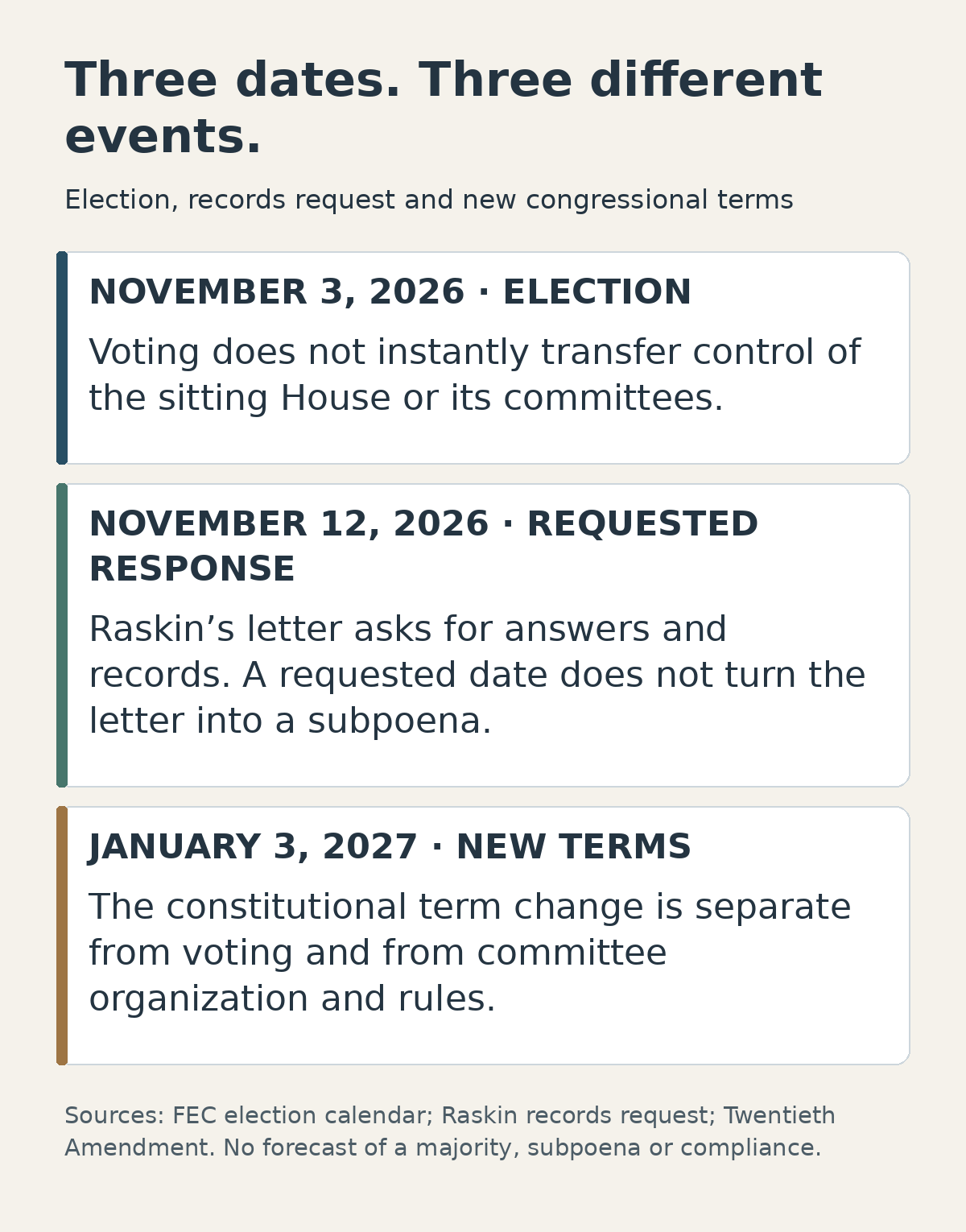
The general election is November 3, 2026. Raskin’s letter requested records and answers by November 12, 2026. Congressional terms change January 3, 2027 under the Twentieth Amendment. Voting, a requested deadline and the term change do not themselves issue a subpoena or establish compliance.
What an authorized investigation would need to explain
Congressional investigation is connected to Congress’s constitutional functions. It is not an unlimited license to demand anyone’s private records simply because those records would make compelling television.
The Congressional Research Service’s oversight manual discusses legislative purpose, committee authority and constitutional constraints. In practice, the important questions would include what a committee is investigating, how the requested material relates to that work and whether the demand falls within its jurisdiction.
An inquiry into financial-conflict safeguards could have a different legal explanation from a request framed only as an effort to expose an individual. The existence of a controversial business relationship does not answer whether a particular subpoena is properly authorized or appropriately scoped.
For a reader, the concrete document matters: who issued it, what records it identifies, what period it covers and what legislative purpose accompanies it. “Congress is investigating Kushner” is a useful starting description. It is not enough detail to evaluate the demand.
Being close to the president does not settle the legal fight
Kushner’s relationship to Trump makes the politics obvious. It does not make every legal question obvious.
In Trump v. Mazars, the Supreme Court addressed congressional demands for a sitting president’s personal information and required careful attention to separation-of-powers concerns. That decision is relevant context, but its special presidential-information analysis is not an automatic immunity for every relative’s business records.
Equally, family ties do not erase otherwise applicable rights or privileges. The actual records, their holder, the demand’s scope and any asserted legal protection would matter. A subpoena for private investment-company records and one seeking presidential communications should not be treated as interchangeable merely because Kushner appears in both stories.
This is where dramatic forecasts often get ahead of the evidence. Until the demand and objection are available, claims that he would certainly have to disclose everything—or could certainly block everything—are conclusions without the necessary documents.
A subpoena and enforcement are different stages
A valid subpoena would be an important escalation. It would still leave a separate question: how a dispute over compliance would be resolved.
Federal law provides a process for certifying certain contempt matters to a U.S. attorney. A referral, a prosecution, a conviction and the production of requested records are different outcomes. One should not be announced as though it automatically delivers the next.
The oversight manual also describes civil enforcement and the complications that arise in disputes involving the executive branch. Those routes require separate decisions and may produce litigation over authority, rights or privileges. A political majority cannot make those questions disappear by wanting answers quickly.
There is a practical distinction between punishing noncompliance and obtaining information. A sanction-focused story may leave readers assuming the requested documents are already on their way. Enforcement reporting should explain which result is being sought and what has actually occurred.
The Justice Department’s 2017 opinion on individual members’ oversight authority adds another limit: it sets out the executive branch’s view of inquiries by individual members without delegated committee authority. That is an executive legal position in a particular institutional setting, not a universal answer to every request directed at a private business.
The records that would make this story move
One way to assess the next headline is to ask four questions. Is it describing an intention or an issued document? Who authorized the demand? What specific material is being sought? And is the reported development a response, an objection or a ruling? The answers locate the story in the process without requiring a reader to become a congressional lawyer.
The distinction can change the significance of the same announcement. A promise to investigate signals an agenda. An authorized demand identifies an obligation to be contested or answered. A ruling addresses the legal dispute actually before the court. Evidence obtained through that process may then support conclusions about conduct. Reporting should identify which step has happened before discussing the next one.
The most revealing next development would be a document that changes the legal position: an authorized subpoena, an actual response, a formal objection, an enforcement filing or a judicial ruling.
For the November 12 request, look for the response itself or a dated statement describing what happened. A news search that turns up no response does not establish that none exists. For a future committee investigation, look for the committee’s adopted rules and the particular authorization rather than assuming they follow automatically from an election result.
Readers should also keep this issue separate from whether Congress can limit military action. Congress’s war-powers tools concerning Iran answer a different question from its ability to demand Kushner’s records. The same political conflict can involve more than one legal mechanism.
Kushner could therefore face subpoenas after the midterms. The meaningful development would be the authorized demand and the evidence it produces. An election result alone cannot tell us whether that demand will happen, survive a challenge or establish a violation.
Sources
House Judiciary Democrats: October 30 announcement and accompanying Kushner records request.
House Rules Committee: 119th Congress rules, January 16, 2025 edition.
Federal Election Commission and National Archives: election date and congressional term change.
Congressional Research Service: Congressional Oversight Manual, March 27, 2026.
Supreme Court: Trump v. Mazars; 2 U.S.C. § 194; DOJ Office of Legal Counsel’s 2017 individual-member opinion.
Jared Kushner: published counsel response to Matthew Cole’s book allegations.