

The best-known figure in the Jared Kushner money story is a historical $2 billion Saudi commitment to funds managed by Affinity Partners. That is an investment-capital figure. It does not, by itself, tell us Kushner’s personal wealth, his take-home income or the truth of separate allegations about private accounts.
The distinctions matter because several financially different things can sound interchangeable in a headline: money committed to a fund, assets a firm manages, management fees, a share of investment profits and an owner’s personal fortune. Add a disputed book account and the opportunity for confusion becomes enormous.
The public documents support a more precise account. There is a dated record of the Saudi commitment and fee terms, a later corporate description of managed assets, Kushner’s account of profit-sharing arrangements, and a separate set of allegations and denials. Each answers a different question.
What the $2 billion figure actually describes
In a September 24, 2024 letter to Affinity, then-Senate Finance chair Ron Wyden described a $2 billion commitment from Saudi Arabia’s Public Investment Fund. The letter reported a 1.25% annual management fee on that committed amount for a period running from June 2021 through August 2026.
Those historical terms permit a simple illustration: $2 billion multiplied by 1.25% equals $25 million for one year. That is arithmetic on the cited commitment base—not a statement of current receipts, profit or Kushner’s personal income.
The date is essential. The period described in the letter ended in August 2026. It cannot establish what an investor-specific agreement charges today. A current fee claim would need current terms and evidence of the relevant payments.
A fund’s money and its manager’s money are different
The SEC’s investor guide describes private equity funds as pooled investment vehicles. An adviser manages money on behalf of a fund. A headline about the size of that investment pool therefore needs to be kept separate from a claim about what the adviser personally owns.
The guide also points readers toward offering documents and investor agreements for fees and expenses. Those contracts matter more than a generic assumption about what private equity firms usually charge. A customary industry percentage would not establish Affinity’s current fee for a particular investor.
In its explanation of starting a private fund, the SEC describes agreements covering capital calls, profit sharing, management fees and withdrawal rights. These are related parts of a business arrangement, not interchangeable financial measurements.
That is why “Saudi Arabia committed billions to Kushner’s firm” is a starting point for examining the relationship. Converting it into “Kushner personally received those billions” adds a conclusion the commitment figure cannot supply.
The same care should apply to an argument defending the arrangement. Identifying money as investor capital does not resolve every question about why an investor selected a manager or whether a public role creates a conflict. It clarifies which financial fact is actually on the table.
Managed assets are a measure of scale
Electronic Arts’ August 4, 2026 acquisition announcement described Affinity as managing more than $6 billion. That is a dated company description of assets under management. It is not a current personal balance sheet or independent regulatory verification of Kushner’s wealth.
The figure can help readers understand the scale the firm was described as having at that time. It cannot be added to the Saudi commitment as though the two figures were separate amounts of personal income. They measure different things and may concern overlapping capital.
Nor does a managed-assets number reveal how much revenue a manager collected. That would require the applicable fee bases, rates, periods and agreements. Inferring a specific payment by multiplying a broad asset figure by a presumed fee rate would conceal all those missing inputs.
A precise-looking answer can therefore be less informative than a careful one. The extra decimal places do not solve a category error.
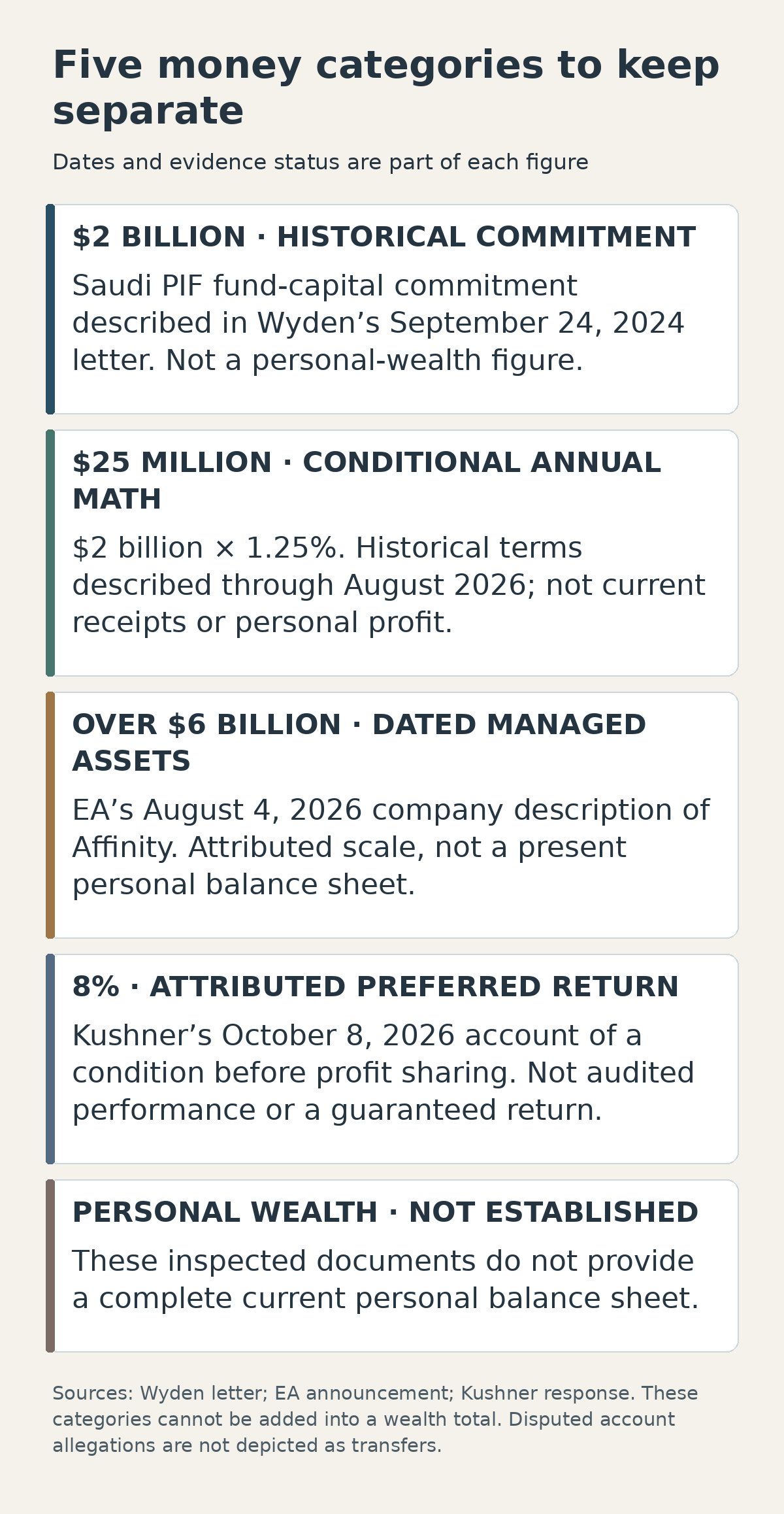
Wyden’s September 24, 2024 letter described a $2 billion Saudi PIF commitment and historical 1.25% fee terms through August 2026. Multiplication gives a conditional $25 million annual illustration, not current receipts or personal profit. EA’s August 4, 2026 description says over $6 billion under management. Kushner’s October 8 response describes an 8% preferred-return condition before profit sharing; this is attributed, unaudited and not a guaranteed return. The inspected documents do not establish current personal wealth. These categories cannot be added into a total.
Fees, profits and Kushner’s own account
Management-company revenue is another category. Even an established fee payment would not automatically tell a reader the owner’s personal profit: revenue, business expenses, distributions and an individual balance sheet are different accounting questions. The records discussed here do not close that chain.
In his October 8 response to The New Yorker, Kushner says Affinity receives its profit share after investors have received their capital and fees back, plus an 8% preferred return. That is his description of the arrangement, not an audited investor account or the governing contract.
A preferred-return condition in that account is also not a guarantee that investors actually earned a particular annual return. It describes a claimed condition for the manager’s profit share. Establishing realized performance would require the relevant results and the terms used to calculate them.
This prevents two mistakes in opposite directions. A management fee does not prove successful investment performance. A profit-sharing threshold does not prove that no other fee was charged. The right question depends on which payment is being described.
The distinction makes financial scrutiny more useful. Instead of asking what one enormous headline number “really means” in the abstract, ask who committed it, who controlled it, who was entitled to which payments, and what the dated record actually documents.
The book allegations are a separate evidence question
A published excerpt from Matthew Cole’s book alleges undisclosed foreign-linked accounts. Kushner’s published counsel response, posted October 22 and dated August 10, denies the account allegations and his involvement.
That establishes an allegation and a denial. Neither is independent proof of the underlying financial events. The historical PIF commitment cannot be used to authenticate the separate account claims simply because both stories involve large sums and foreign interests.
There is also a useful limit in the reporting about alleged phone access. NOS reported on October 23 that Nieuwsuur and de Volkskrant investigated with directly involved people and found no confirmation. The Dutch intelligence service MIVD declined to discuss its methods, knowledge or sources.
An unsuccessful verification effort is not proof that an allegation is false. It also cannot be presented as confirmation. And the phone-access question should not be silently converted into a finding about financial transfers. Those propositions require their own evidence.
A congressional demand does not independently verify a claim
Raskin’s October 30 announcement and accompanying records request put the allegations into an oversight demand. That establishes that a legislator sought answers. It does not create a second, independent source for the original account.
The same principle applies when several news stories trace back to one excerpt. Counting the number of articles can make a claim appear more heavily corroborated than it is. The useful test is whether a later account contributes distinct records, firsthand evidence or verification of its own.
That approach neither dismisses scrutiny nor accepts an accusation on repetition. It makes the reader’s confidence depend on the evidence added, rather than the volume of coverage.
What would establish more
For any new money claim, start with the noun after the number. “Committed” describes an investment undertaking. “Managed” describes an adviser’s investment pool. “Paid in fees” describes a payment category. “Owned personally” makes a different claim about whose asset it is. A story that switches nouns halfway through can change its meaning while leaving the dollar figure untouched.
Then ask for the period and the recipient. An annual illustration cannot be turned into a lifetime total without knowing how many years the relevant terms applied. A payment to a management company cannot be assigned to a person without evidence connecting the company’s receipts to that person’s finances. These questions do not supply a new estimate of Kushner’s wealth. They show what a reliable estimate would have to establish.
For current fees, the useful documents would be current investor-specific agreements and payment records. For investment performance, audited results would help distinguish reported valuations, distributions and realized returns. For personal wealth, a current accounting of personally owned assets and liabilities would be needed.
The disputed-account claims require evidence addressing those accounts and the alleged transactions. A fund’s advertised scale, a congressional letter or a forceful denial cannot substitute for that evidence.
The documented financial relationship remains worth examining on its own terms. The strongest account starts with the historical commitment, keeps each other number attached to its date and meaning, and leaves unsupported conclusions unresolved. That produces a clearer picture than treating every billion-dollar reference as the same money.
Sources
Senate Finance Committee: Wyden letter to Affinity Partners, September 24, 2024.
SEC and Investor.gov: private-fund structure, investor agreements, fees and expenses.
Electronic Arts: August 4, 2026 acquisition announcement and dated Affinity description.
Jared Kushner: October 8 response and published counsel letter concerning Cole’s book.
Vanity Fair: original book excerpt, summarized only as disputed allegations.
NOS: October 23 reporting on the unsuccessful phone-access corroboration effort.
House Judiciary Democrats: October 30 announcement and accompanying records request.